Lord of the Buzzwords: The Fellowship of Pragmatic Developers
Why is this IndustryTrends Hype meme funny?
Level 1: Lemonade Stand Dilemma
Imagine you want to run a simple lemonade stand. You just need a table, some lemonade, and a jar for money. It’s an easy little project you can handle. Now, your very enthusiastic friend comes along and says, “Hey, I heard about this cool new stuff! You should accept Bitcoin for payments and use a robot with AI to serve lemonade!”
Suddenly your simple lemonade stand idea is turning into a crazy high-tech lemonade enterprise. Accepting Bitcoin (which is a use of blockchain, like digital money) means you’d have to set up some complicated computer system just to take a drink order. And getting a robot with AI to serve customers? That’s like building a mini R2-D2 to hand out cups! It sounds super cool, but it’s way more complicated than what you planned. You might spend all summer setting up computers and programming a robot instead of actually selling any lemonade.
So you, being sensible, say “No.” “No, thanks, I’ll just stick to a cash jar and pouring lemonade myself.” That’s the smart move because you’ll actually get the stand working and people served.
This meme is funny for the same reason: the developer is basically in that situation, saying “no” to the wild idea of adding unnecessary fancy tech to a simple project. It’s like they’re saying, “Let’s not turn this into a rocket-powered lemonade stand, okay?” Everyone who has tried to do something simple, only to have someone else suggest a crazy over-the-top addition, will get a laugh from it. The emotion here is a mix of frustration and amusement – frustration for the person who just wants to do the job simply, and amusement because we’ve all seen how people get carried away with the “new shiny” ideas.
Level 2: Buzzwords vs Reality
Let’s break down what’s going on here in simpler terms. We have a new project (maybe a new app or system someone wants built). The sales team – people whose job is to sell ideas or products to clients – suddenly says, “Make it use blockchain and AI!” These terms “blockchain” and “AI” are huge tech buzzwords right now.
Blockchain: This is a technology behind cryptocurrencies like Bitcoin. Technically, it’s a special kind of database that keeps a list of records (blocks) that are linked and secured using cryptography. The key thing is it’s decentralized, meaning it runs on many computers at once rather than one central server. That can make data very secure and tamper-proof. But it also makes things slow, complex, and hard to change. It’s amazing for certain cases (like digital money or verifying transactions between strangers on the internet), but for a normal project (like a company’s internal tool or a website), using a blockchain can be like using a sledgehammer to crack a nut. It might work, but it’s overkill and messy.
AI (Artificial Intelligence): In the business world, when they say “add AI,” they usually mean some form of Machine Learning or smart automation. AI is basically teaching computers to make decisions or predictions on their own by learning from data. It’s how your phone’s voice assistant understands you or how Netflix recommends shows. Cool stuff! But adding AI to a project means you need a lot of things: you need data to learn from, you may need to train a model (which is like training a little brain), and you need to adjust your software to use that model and keep improving it. It’s not a magic on/off switch – it’s more like starting a whole new mini-project inside your project.
Now, why are sales people pushing these? Because “blockchain” and “AI” sound exciting and cutting-edge. Imagine you’re trying to sell a car and you throw in every fancy term – “It’s electric! It’s self-driving! It’s powered by quantum solar blockchain AI!” – it might catch a customer’s attention (even if that word salad doesn’t make sense). Similarly in tech, calling a product “AI-powered” or “blockchain-based” makes it sound modern and valuable. Sales and marketing folks often push for these features because they think it will impress clients or higher-ups, or maybe a client specifically asked, “Can it have AI? We want to be innovative.” This is what we tag as StakeholderPressure or sales_driven_feature_creep. Stakeholders (people who have a stake in the project, like clients or sales execs) are injecting their ideas of cool features after the project started – that’s scope creep (the project scope is creeping bigger and bigger with new requests).
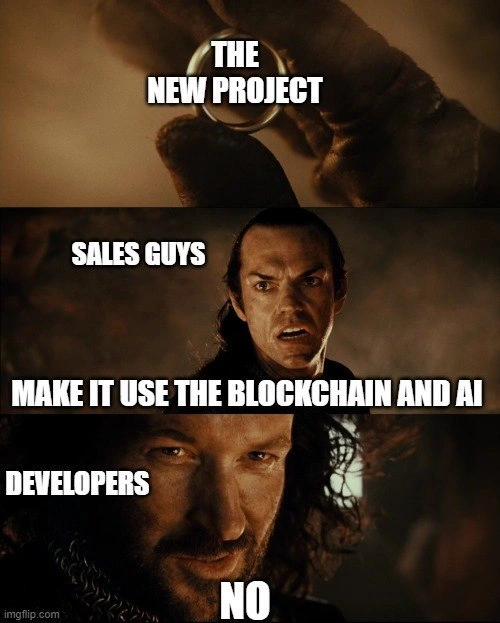
The meme uses Lord of the Rings imagery to dramatize this. The first panel, “THE NEW PROJECT,” shows a hand holding the One Ring over a fire. In LOTR lore, that Ring is super powerful but also corrupting. Here it means the new project is precious and potentially powerful, but also carries risk (like the ring’s curse). The second panel labeled “SALES GUYS – MAKE IT USE THE BLOCKCHAIN AND AI” shows an intense face (that’s actually Elrond from LOTR, who in the movie was sternly saying something important). In the meme, he’s representing the salespeople urgently demanding the latest tech. The third panel, “DEVELOPERS: NO,” shows Aragorn (the hero who’s been through battles) looking resolute. The developer here is like, “I’m not falling for that.” It’s almost like the dev is refusing to put on the One Ring of blockchain/AI because he knows it’s dangerous to just use it willy-nilly. In real life, developers often do have to push back and say, “No, that doesn’t make sense for this project,” or at least strongly explain why doing that would be a bad idea.
Think about it this way: Suppose you’re a junior developer on a team. You’re tasked to build a simple, reliable solution, maybe a website or an internal app. Suddenly a meeting happens where someone from sales or upper management goes, “Our competitors are using AI, we should too!” or “Blockchain is the future, put a blockchain in there!” If you’re new, you might initially think, “Cool, I get to try blockchain/AI!” But soon you learn each of those adds huge complexity:
- If you try to use blockchain, you can’t just drop it in like a library. You might have to use an existing blockchain network or set up a private one, write smart contracts, and handle all sorts of new failure cases (what if a transaction doesn’t confirm? how do we handle keys and wallets?). And you might ask, “Do we even need users to decentralize data? Can’t we just use our trusted database?” Often the honest answer is yes, a normal database is fine (and way simpler).
- If you try to add AI, you need to figure out what part of your app needs “intelligence.” For example, say it’s a project management app – sales might vaguely want “AI” to automatically prioritize tasks or something. As the developer, you’d have to collect data on tasks, define the problem formally, maybe use a machine learning model to rank or predict something. Not only that, you have to constantly update it with new data. What if the AI makes mistakes? It’s a ton of work, and maybe the feature isn’t even clearly defined. Sometimes folks just say “add AI” without a specific goal, which is incredibly frustrating because AI isn’t a decoration; you need a clear problem it’s solving.
So, the developers’ “NO” in the meme is the team pushing back on this. It’s unusual to see a flat “No” (usually it’s more polite or diplomatic in real life), but it emphasizes how strongly the devs feel about not derailing the project. It reflects a common tension in tech companies:
- Sales/Marketing want the product to sound amazing with all the latest features (to attract customers or investors).
- Developers/Engineers want the product to work well and be delivered on time. They know adding random trendy features can jeopardize that.
The tags like TechBuzzwords, MarketingVsReality, and OverEngineering capture this perfectly. Over-engineering means designing a solution more complex than needed. If the job can be done with a simple tool but you use a complex tool just because it’s new or cool, you’re over-engineering. For example, using a full blockchain to store user preferences is over-engineering; a simple database or even a file would do, but someone thought blockchain would sound impressive.
Finally, the context is also humorous because of the LOTR metaphor. In LOTR, many characters are tempted to use the One Ring’s power to solve their problems, but the wise know it’ll corrupt and ruin everything. Same way, many companies are tempted by blockchain and AI to solve every problem, but wise developers know if you use them in the wrong place, you’ll create a monster of a project that could self-destruct. The senior developers’ “No.” is like Gandalf saying, “None shall pass” to bad ideas 😊. It’s a punchy way to represent developers standing up to the hype.
Level 3: One Hype to Rule Them All
In this meme, the One Ring from Lord of the Rings symbolizes a shiny new project—a project that could be powerful but also perilous if misused. The sales team (like characters tempted by the Ring’s power) demands to "Make it use blockchain and AI," chasing the latest tech buzzwords for glory. They’re effectively trying to wield one hype to rule them all. This is a nod to real-world IndustryTrends_Hype: non-technical stakeholders often insist on inserting trendy technologies (AIHype, BlockchainHype) into every project, whether it makes sense or not.
For seasoned developers, this scenario triggers a weary chuckle. We’ve seen the hype-cycle play out before—remember when everything had to be “Big Data”, then “IoT”, then “Microservices”? Now it’s blockchain and AI. The meme’s humor comes from that shared exasperation: the stakeholder pressure to tack on over-engineered solutions versus the developer’s pragmatic refusal (ScopeCreep alert!). The “Sales guys” panel shows a determined, almost feral expression (think of Gollum eyeing the precious Ring) as they demand adding blockchain and AI. They’re enthralled by buzzwords, assuming these terms alone will magically impress clients or investors. It’s MarketingVsReality: sales imagines press releases and client presentations laden with “cutting-edge blockchain-based, AI-driven” goodness.
In contrast, the “Developers: NO.” panel features a battle-worn protagonist (a scruffy Aragorn-like figure) firmly rejecting the call. This is the senior dev who’s been to Mordor and back with failed promises. He knows implementing blockchain isn’t a small tweak—it’s like deciding to carry the Ring to Mount Doom. Blockchain means introducing a distributed ledger with consensus algorithms and cryptography overhead. It’s great for decentralized trustless networks, but shoehorning it into, say, an internal corporate app is massive overkill. It’s as if Sales heard “blockchain = secure and innovative,” so they want it in a project that might just need a regular database. The developer’s emphatic “No.” is a darkly humorous wish-fulfillment; in real life, devs often can’t say a blunt “no” without a two-hour meeting. But the meme cuts to the chase: after surviving enough scope creep wars, a senior dev has zero patience for gratuitous complexity.
This scenario satirizes the classic sales-driven feature creep. Sales or management folks promise a client something flashy to seal a deal (“Oh, our product will use AI and blockchain, no problem!”) and then toss that grenade to engineering. The developer’s hard “No” reflects the pushback that experienced engineers wish they could give when hearing the next absurd request. It’s the voice of sanity trying to save the project (and their sanity) from a doomed sprint into Mount Doom. The truth is, adding AI/ML means needing data pipelines, training models, and dealing with unpredictable results — not exactly something you sprinkle on at the last minute. And blockchain integration could mean re-architecting the whole system for distributed consensus, sacrificing speed and simplicity for a buzzword’s sake. OverEngineering at its finest.
By invoking the epic imagery of LOTR, the meme elevates this office-politics struggle to a mythical quest. The One Ring project is the grand idea that everyone wants to be part of. The “Sales guys” are like Boromir saying, “One does not simply… deliver a project without blockchain and AI” (a riff on the famous Mordor quote). Meanwhile, the developer channeling Aragorn gives a resolute refusal, indicating he’s seen how this story ends. The charred, determined face in the last panel almost breaks the fourth wall, as if he’s one of us developers internally screaming: “Please, not another blockchain/AI mandate, I beg you.”
This is all incredibly relatable in tech companies: the latest TechBuzzwords get thrown at every problem, even when they don’t fit. The meme lands because it captures a power dynamic and an absurdity: the folks who don’t build the software keep insisting on using the fanciest new tools, while those who do build it know that sometimes the fanciest tools just set your project on fire (like the Ring’s fire inscription spelling doom). Developers recognize that blank stare of hype fatigue. It’s practically a war veteran thousand-yard stare, earned from surviving StakeholderPressure that turned simple apps into Franken-projects. The humor has a dark edge: it’s funny because it’s true. We laugh, then cry a little inside, recalling that one project proposal where someone said, “Can we blockchain this?” and you knew the project was about to go off the rails.
In summary, at the senior level this meme nails the clash between shiny marketing demands and technical reality. It’s a battle of One Ring (project) vs Mount Doom (implementation hell). The experienced dev’s refusal is both comedic and cathartic, a stand against turning every new project into a buzzword bingo monstrosity. Seasoned engineers reading this will likely smirk and think, “Yep, been there, told them no, and saved us from a world of pain.”
Description
A three-panel meme using scenes from 'The Lord of the Rings' to illustrate a common conflict in tech. The first panel shows the One Ring, representing 'THE NEW PROJECT.' The second panel features the character Elrond with an intense expression, labeled 'SALES GUYS,' demanding, 'MAKE IT USE THE BLOCKCHAIN AND AI.' The third panel shows the character Isildur, labeled 'DEVELOPERS,' delivering a resolute 'NO.' The meme humorously captures the dynamic where non-technical stakeholders, like sales teams, get swept up in industry hype and request features using trendy technologies like AI and blockchain, regardless of their applicability. The developers, like Isildur refusing to destroy the ring, stand firm in their technical judgment, rejecting the unnecessary complexity and cost of buzzword-driven development
Comments
12Comment deleted
Sales wants to sprinkle some AI and blockchain on the product. Engineering knows that's like trying to solve a null pointer exception by setting the server on fire - it's technically a distributed ledger of ashes, but it doesn't solve the problem
Sure, nothing says MVP like minting the One Ring as an ERC-20 and piping the quest backlog through a transformer - what’s Saruman’s burn rate again?
After 20 years in tech, you realize the real distributed consensus problem isn't Byzantine fault tolerance - it's getting sales to understand that not every CRUD app needs a blockchain, and that 'AI-powered' doesn't mean slapping GPT on a regex matcher. The One Ring had better architectural documentation than most blockchain projects
When sales discovers Web3 and ChatGPT exist, suddenly every CRUD app needs a blockchain backend and an LLM to validate email addresses. Meanwhile, the senior architects are practicing their 'no' in seventeen different diplomatic phrasings, knowing full well that 'distributed immutable ledger' is just PostgreSQL with extra steps and a VC pitch deck
We can do blockchain and AI - if the requirements include decentralized trust and a labeled dataset; otherwise you’re asking for a very expensive append-only log with fancy autocomplete
Sales forges the One Ring of hype; devs know it'll melt into unmaintainable tech debt faster than in Mount Doom
Sales wants 'blockchain and AI'; the senior dev agrees - right after the CAP theorem appendix, a signed FinOps budget for inference, and a justification for trustless consensus on a weekly‑CSV CRUD app
Yes, we use blockchain(linked list) and ai(linear algebra with gradient descent) Comment deleted
the analogy works well on using blockchain and ai to throwing the project in lava Comment deleted
I think both AI and blockchain are good technologies. I also think chocolate is really good and sashimi is really good. I wouldn't add chocolate and sashimi to my chilli, though. Comment deleted
holy shit that's a perfect analogy. I'm stealing that Comment deleted
I am being replaced by bitcoin and chatgpt and forced to play slot machines in a foreign city. My parents are kicking me out so they can use my room to mine bitcoin and are using chatgpt to daytrade cryoto. Meanwhile I am supposed to play the slots machine in the capital, estranged from my beloved hometown. Their rationale is that it is either them who'll get rich with bitcoin chatgpt or I'm going to make with the slots. It's a sad day when offspring are being replaced by bitcoin and chatgpt. I will forever miss playing slots in the bars of my beloved home town. It really sucks. Comment deleted