Lucid Dreaming or AI Prompting: Spot the Difference
Why is this AI ML meme funny?
Level 1: Dream or AI?
Imagine you’re dreaming at night. In the dream, everything looks pretty real until you notice something weird: you look down at your hands, and uh-oh, you have like seven fingers on one hand! 😱 Or you try to read a stop sign or a page in a book, and the words are just scribbles or keep changing every time you look. When that happens, you can be sure you’re in a dream, because in real life you always have five fingers and written words stay the same. Now, funny enough, computers that make pictures (using AI, a kind of smart computer program) mess up in the exact same way. An AI might draw a super realistic scene, but if you look closely, a person in that picture could have a really weird hand (extra fingers or a melted-looking thumb) or any text in the image will be complete nonsense (like “Glorp blarf 123” on a street sign – not real words at all!). So the joke in this meme is that the trick to tell if you’re dreaming – checking hands and text – also works to tell if a picture was made by a computer instead of being a real photograph. If the details are crazy impossible, it’s either a dream or an AI-generated fake image. That’s both surprising and funny, because you wouldn’t expect a cutting-edge computer brain to make the same goofy mistakes our dreaming brains do. It’s like saying: “Hey, computer, I can tell this picture isn’t real – your imagination is just as wacky as mine when I’m asleep!”
Level 2: Hands Down, It’s AI
For someone just getting into AI or programming, it helps to spell out what’s going on here. AI image generators – programs like Stable Diffusion or DALL·E – are tools that create pictures from a text description. They’re a type of generative model, meaning they learn patterns from a lot of example images and then try to produce new images that follow those patterns. Now, these models can make some jaw-droppingly realistic art, but they also have a few notorious weak spots. Two of the biggest ones? Drawing human hands and writing actual text (like signs, labels, or clock faces) within an image. It sounds almost silly, right? You’d think those would be easy since hands and text are everywhere, but consistently getting them right is really hard for the AI. The result is often unintentionally funny or creepy: a person in an AI-generated image might come out with an extra finger or two, or their hands look like melted wax with too many knuckles (classic hand_rendering_failures). And if there’s supposed to be written text in the scene – say, a stop sign or a book page – the letters usually turn into nonsense scribbles (text_rendering_glitches). You can stare at those jumbled characters all day and they won’t form any known language. These mistakes are so common that they’re basically giveaway signs of an AI-generated picture. In fact, the community jokes about “AI can paint a museum-worthy portrait, but can’t count fingers or spell words correctly.” It’s a prime example of AILimitations in current AIGeneratedContent.
Now, let’s talk about lucid dreaming for a second. That’s a state where you’re asleep and dreaming, but you become aware that you’re in a dream – and sometimes you can even control it, like you’re the director of your own movie. Pretty cool! To get better at lucid dreaming, people use something called lucid_dream_checks or reality checks. These are little tests you do to figure out if you’re in a dream or in real life. Two classic tests are: (1) Look at your hands – in dreams, your brain often renders your hands incorrectly, so they might appear blurry, or have an odd number of fingers, or just look “off.” (2) Read some text or a clock – in a dream, written text is notoriously unstable, and clocks might display impossible times or change every time you glance. In the real world, text stays the same and clocks work normally, so if they don’t, you know something’s fishy. People who practice lucid dreaming swear by these checks: if you ever see your hand melt or the words on this screen turn to gibberish, pinch yourself because you might be dreaming!
Here’s where the meme brilliantly ties things together: It says those same two reality checks (hands and text) work as a quick test for AI-generated images. Essentially, it’s suggesting a super simple Turing test for images. (A quick explainer: the original Turing test is a concept from AI where, if a human can’t tell they’re talking to a computer or a person, the AI passes the test. Here we’re applying that idea to pictures: if you can’t tell a picture was made by AI or taken in real life, the AI passes.) So the tweet jokes that to tell if an image was created by an AI (and not a real camera), you just check two things: are the hands drawn correctly, and is any text in the image readable? If the hands look bizarre or the text is gobbledygook, ding ding! – it’s AI-made. It’s funny because it’s such a low-tech, almost comedic solution to a high-tech problem. Imagine an ultra-futuristic AI art generator that can simulate reality… yet a glance at a person’s fingers or a shop sign in the image gives it away. It’s like finding out Superman is in disguise because you notice the tiny tag sticking out from his cape.
For a junior developer or someone new to AI, this is also a neat peek into how AIHypeVsReality often plays out. We hear a lot of hype like “AI can do anything humans can!” But then you learn: well, it still can’t do some pretty basic things right, like draw a proper hand. Why? It comes down to how these models learn. They’re looking at millions of pictures and learning to generate new ones, but they don’t truly understand what a hand is (five fingers, precise joints, etc.) or what text says (they don’t actually read). They just generate what looks right based on examples, and sometimes their guess is a miss. Think of it like this: if you tried to draw a hand from memory after only ever glancing at hands briefly, you might get the number of fingers wrong too. Or if you tried to invent a new language that looks like English writing, it would look like letters but be total nonsense. That’s basically what the AI is accidentally doing.
So, to sum up in plain terms: The meme jokes that figuring out if an image is fake (AI-generated) is as easy as the tricks we use to figure out if we’re in a dream. Check the hands; check the text or clock. Dreamlike_ai_outputs tend to fail those checks, just like dreams do. For anyone who’s seen the wonky outputs from a GenerativeModels based art tool, it’s a chef’s kiss observation. It makes you grin and think, “Wow, that’s true – our fancy AI art bots have the same hiccups as our sleepy subconscious.” And if you haven’t seen these mistakes before, now you’ll know what all the fuss (and laughter) is about when someone says, “Ugh, the AI gave the guy 7 fingers again!” or “All the text on the store signs is gibberish, definitely an AI image.” In short: hands down, this meme nails why those of us playing with AI art sometimes feel like we’re working with a dreamy, creative, but slightly confused robot artist.
Level 3: Reality Checks for AI
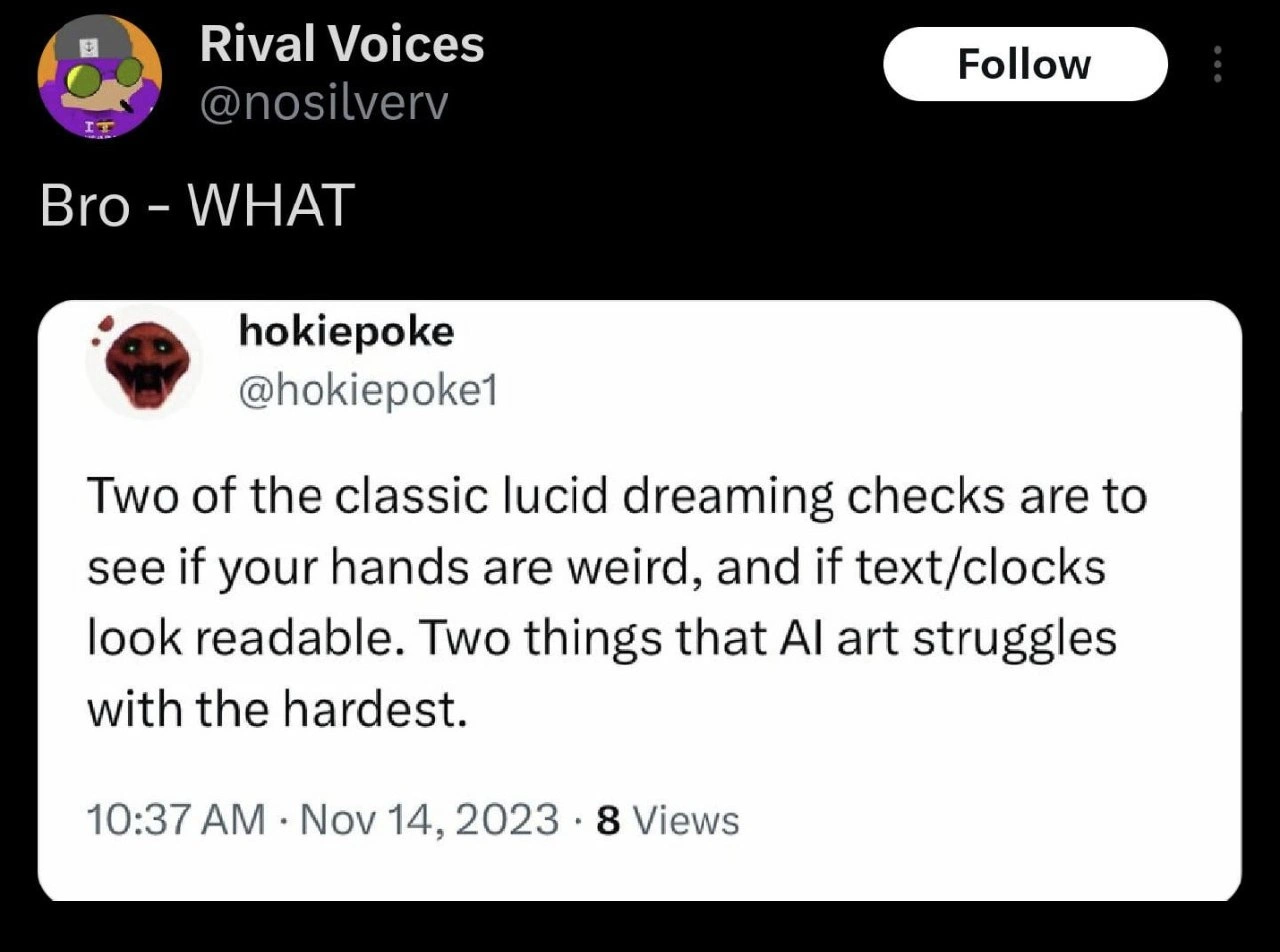
In the world of AI humor, this meme hits a nerve by pointing out an almost spooky coincidence: the very tricks people use to tell dreams from reality are also the tricks to tell an AI-generated image from a real photograph. As the tweet highlights:
“Two of the classic lucid dreaming checks are to see if your hands are weird, and if text/clocks look readable. Two things that AI art struggles with the hardest.”
Seasoned folks in the AI art community immediately nod at this. It’s referencing two infamous failure modes of modern image generators. If you’ve ever tinkered with Stable Diffusion, Midjourney, or other generative models, you know the drill: always inspect the hands and any visible text. More often than not, that’s where the tell is. You might have a stunning portrait that could fool Grandma at first glance, until you notice the subject’s hand has a few extra knuckles or an impossible thumb. Or you generate a gorgeous street scene with neon signs, but every sign is just illegible spaghetti characters. These are classic stable_diffusion_artifacts; they’re basically an AI’s signature quirks, almost like how early photographs always had a bit of blur for moving subjects.
What makes this so amusing to insiders is the parallel to lucid_dream_checks — little reality tests dreamers use. In a dream, the part of your brain that checks consistency is asleep on the job. Clocks might read “88:88” or change time wildly, and your hands might have this vague, shape-shifting quality if you examine them closely. So one recommended method to realize “hey, I’m dreaming!” is exactly that: look at text or your hands for weirdness. Now here comes the punchline: AI-generated images, crafted by state-of-the-art algorithms, coincidentally suffer from the same weirdness. It’s as if these neural networks tap into a dreamlike creative process — amazing imagination but with glitchy details — so you have to do a reality check on them too. This gives us a tongue-in-cheek Turing test for images: can the AI produce a picture where even the tiny details (like hands and writing) hold up to scrutiny? If yes, it passes as “truly real.” If not, well, we catch the dreamlike glitch and yell “gotcha, AI!”
Anyone who’s dealt with AIGeneratedContent in practice knows how AILimitations like these turn into real workflow issues. Developers and digital artists share war stories of trying to coerce the AI into drawing a simple six-fingered hand correctly, often generating dozens of variants hoping one comes out normal. It’s practically a meme itself in AI art circles: “hands are the final boss.” In fact, to avoid the problem, many will strategically pose characters with hands out of frame or buried in pockets. Similarly, if an AI-created scene needs a legible sign or UI screenshot, forget it — you’ll likely end up superimposing real text in post-production. There’s even a crop of helper tools and plugins now, specifically to fix messed-up hands or to do things like text rendering after the AI is done with the image. All this is both frustrating and comical: frustrating because it’s a glaring gap in an otherwise magical technology, and comical because it’s such an obvious tell.
The meme’s timing and phrasing tap into the current vibe of AIHypeVsReality. In demos and marketing, we see AI models touted as if they’re practically indistinguishable from human work. To a point, that’s true — they’ve gotten scarily good at generating art that looks real at a glance. But those of us who’ve looked closely (sometimes literally zooming in pixel-by-pixel on a digital painting) know the dirty secret: these models have blind spots that a human child wouldn’t miss. It’s a classic case of overpromise and underdeliver on the fine details. And that contrast is hilarious in a kind of nerdy way. We love these tools, we’re enthusiastic about their potential, but we also laugh at their quirks. It’s the same kind of affectionate laughter a senior developer might have after the thousandth time hearing “it’s just a small tweak” right before production goes down— we’ve been there, we know the pattern. Here, the pattern is: amazing AI result, check hands, chuckle, yep there’s the glitch. The meme basically says, “AI images are so dreamlike that you literally use dream tests on them.” And for the community in the know, that’s a “Bro, WHAT” level revelation that’s both thought-provoking and worth a good chuckle. You couldn’t ask for a better collision of tech insight and almost philosophical humor. It reminds us that for all the sophistication, today’s dreamlike_ai_outputs still have one foot firmly in the uncanny valley. Spotting them can be as simple as a couple of quick reality checks — a trick borrowed from people who question their reality every night. How meta is that? It’s both a roast and a tribute to how far generative AI has come and how much further it has to go. And if you notice an image where everything else is perfect except the poor mangled hand, you might just smile and think, “Ah, the AI is dreaming again.” (AI’s handiwork, pun intended!)
Level 4: Latent Space Dream Logic
At the cutting edge of AI image generation, models like Stable Diffusion operate in a latent space that often produces results uncannily similar to a surreal dream. These models are essentially high-dimensional pattern synthesizers, trained on vast datasets to paint visual scenes from noise. But while they capture textures, lighting, and general forms with astonishing realism, they lack discrete symbolic reasoning—and it shows. One fundamental gap is the symbol grounding problem: the AI has never been taught the true concept of a “hand” or a written word as an abstract symbol with meaning. Instead, it knows hands and text only as complex visual patterns woven into its training images. The result? A kind of dream logic governs its creations. An AI might generate a hand with six fingers because, in the continuous statistical mashup of all hands it has seen, an extra finger doesn’t scream “impossible” the way it would to a human brain. Likewise, when rendering text on a sign or a clock face, the model produces letter-like or number-like shapes, but without an OCR or language module to enforce real words or valid times, those shapes emerge as gibberish. This isn’t a bug in the code so much as a reflection of how diffusion models diffuse information: they excel at broad strokes and styles, yet fumble on precise, context-free details like counting or spelling. It’s as if the neural network can dream up richly detailed scenes, but can’t pin down the exact logic of five fingers per hand or 12 hours on a clock.
Delving deeper, consider how a diffusion model constructs an image: it begins with pure noise and iteratively refines it, guided by a neural network (often a U-Net) that has learned to denoise in a way that matches the training distribution. At no point does it explicitly tick off a checklist for “five fingers present” or “legible text formed”; it just tries to make each tiny patch of the image look locally plausible. Hands, unfortunately, are topologically complex and vary greatly in appearance (different poses, foreshortening, etc.), which confuses the network’s sense of anatomy. It treats an extra finger as just another plausible variation in the blur of hand shapes it knows. Similarly, text in images is a high-information outlier — most photos have very little printed text, and when they do, each font or lettering style is unique. The model ends up synthesizing “general text-ish noise” rather than specific letters, because it has learned the texture of text but not the alphanumeric semantics. In essence, the generator lacks a global consistency check: it can’t cross-verify “does this string of pixels form a real word in English?” or “are all the fingers accounted for?”. Humans, even unconsciously, perform these checks instantly; our perception flags any deviation from reality’s rules. But a diffusion model has no built-in rulebook — it’s optimizing pixel probabilities, not logical coherence.
This leads to the profound parallel drawn in the meme: AI-generated images and lucid dreams both spring from an unguided creative process that isn’t moored to strict reality. In a dream, our brain’s higher reasoning is partially offline, so while it conjures amazingly lifelike scenarios from memory, it also spawns impossible distortions (like morphing hands or melting text) without us noticing until we actively look for errors. A generative model is much the same; it’s a lower-level pattern machine without a top-down common sense filter. The meme cleverly implies that the Turing test for images might very well hinge on these odd details. In classic AI theory, a Turing test checks if a machine’s behavior is indistinguishable from a human’s. Here we have an visual twist: an image that fails the “hand and text check” betrays its machine-made origin, effectively flunking a mini Turing test of photorealism. Until these models integrate more structured knowledge or hybrid techniques (like combining vision with explicit language understanding), they’ll continue to hallucinate with dreamlike artifacts. It’s a case where the science meets a bit of philosophy: to truly “pass” as reality, an AI must learn the mundane, rule-based truths of the world (five fingers, readable text) that even our subconscious dreams struggle to uphold. And for now, those mundane truths stand as stubborn gatekeepers between almost real and truly real in AI imagery.
Description
This image is a screenshot of a Twitter (now X) conversation. A user named Rival Voices (@nosilverv) posts 'Bro - WHAT' in response to a tweet from hokiepoke (@hokiepoke1). The original tweet by hokiepoke reads: 'Two of the classic lucid dreaming checks are to see if your hands are weird, and if text/clocks look readable. Two things that AI art struggles with the hardest.' The meme draws a fascinating and slightly eerie parallel between the methods used to determine if one is in a dream and the notorious failure points of generative AI image models. In lucid dreaming, checking one's hands often reveals anatomical impossibilities (like six fingers), and text or clocks appear as unreadable or shifting gibberish. This perfectly mirrors the common artifacts seen in AI-generated art, where hands are often malformed and text is incoherent. The post went viral for highlighting this uncanny valley, prompting a 'mind-blown' reaction and sparking conversations about the nature of generated reality versus dreams
Comments
15Comment deleted
So if I see a six-fingered hand holding a book with garbled text, am I in a dream or just looking at the uncurated output from a base Stable Diffusion 1.5 model? The existential horror is functionally identical
Turns out the definitive health-check endpoint for your image model is just /hand.jpg → 200 or 7-fingered nightmare
Turns out the Turing test was backwards all along - we're not checking if machines can convince us they're human, we're checking if they fail the same reality checks we do when unconscious
Turns out AI image generators are perpetually stuck in a lucid dream - they can't render hands properly or generate readable text, the exact same reality checks humans use to detect they're dreaming. It's almost poetic: we built neural networks that hallucinate so convincingly they've inherited the same tells as our own subconscious. Maybe we should add 'can you count your fingers?' to our model evaluation metrics alongside CLIP score and FID
New SLO for the generative art service: 99.9% hands have 5±0 digits and all clocks are readable - if we ever hit it, we’ve secretly replaced the diffusion model with OCR plus a hand‑pose network
Our gen‑AI smoke test has two assertions - len(fingers)==5 and OCR(clock)!=NaN - and it still flakes more than our 99.9% SLO
AI art's CAP theorem: can't guarantee Coherent Anatomy, consistent finger count, or Pose - all at once
Whats SD? Comment deleted
Ahhhh thx Comment deleted
Generative networks, deep dreaming and continual learning have surprisingly quite a bit in common Comment deleted
Perhaps govt is beaming dreams in our brains Comment deleted
This is just because our biological NN is not perfect too Comment deleted
Every biological property is finely tuned for survival, so it must be perfect for the species posessing it. Comment deleted
I tried it once and confirm this check in my lucid dream Comment deleted
or we're in a simulation, and when we sleep we get less iterations on the generative engine to save energy Comment deleted