Skip to content
DevMeme
4922 of 7435
The Unsung Hero Holding Up the Entire AI Industry
AI ML Post #5389, on Sep 2, 2023 in TG

The Unsung Hero Holding Up the Entire AI Industry

Why is this AI ML meme funny?

Level 1: Elephant on a Stool

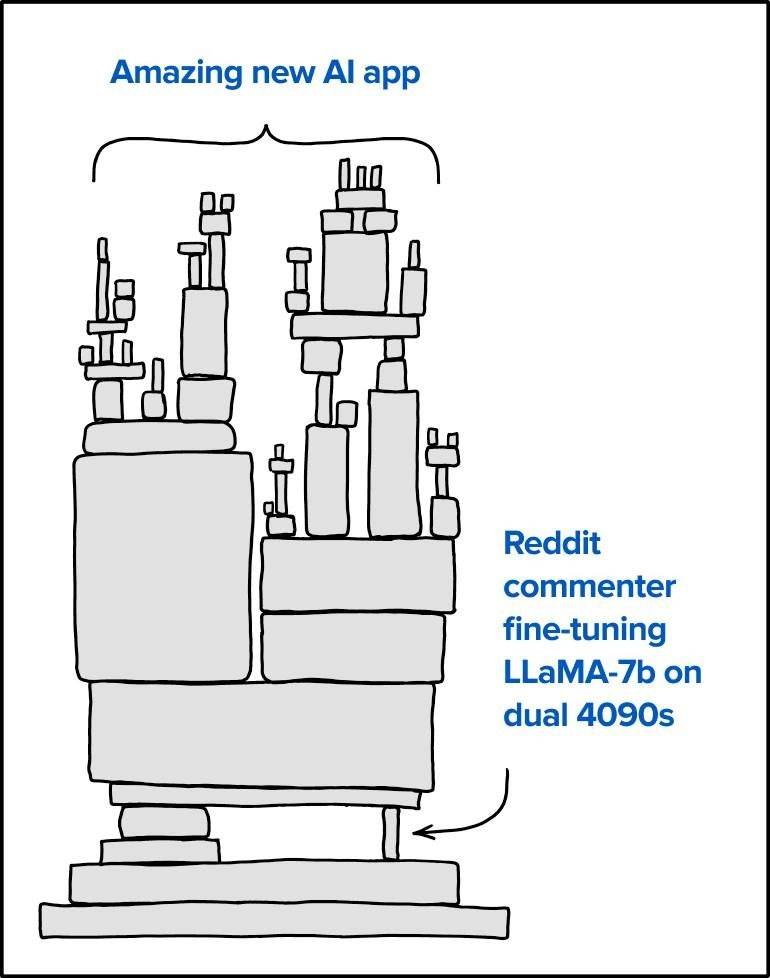
Imagine you see a huge circus elephant standing tall on a tiny little stool. It looks really impressive – wow, an elephant up high! – but also a bit funny and wobbly because you know that stool is really small for something so large. If that stool were removed or even if it shakes a bit, the poor elephant would tumble down, right? This meme is kind of like that. The “Amazing new AI app” is the big elephant everyone is excited about. And the “Reddit commenter fine-tuning LLaMA-7b on dual 4090s” is the little stool holding it up – basically one person’s work on their own computer that’s supporting the whole big fancy thing.

It’s a funny drawing because normally you’d expect a big elephant to have a strong platform under it, not just a single tiny stool. In the same way, you’d think a big new AI product is backed by a huge team and lots of infrastructure, but here the joke is it’s really balanced on one enthusiast’s effort. The emotional core of why it’s funny is that it shows a huge contrast: something very grand and hyped (the elephant or the tall tower/app) relying entirely on something unexpectedly small or simple (the stool or the lone Reddit user’s work). It’s a playful reminder that sometimes, behind a shiny new thing that everyone’s talking about, there might just be one person’s clever idea or tinkering. And if that one person or thing stops doing its job… whoops! the whole act might come crashing down, just like the elephant would without its stool. So people find it funny and a bit insightful – it’s saying “hey, check out this towering fancy invention, it’s actually standing on just one block of support!” in a cartoonish way that anyone can understand.

Level 2: Hype vs Hardware

Let’s break down the meme in plain terms. We have an “Amazing new AI app” – think of this as a shiny new program or service that uses Artificial Intelligence to do something cool for users. Maybe it’s an app that writes poems, answers questions, or generates funny images from text. Lately, there are tons of such AI apps popping up, and they’re often hyped as the next big thing in tech (AIHypeVsReality is the theme here). Now, the meme suggests that this tall impressive “AI app” is built on top of a single big building block: a Reddit commenter fine-tuning LLaMA-7B on dual 4090s. That phrase is stuffed with tech references, so let’s unpack it step by step.

  • Reddit commenter: Reddit is a massive online forum where people discuss all sorts of topics in communities called subreddits. A “Reddit commenter” here implies just an everyday person (an enthusiast, hobbyist, or independent developer) who participates in those forums. It’s not a famous researcher or a tech company, just a member of the community. This already sets a contrast: the foundation of this big AI app is not some official corporate lab, but an ordinary community member. In developer culture, Reddit (along with places like Stack Overflow, Discord channels, etc.) is where a lot of grassroots innovation and knowledge-sharing happens.

  • LLaMA-7B: This is the name of an LLM (Large Language Model). LLaMA stands for “Large Language Model Meta AI” – it was created by Meta (Facebook’s parent company) and released in early 2023 to researchers. The “7B” part means it has 7 billion parameters, which is a way of indicating the model’s size and complexity. For context, parameters in a neural network are like adjustable knobs the model learned during training; more parameters generally allow the model to capture more intricate patterns, though they need more data and compute to train. LLaMA actually came in several sizes (7B was the smallest, others were 13B, 33B, 65B – those larger ones need even more powerful hardware to use). A 7B model, while the smallest of that family, is still pretty powerful – it can generate coherent text, answer questions, and do many of the things you’ve seen AI language models do, though it might not be as fluent or knowledgeable as a 65B model or OpenAI’s GPT-4. Importantly, Meta’s LLaMA wasn’t originally intended for commercial use (at least the original version had a research license), but it leaked online and sparked a wave of experimentation in the open AI community.

  • Fine-tuning LLaMA-7B: Fine-tuning means taking that pre-trained LLaMA-7B model and training it a bit more on a specific task or dataset. Think of LLaMA-7B as a general knowledge base or a jack-of-all-trades in language. If you want it to be really good at a particular thing (say, writing code, or responding like a helpful customer support agent, or speaking in Shakespearean style), you would fine-tune it. This involves feeding it examples of the desired behavior and adjusting the model weights so it learns to specialize. Fine-tuning is much cheaper and faster than training a model from scratch because you’re starting from an already learned foundation. It’s like starting with a car that’s built, and just repainting and tuning the engine for a race, rather than building a car from nothing. In the meme, the base block is a person fine-tuning LLaMA-7B, implying that the real “smarts” behind the amazing app come from this fine-tuned model that someone prepared.

  • Dual 4090s: This refers to two NVIDIA RTX 4090 graphics cards. GPUs (Graphics Processing Units) are the hardware of choice for AI model training and inference because they can do a lot of calculations in parallel (originally designed for rendering 3D graphics, which is also heavy math). The RTX 4090 is a top-of-the-line GPU model from NVIDIA’s GeForce series (very popular in late 2022 and 2023). If you’re not familiar, just know it’s very powerful and also very expensive. Having two of them (“dual”) in one computer means that computer is extremely high-end – we’re talking a setup that likely costs tens of thousands of dollars when you include all parts, and it probably draws a lot of electricity and generates quite a bit of heat. People who run dual 4090s are often either hardcore gamers with multi-monitor 4K setups, or more relevant here, machine learning enthusiasts who need that horsepower to train models at home. Using dual GPUs can roughly double the speed of training a model if done right (each GPU can work on part of the task). So the meme is illustrating that this Reddit user has some serious hardware and is using it to finetune the LLaMA model.

So, putting it together: the bottom block label basically describes a scenario where an individual on Reddit has a monster PC rig and has fine-tuned a large language model (LLaMA 7B), presumably sharing their results or at least making it available somehow. This bottom block is literally propping up the “Amazing new AI app” at the top of the tower. In plainer language, the new app is essentially built on that fine-tuned LLaMA model. The arrow in the image points to that base block, emphasizing “this is what’s really supporting the whole thing.”

Now, why is that funny or revealing? It highlights the gap between the hype and the reality. The phrase AIHypeVsReality captures it well: The hype is the “Amazing new AI app” – you can imagine all the marketing, the press releases, maybe even VC (venture capital) money valuing the startup at millions. It sounds very impressive and proprietary. But the reality is, the core technology comes from an open community effort (an enthusiastic Reddit user fine-tuning an open model on readily available hardware). It’s a bit like seeing a fancy restaurant dish on Instagram versus learning it was actually made from a store-bought sauce mix 😄. In tech terms, this happens when companies use open-source work as the engine of their product without a lot of original contribution.

For a newer developer or someone early in their career, a few key takeaways from this scenario: Open-source and community contributions are huge in AI. A lot of progress is happening in public view on forums and repositories. Even major breakthroughs can come from outsiders or independent collaborations. So, that Reddit user might have shared the fine-tuned model weights on a site like Hugging Face (which is a popular platform to host and download AI models). Then a startup can download those weights and incorporate them into an app. If you’ve used libraries or frameworks that someone on GitHub built, you’ve done something similar on a smaller scale. For example, maybe you used an open-source JavaScript library to add a calendar to your web project instead of coding one yourself – you trusted the community-made component. Here, the startup used a community-made AI model instead of training their own. It’s efficient, but it means relying on community work.

We should also explain why dual 4090s are needed at all: training or even running large ML models is computationally intensive. A model like LLaMA-7B typically requires many gigabytes of memory (RAM on the GPU) just to hold all its parameters and do the matrix multiplications for inference (generating text). Fine-tuning it means you need even more memory to hold not just the model, but also gradients and optimizer states (the extra data needed during training). A single RTX 4090 has 24 GB of VRAM, which actually is enough to fine-tune a 7B model if optimized carefully (sometimes people run 7B on even smaller GPUs by using tricks like 8-bit or 4-bit precision). But two 4090s can share the load or allow a larger batch size, meaning you can feed more examples at once and train faster. GPUs in parallel can either each get a copy of the model and different data (data parallelism), or split the model parameters between them (model parallelism) – either way, it’s about handling big workloads with more silicon. For a junior dev: imagine trying to solve a huge puzzle faster by giving half the pieces to one friend and half to another friend to work on at the same time – that’s parallel processing in a nutshell.

Now, consider how a “wrapper” app might work in practice. Suppose our Reddit friend fine-tuned LLaMA-7B to respond helpfully in a conversational style. They might post on Reddit: “Hey everyone, I fine-tuned LLaMA-7B on instruction-following data and it’s performing almost as well as ChatGPT on some prompts!” They might share the model file or code. A startup could take that model, load it up using a framework like Hugging Face’s Transformers library in their own code, and then build a web interface around it, maybe adding some extra bells and whistles like memory or user accounts. To an end-user, it looks like a brand new original AI chatbot service. But under the hood, whenever a user types a question, the app is essentially just querying that LLaMA-7B model to get the answer. The startup’s unique code might be maybe a few thousand lines of Python/JavaScript for the front-end and server logic – comparatively small next to the billions of neural connections doing the heavy lifting which came from that model file.

This scenario is very common right now. It’s not even a bad thing inherently – it’s like standing on the shoulders of giants (or at least on the shoulders of fellow enthusiasts). But the meme humorously points out one potential pitfall: if all you have is that external model as your base, you might not have stability or control. For instance, what if the model has quirks or errors? If you didn’t train it, you might not know its weak spots. Or what if an update comes out – say a new version of LLaMA or a different model – you might have to fine-tune it again or rely on the original author to do so.

Also, since the meme specifically references Reddit, it hints that this information (the fine-tuned model) might have been discovered in a casual way – like someone reading a Reddit post and going “Oh cool, let’s build a product around this.” That informal origin is both awesome (yay community!) and precarious (what if that Reddit post was hype and the model isn’t as great as claimed, or wasn’t thoroughly tested?).

To relate this to something you might have encountered: have you ever used a code snippet from Stack Overflow to solve a problem in your project? Imagine basing an entire application on a particularly clever code snippet from an anonymous user. It might work initially and save you a ton of time, but you’re sort of trusting that this snippet is solid. If it breaks, you’ll have to debug it, and the original author might not be around to help. In software, we often rely on libraries and packages from the open-source world – and typically, we check if they’re well-maintained, have multiple contributors, etc. Here, the joke is that an entire AI company might be leaning on what is essentially an open-source project by a lone ranger. It’s like writing a commercial game but using a graphics engine one person wrote on Reddit – could be genius, could be a house of cards.

The DevCommunities angle is that places like Reddit (or GitHub, or forums) are where much collaboration and sharing happen. This meme gives a nod to those unsung heroes who share their GPU time and expertise freely with the world. It’s saying that behind many polished AI demos, there might be a story of a community-driven innovation. The fact that they mention the exact hardware “dual 4090s” makes it extra tangible – as if this was a known post where someone bragged or detailed “I fine-tuned LLaMA-7B on my dual 4090 setup and here are the results...”. Anyone who’s been following AI discussion boards can practically see that scenario; it’s quite realistic. Oftentimes, an individual or a small group will publish an impressive model or result (like turning a base model into something nearly as good as a much larger model, by clever fine-tuning or data augmentation). Then, a wave of derivative projects or even startups will spring up around it. It happened with Stable Diffusion (open-source image generator) where people built apps and websites on top of it, and it’s happened with language models too.

In simpler summary: the meme uses a GPU rig metaphor (the tower of blocks) to say “hey, this huge fancy AI thing is actually resting on one tech-savvy Reddit user’s work.” It’s a fun reminder that not everything branded as cutting-edge is built completely in-house; a lot of it is integration and repackaging of community contributions. For a junior dev learning the ropes, it emphasizes how crucial community knowledge and open resources have become. But it also hints: be aware of what’s foundational in your projects – if it’s something as crucial as an AI model, it’s good to understand where it comes from and how stable it is. Otherwise, you might end up with a tall, impressive tower that can wobble if that one block at the bottom shifts.

Level 3: Single Point of Failure

From a senior developer or industry observer’s viewpoint, this meme nails a mix of AI hype and the often precarious reality beneath it. The tall, skinny tower labeled “Amazing new AI app” being supported by one chunky block labeled “Reddit commenter fine-tuning LLaMA-7B on dual 4090s” immediately screams “single point of failure”. In architecture design reviews, a single point of failure is something that, if it goes down, will bring the whole system crashing down. Here that critical piece isn’t a load balancer or a master database – it’s basically Bob on Reddit with his GPU tower. 😅 This is hilariously relatable to anyone in DevCommunities because we’ve seen similar patterns before. It’s essentially calling out how many flashy AI products (the hype-y startups at tech conferences, the ones touting “revolutionary AI”) are often just thin wrappers around open-source models or community datasets. The meme is a tongue-in-cheek way of saying: “This hyped app wouldn’t exist if not for that one enthusiast who did the hard ML work in their spare time.” The tall tower of hype is balancing on a very narrow, community-provided support. That contrast is what senior devs find both funny and painfully accurate.

Why is this combination so humorous and spot-on? Because it captures a real IndustryTrend: in the rush of the AI gold rush (especially around 2022–2023 with all the GenerativeModels craze), countless startups popped up claiming “we built this amazing AI that does X”. But if you peel back the curtain, many of them didn’t train anything from scratch. Instead, they took an existing model (maybe OpenAI’s GPT via API, or an open-source LLM like LLaMA, GPT-J, etc.), possibly fine-tuned it a bit or even not at all, and then built a fancy UI or specific application logic around it. Voilà! That’s the “amazing new AI app.” In other words, their entire value proposition might reduce to glue code and prompt engineering on top of someone else’s neural network. The meme highlights an extreme case: not even a large team or a big open-source consortium – just a Reddit commenter (which implies an individual hobbyist or a very small-scale operation) is the foundation for the startup’s offering. This resonates with developers who remember stories of critical infrastructure depending on one random dude’s code. It’s the AI equivalent of the infamous left-pad incident – where a tiny open-source NPM package maintained by one person (left-pad) was yanked and it broke huge parts of the JavaScript ecosystem. Similarly, here a critical piece of IP (the fine-tuned model) comes from one person’s Reddit thread or GitHub repo. If that person decides to stop updating it, or if a bug is found, the fancy app team might be stuck because they don’t fully own or understand the foundation they built on. In software terms, the bus factor of the entire AI app is effectively 1: if our Reddit fine-tuner “gets hit by a bus” (or simply moves on to a new hobby), the whole tower could crumble. That’s a terrifying thought to an engineering manager, which is what makes it darkly funny to the grizzled veterans out there.

The meme also pokes at the dynamic between DevCommunities and venture-backed startups. It’s highlighting how a lot of innovation in AI is bottom-up. The open-source LLM community on GitHub, Reddit, and forums often shares model weights, training tricks, and fine-tuned variants for free, driven by curiosity and passion. Meanwhile, some startups ride that wave, taking these community models and deploying them as a service or product. The visual of the tower suggests an imbalance: the community effort (bottom block) is comparatively solid but singular, and on top of it the startup is piling feature after feature (blocks upon blocks) reaching for the sky. Industry observers might chuckle because they’ve seen the pattern of “open-source core, proprietary wrapper” before. It’s common in software generally (how many products are basically a cleaned-up UI on top of FFMPEG, WordPress, or TensorFlow?), but in AI it’s even more blatant lately. For example, consider all the “AI content generator” apps that launched – many turned out to be just calling GPT-3/GPT-4 behind the scenes or using the Stable Diffusion model under the hood for image generation, while marketing it as a novel creation. Not that using open components is bad! In fact, reusing proven tech is a smart move. But the meme humorously underscores when the reliance is so heavy on one external piece that it becomes ridiculous – like a skyscraper architect bragging about the penthouse view while all that’s holding up the building is one pillar someone else built.

There’s also an implied commentary on AI hype cycles. The phrase “Amazing new AI app” in the meme is written in that cheerful tech-marketing tone (we can almost hear the startup CEO on stage saying it), and the curly brace encompassing a teetering mess of blocks suggests complexity and perhaps a lack of solid engineering underneath. In contrast, the base block’s label specifically calls out a real technical scenario: “fine-tuning LLaMA-7B on dual 4090s.” That specificity is hilarious to engineers because it’s so granular and real compared to the vagueness of hype. It’s like saying, “Sure, call it magic, but we know it’s actually just this one well-known model running on a PC gaming rig!” The dual 4090 GPUs detail is especially juicy – those in the know realize a GeForce RTX 4090 is an expensive top-of-the-line consumer GPU (often used for 4K gaming or personal AI experiments). Seeing a pair of them in a meme context immediately tells techies, “Whoa, someone is brute-forcing AI at home.” It hints at the DIY nature of the foundation: this isn’t a polished enterprise server cluster, it’s literally something a determined person could set up in a home office with enough cash and cooling fans. The absurdity (and truth) that a cutting-edge AI service might lean on something as unofficial as that is both comical and a bit concerning. It’s the kind of thing an SRE (Site Reliability Engineer) would facepalm at: “Our prod system depends on what? Some guy’s rig under his desk?!”

Let’s acknowledge another layer of irony: by September 2023, there was a huge buzz about open-source LLMs vs. corporate models. Meta’s LLaMA itself was at the center of drama because it was released for research with a non-commercial license, but leaked to the public. This spawned a flood of community fine-tuned models (Alpaca, Vicuna, WizardLM, and countless creatively named variants). Many developers took these and started building products or services. The meme is implicitly winking at that situation. If an AI startup is literally built on LLaMA-7B, and especially if it traces back to someone’s unauthorized fine-tune, there’s a kind of wild-west aspect to it. It’s like building a shiny storefront on land you might not actually have clear title to. Senior folks who have been through corporate compliance checks or licensing headaches will smirk at the notion that an “amazing app” could be riding atop a model that, strictly speaking, the creators might not even be allowed to use commercially. In the AIHypeVsReality tag context, reality includes messy details like licenses, GPU costs, and one-person R&D; hype just glosses over those. The imagery of the tower balancing on one block wonderfully conveys risk: not only technical risk (lack of redundancy, performance limits of one rig), but even legal and maintenance risk. It invites thoughts like, “What if that Reddit user decides to delete their model or stops supporting it? Did the startup even clone the repository or are they hitting an API hosted on his basement server?” Those scenarios sound absurd, but stranger things have happened in fast-moving tech trends.

For many veteran engineers, this meme also evokes memories of being on-call for systems that had unknown dependencies. Picture being the one woken up at 3 AM because the “AI service is down,” only to discover the reason is that some volunteer’s model endpoint is returning 404. It’s a nightmare scenario wrapped in a joke. The DevOps mantra of eliminating single points of failure is completely violated here – and that’s the gag. The RedditThreads mention reminds us that so much cutting-edge knowledge is exchanged informally on forums these days. Perhaps the fine-tuner shared their methodology or even the model weights on a subreddit (maybe something like r/LocalLLaMA or r/MachineLearning), and the startup devs just picked it up. It’s not unlike how Stack Overflow answers or open-source GitHub projects become the backbone of many applications. The difference is, this is not a small utility code – it’s the core “intelligence” of the app. No wonder the tower in the drawing looks so precarious and thin above that one big block!

In summary, at a senior level this meme is a commentary on the fragile architectures hiding behind tech hype. It cleverly compresses a bunch of familiar concepts: AI hype vs. reality, community-driven innovation vs. corporate packaging, and that age-old software engineering cautionary tale of depending on a single external component. It’s the same energy as the joke, “I, for one, embrace our new AI overlords – especially Joe on Reddit who apparently is their real daddy.” It validates the shared experience that behind many glamorous tech demos, there’s often some unheralded nerd with a powerful PC doing the actual magic. Seasoned devs laugh, perhaps a bit nervously, because they know how often the entire tower really is resting on one support like that.

For a bit of fun, here’s a comparison that might as well be titled “AI Startup Hype vs Reality”:

What the Startup Says What’s Really Happening
“Our proprietary revolutionary AI” 🦄 A fine-tuned LLaMA-7B a guy named u/AIGuru42 trained at home
“Backed by cutting-edge infrastructure” 💾 Runs on a PC with 2× RTX 4090 (hope the power bill is paid)
“Disruptive innovation” 🚀 Basically a clever wrapper around open-source model weights
“We have a robust AI stack” 🏗️ Single-point dependency on one Reddit-sourced model

It’s funny because each pair highlights the disconnect. The startup’s polished claims on the left, and the tongue-in-cheek truth on the right. This isn’t to knock the achievement of fine-tuning LLaMA-7B – that is genuinely awesome work! It’s more to poke fun at how that crucial work is hidden behind buzzwords instead of being acknowledged. The meme speaks to an audience of developers who appreciate honesty in what’s under the hood. It reminds us of an era where the joke was, “It’s not AI, it’s just a bunch of if statements.” Now we’ve moved to, “It’s not really our AI, it’s just a fine-tuned LLM someone open-sourced.” Different decade, similar humor.

Level 4: Open-Source Underpinnings

At the cutting edge of AI_ML, we have what researchers call foundation models – enormous neural networks trained on vast swaths of text data. LLaMA-7B is one such Large Language Model (LLM) with 7 billion parameters. Originally created by Meta AI, LLaMA was a generative model intended for research. Fine-tuning a model like this means taking that general-purpose brain and re-training it on a narrower task or dataset so it becomes really good at specific things (like conversing, coding, or following instructions). This fine-tuning usually tweaks millions (or billions) of weight parameters just slightly. In practice, it’s a complex optimization process solved with linear algebra and calculus under the hood (gradient descent, backpropagation, the works). The meme’s foundation block – “Reddit commenter fine-tuning LLaMA-7B” – alludes to a lone enthusiast performing this sophisticated model adaptation on their own rig. It’s a nod to how open-source LLM culture enables individuals with the right hardware and know-how to contribute high-caliber AI models outside of big corporate labs. Fundamentally, it’s an example of transfer learning: leverage a giant pre-trained network and adapt it with relatively lower effort rather than training from scratch. This approach is mathematically efficient and has been validated by countless academic papers and industry successes – from early BERT fine-tunes to modern GPT-based APIs. Fine-tuning allows turning a general language model into a specialized expert by nudging its parameters in just the right ways.

Running or fine-tuning such a model demands serious compute muscle. Here the meme specifies “dual 4090s” – that’s referring to two NVIDIA RTX 4090 GPUs (Graphics Processing Units) working in tandem. The RTX 4090 is a beast of a card (with 24 GB of VRAM each, high memory bandwidth, and thousands of cores for parallel processing). With two of them, the “Reddit commenter” effectively has a personal mini-supercomputer! Training large neural nets is one of the few tasks that can max out these GPUs for hours or days, crunching through matrix multiplications and tensor operations. In advanced setups, multi-GPU rigs use techniques like data parallelism (each GPU processes different batches of data simultaneously) or model parallelism (splitting the neural network’s layers or parameters across GPUs) to handle models that wouldn’t fit on a single card. For a 7B parameter model, one 24GB GPU can often handle it in half-precision, but using two GPUs can nearly halve the training time by sharing the load. The mention of dual 4090s implies the fine-tuner possibly employed distributed training frameworks (such as PyTorch’s DistributedDataParallel) to coordinate both GPUs. It could also hint at the use of advanced fine-tuning techniques like LoRA (Low-Rank Adaptation) or QLoRA – methods popular in the community around mid-2023. LoRA injects small trainable weight matrices into the model, drastically reducing memory requirements for fine-tuning by keeping most of the original weights frozen. QLoRA, on the other hand, uses 4-bit quantization to compress model weights during training, making even a 13B or 30B model tunable on a single 48GB GPU (or a couple of 24GB GPUs in this case). These techniques are pretty cutting-edge – they were outlined in research papers and quickly adopted by hobbyists to fine-tune massive models on consumer hardware without needing an entire data center. The meme’s absurd-looking tower is a perfect metaphor: a towering “amazing AI app” is standing on the shoulders of one solid block of hard technical work – that block being one guy’s carefully fine-tuned model running on bleeding-edge hardware, made possible by these modern ML engineering feats.

What’s particularly fascinating (and a little mind-bending) from a systems perspective is how this scenario inverts the usual expectation of big tech infrastructure. In classical software engineering, if you imagined an application stack, you’d expect robust foundations: maybe a cluster of servers, load balancers, distributed databases – essentially a broad base supporting higher layers. Here, the meme gives us a literal inversion: the whole lofty “AI startup” stack balances on one narrow support – a single user’s GPU rig. It highlights the inherent fragility and the heterogeneous computing nature of AI today, where the most critical component of the system is a fine-tuned ML model that might be running outside the typical enterprise infrastructure. There’s an implicit commentary on the scalability and reliability of such a setup. A dual-4090 rig can deliver incredible computational throughput (on the order of many TFLOPs), but it’s not the same as a managed cloud service or a multi-node training cluster in terms of redundancy or uptime. In academic terms, this is like a “single-node cluster” providing the entire intelligence for a large application. If that node fails, there’s no ensemble of other nodes to seamlessly pick up the slack – it’s a monolithic foundation. This is a single point of technical truth: the entire learned intelligence resides in those weights on that rig. The deep irony, and what makes the meme both humorous and thought-provoking at Level 4, is that complex emergent capabilities (like a conversational AI’s prowess) can now originate from such humble, singular sources. This democratization of model fine-tuning (one Reddit user in a basement can produce a model that rivals what multi-billion-dollar companies deploy) is both exciting and a tad unnerving. It reminds seasoned ML folks of the famous anecdote “With four parameters I can fit an elephant” – here we have 7 billion parameters fitted by one determined person, and that can support an elephantine amount of hype above it.

Description

This meme is a diagram in the style of an xkcd comic, illustrating the dependency stack of modern AI applications. It depicts a massive, complex, and precarious tower of abstractly shaped blocks. A bracket at the top labels this entire structure as an 'Amazing new AI app.' However, an arrow points to one of the smallest, most critical-looking support blocks at the very bottom of the tower. The text accompanying the arrow reads: 'Reddit commenter fine-tuning LLaMA-7b on dual 4090s.' The humor comes from the stark contrast between the huge, polished application and its humble, almost fragile foundation. It satirizes the reality of the open-source AI ecosystem, where groundbreaking commercial products often depend heavily on the unpaid work of enthusiasts and hobbyists who are pushing the boundaries of technology (like fine-tuning a 7-billion-parameter Large Language Model on high-end consumer GPUs) and sharing their results in communities like Reddit

Comments

8
Anonymous ★ Top Pick The entire valuation of the 'Amazing AI App' startup is based on the hope that one Redditor doesn't decide to switch their dual 4090s back to mining crypto or playing Cyberpunk at 240 fps
  1. Anonymous ★ Top Pick

    The entire valuation of the 'Amazing AI App' startup is based on the hope that one Redditor doesn't decide to switch their dual 4090s back to mining crypto or playing Cyberpunk at 240 fps

  2. Anonymous

    Every time finance asks how we keep infra costs down, I just gesture at our “serverless stack” - a CNAME that ultimately resolves to u/CacheMiss13’s water-cooled 4090 humming under an IKEA desk marked prod

  3. Anonymous

    Nothing says 'I understand distributed systems' quite like explaining to your spouse why the electricity bill tripled after you decided that fine-tuning a 7B parameter model on consumer GPUs was definitely more cost-effective than using a cloud provider's A100s

  4. Anonymous

    Ah yes, the classic 'revolutionary AI startup' architecture: a precarious tower of hype built on the foundation of someone's gaming rig running a 7B parameter model they found on Hugging Face. The dual 4090s are doing the heavy lifting while the marketing deck claims they've achieved AGI. Meanwhile, the actual innovation is approximately the size of that bottom block - a fine-tuned model that probably just learned to respond 'As an AI language model...' in a slightly different tone. The real engineering feat here isn't the AI; it's convincing VCs that this Jenga tower won't collapse when you ask it anything outside the training distribution

  5. Anonymous

    Enterprise AI, 2025: cloud‑native - meaning the cloud is a Redditor’s dual 4090s and the SLA is his power bill

  6. Anonymous

    LLaMA-70B on dual 4090s: the triumph of Reddit optimism over tensor arithmetic

  7. Anonymous

    The real foundation model is the anonymous Redditor with two 4090s running QLoRA at 3 a.m.; please add them to the on-call rotation

  8. @qwnick 2y

    sli doesn't not exist for 4090, right?

Use J and K for navigation