Skip to content
DevMeme
4921 of 7435
The PM Who Caused Their Own Problems
TechDebt Post #5388, on Sep 1, 2023 in TG

The PM Who Caused Their Own Problems

Why is this TechDebt meme funny?

Level 1: Clean Up Your Mess

Imagine you have a big toy room. Every day, you get a new toy to play with, but you never put away yesterday’s toys. You just drop them on the floor and move on to the next fun thing. At first, this is great – so many toys, so much fun! But after a while, the room is really messy. Now, something simple like finding your favorite action figure or even walking across the room takes a long time because there are toys scattered everywhere. You trip over a puzzle, you have to move three boxes to reach one little doll – everything is harder because of the mess.

Now picture that you complain, “It’s taking me way too long to do this easy thing!” (Maybe you’re just trying to set up a tiny tea party for your dolls, which should be simple.) Well, why is it so hard? Because you never cleaned up your old toys. In this story, getting new toys all the time is like adding new features to a software product, and not cleaning up the room is like not fixing or organizing the messy parts of a project. The person complaining in the meme is like the kid who says “Why is my room such a disaster? It’s so hard to move around!” while forgetting that they were the one who made the mess by never cleaning up.

The joke here is basically saying: the reason it’s slow to do small things is because you didn’t take care of the big mess first. It’s funny (and a little ironic) because the one who is upset about the situation is the same one who caused it. Just like a child who blames the messy room for losing a toy – when they’re the one who threw toys everywhere – the product manager is blaming the “slow team” for delays, when really he created the chaos by not cleaning up the “toys” (the code) along the way.

In plain terms, if you don’t tidy up as you go, eventually it becomes a haunted house of clutter that slows everything down. The Scooby-Doo style cartoon shows this in a silly way: the ghost causing trouble was actually the mess that someone made themselves. So the meme is like a friendly reminder with a laugh: “Hey, clean up your mess, or even easy tasks will become hard!” We laugh because the ghost (the problem) turned out to be the person’s own doing all along.

Level 2: Features Over Fixes

Let’s break down the joke in plain terms. It’s poking fun at a common situation in software teams, using the Scooby-Doo cartoon format as the backdrop. Here are the key parts:

  • Product Manager (PM) – This is the person on a software team who decides what features or changes should be worked on. They manage the product roadmap (the plan of what gets built and when) and represent the business side’s priorities. In the meme, the blond guy Fred is labeled “PM,” so he represents the product manager character. He’s basically the one in charge of what the team focuses on.
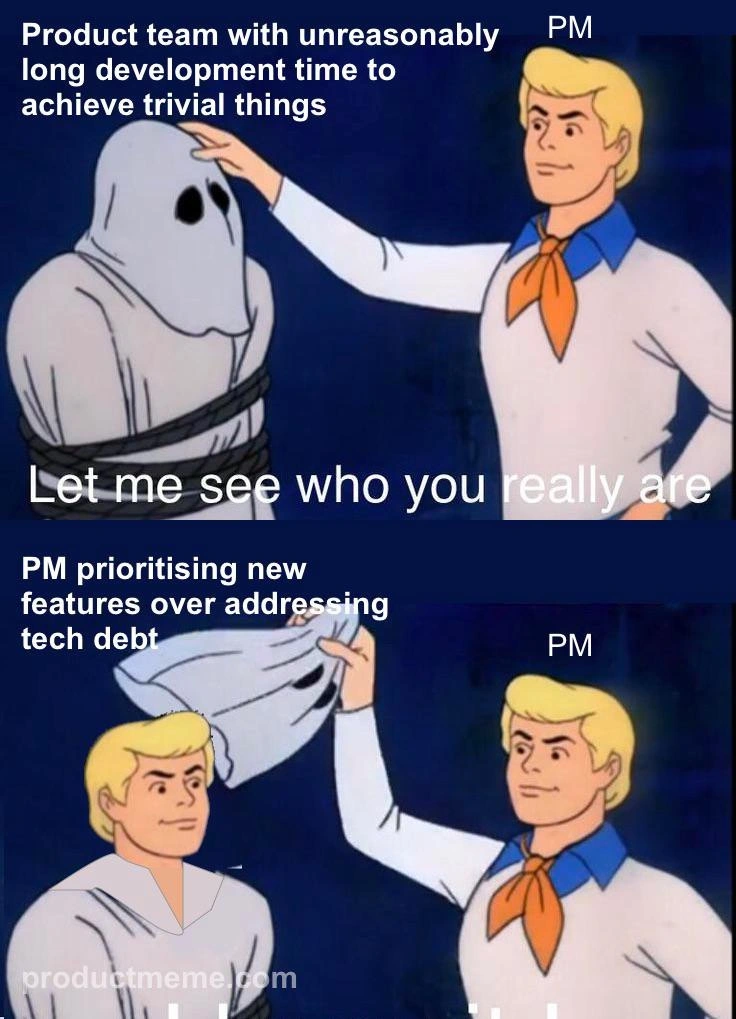
  • “Product team with unreasonably long development time to achieve trivial things” – This phrase describes a situation where the development team (the programmers) is taking a very long time to do something that sounds simple or “trivial.” Imagine being asked to add a small button or change a color in an app, and it ends up taking days or weeks. To someone not involved in the coding, that delay feels unreasonable for such a small request. In the meme, this idea is represented by the ghost figure labeled with that long phrase – it’s the mystery of why the team is so slow at completing easy tasks.
  • “Let me see who you really are” – This is a direct quote from Scooby-Doo. In the cartoon, after the gang catches a villain (who’s usually dressed as a ghost or monster to scare people), Fred pulls off the mask and says this line to reveal the bad guy’s true identity. It’s a dramatic “aha!” moment. In our meme, the PM is doing the unmasking, treating the slow development as if it’s a masked villain he’s caught. He wants to find out what’s causing those delays.
  • Technical Debt – This is a metaphor developers use to describe the accumulated shortcuts and sloppy code that happen when you rush work. If a team skips writing tests, doesn’t refactor messy code, or postpones cleaning up problems, those things pile up as “debt.” The term makes it sound like financial debt: you “borrow” time by not doing proper work now, but you pay interest later because that sloppy work will cause extra trouble down the road. For example, not fixing a known bug today might mean spending twice as long fixing it when it causes a bigger issue next month. In the meme, when it says “addressing tech debt,” it means doing the clean-up and fixes in the code to pay off that debt.
  • Prioritizing new features – This means choosing to work on adding new functionalities (new buttons, new pages, new shiny things for users) instead of improving what’s behind the scenes. The meme specifically calls out the PM for “prioritising new features over addressing tech debt.” In practice, many PMs decide that building something new is more important than spending time to polish or fix the existing code. This keeps happening sprint after sprint, so the unfinished clean-up tasks just keep accumulating.
  • Feature Creep (a term tagged in the post) – Feature creep is when more and more features or requirements are added to a project, often without a pause or a plan for maintaining what’s already there. It’s like a project that keeps “creeping” bigger and bigger. In our context, if a PM always says “Yes, let’s also add this feature and that feature,” the project scope balloons. Feature creep often contributes to technical debt because the team is always focusing on the next new thing instead of stabilizing what they just built.
  • Deadline Pressure – This refers to the stress of having a fixed timeline. For example, if a release date is coming up or there’s a demo next week, everyone feels pressure to get features done quickly. Under deadline pressure, a team might intentionally take some shortcuts – like hard-coding something just to make it work now, telling themselves they’ll fix it later. Those shortcuts become technical debt if “later” never comes. PMs often impose or communicate these deadlines, urging teams to deliver by certain dates, which can lead to accumulating more debt.

Now, let’s connect these pieces to the meme’s story. In the top panel, the PM (Fred) is frustrated and confused about why the product/development team is so slow. He’s basically saying, “Why does it take forever to do something so simple?” That scenario is common if you’re new to working on real-world projects: non-developers sometimes genuinely can’t understand why a tiny change can take a whole week. The PM in the meme is depicted as if he’s about to solve a mystery — the mystery of the slow team.

In the bottom panel, the mystery is solved. When Fred the PM pulls off the ghost’s mask, the caption reveals that the “ghost” causing the delays was actually “PM prioritising new features over addressing tech debt.” In plainer terms, the reason the team is slow is because the product manager kept choosing to add features instead of fixing the underlying code issues. It’s a self-inflicted problem. The meme is saying the PM is unmasking the culprit and finding out it’s essentially his own management decisions. He was blaming the team (thinking maybe the developers or something unknown was at fault), but it turns out the long delays were caused by all the accumulated technical debt, which exists because the PM never allowed time to clean it up.

For a junior developer or someone just learning about this stuff, here’s a relatable scenario: imagine you join a project that’s a few years old. You’re asked to make a small change, like update the text in a confirmation email. You think, “This shouldn’t take long at all.” But when you go into the code, it’s a tangled mess. Maybe the email text isn’t in one place – it’s hard-coded in multiple spots. The email system is intertwined with a bunch of other features (like user registration and notifications) in confusing ways. What should have been a 10-minute text change turns into a multi-hour or multi-day hunt through code, testing, and fixing side-effects. That frustrating experience is often due to technical debt: the code wasn’t clean or flexible because people patched it together over time without refactoring. If you ask, “Why is it like this?” you might learn that every time someone touched email functionality in the past, the team was in a rush. They just added what they needed without thinking of the long term.

The meme’s joke is basically pointing out this cause-and-effect: when you only care about new features and never allow time to tidy the code, you end up slowing yourself down. The product manager in the picture is essentially facing the consequences of his own choices. It’s funny because he’s both the one complaining and the one at fault – like a silly twist ending. The Scooby-Doo unmasking makes it light-hearted: normally, Fred would reveal the bad guy and everyone would gasp. Here, the gasp is because the “bad guy” making work slow is “PM prioritising new features over tech debt” – not a person, but a practice. And Fred is the PM, so it’s like he’s saying, “Oh no, the bad guy is… me!”

So, in simple terms: the team took a long time to do something easy because the codebase was in bad shape (full of legacy problems and quick hacks). And the codebase was in bad shape because the boss (PM) always said “do new stuff now, fix problems later,” and later never happened. The meme is a fun way to gently poke at that boss/PM, showing that when he tries to find the scapegoat for the delays, he ends up holding a mirror to himself. It’s a bit of shared tech humor about why paying down tech debt (fixing and improving the code) is important: otherwise even trivial updates become a nightmare. The categories like TechDebt, Management_PMs, Deadlines all come together here: ignoring technical debt (tech cleanup) due to management pushing for features under deadlines leads to the very delays everyone hates.

Level 3: Ghost of Tech Debt Past

In this meme, a classic Scooby-Doo unmasking scene is repurposed to expose the real villain behind slow development. On the top panel, Fred (wearing his trademark white sweater and orange ascot) is labeled PM (Product Manager) and is about to reveal the identity of a hooded ghost. The ghost is tied up, captioned “Product team with unreasonably long development time to achieve trivial things.” Fred declares, “Let me see who you really are,” suspecting some sinister force making trivial features take forever. In the bottom panel, Fred pulls off the mask – and the ghost is revealed to be the PM prioritizing new features over addressing tech debt. In other words, the product manager investigating the “cause” of delays finds out it’s actually their own feature-first approach that’s the culprit. The meme literally has the PM unmasking himself as the villain. It’s a biting commentary on how management sometimes blames the dev team’s slow progress when, in fact, the delays are caused by management’s own decisions to ignore maintenance.

Experienced developers recognize this scenario all too well. The humor lands because it’s painfully relatable: the very person complaining about “long development time for trivial things” is the one who insisted on piling up Technical Debt in the first place. In many teams, product managers or stakeholders push for more and more features (Feature Creep) to satisfy market demands or StakeholderExpectations, while postponing any “unnecessary” cleanup. Initially, this can make the team deliver new stuff quickly – you take shortcuts, slap on quick fixes, and ignore underlying issues to meet the next DeadlinePressure. But over time, those shortcuts accumulate into a ghoulish mess of hacks, brittle code, and outdated components – the infamous technical debt. Suddenly, even adding a simple button or changing a text label (“trivial” in theory) requires navigating a minefield of spaghetti code and half-broken modules. The development team gets slower and slower, not because they became incompetent overnight, but because the codebase is haunted by the ghosts of unresolved issues. The “trivial” tasks are trivial only to someone who doesn’t see the tangle under the hood.

This meme calls out a frequent agile pain point: new features get priority over fixing bugs or refactoring, sprint after sprint. The product manager (PM) keeps saying “we’ll handle those tech debt items later, maybe next sprint,” but later never comes because there’s always another shiny feature to chase. This is classic management vs engineering tension. The PM is under pressure to show constant feature progress (so they keep the roadmap packed), and they treat maintenance as a luxury. Meanwhile, developers are waving warning flags that the codebase is getting crusty. Every experienced engineer has sat through a meeting where they try to explain that the reason a “five-minute change” is taking five days is the mountain of ugliness under that part of the code. But often those warnings go unheeded until the situation is dire (like when something finally breaks in production at 3 AM on a weekend – guess who gets paged? Not the PM.).

From an architectural perspective, unchecked technical debt behaves like compound interest – the longer you wait to pay it off, the “interest payments” (extra effort later) grow exponentially. A senior dev can spot when a codebase is approaching the tipping point where even small changes have huge ripple effects. Maybe the project skipped upgrading a major library for years (because “if it ain’t broke, don’t fix it”), and now implementing a trivial new feature triggers compatibility issues that require a massive overdue upgrade. Or perhaps quick hacks piled up in the authentication module to rush out features, and now a simple login tweak means untangling a snarled web of spaghetti code. In essence, ignoring tech debt is borrowing time from the future: you get a short-term boost in speed at the cost of much slower progress later. The PM in the meme is discovering the spooky truth: those “time savings” from skipping maintenance are now coming back to collect their debt, just when they want things done fastest.

This situation is too real in many agile teams. The roadmap is full of new features to appease sales and customers, but the “boring” foundational work (like refactoring old code, writing tests, upgrading dependencies, improving infrastructure) keeps getting deferred. Eventually, progress grinds to a halt. That’s when management starts asking, “Why are simple tasks taking so long? Who’s responsible for this?” The Scooby-Doo format is perfect here: the PM suspecting something external slowing down the team, only to reveal the true masked villain is their own backlog decisions. It’s a comedic way of saying, “Look in the mirror, this delay is home-grown.”

The meme resonates because it flips the usual blame game. Often, we see managers implicitly questioning the developers for not delivering faster – “maybe the devs are over-engineering or not focused enough.” But here, the reveal is that the blame lies with the PM’s feature-first obsession. It’s an “aha!” moment that seasoned devs wish would happen in real life more often. (If only we could literally pull off a mask and show some managers: “Surprise! The reason we’re slow is all the junk we piled up per your instructions!”) It underscores a hard truth in software projects: if you ignore underlying problems for too long, those problems become the project’s biggest obstacle. The PM essentially set a trap for themselves: by constantly deferring maintenance in favor of new features, they ensured that future feature delivery would bog down. The meme’s punchline is that the PM is basically catching themselves red-handed for the delays they complained about.

To give a concrete example that senior folks chuckle at: imagine a PM demands a new user profile field be added by end of sprint – sounds simple. But because the code is a decade old and full of crusty corners (no one ever had time to refactor the profile module), adding this one field means:

  • Updating a fragile XML configuration that’s been copy-pasted across five different places (touch it, and you risk breaking something unexpected).
  • Extending a base class that’s already doing ten unrelated things (a classic tech debt anti-pattern that makes changes risky).
  • Writing a migration script for an ancient database schema that still has some legacy quirks from 2005.
  • Fixing side-effects in an email notification function that, surprise, is tightly coupled to the user profile logic in a hacky way.
  • Performing a bunch of manual tests through the UI because the automated tests were never written (there was never time for testing with all those features to build).

What the PM thought was a quick win turns into a week of whack-a-mole with all the hidden monsters in the codebase. This one “trivial” addition becomes a boss battle against all the accumulated issues lurking beneath the surface. Multiply that by dozens of such decisions and you see why the product team (developers) ends up with “unreasonably long development time” for seemingly trivial changes. Chasing features at all costs creates a codebase that actively resists change, which then makes delivering the next feature even slower. It’s a vicious cycle.

The Scooby-Doo unmasking trope adds a layer of nerd humor here. In the classic cartoon, Fred pulling off the mask usually reveals some predictable villain that the audience likely suspected. The trope is so well-known that “Let’s see who you really are” has become a meme format on its own. By labeling both Fred and the masked ghost as PM roles (the PM investigating, and the PM’s prioritization as the villain), the image humorously portrays a PM essentially accusing their team (“this product team is too slow!”) and then realizing they themselves (their management strategy) are to blame. It’s a cartoonish representation of a serious real-world problem, done in a lighthearted ProductManagementHumor style. Engineers share this meme with a mix of laughter and a sigh, thinking, “Yep, we’ve lived this one.” It’s cathartic because it’s a truth we often can’t bluntly tell our bosses: that constant FeatureCreep without maintenance is the real monster haunting our sprints.

Fred (PM): “Jinkies! The cause of our delays... it was me all along!”
Unmasked Ghost (Tech Debt): “And I would have delivered those features on time, if it weren’t for my own meddling roadmap!”

Level 4: Entropy Always Wins

At a fundamental level, this meme highlights what could be called the Second Law of Software Thermodynamics: without active effort, software entropy always increases. In physics, the second law of thermodynamics says that entropy (disorder) in a closed system tends to increase over time. Similarly, in a codebase, if you keep adding features (increasing complexity) and never refactor or clean up (reduce entropy), the overall disorder of the system will inevitably grow. This disorder is precisely what we nickname technical debt. It’s not just a metaphor – it’s an observable phenomenon in software evolution. In fact, Lehman’s Laws of Software Evolution (proposed in the 1970s) include one that essentially states: as a program evolves, its complexity increases unless work is done to maintain or reduce it. In other words, a development team must put in energy (time and effort) to reorganize, simplify, or improve the code – otherwise the code will rot or become more chaotic over time. The product manager in the meme kept pushing new features without investing that energy to reduce complexity, effectively obeying the law of increasing entropy: each new feature adds a bit more disorder, and none of that is ever cleaned up. Eventually, the system’s complexity reaches a tipping point where progress slows to a crawl.

The concept of TechnicalDebt was originally coined by Ward Cunningham as a way to frame this phenomenon in financial terms. When you take a shortcut in code or postpone a necessary cleanup, it’s like taking on debt. You gain a short-term benefit (like faster delivery of a feature, analogous to a cash loan), but you incur an “interest” cost – future development will be harder and slower because of that decision. If you never pay down the principal (i.e., address the debt by refactoring or fixing the underlying issues), the interest accumulates. Eventually, just as unpaid financial debt can bankrupt you, unaddressed technical debt can cripple a project. There have been attempts in the software engineering field to quantify technical debt and its interest mathematically – for example, models that estimate how much extra time each additional code smell or bug adds to future tasks. While it’s hard to get a precise formula, the trend is clear: accumulating tech debt has a compounding effect on development time. An equation for this “interest” might look like:

Effective Dev Speed = Base Speed / (1 + Tech_Debt)^n 

where n might be some factor related to the complexity of integrating new features. As Tech_Debt grows, the denominator grows, and your effective speed drops dramatically. It’s not literally an equation teams use, but conceptually senior engineers feel this: double the mess and you more than double the time to add anything new.

There’s also a project management analogue to the famous CAP theorem or the engineering “iron triangle” (fast, good, cheap – pick two). In our context: you can develop fast, you can keep code quality high (low debt), and you can do it with minimal investment in refactoring (cheap in the short term). The catch is you can’t have all three continuously. If you constantly choose fast and cheap (rushing out features without cleanup), you sacrifice good – meaning the internal quality suffers. Initially that seems fine (the product features work, users are happy), but over time that missing quality comes back as massive drag on speed, meaning you eventually lose the “fast” advantage too. It’s like a law of conservation of effort: the effort you skip now is not destroyed; it is stored as debt and you will expend it with interest later. No matter how clever your team is, ignoring systemic code problems will inevitably slow you down. This is basically guaranteed by the nature of software complexity.

From a historical perspective, the industry has plenty of cautionary tales. Large projects sometimes reach a point where the only way forward is a complete rewrite or a major refactor – essentially “paying off” a huge debt in one lump sum. For instance, Netscape in the 90s famously decided to rewrite Communicator from scratch due to mounting code issues (which didn’t end well for them), and more modern projects schedule “engineering sprints” or “refactoring quarters” when things become unsustainable. Academic research on TechnicalDebt (yes, there’s research and even conferences on it) tries to find ways to detect debt early and manage it proactively. They classify types of debt (code debt, design debt, even people or knowledge debt) and try to measure the impact on productivity. One consistent finding: ignoring problems doesn’t make them go away – the debt metaphor holds true. If a product manager only values new features and treats the codebase as an infinite capacity machine, they’re defying what seasoned engineers know as a fundamental law: complexity accumulates, and eventually, it has to be addressed.

In summary, the meme’s scenario is a practical illustration of these principles. If you continually violate the “laws” of good software engineering by not paying down debt, you end up in a state where the simplest task is bogged down by layers of complexity. It’s virtually a guaranteed outcome – as predictable as gravity or entropy in a closed system. The only surprise for the PM is that they didn’t see it coming. The Scooby-Doo unmasking is a playful way to depict this inevitability: pull off the mask of those schedule delays, and you reveal an accumulation of neglected complexity — a direct result of the PM’s choices. It’s both a joke and a software engineering lesson wrapped in one: there’s no escaping the entropy of tech debt, except by confronting it.

Description

This meme uses the two-panel 'Scooby-Doo villain reveal' format to critique a common dynamic in software development. In the top panel, Fred from Scooby-Doo, labeled 'PM' (Product Manager), is about to unmask a ghost who is labeled 'Product team with unreasonably long development time to achieve trivial things.' The text reads, 'Let me see who you really are.' In the bottom panel, the ghost's mask is removed, revealing that the villain is an identical copy of the PM. This unmasked character is labeled, 'PM prioritising new features over addressing tech debt.' The meme humorously illustrates the irony of a Product Manager complaining about slow development, when the root cause is their own strategy of consistently pushing for new features while neglecting the accumulating technical debt. This neglect makes the codebase harder to work with, thus slowing down all future development, including the 'trivial things.'
Comments

8
Anonymous ★ Top Pick A PM who prioritizes features over tech debt is just taking out a high-interest loan from the Bank of Developer Sanity, and the velocity chart is the first payment to bounce
  1. Anonymous ★ Top Pick

    A PM who prioritizes features over tech debt is just taking out a high-interest loan from the Bank of Developer Sanity, and the velocity chart is the first payment to bounce

  2. Anonymous

    Turns out that 4-week “trivial tweak” isn’t a dev problem - it’s the compounded interest on the subprime tech-debt mortgage the PM signed three roadmaps ago

  3. Anonymous

    After 15 years of watching PMs promise 'we'll address the tech debt next quarter,' I've learned that 'next quarter' exists in the same temporal dimension as 'when Half-Life 3 releases' - theoretically possible but practically mythical

  4. Anonymous

    The real Scooby-Doo mystery here is how PMs expect O(1) feature delivery while systematically converting the codebase into O(n²) spaghetti. Every sprint they unmask 'slow developers' only to find their own reflection - a product backlog that treats refactoring tickets like Schrödinger's cat: simultaneously critical and never prioritized. The technical debt compounds at venture capital rates while they wonder why that 'simple' feature now requires touching 47 files across 12 microservices, each with its own bespoke error handling and zero test coverage

  5. Anonymous

    Prioritize new features over tech debt long enough and compound interest turns a “trivial checkbox” into a cross-service refactor, schema migration, and a handshake with the SOAP gateway

  6. Anonymous

    The real plot twist: tech debt isn't the ghost - it's the PM's feature roadmap, haunting sprints until someone rips off the mask

  7. Anonymous

    Every “two-hour button” takes two sprints when you’re paying compound interest on a six‑year monolith and the PM’s OKR is features shipped, not debt retired

  8. @LionElJonson 2y

    that is what happens when you dont have technical lead (or the one existing has smol pipi)

Use J and K for navigation