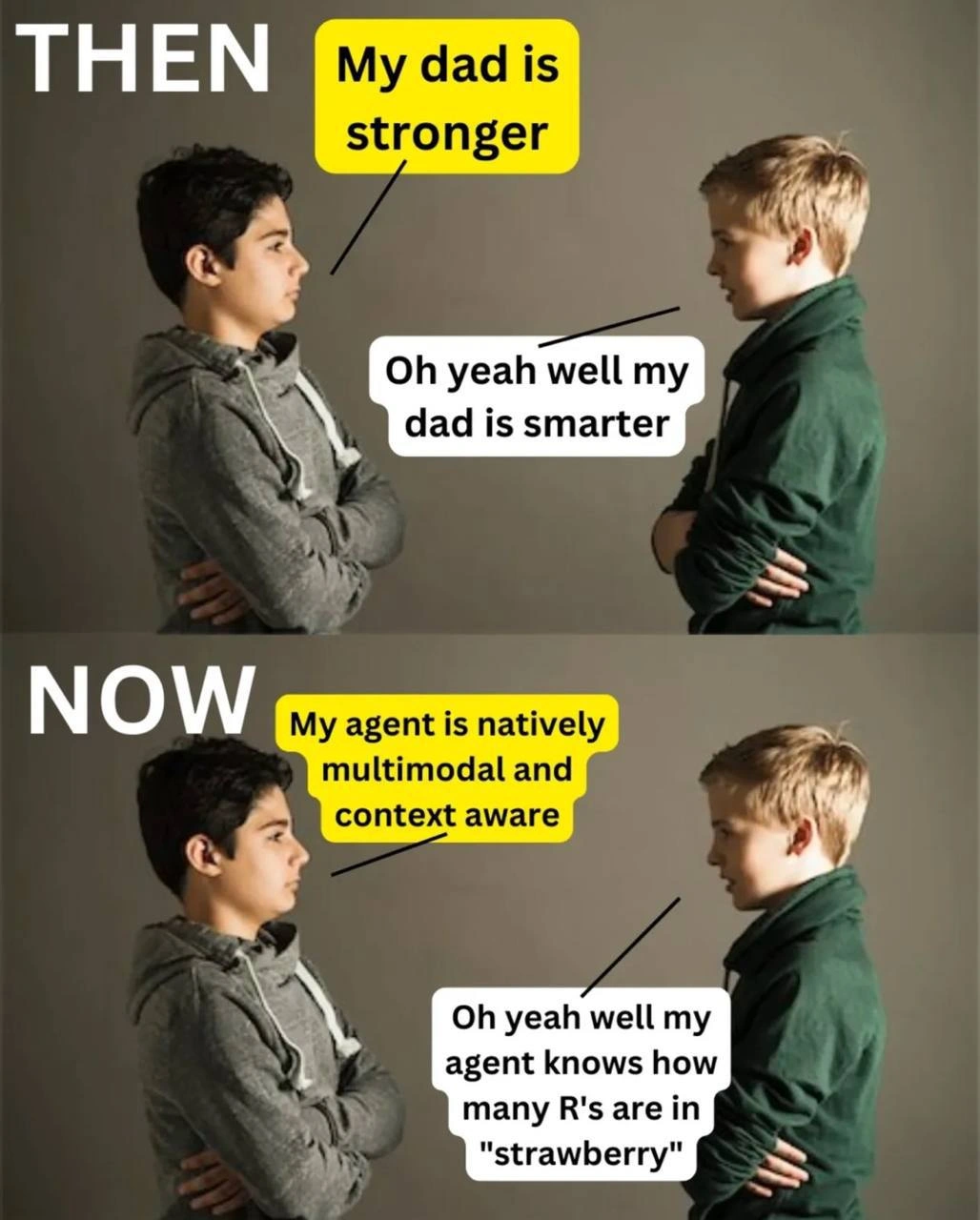
The Evolution of Childhood Bragging Rights, from Dads to AI Agents
Why is this AI ML meme funny?
Level 1: Big Words on the Playground
Imagine two kids on a playground trying to outdo each other. In the old days, one might say, “My dad is the strongest in the world!” and the other would reply, “Oh yeah? Well, my dad is the smartest in the world!” They’re just proudly comparing whose father is more awesome, even though it’s a silly, endless argument. Now picture kids doing the same thing but with their favorite gadgets or friendly AIs. The first kid basically says, “My special computer friend can do all sorts of things at once and never forgets anything!” Then the second kid fires back, “Oh really? Well, my computer friend can do this super-specific thing perfectly (like count the letters in a hard word)!” It’s a funny twist because we don’t expect children to talk that way, using big tech words. They’re treating their AI programs like all-powerful superheroes, just like kids used to talk about their dads. The heart of the joke is that people always find something to brag about – it used to be our strong or smart parents, and now it’s our fancy smart computers. Hearing youngsters use grown-up tech lingo to one-up each other is just plain amusing. It’s like two little friends saying, “Mine is better than yours!” but instead of talking about toys or parents, they’re bragging about whose imaginary robot buddy is cooler. The contrast is cute and absurd, and that’s why it makes us laugh.
Level 2: Buzzword Boasting
Let’s break down the big tech words these kids are throwing around. When the first kid says, “My agent is natively multimodal and context aware,” he’s basically bragging in developer language about his AI buddy. An “AI agent” here means a smart program or AI assistant that can do tasks for you (imagine something like a super advanced chatbot that can also use tools or browse information). “Multimodal” means this AI can handle different forms of input or output — for instance, not just text, but maybe images and sounds too. Saying it’s natively multimodal implies it was built that way from the start. Think of it like a person who is bilingual from birth versus someone who learned a second language later; a natively multimodal AI was trained to understand multiple “languages” of data (like pictures and text) all at once. That’s definitely a fancy feature in the AI world right now.
Next, “context aware” is another brag-worthy trait. Context awareness means the AI can remember what’s going on and use it to make better decisions or responses. In a simple chatbot, if you ask a question, it might forget what you said two questions ago. But a context-aware agent remembers the conversation history or the situation. For example, if you first ask “What is the capital of France?” and then follow up with “How long would it take to drive there from here?”, a context-aware assistant knows “there” means Paris and keeps track of “here” based on earlier info you gave. It doesn’t get confused easily. Developers often talk about context windows, which are like the AI’s short-term memory capacity — how much text it can consider at once. Bragging that your model is context aware hints that it has a larger memory or better way of keeping track of what’s been said. In human terms, it’s like saying “My friend never forgets anything I tell them during a conversation.” Definitely a useful trait!
Now, the retort from the other kid: “Oh yeah well my agent knows how many R’s are in ‘strawberry’.” At first glance, this sounds super specific and even silly. He’s literally saying his AI can count the number of times the letter “R” appears in the word “strawberry.” (By the way, “strawberry” has two R’s in it – one in the middle, one at the end.) Why is this funny or interesting? Well, it’s poking fun at the idea that sometimes people brag about very trivial things when it comes to AI. Counting letters in a word is something even a basic program or a six-year-old kid could do, right? It’s not exactly a demonstration of genius. But ironically, in the realm of LLMs (Large Language Models), there have been many cases where the AI messes up counting or spelling tasks because they don’t “think” the way humans do; they predict text based on patterns rather than explicitly counting. So here it’s like the second kid is grasping at a benchmark banter point — a small victory — to say “well, my AI isn’t dumb, it can even do this little trick correctly!” It’s a tongue-in-cheek way to one-up the first kid’s fancy boast with something that sounds technically detailed but is actually pretty superficial.
In simpler terms, the then vs now contrast is the joke. THEN (in the past), kids would show off by saying “My dad can do X” and the other would reply “Oh yeah? Well my dad can do Y!” Basic one-upmanship. NOW, these kids are basically doing the same thing, but instead of dad’s strength or intelligence, they’re comparing whose AI system is more advanced. Using big buzzwords like “multimodal” and “context aware” is like using secret code to sound super impressive. It’s techie bragging. The humor is that elementary-age kids (in the meme) probably wouldn’t really talk this way — it’s us, the developers and tech enthusiasts, who do! We’re essentially seeing a mirror of our own behavior in a playground argument form. Anyone who’s been around AI forums or tech meetups has probably heard folks humble-brag about how their model or project has some state-of-the-art feature. It’s both relatable and ridiculous when you take a step back. The meme is gently teasing those of us in tech: we might not brag about our dads on the playground anymore, but we sure have found new “cool” things to boast about. And sometimes, if you strip away the jargon, it’s as basic as counting letters in a word. 😅
Level 3: From Bench Press to Benchmarks
What makes this meme hilarious to industry veterans is the perfect parallel it draws between old-school playground power contests and today’s AI one-upmanship. “My dad is stronger” vs “my dad is smarter” was the classic battle of brawn vs brain – a rite of passage on elementary school blacktops. Fast forward to the “NOW” panel, and we have essentially the same chest-thumping contest, but updated to the era of AI assistants and machine learning bragging rights. The left kid’s claim, “My agent is natively multimodal and context aware,” sounds exactly like an engineer flexing about their latest AI model on a tech forum. It’s the computational equivalent of bragging about dad’s muscles – except here the “muscles” are the model’s advanced features (like being able to handle images, text, and long conversations all in one). The right kid’s comeback, “Oh yeah well my agent knows how many R’s are in ‘strawberry’,” satirizes the almost absurd level of granularity and triviality that these AI flexes can reach. It’s as if two machine learning researchers were trying to out-do each other by citing obscure benchmarks: one goes broad, boasting about architecture and capabilities, and the other goes surprisingly narrow, boasting about acing a specific quirky test. AIHypeVsReality in a nutshell: lofty claims met with oddly specific proofs.
This resonates with developers who’ve witnessed how tech bragging has evolved (or devolved) over the years. Decades ago, a playground brag for tech-savvy kids might have been “My PC has 16MB of RAM” versus “Oh yeah, well my dad’s PC has 32MB and a Pentium CPU!” – raw hardware muscle bragging. In the early 2000s, companies and devs flexed about clock speeds and “gigahertz” in CPUs, akin to saying “my dad can lift 300 lbs.” Later, the bragging shifted to software smarts: “my algorithm is faster” or “my search engine is smarter,” echoing “my dad is cleverer than yours.” Now we’ve arrived at the era of AI model hype. The modern engineer’s equivalent of playground boasting often sounds just like the meme: our model has more parameters, our model is multimodal, our model has a 100k token context window, and so on. It’s a parameter count comparison arms race, much like kids escalating who has the cooler dad. The meme expertly pokes fun at this trend by putting those ridiculous-sounding boasts back in the mouths of actual kids on a playground, exposing how childlike such competitive hype can seem.
There’s an implicit wink to those of us in the field: we’ve all sat through meetings or conference talks where someone proudly declares something like “Our new chatbot can read images and remember the whole conversation!” — expecting oohs and aahs. It’s impressive, sure, but it’s also a bit performative. The other person might counter with, “Well, ours can solve this tricky puzzle or passed that niche quiz.” In reality, both accomplishments might be incremental, but in the hype bubble each becomes a trophy. The line about knowing how many “R”s are in strawberry is especially funny because it highlights how petty these bragging points can be. It’s the AI equivalent of saying, “Oh yeah? Well, my dad can touch his nose with his tongue,” i.e., a weird flex that doesn’t actually prove who’s stronger or smarter overall. IndustryTrends_Hype is written all over this: the meme jabs at how companies and devs sometimes focus on flashy bullet-point features or gimmicky benchmark tricks to claim supremacy (AIHype at its finest). Senior developers chuckle because they’ve seen this pattern repeat — today it’s LLM features, yesterday it was software frameworks, and it’s always somewhat relatable. We know that a truly useful AI agent should probably be bragging about solving real problems or delivering reliable results, not just counting letters or stacking buzzwords. The shared joke is in recognizing our own tendency to get caught up in these silly “my tech is bigger/better than yours” moments, just like kids on a playground.
Level 4: Transformer Arms Race
Behind the playground banter lies an arms race of AI model capabilities reminiscent of kids comparing muscle power. The phrase “natively multimodal and context aware” is loaded with deep learning jargon that hints at cutting-edge transformer architectures. Multimodal models are those mighty neural networks that ingest and fuse different types of data — for example, processing an image and a text prompt together. This is not trivial: it requires combining visual feature extractors (like a CNN or Vision Transformer) with language-understanding transformers into one unified system. Researchers have been pushing for such natively multimodal agents, meaning the model was designed from the ground up to handle multiple input modalities simultaneously, rather than bolting on an extra module as an afterthought. Academically, this involves aligning different embedding spaces so that, say, a picture of a strawberry and the word “strawberry” evoke compatible internal representations. It’s a bit like teaching a model in multiple languages at once — except one language is images, another is text, maybe even audio. The brag here is that “my agent” (think of a custom AI assistant or LLM-powered bot) has this sophisticated, cross-domain understanding baked in.
Then there’s “context aware.” In transformer terms, context awareness points to handling longer or more relevant sequences of information without losing the thread. Standard Large Language Models (LLMs) have a fixed context window (often a few thousand tokens) that limits how much conversation or text history they remember at once. An agent bragged about as context aware implies it can maintain state or memory beyond those limits – perhaps via an extended context window (32K tokens or more) or by using retrieval techniques to pull in past information. This is a technical bragging right because enabling a model to be truly context-sensitive often means grappling with the quadratic complexity of self-attention or adding memory modules. In essence, these kids are flaunting that their AI can pay attention and remember like an elephant, not a goldfish.
The retort brag — “my agent knows how many R’s are in ‘strawberry’” — seems comically simple, but under the hood it alludes to an interesting quirk of language models. Counting characters in a word is something a trivial script or any kid who can spell can do, but LLMs have historically stumbled on tasks like this because they predict text in a fuzzy, probabilistic way rather than executing precise algorithms. For a senior ML engineer, someone bragging that their model can flawlessly count letters is hinting that their agent might have integrated a form of discrete reasoning or tool-use (like calling an external function to count letters), or simply that it’s so well-trained (or fine-tuned) that it overcame a known limitation of vanilla transformers. It’s akin to boasting that your cutting-edge model has finally mastered a deterministic operation inside its stochastic brain. This touches on the broader AI research trend: there’s an ongoing parameter-count and capability race where more layers and billions of parameters are thrown at models to unlock “emergent abilities.” The brag about counting R’s tongue-in-cheek highlights how even enormous models sometimes lack trivial skills, so when one finally nails a simple task consistently, its proud parent (the developer) crows about it. In the grand scheme, this meme humorously exposes the hype-to-reality gap: we talk about AI in grandiose terms (multi-modal! context-aware!) yet often celebrate baby steps like a letter-counting victory.
Description
A two-panel meme format comparing childhood arguments of the past to the present. The top panel, labeled 'THEN', shows two young boys facing off. One boy says, 'My dad is stronger,' to which the other replies, 'Oh yeah well my dad is smarter.' The bottom panel, labeled 'NOW', depicts the same two boys. The first boy boasts, 'My agent is natively multimodal and context aware,' using modern AI jargon. The second boy retorts with a seemingly simple but tricky challenge: 'Oh yeah well my agent knows how many R's are in "strawberry".' This meme humorously contrasts the straightforward boasts of the past with the complex, buzzword-laden claims of today's technology. The technical joke lies in the fact that while high-level AI concepts like multimodality are impressive, Large Language Models (LLMs) have historically struggled with deceptively simple, specific tasks like counting characters in a word. It's a satire on AI hype versus actual, sometimes surprising, limitations
Comments
17Comment deleted
One agent has a 1.8 trillion parameter model that's natively multimodal; the other can pass the 'strawberry' test. Let's be honest, the second one is the real AGI
We’ve gone from arguing about CPU clock speed to arguing whether your 175-B model can count the R’s in ‘strawberry’ - apparently Moore’s Law now measures ego per token
The real flex isn't having an agent with RAG, function calling, and chain-of-thought reasoning - it's having one that can finally pass the kindergarten spelling test that stumped GPT-4 for months
The strawberry test became the 'FizzBuzz of LLMs' - a deceptively simple problem that exposed how models trained on trillions of tokens could still fail at counting three R's. It's the AI equivalent of discovering your distributed system can handle petabytes of data but crashes when someone sends a null byte. Turns out 'natively multimodal and context aware' doesn't include 'can count letters in a word,' which is roughly the AI version of bragging about your microservices architecture while your health check endpoint returns 500
Before we ship anything "agentic and multimodal," can it pass the strawberry‑R eval at T=0 with no retries, no CoT, and no vector lookup?
Congrats on the letter-count demo; talk to me when your 'natively multimodal' agent survives cold starts, rate limits, and still closes a Jira ticket without hallucinating requirements
From biceps to benchmarks: my agent's context window outlasts your dad's bedtime stories
what you'll use the island for? Comment deleted
inviting pedophiles over and disappearing them :) Comment deleted
Planning on selling hunting licences a'la https://tvtropes.org/pmwiki/pmwiki.php/Main/HuntingTheMostDangerousGame ? Comment deleted
My agent can solve a tower of Hanoi with four layers Comment deleted
I was solving it as a kid in kindergarten 👏 Comment deleted
Congratulations, you're smarter than AI 🎉😂 Comment deleted
even chimpanzee is smarter than ai Comment deleted
How generous of you, I'd say that even a pidgeon displays more intellect than AI Comment deleted
pigeons are pretty smart birds tbf Comment deleted
so smart that they usually just don't care. like Buddhist monks Comment deleted