She Thinks She Can Fix Him, But He's Busy Debugging the Universe
Why is this Mathematics meme funny?
Level 1: Never-Ending Puzzle
Imagine your friend proudly says, “I’m going to help change him, make him better!” about her boyfriend. But here’s the catch – what needs “fixing” isn’t like a bad haircut or a messy room. It’s more like the boyfriend’s brain is filled with giant unsolved puzzles that even the smartest people in the world scratch their heads over. 😅
It’s as if the boyfriend is a puzzle with pieces missing. One piece is a riddle about whether super hard puzzles can ever be made easy (that’s the P vs NP thing), another piece is a super long math equation about how air and water flow (that’s the Navier–Stokes one), and another piece is a drawing about teeny tiny particles zooming around. These are really big puzzles – imagine puzzles so hard that there’s literally a $1,000,000 prize for anyone who can solve them!
So when the girlfriend says “I can fix him,” it’s funny because it’s like someone saying “I can solve a never-ending maze all by myself.” We giggle because we know something she doesn’t: her boyfriend’s “problems” are more like mysteries of the universe than simple bad habits. It’s sweet that she wants to help, but it’s a bit like trying to fix a broken spaceship with just a band-aid. The thought is nice, but those issues are way beyond a quick fix from a loved one.
In super simple terms: the meme is comparing a complicated, nerdy guy to a huge unsolvable riddle, and the girlfriend thinks she can solve him just with care and effort. It’s funny and cute because we know her task is impossible – kind of how a child might say “I’ll fix the broken computer by pressing the keys,” not realizing the problem is massively complex. It’s making us laugh at how over-the-top the boyfriend’s “quirks” are. In real life, you help someone by maybe encouraging them to eat healthy or be on time. But helping someone “solve P vs NP” (one of his issues) is like helping someone learn to fly by tomorrow – it’s just not gonna happen!
So the joke is warm-hearted with a dash of nerdiness: the idea of fixing someone gets hilariously exaggerated. The boyfriend isn’t portrayed as mean or bad, just absurdly complex – like a never-ending puzzle. And the girlfriend’s optimism, while admirable, is as naive as thinking you can read one big book and suddenly know everything. It makes us smile because we all know people (or have been people) who thought a tough problem would be easy to solve, only to discover it’s a real brain-buster. Here, that scenario is turned into a goofy cartoon of a relationship.
In the end, it’s saying: Some people (and problems) are not simple – and that’s what makes this joke so relatable and funny. The girlfriend’s line “I can fix him” meets the boyfriend’s galaxy of nerdy puzzles and leaves us all chuckling, because we see the gentle truth: he’s not a broken toy you fix with glue; he’s more like a mystery novel with the last chapter missing. 🧩❤️
Level 2: Not a Normal Bug
Let’s break down what’s actually happening in this meme for those not steeped in advanced math or the “girlfriend fix him” trope. The meme starts with the caption “I can fix him”, which is a pretty common saying when someone (often jokingly) talks about dating a person with obvious flaws, thinking their love or care can change that person for the better. It’s like seeing a glitchy program and saying “I can patch that.” The humor usually comes from the fact that the person in question is often far from fixable (at least easily) – maybe he’s a chronic procrastinator or has some wild habits.
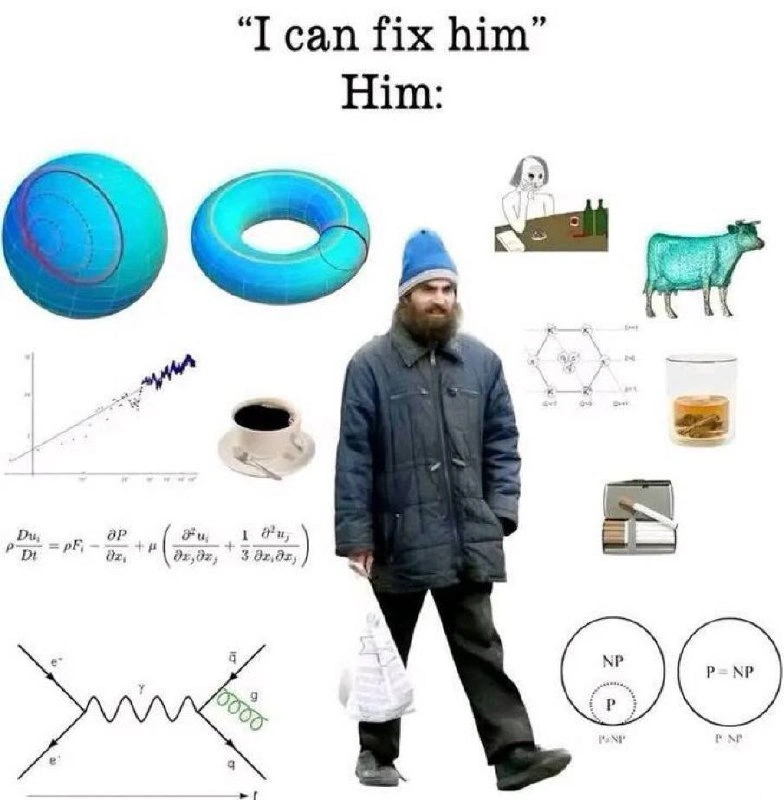
In the picture, after the phrase “Him:”, we see this scruffy-looking dude in a coat and beanie, carrying a plastic grocery bag. He looks like an ordinary guy you might pass on the street, maybe a bit unkempt. But floating around him are all sorts of braini🧠 stuff – not beer cans or sports cars, but diagrams and equations straight out of a grad school nightmare! Each of those floating images is a clue to some super high-level concept:
- Blue sphere and torus (donut) + coffee cup: These colorful shapes are about topology, which is a fancy branch of math that studies how surfaces can be stretched or deformed. A classic joke in topology is that a coffee mug and a donut (torus) are equivalent shapes because each has one hole (the mug’s handle and the donut’s center). You can imagine made-of-clay versions: if you slowly morph a donut shape, you can turn it into a coffee mug shape without tearing it – the hole just moves into the handle. A sphere, however, has no holes, so it’s a different topological class. The meme showing a sphere morphing into a torus with a coffee cup nearby signals that “Him” isn’t daydreaming about normal things – he’s pondering abstract math about shapes. It’s as if he’s thinking: “Hmm, can I continuously deform this sphere into a donut?” (Spoiler: you can’t, unless you punch a hole through it). This kind of deep thought is not a typical personal issue – it’s something pure math nerds relish.
- Noisy scatter plot with a line: This looks like a linear regression plot – you have a bunch of data points scattered around and a line fitting through them. That’s basic data science or statistics: trying to find patterns or trends in chaotic data. If our guy has that floating around his head, he might be preoccupied with analyzing data or worried about some statistical model. It’s like he’s literally seeing the world in graphs and equations. A regular person’s “problem” might be forgetting to pay bills; this guy’s “problem” might be trying to achieve a better $R^2$ value on a dataset at 3 AM. 😅 It signals an over-analytical personality.
- Steaming coffee cup: Aside from being part of the topology joke with the donut, a coffee cup is a universal symbol for coder fuel or academic fuel. Late nights, lots of thinking? Bring on the caffeine! The fact that it’s shown steaming probably means he is powered by coffee. That in itself is very normal in developer or researcher culture (many of us practically have coffee in our veins), but here it emphasizes that he’s possibly spending long hours awake working on these puzzles. So coffee might be one of his “quirks” – not getting enough sleep and always caffeinated, which girlfriends often do try to “fix” (“Maybe try drinking less coffee, dear?”).
- Incompressible Navier–Stokes equation: Now, that line of symbols is a doozy. It’s the Navier–Stokes equation, which governs fluid flow (how liquids and gases move). In particular, it looks like the incompressible Navier–Stokes form (with terms for pressure $P$, viscosity $\mu$, etc.). Why is this significant? Well, understanding Navier–Stokes fully is one of the great unsolved math problems – specifically, we can write the equation down, but proving that nice solutions always exist (and don’t blow up) in 3D is unsolved. It’s one of the official Millennium Prize Problems, meaning there’s literally a $1,000,000 prize for solving it! So if this guy has Navier–Stokes floating as one of his “bugs,” it’s saying he’s worried about a problem so hard that no mathematician has resolved it yet. In simpler terms: imagine someone’s “issue” is that they haven’t figured out how to travel faster than light – that’s not really a personal flaw, that’s an impossible mission (so far). Navier–Stokes here represents a holy grail challenge in math and physics. For context, Navier–Stokes equations describe things like weather patterns or water flow; solving them generally can help predict turbulence. But he’s not just reading about it – the implication is he’s actively grappling with it, as if it’s his personal project or obsession.
- Quantum chromodynamics Feynman diagram: In the bottom-left of the image, that zig-zaggy line with e⁻, γ, q, g labels is a Feynman diagram, which physicists use to visualize particle interactions. Specifically, it looks like an electron ($e^-$) emitting a photon (γ), which then decays into a quark–antiquark pair ($q \bar{q}$) connected by a gluon (g). This is heavy quantum physics stuff related to the strong force (quantum chromodynamics). If he’s thinking in Feynman diagrams, he’s literally imagining subatomic particles interacting – something only particle physicists and quantum geeks do. This implies he’s tackling problems like the Yang–Mills theory or the "mass gap" problem (another Millennium Prize Problem about why particles like gluons have mass). In everyday terms, it’s as if one of his “quirks” is daydreaming about how quarks and gluons behave. That’s way beyond worrying about normal life issues! It’s like having a partner who zones out because they’re mentally simulating the Big Bang instead of paying the electric bill.
- Chemical hexagon graph: To the right of him, there’s a hexagon with some letters – it resembles a chemical structure (like a benzene ring, which is a hexagon of carbon atoms) or perhaps a graph theory diagram. Six points connected could be a molecule or a graph node network. If it’s a benzene ring, that’s a fundamental molecule in organic chemistry. If it’s meant as a graph, perhaps it hints at another big math problem or just that he’s mapping relationships in some complex system. Either way, it’s another sign of scientific obsession. A normal person might doodle hearts or their name – this guy doodles molecular structures or abstract graphs. It’s painting the picture that even his idle scribbles are super advanced.
- Twin circles labeled NP and P≠NP: In the bottom-right, we have what looks like two circles (like a Venn diagram or separate sets), one labeled NP, and another labeled P=NP (or maybe showing P inside NP). This clearly references the P vs NP problem. To explain simply: P is the set of problems that are easy for computers to solve quickly (polynomial time), and NP is the set of problems for which a given solution can be checked quickly. All P problems are in NP (if a problem is easy to solve, it’s easy to check the solution too), but there are many NP problems that seem much harder to solve than to check (like solving a big Sudoku puzzle: hard to solve, but if someone gives you a completed Sudoku, it’s easy to verify it’s correct). The big question is: are those “hard to solve” problems actually fundamentally hard, or do we just not know the trick yet? That’s the P vs NP question. If P ≠ NP (which most suspect), it means there are problems that will always be impractical to solve exactly, even though verifying a candidate solution is easy. If P = NP, it would be earth-shattering because suddenly all those tough problems (including many encryption methods) become easy. So how does this relate to “fixing him”? Well, if he’s got P vs NP on his mind, it suggests one of his “personal issues” is that he’s preoccupied with a famous unsolved computer science problem. That’s not something a hug and a heartfelt talk can solve, right? It’s implying he’s on a mental quest to answer a question that nobody has answered since it was posed in the 1970s!
- Whiskey glass and cigarette pack: Now, these two items – a glass of whiskey (with ice) and a box of cigarettes – are actually the only “normal” red-flag items in the scene. They’re the kind of issues a girlfriend might genuinely want to fix: maybe he drinks a bit too much or smokes, which are common bad habits. In many “I can fix him” jokes, these are the types of traits the person might overlook or try to help with. The fact that they appear here among all the insane maths and physics hints is deliberate: it’s showing that yeah, he might have those issues too, but compared to proving Navier–Stokes, quitting smoking is small potatoes. The contrast is funny: we expect “I can fix him” to refer to stuff like stop him from smoking, but in this meme it’s like “I can convince him to solve the NP vs P problem and stop being obsessed with it.” It amplifies how out-of-depth her claim is.
So, putting it all together: the girlfriend is looking at a guy who is basically a walking encyclopedia of unsolved puzzles and thinking she can “fix” him. To a developer or scientist, this is immediately humorous because these floating items are like seeing big red ERROR flags that scream “unsolvable!” We often use the term “bug” for something going wrong in software. Here each unsolved problem is like a giant “bug” in the universe’s code that no one has a fix for yet. The meme caption even phrased it like a software scenario: “Girlfriend Promises Patch; Boyfriend Ships With … Bugs.” In dev-speak, a patch is a fix, and to ship with bugs means to release a software version even though known issues weren’t resolved. So the title jokes that the girlfriend promises she’ll patch him up, but the boyfriend (as if he’s a software release) “ships” with all these insane issues still present (topology glitches, Navier–Stokes crashes, P≠NP errors). It’s a cute cross-over between relationship lingo and software lingo.
For a junior developer or a student, the key takeaway is: This guy’s problems are not normal. They’re referencing things like:
- CS Fundamentals: e.g., algorithm complexity (that’s P vs NP: it’s about how fast algorithms can possibly solve problems. The tag
BigONotationrelates here – Big O is how we measure algorithm speed like $O(n^2)$ or $O(2^n)$, and P vs NP is essentially about whether some problems can be solved in polynomial time or if they inevitably require superpolynomial explosion of time). - Mathematics: heavy-duty equations like Navier–Stokes (fluid dynamics) and topology (donuts vs spheres).
- Meta humor: it’s self-referential in that it assumes the viewer can recognize these obscure references. It’s basically a meme for STEM insiders, combining math/CS inside jokes with a common relationship joke format.
If you’re new to these concepts, think of it like this: Imagine a friend says “I’m going to fix my old car this weekend,” but the car’s “issues” include needing a brand new type of engine that hasn’t been invented yet. You’d laugh because that’s clearly beyond a weekend garage fix. Here, the girlfriend saying “I can fix him” while he’s surrounded by century-old scientific puzzles is that same kind of laughable overconfidence. The meme is a lighthearted way to say “this person’s problems are way beyond your ability (or anyone’s ability) to solve on a whim.” It resonates especially with developers and academics because we often encounter people (or managers) who underestimate how hard a problem is. If you’ve ever had a boss ask, “Can’t you just make the software do ___?” and that request turned out to be something like “solve an NP-hard problem in real-time,” you’ll feel the wink here. It’s relatable: we’ve all been either the optimistic fixer or the complicated fix-ee at some point.
So, bottom line in simpler terms: the meme humorously shows a girlfriend thinking her guy’s quirks can be fixed, but those quirks are depicted as legendary math riddles and physics theories. It’s poking fun at the idea that love alone isn’t going to solve NP vs P. In developer lingo, she’s trying to debug a system whose “bugs” are essentially unsolvable by any known method. It’s a playful mashup of relationship humor and super nerdy Easter eggs, and the more you know about those floating items, the funnier (and more absurd) it gets.
Level 3: Intractable Boyfriend
Girlfriend: “I can fix him.”
Reality: Him is basically a production server spitting out 500 errors from unresolved theoretical constraints.
In this panel, a well-meaning girlfriend believes she can apply a quick patch to “fix” her boyfriend’s issues, much like a junior dev optimistically tackling a gnarly bug after glancing at the stack trace. But any senior engineer glancing at the floating clues around this guy instantly gets the joke: his “issues” aren’t your run-of-the-mill bad habits – they are NP-hard in the truest sense! The humor hits home for experienced developers and computer scientists because it’s riffing on two things simultaneously: the classic “I can fix him” relationship trope and the hubris of thinking you can easily solve problems that are, in fact, unsolvable or ridiculously hard. It’s as if someone said, “Don’t worry, I’ll refactor this 20-year-old legacy codebase over the weekend,” but the codebase in question is the entire Linux kernel. 🤦♂️
Seasoned devs recognize the pattern: whenever a bright-eyed newcomer (or an overconfident manager) says “It’s fine, I’ll just fix it!” about a complex system, the old guard exchange knowing looks. We’ve wrestled with “bugs” that turned out to be fundamental limitations – the kind you work around but never truly eliminate. This meme cranks that scenario to 11 by making the guy’s flaws literally the great unsolved problems of science. It’s the ultimate example of “works on my whiteboard, not in reality.” The girlfriend here is essentially promising a one-click bugfix for a cluster of issues so gnarly that entire scientific careers have been devoted to them. In other words, she’s bitten off a task harder than NP-complete – let’s call it “GF-complete”, where only an infinitely patient (or oblivious) partner would even attempt it.
Look at the inventory of quirks orbiting the boyfriend like he’s a walking Stack Overflow question no one can close:
- A messy Navier–Stokes equation scribble: Not your typical “he leaves the toilet seat up” issue. This stands for one of the hardest open problems in fluid mechanics. Any dev who has debugged a wicked performance issue might smirk here: it’s like a codebase with unpredictable race conditions – you think you nailed one, but the turbulence comes roaring back in another form. Fixing him would mean proving something mathematicians have chased in vain. That’s beyond a relationship heart-to-heart; that’s more like a Nobel Prize research program!
- The P vs NP circles: Relationship red flags? Try global computer science red flags. The diagram likely shows P tucked inside NP, with a big question mark about whether they’re actually equal. Every coder has heard of this puzzle – it’s legend. Solving it would upend everything from cryptography to scheduling algorithms. An experienced engineer can’t help but chuckle: we struggle to get polynomial-time algorithms for NP-hard problems, and here’s this dude carrying that very dilemma around like emotional baggage. He’s basically walking around with a sign that says “I have a million-dollar unsolved problem.” If she thinks a bit of couples therapy can resolve that, well… we have strong evidence that it’s not that simple.
- The topology donut-vs-sphere and coffee cup: This is pure nerd signaling. It screams that his mind wanders to abstract math landscapes where coffee cups morph into donuts (a classic topology joke). A senior dev might compare this to that colleague who writes code in Haskell using monads and category theory for problems that might’ve been solved with a simple loop – brilliant, but try “fixing” his approach? Good luck. The guy isn’t just thinking outside the box; he’s thinking outside the 3D Euclidean space entirely. That’s not a personality quirk you remedy with a pep talk – that’s a worldview steeped in math abstractions. To “fix” that, the girlfriend would need to be as fluent in algebraic topology as he is, or she risks coming off like a PM telling a kernel hacker to "just make it user-friendly."
- The Feynman diagram & chemical graph: These suggest his idea of a fun doodle is second-order perturbation theory or molecular structures. He’s not at the bar flirting; he’s deriving gauge symmetry results on napkins. For devs, this is like that coworker who spends their free time implementing a compiler for a language they invented – it’s passion at a level that’s hard to relate to (and definitely not something you “correct” in someone). The girlfriend’s patch plan is utterly outmatched here; it’s as if she’s planning a minor version bump, but his issues are more like architectural overhaul territory. Quantum chromodynamics doodles aren’t resolved by “talking about your feelings” – they’re more of a “publish a paper in Physical Review” ordeal.
The juxtaposition of common vices (whiskey glass, pack of cigarettes) with esoteric academic problems is the crux of the joke. Most people, when they say “I can fix him,” are referring to habits like drinking less, getting him to clean up, or be more responsible. In our meme, those normal red-flag habits are literally present (the drink and smokes), but they’re completely overshadowed by monumental intellectual quagmires. It’s like a bug report that includes “needs to stop leaving dirty socks around” and “also, needs to resolve the Riemann Hypothesis.” The latter makes the former look trivial! This absurd contrast is something veteran developers appreciate because it resonates with the experience of triaging bug reports or tech debt: sometimes you have a couple of minor lint errors… and also your core algorithm is unsolved in theory. Where do you even start? 😅
To highlight the contrast, consider this tongue-in-cheek comparison:
| Common Red Flag | This Guy’s “Red Flag” |
|---|---|
| Leaves dirty dishes around | Leaves unsolved proofs on every surface |
| Stays up too late playing video games | Loses sleep chasing a solution to Navier–Stokes |
| Forgets to text back on time | Forgets to eat while pondering if P = NP |
In a normal relationship, you might debug a partner’s bad habits through communication or compromise. But how do you “debug” open research problems? You can’t exactly sit him down and say, “Honey, can we talk about your tendency to hypothesize exotic manifolds at the dinner table?” There’s no Jira ticket for resolving the mass gap in Yang–Mills theory on a Sunday afternoon.
From a senior dev perspective, the girlfriend’s well-intentioned claim is humorous because it reeks of naïveté – a bit like an intern insisting, “I’ll just rewrite the whole system from scratch to fix those bugs,” without realizing the system is bound by laws of physics and decades of complexity. We’ve all been that optimistic problem-solver at some point, blissfully unaware of the dragons lurking in the details. The meme nails that dynamic: her confidence vs. the sheer absurd scale of his “problems.” It’s a meta-joke about scope creep in relationships – she signed up to help him be a better man, but discovered his issues exist on a cosmic intellectual plane. It’s as unfixable (by one person, in a short time) as attempting to refactor a project that inherently relies on an undecidable problem (like trying to make a perfect general bug-free algorithm for halting problem – you can’t, it’s proven impossible).
Experienced developers and academics chuckle here because they’ve learned the hard truth: some problems you don’t fix, you manage. If your system relies on, say, cryptographic hardness (an NP assumption), you don’t “solve” $P \neq NP$ yourself – you live with the uncertainty and plan accordingly. Likewise, if you’re dating a walking encyclopedia of unsolved conundrums, you probably learn to tolerate a bit of eccentricity. The phrase “I can fix him” becomes ironic because fixing implies closure, but these problems have no closure in sight. It’s the ultimate inside joke: Haha, good luck girl, you’re trying to patch a black hole.
So, at this level, the meme is simultaneously poking fun at the girlfriend’s optimistic ignorance and celebrating the boyfriend’s epic nerd status. It speaks to the programmer in us that has confidently promised a one-line fix before realizing the bug was a symptom of the universe’s complexity. It’s a gentle reminder that certain bugs (or people) are not just broken – they’re complicated by nature. And as any senior dev will tell you, complexity is not something you “fix” overnight; it’s something you carefully navigate or sometimes just learn to live with. The collective laugh comes from recognizing that familiar disconnect between hopeful simplicity and daunting reality – a gap as wide as NP is from P.
Level 4: Millennium Bugs
At the most theoretical level, this meme is essentially parading a collection of infamous unsolved problems in mathematics and computer science – the kind that earn millennium prize money and eternal bragging rights. The “Him” in the image is brimming with academic unsolvables, as if he’s a human embodiment of open GitHub issues that no one on Earth has managed to close. We see a Navier–Stokes equation (that intimidating fluid dynamics formula), the P vs NP dilemma, and what looks like a quantum field theory Feynman diagram – each of these is a grand challenge that has baffled experts for decades. These aren’t just tough bugs; they’re fundamental questions at the very core of math and CS, often called the Millennium Prize Problems. Solving any one of them would be a career-crowning achievement (with a $1,000,000 prize to boot), akin to pushing a monumental update to humanity’s knowledge base.
Why are these such intractable problems? Consider P vs NP, the crown jewel of theoretical computer science: it asks whether every problem whose solution can be verified quickly (NP) can also be solved quickly (P). Formally, it’s about whether $P = NP$ or not (most suspect $P \neq NP$). This isn’t just academic nitpicking – a proof either way would shake computing to its foundations. If somehow P = NP, a whole class of problems that currently take exponential time ($O(2^n)$ or worse) to brute-force might suddenly have polynomial-time ($O(n^k)$) algorithms. That would mean trivial solutions to encryption, scheduling, logistics, you name it – essentially breaking modern cryptography and solving puzzles that are currently impractical. On the other hand, proving P ≠ NP would cement our understanding that some tasks (like the infamous traveling salesman problem, or breaking certain encryptions) are inherently computationally hard no matter how clever we get. The meme’s little Venn diagram with circles labeled P and NP hints at this great unsolved riddle of complexity theory. It’s the kind of “bug” that every theoretical CS grad has poked at, but which stubbornly resists any “patch” – a bit like a function that nobody can optimize because we’re not even sure if an optimization exists.
Next, take that Navier–Stokes equation featured (shown with $\rho \frac{Du}{Dt} = \rho F_i - \frac{\partial P}{\partial x_i} + \mu\left(\frac{\partial^2 u_i}{\partial x_j \partial x_j} + \frac{1}{3}\frac{\partial u_j}{\partial x_j}\partial x_i\right)$). This is the core of fluid dynamics, governing how fluids (like air and water) flow and evolve. Engineers and physicists use Navier–Stokes formulas to simulate weather, airplanes, ocean currents – yet, the math behind it is so gnarly that we don’t even know if smooth, well-behaved solutions always exist in 3D! The Millennium Problem here (the Navier–Stokes existence and smoothness hypothesis) asks: for nicely behaved starting conditions, will Navier–Stokes always produce nice, non-blowing-up solutions over time? No one has proven it yet. It’s as if our “boyfriend” has an open ticket titled “Fix fluid turbulence mathematics” with a 150-year backlog. Fluid turbulence is dubbed the last unsolved problem of classical physics – it’s inherently chaotic, almost like a race condition in nature’s code that no amount of unit tests has tamed. To “fix” that bug, one might have to parse through infinite edge cases (literally, since turbulence exhibits infinitely many scales of motion). In software terms, it’s not a simple off-by-one error; it’s more like proving an entire scheduler or concurrency model will never deadlock, without exceptions – an infinitely complex verification problem.
The meme’s topology references (the blue sphere morphing into a torus, plus a coffee cup) allude to deep mathematical shape-shifting theorems. Topologists study properties that stay the same even when shapes stretch or deform. The running joke is that a donut (torus) and a coffee mug are homeomorphic (essentially the same shape) because each has one hole – a fact that tickles mathematicians. Here, these shapes hint at exotic problems like the Poincaré Conjecture, which posited (roughly) that a shape with no holes is basically a stretched-out sphere. That conjecture stumped mathematicians for a century until Grigori Perelman solved it in 2003. Amusingly, the bundled-up man in the meme strongly resembles Perelman himself (famous beanie, beard, and grocery bag included)! Perelman famously declined the Fields Medal and the $1M prize – a true tortured genius move – which adds another layer to the humor: this “fixer-upper” boyfriend might literally be the dude who solved one impossibly hard problem but carries a bunch more unresolved ones with him. If your boyfriend’s “quirks” include the Hodge Conjecture or Yang–Mills mass gap (two other millennium problems possibly hinted by the chemical hexagon graph or that particle physics doodle), well, good luck debugging those without a PhD (or three)! Each symbol orbiting him – from the quantum chromodynamics Feynman diagram (that squiggly line with e⁻, q, g labels showing electrons and quarks exchanging gluons) to that cyan wireframe cow (a wink at the classic “spherical cow” simplification in physics) – underscores how profoundly niche and complex his mental world is. These aren’t normal issues; they’re fundamental scientific conundrums. In formal terms, they’re akin to edge-case scenarios that break all conventional models, or known NP-hard problems where no efficient algorithm exists. He’s basically a walking collection of GitHub issues labeled “Research Required” or “Won’t Fix: Hard Theoretical Limit” 💾.
In short, the meme operates on a delightfully nerdy plane: it jokes that fixing this man would require solving problems that are literally unsolved at the global level. This is humor that winks at anyone who’s delved into theoretical Computer Science or advanced mathematics – the deeper your knowledge, the more layers you peel back. Just as a senior systems architect chuckles at a new programmer who proposes to “quickly fix” a bug that’s actually provably NP-hard, the seasoned academic soul laughs at the idea of casually patching a person whose “bugs” include the Navier–Stokes equation and P ≠ NP. Even if you throw the world’s best minds at these, the “PR” (pull request) is still open. Our “broken” boyfriend is basically running on an experimental branch of reality full of unresolved merge conflicts with mathematics itself. Fix him? That’s a task so Herculean, it makes rewriting a monolithic legacy codebase in a week look trivial. The comedic brilliance here lies in conflating personal flaws with unsolved scientific puzzles – implying that this guy’s issues are on a cosmic difficulty setting. It tickles the tech crowd because we recognize the absurdity: some bugs (and some people) aren’t ever getting that one-line fix, not without a breakthrough of historic proportions.
Description
A meme using the popular 'I can fix him' format to satirize intellectual obsession. The top text reads, 'I can fix him,' followed by 'Him:'. The 'him' is represented by a central photo of a disheveled man with a beard and beanie, surrounded by a collage of complex scientific and mathematical concepts. This collage includes diagrams of a sphere and a torus from topology, the Navier-Stokes equations for fluid dynamics, a Feynman diagram illustrating particle interactions, a Venn diagram for the P vs NP problem in computer science, a 'spherical cow' physics joke, and other symbols of intense academic pursuit like coffee, whiskey, and cigarettes. The humor lies in the absurdity of applying the 'I can fix him' trope to someone whose 'problems' are not personal flaws but rather some of the most profound and unsolved questions in science. For a technical audience, it's a relatable joke about the isolating nature of deep, abstract work and how it can be misinterpreted by outsiders
Comments
11Comment deleted
She's worried about his emotional unavailability, but he's just trying to determine if her plan to 'fix' him is even computationally feasible in polynomial time
Sure, she can “fix” him - right after we land a constant-time algorithm for Navier-Stokes, prove P=NP, and deploy it all without causing a topology mismatch in production
She thinks she can refactor him, but he's still trying to prove P=NP while maintaining a codebase written entirely in Brainfuck, eating cookies for dinner, and insisting that topology is 'basically just Docker networking.'
When the new senior hire confidently says they'll refactor the legacy monolith, optimize all N+1 queries, solve the distributed consensus problem, AND finally resolve whether P=NP - all before the next sprint. Spoiler: He's already on fire, he just doesn't know it yet. The Navier-Stokes equations have a better chance of being solved than that technical debt being paid down
Promising to “fix him” here is an NP-hard refactor on an adversarial monolith - the best you’ll ship is a coffee-fueled heuristic with no provable bounds and a Feynman diagram in the design doc
She thinks she can fix Perelman? That's bolder than claiming P=NP while debugging his Ricci flow
He claims P=NP; the only many-to-one reduction he’s nailed is coffee cup → torus
I don't get it Comment deleted
That's Perelman, probably Comment deleted
this guy is literally arsen markaryan although i dot't get the meme too Comment deleted
this guy is perelman Comment deleted