Skip to content
DevMeme
2962 of 7435
The Futile Magic of robots.txt
Security Post #3272, on Jun 17, 2021 in TG

The Futile Magic of robots.txt

Why is this Security meme funny?

Level 1: Keep Out Sign

Imagine you have a cookie jar, and you put a big note on it that says: “Dear Thieves – Please do NOT take any cookies from this jar. Thanks!”. Now, a really polite person or a friend might see the note and think, “Okay, I’ll respect that.” But if a cookie-loving sneak really wants a cookie, do you think a note will stop them? Probably not! They’ll just ignore the note and grab a cookie anyway.

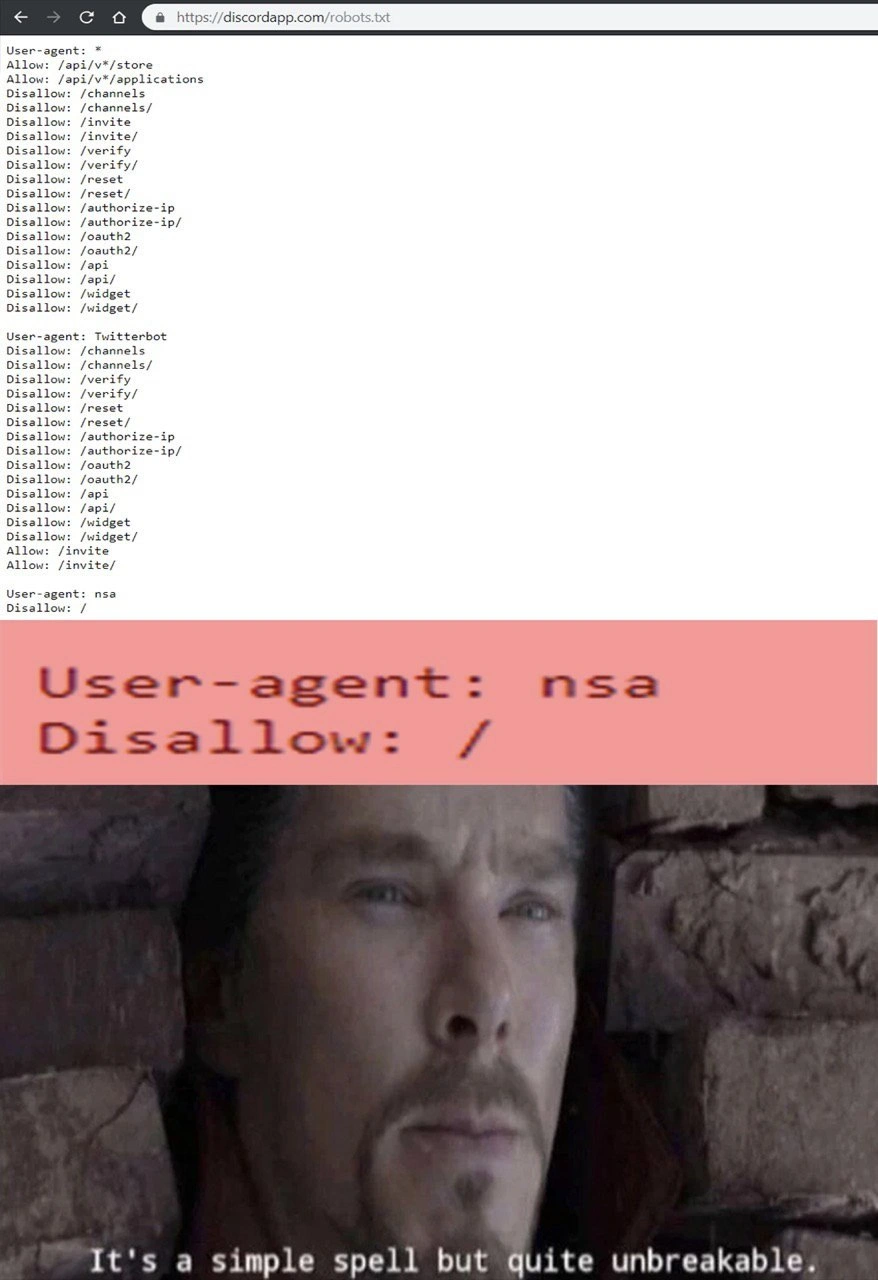
This meme is laughing about the same kind of idea, but on a website. Discord wrote a little file (kind of like a note on a door) saying “No sneaking around, okay?” specifically telling the “NSA” (a big spy organization) not to look at anything on the site. It’s funny because, just like a thief won’t listen to a “keep out” sign, a sneaky spy or bad guy on the internet won’t listen to a simple text note. The picture of the wizard saying “It’s a simple spell but quite unbreakable” is joking that the note is like a magic spell protecting the site – when obviously, it’s not. Anyone determined can just ignore the note. In the end, it’s a silly way to remind us that real locks work better than polite notes when you truly want to keep someone out.

Level 2: Crawler Courtesy

Let’s break down what’s actually happening here. A robots.txt file is a publicly accessible text file that websites use to communicate with web crawlers (also known as bots, spiders, or indexing robots). It’s part of the informal Robots Exclusion Standard. The rules inside it are like guidelines or requests: they tell automated crawlers which URLs on the site they "Allow" or "Disallow" for crawling. For example, a site might say:

User-agent: *  
Disallow: /private/  
Allow: /public/  

This would be a polite request to all bots (User-agent: *) asking them not to go into the /private/ area, but saying the /public/ area is fine to crawl. Legitimate crawlers like search engines usually comply out of courtesy and good web citizenship. They don’t want to index pages you’ve marked Disallow because you, as the site owner, indicated those aren’t for public indexing (perhaps they are admin pages or sensitive content). It’s all about security vs usability trade-offs: you want your site indexed by Google (for usability/discoverability), but you might not want certain paths or APIs indexed, so you rely on this gentleman’s agreement to guide the well-behaved bots.

Now, each rule is tied to a User-Agent, which is basically an identifier for a bot or browser. When a web crawler like Googlebot visits your site, it presents a User-Agent string like "Googlebot/2.1 (+http://www.google.com/bot.html)". In your robots.txt, you can target rules specifically to that bot by name. In the snippet shown, Discord’s file has sections for User-agent: * (meaning all bots) and User-agent: Twitterbot (Twitter’s link-preview crawler). Those entries list Disallow rules for specific URL patterns (like /channels/, /api/, /oauth2/, etc.), and a couple of Allow rules (like /invite) explicitly permitted for Twitter’s bot so it can unfurl Discord invite links. This is all normal web development stuff: guiding friendly bots on what they should or shouldn’t do.

The curveball is the User-agent: nsa line. NSA refers to the United States National Security Agency – infamous for intelligence gathering and likely to run web scanners or crawlers as part of their operations. By inserting User-agent: nsa with Disallow: /, the file is effectively saying “Hey, any bot that calls itself ‘nsa’ is not allowed to crawl anything on this site.” This is almost certainly a joke or satirical commentary by Discord’s developers. Why? Because nothing requires a bot to identify itself honestly. If the NSA truly had a web crawler, do we really think it would announce itself as “nsa” in the User-Agent? Of course not! It would operate undercover, perhaps pretending to be a normal browser or another innocuous agent.

This is where user_agent_spoofing comes in: it means a client software can lie about its identity. For instance, I could use a tool like curl or write a Python script using the requests library and set my User-Agent to literally anything I want. For example:

# Using curl to fetch a page, pretending to be Firefox
curl -H "User-Agent: Mozilla/5.0 (Windows NT 10.0; Win64; x64)" https://discordapp.com/channels/

This request would look (to Discord’s servers) just like a regular web browser (Firefox on Windows 10). If I were the NSA (or a malicious scraper), I’d do something like that rather than saying "User-Agent: nsa". In fact, I could even impersonate Googlebot to bypass naive filters – some poorly coded systems might give Googlebot special access. But major search engines like Google are aware of this trick; they often verify crawler identity by IP ranges or additional checks. The key point remains: robots.txt relies on trust. It’s a voluntary compliance system, not an enforced security mechanism.

Newer developers might not immediately realize how superficial this protection is. It’s easy to see a Disallow line and think, "Ah, that URL is protected." In truth, it’s only politely hidden from compliant bots. Anyone else (hackers, scrapers, or a curious individual) can still access that URL directly if it isn’t otherwise secured. It’s like reading a sign on a door; the sign says "Do not enter," but the door isn’t locked. The internet has many of these “courtesy rules.” For instance, the HTTP protocol includes the User-Agent header to identify the client, but there’s no built-in guarantee that header is truthful. Similarly, robots.txt is widely adopted by respectable bots, but it’s not backed by any authorization checks.

This meme serves as a funny security awareness reminder: don’t confuse security by obscurity with real security. Security by obscurity means trying to secure something by hiding details or relying on secrecy (like assuming attackers won’t find a URL or figure out your “secret” code because it’s not obvious). It’s generally considered a weak strategy because once the secret is out – or if the attacker just ignores your guidelines – you have no real defense. Discord’s User-agent: nsa entry is a perfect satire of this: it’s so obviously not a real safeguard, it reads more like a comedic Easter egg for tech-savvy folks. It mocks the notion that a simple text file rule could be an “unbreakable spell” against a sophisticated adversary. In practice, keeping truly sensitive stuff safe means using things like authentication, encryption, and proper access controls – things that actually block access, rather than just requesting not to be accessed.

So, in summary: robots.txt is a polite web guideline, not a security wall. The meme exaggerates this by joking that Discord cast a “magic spell” in robots.txt to keep the mighty NSA out. Developers in on the joke will chuckle because it underlines an important lesson in a humorous way: advisory protocols are not the same as actual security measures.

Level 3: Security by Incantation

"It's a simple spell but quite unbreakable." – if only web security worked that way...

In this meme, Discord's robots.txt file includes a tongue-in-cheek entry:

User-agent: nsa  
Disallow: /  

This is basically a magical thinking approach to security – as if writing the name of an all-powerful spy agency in a text file and saying "you shall not pass" will actually stop them. Experienced developers immediately recognize the snark: robots.txt is an honor-system rulebook for web crawlers, not a hardened barrier. Relying on it to block the NSA is like relying on a cardboard cutout of a guard to secure a bank vault. Sure, it looks like security, but it’s purely cosmetic, a prime example of security theater.

Why is it funny? Because it highlights a classic security flaw born of either ignorance or irony: mistaking an advisory protocol for an access-control mechanism. In reality, robots.txt offers no cryptographic or enforcement guarantees – it’s the web equivalent of saying "pretty please, don't look here." A well-behaved search engine crawler (think Googlebot or Bingbot) will check this file and politely steer clear of disallowed paths. But a malicious bot or a determined agency crawler? They couldn’t care less. They either ignore the file entirely or, even more slyly, pretend to be something else. The User-Agent string (which identifies a crawler/browser) is just text sent in an HTTP header. There’s nothing stopping the NSA – or anyone – from spoofing it. It’s trivial to masquerade as another agent or none at all. Picture a script kiddie giggling as they change their bot’s User-Agent to "TotallyNotNSA/1.0" and waltz right in. The robots_txt rule is powerless because HTTP trusts clients to declare their identity honestly (an assumption that holds only in a world of perfectly good actors).

Seasoned devs have been burned by this kind of security by obscurity before. It’s the same false sense of safety as putting sensitive info on a website but not linking to it, hoping no one finds the URL. (Spoiler: they do.) In WebDev, we know that if something shouldn’t be accessible, you lock it down for real – require authentication, enforce permission checks, maybe implement actual network-layer blocks – you don’t just hide it behind a “do not enter” sign. The meme’s humor lies in the absurd confidence of that one line User-agent: nsa Disallow: /. It’s portrayed as an “unbreakable spell”, poking fun at how naive such a belief is. The red-highlighted text and the Doctor Strange image (him being a master of arcane spells) hammer the irony: this simple text file is being compared to a powerful sorcerer’s enchantment. Every senior engineer chuckles because we’ve seen management or junior devs apply similarly naive solutions and act like the problem is solved. “We blocked the hacker; we told them not to come in! Our job here is done.” It’s a bitter, cynical laugh, because deep down we all know how foolish that is. In the real world, an attacker (or an NSA web crawler) won’t stop at a polite request. As a security measure, this spell is made of tissue paper. The meme brilliantly lampoons that gap between real security and feel-good measures: one is hard and rarely visible, the other is easy and very visible ("Look, boss, we banned the NSA!"). Seasoned developers recognize this pattern instantly and appreciate the dark humor – it’s both a facepalm at whoever thinks this would work and a nod to the enduring truth that simple fixes for complex problems are usually pure fantasy.

Description

A two-panel meme that humorously juxtaposes a technical directive with a famous movie quote. The top panel is a screenshot of a browser displaying the contents of a `robots.txt` file, likely from discordapp.com. The text file shows standard rules for web crawlers, but the final entry is highlighted in red: `User-agent: nsa` followed by `Disallow: /`. This is an instruction for any web crawler identifying as the 'nsa' (National Security Agency) to not crawl any part of the website. The bottom panel features a still of Doctor Strange from the Marvel Cinematic Universe, looking serious, with the caption, "It's a simple spell but quite unbreakable." The humor is deeply ironic; the `robots.txt` protocol is entirely voluntary and would be trivially ignored by a sophisticated state actor like the NSA. The meme hilariously portrays this simple text file as a powerful, magical barrier, a concept that any experienced developer or security professional would find absurd, highlighting the vast difference between convention and enforcement in web security
Comments

61
Anonymous ★ Top Pick That robots.txt entry is the equivalent of a 'No Trespassing' sign for a Predator drone. It's a nice thought, but it's not going to stop them from reading your metadata
  1. Anonymous ★ Top Pick

    That robots.txt entry is the equivalent of a 'No Trespassing' sign for a Predator drone. It's a nice thought, but it's not going to stop them from reading your metadata

  2. Anonymous

    “Why bother with mTLS and zero-trust when you can just add ‘User-agent: nsa\nDisallow: /’ to robots.txt and call it a day? Audit passed, budget saved.”

  3. Anonymous

    Ah yes, the impenetrable defense of robots.txt - because if there's one thing intelligence agencies are known for, it's strictly adhering to web crawler etiquette and politely respecting your Disallow directives while conducting mass surveillance

  4. Anonymous

    Ah yes, the classic 'Disallow: /' for User-agent: nsa - because we all know the NSA's sophisticated SIGINT capabilities are completely thwarted by a plaintext file that's literally designed to be advisory-only. It's the digital equivalent of putting up a 'No Trespassing' sign in front of Fort Knox and expecting it to stop a heist. The real irony? They're probably already inside your TLS handshake before your robots.txt even loads. But hey, at least Discord's legal team can say they tried, right?

  5. Anonymous

    If your threat model includes “NSA” and your mitigation is robots.txt, congratulations - you’ve implemented Security Theater as Code

  6. Anonymous

    Robots.txt: 100% effective against bots with manners, 0% against those with national security letters

  7. Anonymous

    Finally, true nation‑state defense-in-depth: Disallow: / for nsa in robots.txt - should shave at least two controls off our next NIST audit

  8. @ZgGPuo8dZef58K6hxxGVj3Z2 5y

    😂😂😂😂😂😂

    1. @viktorrozenko 5y

      ты по ходу знаешь о чем это. объясни в чем прикол

      1. @sylfn 5y

        https://t.me/devs_chat/21715 As long as translation to English is present, you can talk in any language you want Разговаривай на любом языке, но не забывай про перевод на английский

      2. @RiedleroD 5y

        warning 1/3 for @wilsondivine for not talking english

        1. @viktorrozenko 5y

          It's "speaking" English, bro...

          1. @RiedleroD 5y

            same difference

          2. @sylfn 5y

            "using"

            1. @viktorrozenko 5y

              Or that

              1. @RiedleroD 5y

                doesn't matter to get the point across

  9. @immraytal 5y

    explain pls

  10. @boymoderologist 5y

    what is nsa

    1. @ZgGPuo8dZef58K6hxxGVj3Z2 5y

      National Security Agency I think

      1. @WickedClassy 5y

        ^

    2. @ZgGPuo8dZef58K6hxxGVj3Z2 5y

      "Goverment" Spy

  11. @WickedClassy 5y

    This is almost as powerful as having your browser send do not track requests

    1. @ZgGPuo8dZef58K6hxxGVj3Z2 5y

      😂😂😂😂😂😂

  12. @boymoderologist 5y

    got it

    1. @ZgGPuo8dZef58K6hxxGVj3Z2 5y

      Perfect

  13. @boymoderologist 5y

    its like

  14. @boymoderologist 5y

    "do not enter if you are under 18"

  15. @boymoderologist 5y

    on porn sites

  16. @viktorrozenko 5y

    Sorry tho, I didn't know there was a rule about that

    1. @RiedleroD 5y

      no problem, that's why I warn people before banning them :) u got three lives left

      1. @Roman_Millen 5y

        1 gone and still 3 left? Are you counting from 0?

        1. @RiedleroD 5y

          No, you can get warned 3 times without getting banned, so I count 4 lives.

          1. @pavloalpha 5y

            If I speak Russian will u warn me?

            1. @RiedleroD 5y

              if you don't provide an english translation, yes

              1. @pavloalpha 5y

                Привет

                1. @RiedleroD 5y

                  warning 1/3 for @Umlaut for being a little bitch

                  1. @pavloalpha 5y

                    I'm not a little bitch

                  2. @pavloalpha 5y

                    Btw that means "Hello"

                    1. @RiedleroD 5y

                      I know, I put it through google translate

                      1. @pavloalpha 5y

                        Yeah, and that spells like "Privet"

                        1. @RiedleroD 5y

                          oh, I know privet, actually.

                          1. @pavloalpha 5y

                            Do u have Russian keyboard?

                            1. @RiedleroD 5y

                              no, I meant I understand privet when spoken

                              1. @pavloalpha 5y

                                As I see here a lot of people speak russian

                        2. @DefDef 5y

                          You should check out more official word for Hello: Zdravstvuyte

                          1. @RiedleroD 5y

                            jesus

                          2. @pavloalpha 5y

                            Niggers?

                            1. @RiedleroD 5y

                              fun fact: most niggers don't speak russian

                              1. @pavloalpha 5y

                                Btw I just like this word and how it spells

                            2. @DefDef 5y

                              We have a word for a book: Kniga

                              1. @RiedleroD 5y

                                spicy

                                1. @pavloalpha 5y

                                  Man u even can't emagine how I envy you

                              2. @pavloalpha 5y

                                I know

  17. @viktorrozenko 5y

    Lol

  18. @deerspangle 5y

    Yup, that's about as far as discord's security from such things goes.

  19. @Alivali 5y

    I googled and found kaspersky. Does it mean your site is malicious and don't want to let kaspersky to scan your site in order not to be detected as malicious site for users?

  20. @a_shestakov 5y

    When there are a lot of comments in this channel - most likely it is a discussion of Russian language usage

  21. @wizaral 5y

    Yes

  22. @ZgGPuo8dZef58K6hxxGVj3Z2 5y

    *Space* agency

  23. @dugeru42 4y

    You are talking about nasa Nsa is different fruit

  24. @dugeru42 4y

    Spicy one

Use J and K for navigation