Skip to content
DevMeme
2463 of 7435
The Nginx vs. Apache Feud, with Attack Helicopters
WebDev Post #2737, on Feb 9, 2021 in TG

The Nginx vs. Apache Feud, with Attack Helicopters

Why is this WebDev meme funny?

Level 1: Playground Rivalry

Imagine two kids on a playground arguing about whose favorite toy is better. One kid shouts, “My toy is way cooler than yours!” and even starts calling the other kid’s toy stupid. Now the first kid’s friends all cheer and say, “Yeah! We’re the Cool Toy club!” Then, just to one-up the other side, they bring over an even bigger toy – like a giant remote-control helicopter – and go, “See? We have this on our side too!” Suddenly it’s not just a simple argument but a pretend battle with toy gangs and a huge helicopter backing them up. It’s funny because it’s so over-the-top. The kids are treating a small disagreement like an epic showdown, just like developers jokingly turned a nerdy Apache vs NGINX debate into a gang fight with an attack helicopter for backup.

Level 2: Server Turf War

Let’s break down the joke in simpler terms. Apache and NGINX are two widely-used programs that run on servers to deliver web pages to you – they’re like the unsung workhorses of the internet. Whenever you type a URL and hit enter, a web server (often Apache or NGINX) is what sends back the HTML, images, and data to your browser. In other words, they power the backend of websites. Now, Apache has been around since the mid-90s and was for a long time the default choice for web hosting. NGINX (pronounced “engine-X”) came later (mid-2000s) with a design that made it super efficient at handling lots of users at once.

Developers often compare and debate these two. Think of it like two popular car models – both get you from A to B (serve websites), but one might be newer, faster, or more fuel-efficient in certain conditions. Apache vs NGINX is a classic discussion in web development circles. Apache is known for its rich features and flexibility (you can drop a .htaccess file into a folder to tweak settings just for that folder, which is convenient on shared hosts). NGINX is known for speed and low resource usage (it can handle a huge number of simultaneous connections with less memory). This means if you run a very busy site, NGINX might cope better under heavy load. But Apache’s been around forever, so a lot of legacy sites and companies still use it, and it has tons of modules and integrations.

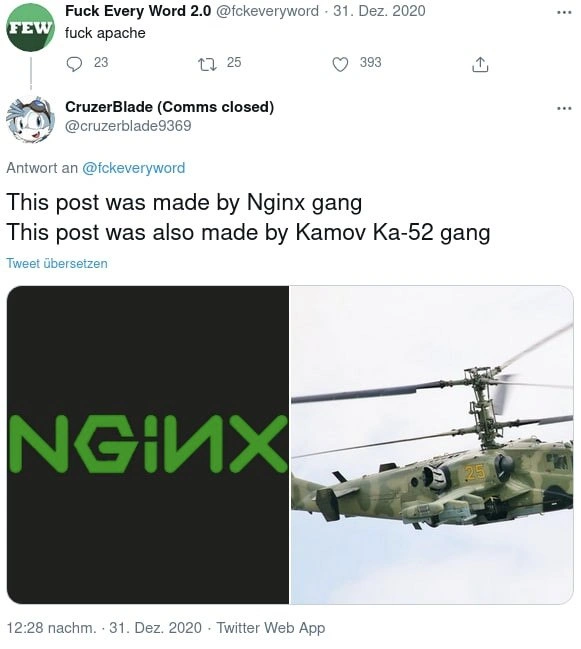
So what’s happening in this meme? The first tweet says “fuck apache” – blunt and a bit crude, yes – but basically that means “I’m fed up with Apache and I prefer not to use it.” It implies the person is an NGINX fan (someone who strongly prefers NGINX). On the internet, you’ll see joking references to “gangs” or “teams” for tech preferences (like Team iPhone vs Team Android). Here, calling it the “Nginx gang” is a tongue-in-cheek way to label the group of people who would nod in agreement at dissing Apache. It’s like saying “Yep, only the Nginx fan club would post something like that.”

Now, the reply takes this a step further into the absurd. It says: “This post was made by Nginx gang. This post was also made by Kamov Ka-52 gang.” Why suddenly mention a Kamov Ka-52? This is where the double meaning of “Apache” comes in. Besides being a web server, Apache is also the name of a famous US Army attack helicopter (the Apache AH-64). So the reply jokingly adds that the post was made by the “Ka-52 gang” – basically, fans of the Kamov Ka-52 helicopter, which is a Russian attack helicopter. The Ka-52 (nicknamed “Alligator”) is like Russia’s equivalent to the Apache helicopter. By saying the Nginx gang also belongs to the Ka-52 gang, the meme is equating the tech rivalry to a military hardware rivalry. It’s as if the Nginx supporters not only beat Apache in web servers, but they’ve also got a cooler attack helicopter to back them up on the battlefield!

In the image attached to the tweet, on the left side you see the bright green NGINX logo, and on the right side a photo of a Ka-52 helicopter. So, visually, it’s showing the two “gangs” side by side: the Nginx gang’s emblem and their heavy-duty backup. Calling in backup is a phrase meaning bringing in reinforcements. The joke is that trash-talking Apache (the server) wasn’t enough – they had to call in the big guns (literally an attack helicopter) to really hammer the point.

All of this is of course in good fun. In real life, there’s no actual gang, just developers who prefer one tool or the other. And nobody actually brings helicopters into web server debates! But tech folks love mixing serious and silly. Here they took a mundane tech argument and gave it a ridiculous action-movie twist. If you’re new to this kind of tech humor, just know it’s how developers bond over the tools they love (or hate) – by joking about them as if they were rival gangs or competing armies. It’s a playful way to say “My choice could blast your choice out of the sky!” without anyone actually getting hurt.

Level 3: Reverse Proxy War

The meme sets the stage for a classic Apache vs NGINX showdown, a rivalry every web developer learns about sooner or later. It’s portraying this tech duel as if it were a gang fight or a full-on military skirmish — complete with an attack helicopter for backup! In the developer world, Apache and NGINX are two leading web servers (software that serves web pages to your browser). Over the past two decades, they've accumulated almost fanatical followings. Engineers often joke about being in the “Nginx gang” or “Apache gang,” the way sports fans might rep their home team. Here, one Twitter user quips “fuck apache”, which is a pretty blunt way of saying “I’m so done with Apache; NGINX is superior”. It’s the kind of exaggerated smack-talk you’d see when someone’s had it with Apache configuration issues or performance headaches and has switched allegiances to the sleeker server.

In reply, another user doubles down on the gag by saying “This post was made by Nginx gang. This post was also made by Kamov Ka-52 gang.” This format – “made by X gang” – is a popular meme structure on social media. It’s like joking that a provocative statement clearly comes from a biased party. So if someone tweets “Apache sucks,” the NGINX gang proudly steps in to claim responsibility. But the joker here didn’t stop at the web server feud; they escalated it to a second, parallel feud: attack helicopters. Why? Because “Apache” isn’t just a server, it’s also the name of the famous American Apache AH-64 attack helicopter. So the tweet is implying: Not only are we the crew behind this anti-Apache (server) message, we’re also the crew that flies the Ka-52 and says it’s better than the Apache (helicopter)! It’s an absurd, over-the-top way to drive home the point. Picture a group of sysadmins in sunglasses and leather jackets (all in on the joke) who love NGINX so much that they metaphorically ride into battle with a Russian gunship to dunk on anything named “Apache.”

This humor resonates with developers because it captures real sentiments in a tongue-in-cheek way. For years, Apache was the undisputed king of web servers – the default in the LAMP stack (Linux, Apache, MySQL, PHP) that ran huge swaths of the early web. It’s battle-tested and reliable, but also seen as a bit old-school. Configuration in Apache can feel clunky: ever wrestled with an .htaccess file or scratched your head at a RewriteRule regex? Many of us have felt that pain. NGINX, introduced in the mid-2000s, came along promising lightweight speed and a simpler config syntax. It quickly gained a rep for efficiency (great for handling high traffic or acting as a reverse proxy and load balancer in front of apps). Adopting NGINX could drastically cut memory usage and boost throughput compared to an out-of-the-box Apache setup. So the “Nginx gang” often brags that their server is just technologically superior.

To illustrate, here’s a taste of their configuration styles side by side. Let’s say you want to redirect an old URL to a new one on your site:

# Apache (.htaccess or httpd.conf)
RewriteEngine On
RewriteRule ^oldpage$ /newpage [R=301,L]
# NGINX (inside a server block)
location /oldpage {
    return 301 /newpage;
}

As shown, NGINX’s configuration syntax can be more straightforward for tasks like redirects. Apache’s solution works fine, but to newcomers those cryptic square bracket flags and regex patterns can look like arcane magic. This difference feeds the web server rivalry. Devs swap stories like, “I replaced Apache with NGINX and my site now flies,” while Apache die-hards might retort, “NGINX is great, but Apache’s .htaccess gives you flexibility NGINX can’t match without redeploying config.” It’s almost a turf war in the ops community.

Now, by introducing the Ka-52 helicopter reference, the meme cranks the drama up to eleven. It’s parodying how tech debates can sometimes feel as intense as actual warfare to those involved. The Kamov Ka-52 “Alligator” is basically Russia’s answer to the US Apache helicopter — a formidable attack chopper in its own right. In meme language: NGINX wasn’t content just beating Apache on web servers, it had to flex air superiority too. It’s hilarious through exaggeration. No developer actually settles server debates with attack helicopters, of course, but the imagery perfectly satirizes the combative fervor of these debates. Everyone gets to chuckle at how ridiculously passionate we can get over our tooling. After all, it’s just software – but framing it as a battle of gangs with heavy artillery makes our everyday tech humor ridiculously epic.

Level 4: Asynchronous Assault

Deep in the trenches of server architecture, this meme hints at a concurrency model dogfight between two titans of web infrastructure: Apache HTTP Server and NGINX. The technical rivalry boils down to how each handles thousands of simultaneous web connections. Apache’s older design often relies on spawning multiple threads or even separate processes (depending on its MPM, like prefork or worker) for incoming requests. Each thread can handle one connection at a time, which is straightforward but carries overhead — imagine allocating a whole mini-program for each user hitting your site. In the early web era, this was fine. But as traffic scales up (think of the classic C10K problem – serving ten thousand clients at once), Apache’s approach can strain system resources. More threads mean more memory consumed (each thread with its own stack and context) and more CPU time spent on context-switching between threads.

NGINX burst onto the scene with a radically different, event-driven architecture. Instead of one thread per connection, NGINX uses a handful of worker processes employing an asynchronous I/O loop. Essentially, a single worker can juggle thousands of connections by non-blockingly monitoring socket events (using efficient kernel interfaces like epoll on Linux or kqueue on BSD). When a new request comes in or data is ready to send, an event fires, and the worker quickly attends to that connection before moving on to the next, all within the same thread. This design slashes the overhead per connection — you no longer need 10,000 threads to handle 10,000 clients, maybe just a few cleverly orchestrated loops. It’s a bit like a high-speed assembly line where one specialist rapidly switches tasks, versus Apache’s army of workers each doing one task. The result? NGINX can serve static files and proxy requests with impressively low memory usage and high throughput under load that would make a traditional Apache setup sweat.

Fascinatingly, the meme’s helicopter gag has a hidden technical parallel. The Russian Kamov Ka-52 “Alligator” attack helicopter uses an unusual coaxial rotor design — twin rotors stacked on the same axis, spinning in opposite directions. This eliminates the need for a tail rotor (which conventional helicopters like the Apache AH-64 require to counteract torque). In engineering terms, it’s an elegant solution to a fundamental problem: by rethinking the design, the Ka-52 achieves stability and lift without the extra apparatus. Analogously, NGINX’s event-loop architecture eliminated the need for Apache’s extra threads/processes for each connection. Both designs threw out the old playbook’s “one problem, one dedicated solution” approach (tail rotor for torque, thread for connection) in favor of a more innovative, integrated solution. The meme equates NGINX to the Ka-52 calling in air support against Apache: it’s an insinuation that NGINX’s sleek, modern engineering can outmaneuver Apache’s more old-school, resource-heavy approach — much like a novel twin-rotor gunship might dominate a battlefield where a classic helicopter would struggle.

Description

This image is a screenshot of a Twitter exchange that creates a clever, multi-layered joke. The top tweet from 'Fuck Every Word 2.0' simply says, 'fuck apache.' A reply from 'CruzerBlade' uses the 'This post was made by X gang' meme format, stating, 'This post was made by Nginx gang' and 'This post was also made by Kamov Ka-52 gang.' Below this text is a side-by-side image: on the left is the green NGINX logo, and on the right is a Russian Kamov Ka-52 attack helicopter. The humor operates on two levels. The primary joke is the well-known rivalry in the web development world between the older Apache HTTP Server and the more modern, high-performance Nginx web server. The second, more clever layer of the joke is a pun on the name 'Apache,' which is also the name of the AH-64 Apache, a famous American attack helicopter. The Kamov Ka-52 is a Russian competitor to the Apache helicopter, making the 'Kamov Ka-52 gang' a perfect real-world counterpart to the 'Nginx gang' in their shared opposition to 'Apache.'
Comments

12
Anonymous ★ Top Pick Some engineers argue about Apache's .htaccess being slow, others complain about Nginx's regex location blocks. The real 10x engineer just asks which one has a better API for the Hellfire missiles
  1. Anonymous ★ Top Pick

    Some engineers argue about Apache's .htaccess being slow, others complain about Nginx's regex location blocks. The real 10x engineer just asks which one has a better API for the Hellfire missiles

  2. Anonymous

    NGINX feels like rolling in a Ka-52 on Apache’s Huey convoy - right up until you realise someone still has to translate 800 lines of .htaccess voodoo; twin-rotor concurrency can’t outgun legacy mod_rewrite sorcery

  3. Anonymous

    The real Apache killer wasn't Nginx's event-driven architecture or superior concurrent connection handling - it was a Russian attack helicopter. Though to be fair, both the Ka-52 and Nginx are known for their ability to handle multiple targets efficiently without spawning unnecessary child processes

  4. Anonymous

    The beauty of this meme is that it works on multiple levels: Apache the web server is known for its heavyweight .htaccess files and module bloat, while the AH-64 Apache is literally a heavy attack helicopter. Meanwhile, Nginx is lean, event-driven, and handles concurrent connections efficiently - much like how the Ka-52's coaxial rotor design is more mechanically elegant. Both comparisons suggest that sometimes the Russian approach to engineering (whether in software or rotorcraft) prioritizes raw performance over American feature creep. Though let's be honest, most of us are just running both behind a CDN anyway

  5. Anonymous

    Nginx gang: give me epoll and a tiny RSS - under C10K the only thing that should spin is a Ka‑52 rotor, not 10k Apache prefork workers

  6. Anonymous

    Because epoll > prefork and .htaccess is a footgun, the only “Apache” we still allow in prod fires Hellfires - though ops insists on a Ka-52 for rotor-level redundancy

  7. Anonymous

    Nginx epoll-handles 10k conns with one worker; Apache forks 'em all and begs for swap space. Gang-certified overkill

  8. @fimbvlwinter 5y

    Тут Ка-50, а не Ка-52

  9. @pixelsex 5y

    this

  10. @mvolfik 5y

    seriously though. fuck apache

  11. @Roman_Millen 5y

    Yeah, but at least this channel doesn't post shitty memes about Yandex.

    1. @p4vook 5y

      Or doesn't it?

Use J and K for navigation