Skip to content
DevMeme
5215 of 7435
Useless 'Life Hacks' as a Metaphor for Bad Programming Advice
DevCommunities Post #5717, on Nov 29, 2023 in TG

Useless 'Life Hacks' as a Metaphor for Bad Programming Advice

Why is this DevCommunities meme funny?

Level 1: The Silly Advice Joke

Imagine your friend excitedly tells you, “Hey! If you hold your pencil upside down while doing math homework, you’ll get an A+ on your test!” That sounds pretty silly, right? You know that using a pencil differently won’t actually make you better at math – you still have to study and practice to do well. This meme is making the same kind of joke, but about coding advice on the internet. It shows a goofy trick with a juice box straw (putting the straw a “special” way that supposedly gets more juice out). In reality, that straw trick doesn’t really give you more juice – it’s just a pointless idea someone treated like a big secret. A well-known programmer on Twitter, Theo, jokes that a lot of the tips he sees people share about programming are just as useless as that straw trick. In other words, some advice might sound clever but doesn’t actually help you become a better coder, just like a weird straw doesn’t actually give you more drink. It’s funny because we all recognize how ridiculous it is when someone acts like a tiny, obvious trick is a huge discovery. The meme is basically saying: “Don’t be fooled by every ‘cool tip’ you hear – some of them are as empty as a juice box with a bent straw!”

Level 2: The Straw Trick Analogy

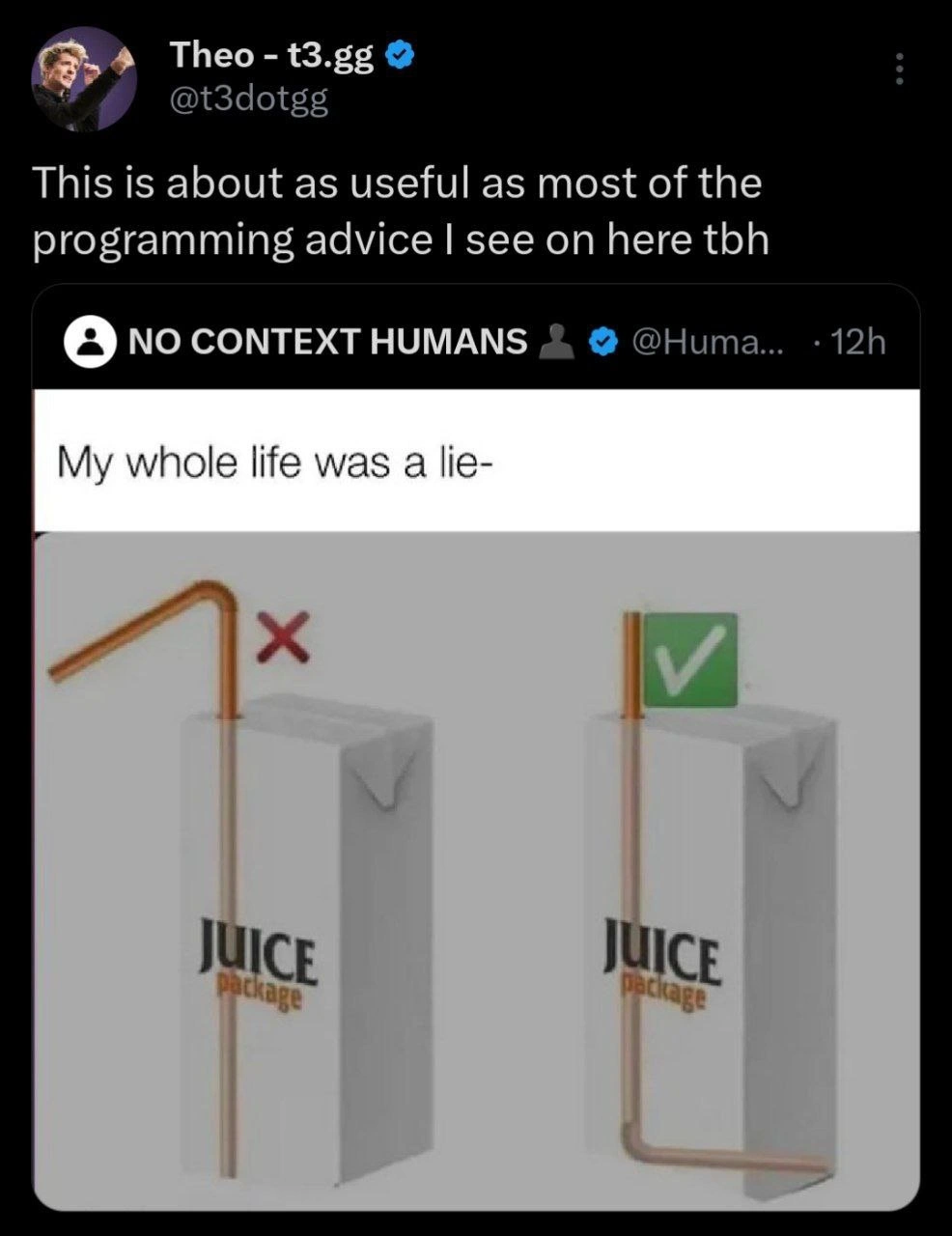
This meme is comparing programming tips on Twitter to a silly juice box straw “life hack.” On the top, we see a tweet from Theo (a developer known in the online dev community) saying: “This is about as useful as most of the programming advice I see on here tbh.” He’s responding to another tweet (using Twitter’s quote tweet format) that showed a supposed trick about how to put a straw in a juice box. The quoted tweet, from an account called NO CONTEXT HUMANS, says “My whole life was a lie-“ above two pictures of a juice carton labeled “JUICE package.” In the left picture, the straw is bent awkwardly over the top of the box (marked with a red X ❌, implying “wrong way”). In the right picture, the straw is inserted pointing down to reach the bottom (marked with a green check ✅, implying “right way”). Essentially, someone is claiming you should aim your straw toward the bottom of the juice box to get every drop, and they’re joking that they’ve been doing it “wrong” their whole life. It’s a useless life hack presented as a mind-blowing revelation. Most people chuckle at this because, frankly, it doesn’t really change anything — you were going to get the juice out anyway by tilting the box or the straw normally. The dramatic line “My whole life was a lie” is an exaggeration for humor, since nobody’s life actually changes from a tiny straw adjustment.

Theo’s comment humorously says that a lot of programming advice on Twitter is just like that straw trick: pointless or obvious once you think about it. On Twitter, many developers or tech influencers share short tips and online coding tips – for example, a tweet might declare “Pro tip: name your variables clearly” or “Shortcut: press Ctrl+C twice to cancel a terminal task faster.” Some advice is helpful, but a lot of it is very basic (things you’d learn in your first week of coding) or lacks important context. For instance, someone might tweet “Don’t use for loops, use map/reduce!” with a green checkmark, as if it’s always the superior way. That could be decent advice in certain cases (higher-level functions can make code cleaner), but it’s not universally true – and if you’re a beginner, it might even confuse you or lead you to write weird code just to follow the tweet.

In developer communities (especially on Twitter, often called TechTwitter), people love sharing these bite-sized tips, tricks, and mantras. It’s part of the DeveloperCulture of trying to help others or sometimes just trying to sound knowledgeable. However, not all advice is equal:

  • Obvious tips – A lot of tweets state things that are common sense or taught in any beginner tutorial (like “comment your code” or “use version control”). These get many likes because everyone can agree with them, but they don’t actually teach an experienced dev anything new.
  • One-size-fits-all advice – Some tips present a rule as absolute (“never use goto”, “always use microservices”) without context. In reality, there are exceptions and nuances. A new developer following such advice blindly might run into problems or misunderstand why the rule exists.
  • Clickbait “hacks” – These are the programming equivalents of the straw-in-juice-box trick. For example, a flashy graphic might show a “hidden trick” like a keyboard shortcut or a quirky use of a language feature. It’s presented as if it’s a game-changer (green checkmark: “Do this and your coding life will change!”), but in practice it’s either a very tiny improvement or something that could even be bad practice if overused.

Theo is expressing DeveloperSkepticism: as an experienced dev, he’s saying “to be honest (tbh), most of the tips I see here are as useless as this straw hack.” This is a bit of a roast of online coding advice culture. Many seasoned programmers feel that Twitter is full of noise: lots of people repeating the same simple ideas or giving advice that sounds exciting but isn’t too practical. It can be frustrating for knowledgeable devs to see important concepts oversimplified or newbies potentially led astray. At the same time, it’s played as humor – everyone on DeveloperHumor threads can laugh because we recognize how true it can be. We’ve all seen that overly enthusiastic post about a trivial trick, just like we’ve all seen silly everyday life hacks (like “Put your toast in the freezer for 1 minute to spread butter easier!” – technically a tip, but not exactly life-changing).

It helps to understand why these low-value tips spread. Social media rewards posts that are easy to understand and share. A tweet that says “🔥 5 Awesome Python tricks you wish you knew!” with a fun image might get tons of retweets from beginners thinking they’ve found gold. However, deep or nuanced advice (say, an explanation of concurrency issues or how to improve system design) can’t be conveyed in a few snappy sentences and might only interest advanced folks – so it doesn’t go as viral. This creates a kind of misaligned expectation especially for those learning: if you scroll through Twitter for advice, you might start believing there are quick hacks to become a rockstar programmer. But in reality, becoming good at coding is more about consistent learning and understanding core concepts (data structures, algorithms, clean code, etc.) than about any single “trick.”

The meme basically says: “See this goofy straw trick? That’s how silly a lot of programming tips on here look.” It’s funny to developers precisely because it’s a bit sarcastic but true. We laugh, acknowledging we’ve seen those posts and maybe even fallen for a few, just like people might try that straw idea only to realize it doesn’t make a real difference. The LearningCurve for new programmers involves sorting out which advice is actually worthwhile. A good rule of thumb is to take Twitter tips with a grain of salt – enjoy them, but double-check with more reliable sources (documentation, books, experienced mentors, or well-regulated forums like Stack Overflow) before assuming your “whole programming life was a lie.” In the end, real progress comes from practice and deeper learning, not just clever hacks. The meme’s joke lands because it reminds us of that fact in a lighthearted way, using the absurdity of a juice-box hack as an example of what not to get too excited about.

Level 3: All Straw, No Juice

"This is about as useful as most of the programming advice I see on here tbh" – Theo’s tweet sets a skeptical tone, comparing a trivial juice-box straw trick to the TechTwitter advice avalanche. This meme highlights the signal-to-noise ratio problem in online dev communities: a flood of flashy “life hack” style programming advice that sounds mind-blowing but barely moves the needle in real coding challenges. The two-panel image (straw bent pointlessly vs. straw reaching the bottom) is a perfect visual metaphor for certain Twitter coding tips – the kind that promise a game-changing insight but really just rearrange the straw without giving you any more juice (i.e., no more actual value).

On Developer Twitter, it’s common to see threads like “10 tips to become a 10x developer” or “You won’t believe this one cool VS Code trick!” garnishing thousands of likes. Much of this advice feels about as profound as learning you can angle a straw in a juice box. Experienced developers often read these hot takes and roll their eyes, because they’ve been in the trenches of production outages and messy legacy code where no 280-character tip will save the day. We recognize the pattern: someone presents a “My whole life was a lie”-style revelation (like the right-panel straw hack with the ✅) implying we’ve all been doing something fundamentally wrong. But in reality, just as juice boxes were never a big unsolved problem, most of these “amazing” coding tips address things that weren’t a real pain point or are already obvious to anyone with some experience. It’s a classic case of misaligned expectations – newcomers are led to believe there’s a quick fix or secret trick for everything, while veterans know that true expertise comes from understanding fundamentals, not one-off hacks.

This meme’s humor lies in that shared “so true” moment among developers: we’ve all scrolled through Twitter or dev forums and seen advice that’s technically not wrong but is hilariously low-value or context-free. For example, an online tip might loudly proclaim a shortcut like “Write comments for your code!” (no kidding…) or push a one-liner JavaScript trick as if it’s revolutionary. Sure, such a tip might have a tiny benefit (like a straw angled to sip the last drops), but it’s rarely the silver bullet it’s hyped up to be. Meanwhile, complex issues – say, choosing the right architecture or debugging a concurrency bug – cannot be solved by a quick tweet-length aphorism. The DeveloperSkepticism here is well-earned: seasoned devs have seen juniors latch onto some “Twitter wisdom” (🏷️ online_coding_tips) only to discover it doesn’t apply universally or, worse, it was a bad practice outside the narrow scenario. It’s the equivalent of someone insisting the juice tastes better if you drink it upside-down: a quirky idea that doesn’t address any real thirst.

There’s also a commentary on how DeveloperCulture online rewards engagement over depth. Much like clickbait life-hack memes, tweets with bold claims (“You’re coding wrong – do THIS instead ✅”) get attention, even if the actual content is as trivial as using a straw properly. This creates a DevCommunity echo chamber where superficial tips circulate endlessly. Everyone’s chasing the next viral “juice-box hack”, but few are sitting down to write nuanced threads about, say, memory management or system design – those don’t fit in a punchy graphic or a one-liner tweet as easily. As a result, truly useful advice is diluted by a sea of repetitive beginner tips and questionable “best practices.” The meme calls this out with sarcasm: Theo essentially says, “Look, this straw hack impressed someone enough to say ‘my life was a lie,’ and that’s exactly how ridiculous a lot of programming advice sounds to those of us who know better.”

In real-world terms, this humor resonates because many of us have wasted time on useless life hacks – whether in day-to-day life or in coding – that promised more than they delivered. It’s a gentle roast of the noise we endure on tech social media. The veteran perspective here is battle-scarred and witty: after you’ve spend late nights solving actual problems, you can’t help but chuckle (or groan) when a tweet suggests that the secret to scaling your app is something as simplistic as rearranging a straw. The truth is, if a piece of advice fits in a tweet image with a big green checkmark, it’s probably not addressing the hard stuff. And as any cynical senior dev will tell you, grasping at straws like these won’t quench your thirst for real improvement. Sometimes, the only straw that matters is the one stirring your coffee at 3 AM while you debug production – and no tweet-sized tip is going to replace that hard-earned experience. 🙃

Description

A screenshot of a tweet from user 'Theo - t3.gg' (@t3dotgg). The tweet reads, 'This is about as useful as most of the programming advice I see on here tbh'. Theo is quote-tweeting a post from 'NO CONTEXT HUMANS' which says, 'My whole life was a lie-'. The image in the quoted tweet is a two-panel diagram showing a 'JUICE package' carton. The first panel shows a straw inserted incorrectly into the top, marked with a red 'X'. The second panel presents a supposedly correct method: inserting the straw straight down through the entire carton, bending it 90 degrees to exit the bottom side, and then bending it up again, marked with a green checkmark. The core joke is the utter absurdity of the proposed 'solution'. Theo's commentary applies this to the tech world, satirizing the flood of impractical, overly complicated, or just plain wrong programming advice that circulates on social media, often presented as a groundbreaking revelation


Comments

20
Anonymous ★ Top Pick Most programming 'hacks' on social media are like this juice box trick: they seem clever, solve a problem that doesn't exist, and completely ignore the fundamental constraints of the system, like physics... or the fact that your entire dev team will now want to murder you
  1. Anonymous ★ Top Pick

    Most programming 'hacks' on social media are like this juice box trick: they seem clever, solve a problem that doesn't exist, and completely ignore the fundamental constraints of the system, like physics... or the fact that your entire dev team will now want to murder you

  2. Anonymous

    Tech Twitter: reroute the straw to the bottom of the juice box and call it an “event-driven hydration pipeline” - same 200 ml of sugar water, just with two extra points of failure

  3. Anonymous

    Just like that juice box straw, the best programming advice often bends the rules - but Twitter will still insist you're holding it wrong while their own architecture is held together with cron jobs and prayers

  4. Anonymous

    Senior engineers know that most viral 'programming tips' are the technical equivalent of discovering you can insert a straw vertically into a juice box - technically correct information that everyone figured out by age 7, repackaged as profound wisdom for engagement metrics. The real skill isn't finding the 'correct' way to use the juice box; it's recognizing when the entire debate is a distraction from actual architectural decisions that matter

  5. Anonymous

    Tech Twitter in one slide: straw routing with a big green check promising 10x throughput; senior reality - P0 root cause: JuiceNotFoundException

  6. Anonymous

    Most “architecture threads” are the L‑shaped straw of engineering - optimized for engagement, not throughput; try it in prod and you’ll just be sucking air

  7. Anonymous

    Twitter dev advice: bendy straws that leak everywhere - until you pierce the spec directly

  8. @realVitShadyTV 2y

    What da fuck?

  9. @trainzman 2y

    It is exactly for this reason the straw is depicted as in the left ('wrong') variant on every juice pack featuring itself on the cover

    1. @Ra_zor 2y

      Throwing valid reasonings at such «mindblowing revelations» is the same as trying to persuade an aggressive schizo that his behavior is not socially acceptable

      1. @trainzman 2y

        ik

  10. @ejnshtein 2y

    Based tweets from theo, as usual

  11. Deleted Account 2y

    was i not supposed to shove it up my ass then?

    1. @lawenard 2y

      No that's based if you're QA keep up the good work

    2. @RiedleroD 2y

      The straw works the way you decide, no sweat there, boys

      1. Deleted Account 2y

        i mean, i do get really sweaty when i use the straw like that so idk

  12. @SamsonovAnton 2y

    This one is real.

  13. @SamsonovAnton 2y

    This one is 🤪

    1. @lab0rat 2y

      Always opened banana like on the right until discovered that opening it like on the left is much easier and you ain't need to deal with top black point of banana

  14. @Br1ket 2y

    How about a dishwashing sponge? Imho, most people keep it upside down

Use J and K for navigation