Cloud Native: The Fun and Easy CNCF Landscape
Why is this Cloud meme funny?
Level 1: So Many Pieces
Imagine someone tells you, “Hey, let’s build this awesome new spaceship toy, it’s super fun and easy!” They sound really excited and make it seem like it’ll be a piece of cake. But then, when you open the box, you find a thousand tiny LEGO pieces and a huge instruction booklet with hundreds of steps! Suddenly, what they called “easy” looks really complicated, right? You might laugh and say, “This isn’t just a little toy, this is a whole project!”
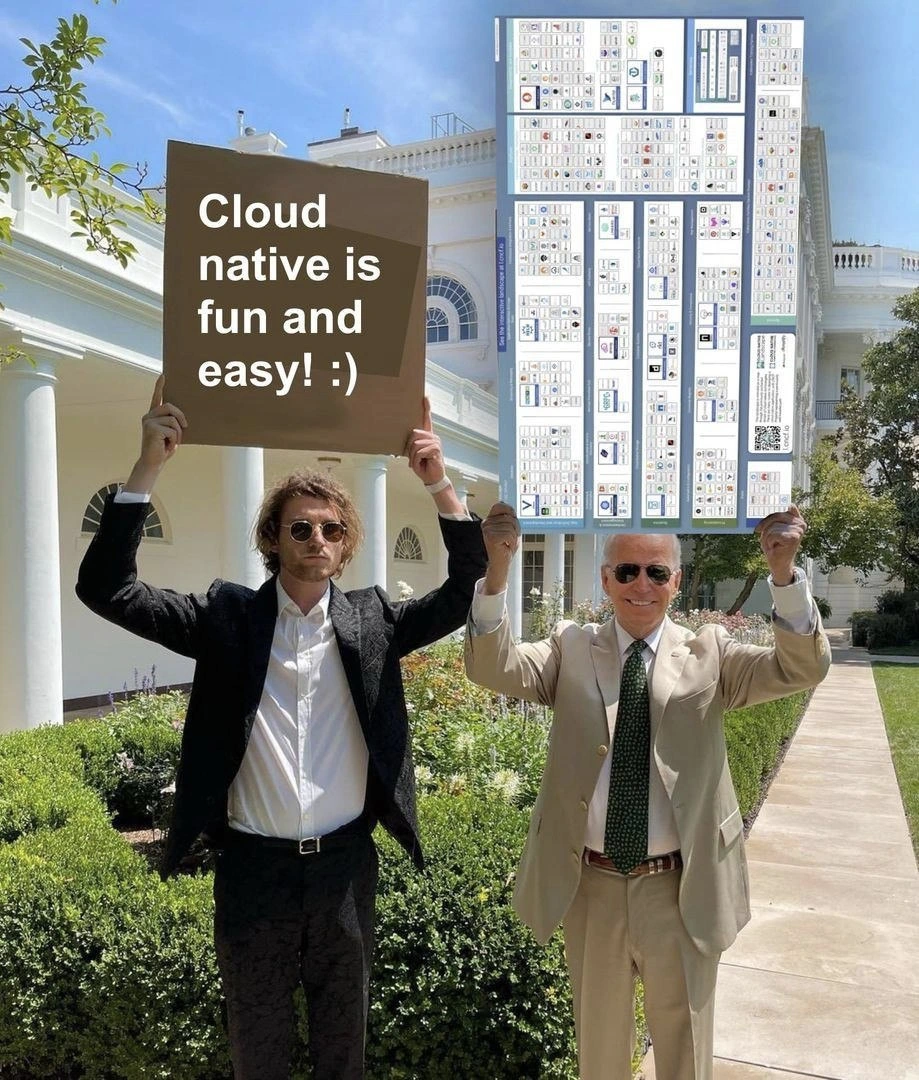
That’s exactly what this meme is joking about, but with computers and the cloud. The first person’s sign, “Cloud native is fun and easy! :)”, is like someone saying the new toy (cloud technology) is simple. The second person’s giant poster full of logos is like dumping out all those LEGO pieces on the floor and holding up the gigantic instruction book. It shows that actually, there are a lot of parts to deal with.
In simple terms: sometimes people describe something as if it’s very simple (maybe to sell the idea or because they’re optimistic), but in reality, when you actually try to do it, you discover it’s made of many, many complicated parts. The meme is funny because we see the huge difference between the easy story and the complicated reality in one picture. It’s like saying “Sure, making a castle is easy!” and then revealing a table filled with piles of bricks, towers, moats, and dragons to assemble. Anyone can see that and go, “Whoa, that’s not so easy after all!”
So, the emotional core here is a mix of surprise and comedic exaggeration. You feel a bit of sympathy for that second person holding the poster – like, oh boy, they have a lot on their plate! And you kind of smile because we’ve all been in a situation where someone promised “Oh, it’s simple, don’t worry,” and then it turned out to be much more involved. It’s a gentle reminder: sometimes things that sound easy have a lot of hidden work behind them. And that big poster with all the tiny logos? That’s just a funny way to show all the hidden work in one overwhelming image, getting us to chuckle at how out-of-sync the two messages are.
Level 2: Behind the Buzzwords
Let’s break down what’s happening in this meme in more straightforward terms. We have two people holding up signs. The person on the left has a simple cardboard sign that says, “Cloud native is fun and easy! :)” This represents someone (often a marketing person or an enthusiastic speaker) making a bold claim that working with cloud technology is simple and enjoyable. The person on the right, however, is holding up an enormous poster filled edge-to-edge with tiny logos, boxes, and names of tech projects. This poster is a real thing known as the CNCF cloud-native landscape. CNCF stands for Cloud Native Computing Foundation, which is an organization that hosts and nurtures many open-source projects related to cloud computing. The CNCF landscape poster is famous (or infamous!) for showing just how many different tools and technologies exist in the “cloud-native” world. It’s so detailed that from afar it looks like a dense grid of tiny icons – each icon is a logo of a project or product (for example, the logo for Kubernetes, one for Prometheus, one for Docker, etc.), and they’re grouped into categories like container platforms, databases, monitoring systems, continuous integration tools, and so on.
In the photo, the contrast is immediately clear and comical. The left sign is extremely simple – just a few words on cardboard, probably hand-painted, with a smiley face. It’s conveying a simple, happy message. The right poster is the opposite: professionally printed, complicated, and frankly a bit overwhelming even to look at. It’s conveying, “Whoa, there’s a lot to deal with here.” For someone new to these concepts: “cloud-native” refers to a way of building and running applications that exploits the advantages of cloud computing. Cloud-native apps are typically broken into small pieces (called microservices) and run in containers (a lightweight form of virtualization) which can be easily moved around and scaled. Kubernetes is a popular open-source system for orchestrating (managing and scheduling) those containers across a cluster of machines. When people say “just put it on Kubernetes, it’ll be easy,” they’re talking about this idea of using Kubernetes to handle deployment, scaling, and management of containerized applications automatically.
Now, the joke here is that while cloud-native technology has a lot of benefits, it’s not as “easy” as that cheerful sign suggests. In practice, building a cloud-native system means you have to consider a ton of things: how will all your microservices find each other on the network (service discovery)? How will you monitor your services to know if something goes wrong (monitoring and logging tools)? How do you deploy updates to your services without downtime (CI/CD pipelines for Continuous Integration/Continuous Deployment)? How do you store data (databases, storage systems)? How do you ensure everything is secure (managing authentication, encryption, secrets like passwords/keys)? The CNCF landscape poster is essentially a big map of all the recognized tools and projects that help address these questions. Each logo on that poster is a technology or service. For example, you’d find Prometheus (a system for collecting metrics and monitoring), Grafana (dashboard for those metrics), Docker (a technology for building containers), Helm (a tool to package Kubernetes applications), Istio or Linkerd (technologies for a service mesh, which manages communication between microservices), Envoy (a proxy used in service meshes), MySQL or MongoDB (databases), and hundreds more. It’s literally an eye chart of cloud tech. There’s even a joke that you need a microscope to read all the logos on it!
So, why is this funny to developers? Because it captures a truth: Non-technical folks or marketing teams may casually say “We should be cloud native, it’ll make life easier,” unaware of how complex the implementation really is. Meanwhile, developers and DevOps engineers know that “cloud native” often means lots of configuration files (often written in YAML), lots of new tools to learn, and an ecosystem so vast it can feel like drinking from a firehose. (For context, YAML is a text format for writing configuration – Kubernetes, for instance, uses YAML files to let you describe what your system should do, like what containers to run, how to network them, etc. It’s very powerful, but writing YAML can be tedious and it's sensitive to indentations and formatting. The term “YAML hell” or “YAML fatigue” comes from engineers having to write and maintain huge amounts of these files.)
It might help to think of an analogy even at this intermediate level: Imagine someone says, “Oh, cooking dinner is easy, you just throw ingredients in a pot!” That’s like the left sign. But then the right sign is an entire cookbook of gourmet recipes, dozens of ingredients, specialized cookware, timing charts, etc. In tech terms, the left sign is the high-level promise (“cloud will solve our problems, easy!”) and the right poster is the fine print reality (you need to integrate all these components correctly to fulfill that promise). A junior developer or someone just learning about cloud might not recognize all the logos on that poster, and that’s exactly the point – even experienced folks don’t know them all offhand! It’s a huge landscape. No single person knows every tool on there deeply; people specialize (one person might be a Kubernetes expert, another knows monitoring systems well, etc.). So the meme is also poking fun at the idea that cloud-native is a simple, uniform thing – in reality it’s an umbrella term covering a vast, evolving field.
Let’s define a few key terms from the meme clearly:
- Cloud Native: Building and running applications to take advantage of cloud computing features. This usually means your app is split into microservices, packaged into containers, dynamically managed (often by systems like Kubernetes), and can scale or heal itself automatically. Cloud-native apps are designed to handle failure gracefully and scale out on demand.
- Microservices: Instead of one big application (a monolith), you build many small services, each responsible for a specific thing (for example, one service for user accounts, another for payments, another for notifications). These services talk to each other over a network. Microservices can make development more flexible (teams can work independently on different services, and you can scale parts of the app independently), but coordinating them adds complexity since now the “calls” between parts of your app go over the network rather than in-memory function calls.
- Containers: A technology (popularized by Docker) that packages up an application and its environment so it can run reliably on different computers. You can think of a container as a lightweight mini-computer or an isolated workspace just for your app. Containers make it easier to move software from a developer’s laptop to a server (e.g., “it runs on my machine” problems are reduced).
- Kubernetes: Often abbreviated “K8s” (since there are 8 letters between K and s), it’s an open-source platform to orchestrate containers. Orchestration means Kubernetes decides when and where to run your containers, manages scaling them up or down, replaces ones that crash, handles networking between them, and so on – all based on the desired state you declare (usually via YAML config files). It’s like an operating system for the cloud, managing all these containerized applications. Powerful, but definitely not something you learn in an afternoon.
- DevOps/SRE: These are roles or mindsets that blend software development (Dev) with IT operations (Ops). The idea is to automate and streamline the process of getting code from development to production reliably. SRE stands for Site Reliability Engineering – SREs often focus on keeping systems running, automating infrastructure, monitoring, and responding to incidents. In a cloud-native context, DevOps/SRE folks are typically the ones wrestling with all those tools on the big poster to keep the platform stable and efficient.
- Observability: This term means how well you can understand what’s happening inside your system based on the external outputs. In practice, it’s about logs (record of events), metrics (numerical measurements like CPU usage, requests per second, error rates), and traces (records of how a single request travels through various microservices). Tools like Prometheus (metrics), Grafana (dashboards), and Elastic Stack or Loki (logging) are key for observability. If you deploy lots of microservices, observability tools are crucial so you’re not flying blind.
- Service Mesh: When you have dozens of microservices all talking to each other, you get a complex web of network communication. A service mesh is an infrastructure layer that manages that communication. It can handle things like routing requests, retries, security between services, and monitoring, without each microservice needing to implement those features itself. Istio and Linkerd are examples. Think of it as a dedicated traffic controller and security guard for service-to-service traffic in your cluster.
- YAML (Yet Another Markup Language): A human-readable data format often used for configuration files. In cloud systems, you describe what you want (resources, settings) in YAML files. For instance, a Kubernetes Deployment YAML might specify “run 3 copies of container X, using image version Y, with these environment variables, etc.” It’s straightforward but can become very lengthy and nested for complex configs. Missing a space or indent can break it, which is why people joke about suffering from “YAML indent errors” after staring at config files too long.
Now, with those terms in mind, the meme’s meaning becomes clearer: Marketing might say something like, “We’ll adopt cloud-native tech and everything will be smooth and simple!” Meanwhile, the engineers know that means choosing and using a lot of new technologies – maybe Kubernetes for orchestration, Docker for containers, Prometheus/Grafana for monitoring, Fluentd or Elastic for logs, Linkerd for service mesh, Vault for secrets, Argo or Jenkins for CI/CD, Terraform for infrastructure automation – the list can keep growing. The big poster of logos is basically yelling, “There’s a lot more to ‘cloud-native’ than a buzzword!”.
An early-career developer or someone just learning this stuff might feel overwhelmed seeing all those tool names. Don’t worry – that’s normal! Part of the meme’s joke is exactly that overwhelming feeling. The reality is that nobody introduces all those tools at once. In real projects, teams pick and choose a subset that fits their needs. But even that subset can be quite a few moving parts. For example, a small “cloud-native” web app might use: Docker (containers), Kubernetes (to run them), Helm (to simplify Kubernetes configs), Argo CD (to deploy updates), Prometheus/Grafana (to monitor metrics and show dashboards), and Fluent Bit + Elasticsearch + Kibana (for log collection and searching). That alone is 7 different technologies to learn/configure, and it’s a fairly common minimal setup! Now scale that up to a larger organization and you can easily be dealing with dozens of integrated tools.
This leads to the phenomenon sometimes called “too many tools” or tool sprawl. It means the set of tools becomes so large that managing them is a challenge in itself. Newcomers might have to onboard to 10 different systems just to get the development environment working. Each tool has its own configuration, quirks, and learning curve. The meme highlights this by visually overloading one side of the image with a crowded landscape of tech logos. It’s basically saying: the claim that it’s all easy is ignoring the reality that cloud-native is an ecosystem of many interconnected parts.
In summary, at this level, you can understand the meme as calling out the difference between hype and reality. Hype (left sign) says: “Cloud-native, containers, Kubernetes – it’s the cool new thing and it’s simple!” Reality (right sign) responds: “Here’s what actually comes with that territory – an entire landscape of complex tools and choices you have to navigate.” It’s funny to people in tech because we’ve all seen that scenario where someone underestimates the complexity of a project thanks to optimistic marketing, only to be shocked by the actual effort required. The meme just illustrates it in a single, very pointed image.
Level 3: Tooling Tsunami
For those of us who have battled in the trenches of CloudNativeArchitecture, this meme hits home as soon as we see that enormous poster of logos. It’s an instant inside joke about marketing_vs_reality. On the left, you have the breezy claim "Cloud native is fun and easy!" – something you might hear from a sales team, a tech evangelist at a conference, or a well-meaning manager after reading an online article. On the right, you literally have the famous CNCF cloud native landscape chart, which is essentially a wall-of-shame (or pride, depending on perspective) illustrating just how sprawling the cloud tool ecosystem has become. The humor is in the gulf between the slogan and the reality. If you’ve spent any time in modern DevOps or SRE roles, you’ve likely experienced this gulf firsthand. It’s that familiar scenario where an executive or client chirps, “Can’t we just throw it in Kubernetes? That’ll solve everything!” Meanwhile, you – the engineer – are staring at a checklist of 47 separate components and services that need to be configured, integrated, and maintained to actually make “throwing it in Kubernetes” production-ready.
The image literally portrays that disconnect. The person holding the small cardboard sign (with its smiley face and all) represents the simplified narrative — the idea that adopting cloud-native tech is like pressing an easy button to instant fun, scalability, and reliability. The person next to them, hoisting the gigantic printed poster overflowing with tiny logos, represents the engineer’s reality — all the too_many_tools and platforms that constitute “cloud native” in practice. It’s a marketing vs. engineering standoff in photographic form. For those who recognize it, the poster is the CNCF (Cloud Native Computing Foundation) landscape, which categorizes hundreds of projects and products: containers, container orchestration, CI/CD pipelines, messaging systems, databases, monitoring tools, security solutions, service meshes, and on and on. The CNCF landscape has become a bit of a legend in tech circles for its overwhelming complexity — it’s often used in presentations to elicit a gasp or a laugh at how absurdly crowded the cloud space is. Seeing it held up as a “rebuttal” to “Cloud native is easy” is immediately chuckle-worthy to veteran developers. It’s like someone saying “rocket science is simple” and someone else unfolding an enormous schematic blueprint with hundreds of interconnected parts and saying, “Really? Care to revise that statement?”
Seasoned engineers will nod knowingly at the subtext: we’ve all been sold on a new tool or paradigm that promised to simplify our lives – “Serverless will let you focus just on code,” “Microservices will let teams move faster,” “Kubernetes will handle the hard parts,” etc. – only to discover that each comes with a learning curve and a cascade of auxiliary tooling. Take Kubernetes as a prime example: yes, it elegantly automates container deployment and scaling. But to use Kubernetes in the real world, you suddenly need to deal with YAML files for everything (deployments, services, ingress rules, config maps…). Pretty soon you’re drowning in YAML – a phenomenon so common that YAML fatigue is now a term of art. Kubernetes by itself is rarely enough; you also have to set up container build pipelines (hello, Jenkins or GitLab CI), manage container registries, pick a CNI (Container Network Interface plugin) to handle networking, configure storage classes for persistent data, set up observability (metrics and logging via tools like Prometheus, Grafana,EFK/ELK stack), secure service communication (maybe with a service mesh like Istio or Linkerd), manage secrets (Vault or K8s secrets), implement continuous delivery (Argo CD or Flux), etc. The list feels endless – because it kind of is! That CNCF poster is constantly growing; every year new projects sprout to solve niche problems or improve on old solutions. For an engineer, that poster can induce both awe and dread. Awe at the innovation, and dread at the thought: “Do I need to know all of these? How do they all fit together?”
The comedic punch of this meme comes from that shared anxiety and borderline absurdity of the situation. It’s a form of DevOpsHumor that gets an eye-roll and a laugh in stand-ups or Slack channels: “Sure boss, cloud-native is totally easy – it’s as easy as picking one item from each aisle in an infinitely long grocery store and then cooking a gourmet meal with them.” The truth is, engineers often feel like they are facing a Tooling Overload tsunami when their organization decides to go “all in” on cloud-native. The boss might be expecting a quick win (“We’ll just containerize everything and be done by Q3”), while the engineering team knows they’re about to enter a maze of decisions and trade-offs. Which message queue do we choose (Kafka, RabbitMQ, NATS…)? Which tracing system (Jaeger, Zipkin)? How do we handle deployments – raw kubectl apply scripts, or use Helm charts, or embrace GitOps? And if something breaks at 2 AM, who’s on pager duty to sift through the 15 interconnected dashboards we’ve set up? There’s a real engineering tradeoff here: cloud-native approaches offer huge benefits in scalability and resilience, but they shift a lot of complexity onto the teams building and maintaining the system. The meme points out that what marketing glosses over as a one-liner actually entails system complexity that can feel comical (or tragic) to those knee-deep in it.
Many of us have war stories that align with the image on the right. We remember when deploying an application was just copying a WAR file to a Tomcat server and calling it a day. Now a “simple” deployment might involve building a Docker image, pushing it to a registry, writing a Kubernetes Deployment YAML, a Service YAML, configuring horizontal pod autoscalers, updating a Helm chart, and checking CI/CD pipelines. It can feel like going from a tricycle to a fighter jet – sure, the fighter jet is faster and more powerful, but operating it is a tad more complicated! This dynamic often leads to a sense of over-engineering. There’s an unspoken joke in the industry: “We solved so many problems we didn’t even know we had, using tools no one understands completely.” The CNCF landscape itself can be seen as a monument to overengineering at times – do we really need five different service meshes or ten database options? For better or worse, it’s the marketplace of ideas in open source: every problem will attract numerous solutions. Engineers end up tasked with evaluating and integrating these, which is a lot of work that isn’t obvious from the outside.
The meme resonates strongly in the DevOps/SRE community because it also reflects the experience of yaml_fatigue and cognitive overload. It’s sarcastically “funny” to recall that meeting where some higher-up enthusiastically said, “We’ll go cloud-native, use Kubernetes, it’ll simplify ops!” — but they didn’t mention the need for a dedicated platform engineering team to manage that Kubernetes cluster 24/7, nor the countless hours to be spent debugging why the Ingress isn’t routing or why the CI pipeline suddenly failed after a dependency upgrade. The left-hand poster’s claim that it’s all “fun and easy” could also be read as a jibe at tech marketing in general. Product marketing often does paint new technology as if it’s magic: “Just adopt our cloud solution and watch your productivity soar!” Seasoned devs have learned to smile at this because they know the easy_button_myth – there is no real “easy” button in complex systems. If anything, every “easy” claim comes with fine print. The fine print in this case is that giant landscape: “Some assembly required. By ‘some’, we mean you’ll spend the next six months stitching together different systems and tools.”
To further illustrate the marketing vs reality gap, consider a quick comparison of expectations versus tasks in a cloud-native project:
| Marketing Promise | Engineer's Reality |
|---|---|
| “Deploying is one-click!” | Prepare Dockerfiles, write Kubernetes manifests, configure CI/CD pipelines, and run kubectl apply repeatedly (hoping no YAML indent is wrong). |
| “It scales automatically!” | Set up metrics (Prometheus), configure autoscalers, define resource requests/limits, and still handle traffic spikes manually when auto-scale isn’t fast enough. |
| “Everything is managed for you!” | Manage the managers: upgrade Kubernetes versions, fix Helm chart issues, maintain etcd backups, rotate certificates, and be on-call for the managed service outages. |
| “No Ops needed – developers can focus on code.” | Developers end up writing Terraform or Kubernetes configs (which is code in another form) and troubleshooting cloud infrastructure issues just as much as writing business features. |
Each line in that table will likely get a knowing laugh (or sigh) from an experienced dev, because we’ve felt those pains. It’s DevOps humor distilled: the notion of a completely hands-off, carefree cloud is a mirage. You can achieve amazing things with cloud-native tech – self-healing apps, global scale, rapid deployments – but the meme reminds us that behind the scenes is a Rube Goldberg machine of interconnected parts requiring constant attention.
The mention in the description of “Kubernetes YAML jungles, service meshes, and observability stacks multiplying faster than you can say kubectl apply” is spot on. It paints the picture of an engineer’s workspace: multiple terminal windows and dashboards open, a slew of YAML files for each microservice, maybe a Grafana graph on one screen, and a log tail on another – all to support what marketing called a “cloud-native, microservices app that practically runs itself.” It’s overwhelming but true to life. We joke about needing a machete to cut through the YAML jungle or how adding Kubernetes to a resume also implies signing up for an endless stream of new YAML definitions. The term “yaml_fatigue” captures that exhaustion perfectly.
And let’s not forget the human angle in this senior perspective. There’s a bit of catharsis and camaraderie in this meme. It says, “You’re not the only one who feels this is crazy.” Every time a new tool or complexity is piled on and you roll your eyes or feel a headache brewing, remember a whole community of engineers worldwide is holding up that giant CNCF poster in spirit, saying “We know, this is what we’re dealing with too.” That sense of shared WTF can be comforting. It also subtly pushes back on unrealistic expectations: if your non-technical boss expects a quick cloud migration because they’ve heard it’s “easy”, showing them a slice of that landscape (or even this meme) might be an eye-opener. In essence, the meme is a cheeky reality check. It tells us that yes, cloud-native can achieve great feats, but it’s not the simplistic playground the buzzwords might imply. It’s more like a Tooling Tsunami – exciting, powerful, but also capable of drowning you if you’re not prepared. We laugh because it’s hilariously true: in cloud-native engineering, “fun and easy” often comes with a giant unspoken “…after you’ve tamed this insanely complex ecosystem.”
Level 4: Entropy as a Service
At the deepest technical level, this meme highlights the inherent complexity of modern cloud-native systems – complexity grounded in fundamental computer science and distributed systems theory. The innocuous cardboard sign claiming "Cloud native is fun and easy! :)" is in direct tension with the massive poster of the CNCF Cloud-Native Landscape on the right, which is essentially a taxonomy of countless cloud tools and projects. This contrast is a visual punchline: it’s like seeing someone assert a trivial solution to a problem, while the full state-space of that problem (the hundreds of components and subsystems involved) looms right beside them. The humor lands because anyone versed in distributed systems knows there’s a chasm between marketing platitudes and the entropy unleashed by real-world cloud architectures.
From a theoretical standpoint, distributed systems are never truly simple – there’s a well-known informal Law of Distributed Computing akin to the second law of thermodynamics: you can’t eliminate complexity, only shift it around. In academic terms, one might recall the CAP theorem (proposed by Eric Brewer) which states that a distributed system can only guarantee at most two out of three properties – Consistency, Availability, and Partition tolerance – at any given time. “Cloud native” architectures (with microservices, clusters of containers, etc.) inherently confront this CAP trade-off. Marketing can claim cloud-native is easy, but under the hood, engineers must constantly navigate choices like strong consistency vs. eventual consistency, or fail-fast vs. retry logic, depending on what the system favors. Each choice begets new supporting infrastructure – for example, choosing consistency might involve coordinating state via a consensus algorithm (like Raft in etcd for Kubernetes) which itself is a non-trivial distributed protocol born from deep theoretical groundwork (the classic Paxos paper by Leslie Lamport, anyone?). In other words, that huge CNCF landscape poster isn’t just random over-engineering – it’s a direct outcome of** theoretical limits** and design trade-offs in distributed computing. When you break a monolith into microservices, you’re fundamentally trading simple in-process function calls for network calls that can fail, time out, or arrive out of order. The system grows new dimensions of complexity: concurrency, partial failures, Byzantine fault tolerance, distributed transactions – each requiring its own specialized tooling and careful design. The meme’s giant poster, crammed with logos, is essentially a map of solutions to these very hard problems (and often, multiple competing solutions to each problem!).
It’s also a nod to the classic Eight Fallacies of Distributed Computing. Those fallacies (e.g. “the network is reliable”, “latency is zero”, “topology doesn’t change”, “there is one administrator”, etc.) are unwritten assumptions that beginners might make but seasoned engineers know to be false. The cheeky smiley on the “fun and easy” sign implicitly assumes all those fallacies – as if none of the usual distributed nastiness applies – while the encyclopedic poster on the right screams the reality: each fallacy demands countermeasures. Network unreliable? – you need load balancers, retransmissions, perhaps a message queue (see all those Cloud messaging logos on the poster). Latency non-zero? – better implement caching layers (spot the caching and CDN icons in the landscape). Topology changes? – you’ll require dynamic service discovery and orchestration (hello Kubernetes, Consul, etc.). In short, every naïve assumption gets answered by another box on that poster. The combinatorial explosion of components isn’t accidental; it arises from the myriad failure modes and concerns one must address when building a distributed CloudNativeArchitecture. The very term Cloud Native suggests applications designed to run at scale on distributed infrastructure, and theoretically, managing such systems edges into solving NP-hard problems. For instance, scheduling containers onto cluster nodes is a variant of the bin-packing problem (NP-hard), so Kubernetes uses heuristics in its scheduler. Maintaining consistency across nodes calls for quorum algorithms grounded in theoretical CS. Achieving resiliency and consensus across unreliable nodes recalls the famous Byzantine Generals Problem – out of which protocols like Paxos and Raft emerged. Microservices architectures essentially distribute what used to be a single process across a network; by doing so, they introduce all the complexity that networking and concurrency bring. This is why a service mesh (like Istio or Linkerd, whose logos likely appear on that poster) becomes necessary – it’s an entire subsystem just to manage how microservices talk to each other reliably and securely. The sign might as well be saying “Rocket science is easy!”, and the poster is the stack of PhD theses proving why it’s not.
Another lens here is systems theory and the idea of emergent complexity. When you have dozens or hundreds of interacting components, the overall system behavior can’t be easily predicted by looking at any one piece in isolation. In complexity theory terms, the global behavior is non-linear in relation to the local behaviors. This is why cloud architects emphasize observability (telemetry, tracing, logging) so much – you need that visibility to even understand emergent system states. There’s a tongue-in-cheek formula one might apply: if each service or tool in your cloud stack has a reliability of, say, 99%, then a system composed of N independent components has a worst-case upper bound reliability around the product of their reliabilities. For large N, this gets scary: for example, if you rely on 100 independent services each with 99% uptime, the probability everything is up simultaneously could be roughly $(0.99)^{100} \approx 0.366$ (only ~36.6%!). In practice, not every component failure brings down the whole system (they’re not all strictly serial dependencies), but the point stands: more moving parts means a higher chance something is broken at any given time. Engineers combat this with redundancy, self-healing designs, chaos testing, etc., but those strategies are yet more pieces of the puzzle – more boxes on the diagram. The meme wryly hints that cloud-native’s “fun and easy” promise glosses over this explosion of complexity and the reliability math that goes with it.
Finally, consider the Conway’s Law perspective and a bit of computing history. Conway’s Law posits that system architecture tends to mirror the organizational structure that produced it. Modern tech organizations often have many small teams (“two-pizza teams” in Amazon’s lore) each owning a microservice. This yields systems with many microservices (surprise!), each potentially requiring distinct tools or frameworks – hence the swell of logos representing various projects on the CNCF landscape. There’s also a historical trend: we moved from monolithic architectures (one giant codebase on one big server) to service-oriented architecture and then to fine-grained microservices and serverless functions. Each evolutionary step aimed to solve scaling and agility issues of its predecessor, but also introduced a new layer of tooling. In the 2000s, deploying a web app might have meant installing LAMP (Linux, Apache, MySQL, PHP) – a relatively small, well-defined stack. In contrast, a 2021-era cloud deployment might involve containerizing the app (Docker/Containerd), orchestrating it (Kubernetes), wiring in dozens of platform services (APIs, authentication, monitoring, caching, messaging, and more). The CNCF landscape poster is effectively the periodic table of this cloud-native ecosystem, constantly expanding. It’s overwhelming, but it exists for a reason: each element addresses a specialized need. The meme makes a sardonic point that despite all our advancements, complexity in distributed computing is conserved. In product design there’s even Tesler’s Law (the Law of Conservation of Complexity): some complexity in a system is unavoidable – if it’s made to look simple for end users or executives, that complexity has merely been pushed onto developers, engineers, or hidden in configuration. The gentleman on the left holds the simple user-facing promise (the marketing “easy button”), and the gentleman on the right reveals Tesler’s Law in action – the engineer's burden of hundreds of interconnected pieces. In summary, at this level, the meme’s humor emerges from fundamental truths of computer science: distributed systems are hard, and any attempt to make them “easy” on the surface inevitably creates a vast infrastructure of complexity underneath. The cloud-native landscape isn’t an accident; it’s an inevitability – the entropy that must be managed for modern software to deliver on those cheerful promises.
Description
This is a photoshopped meme featuring two men standing in front of the White House. The man on the left, with sunglasses and a casual suit, holds a simple cardboard sign that reads, 'Cloud native is fun and easy! :)'. The man on the right, photoshopped to be US President Joe Biden, is smiling and holding up a massive, dauntingly complex chart, which is the official CNCF (Cloud Native Computing Foundation) Landscape diagram. The chart is filled with hundreds of tiny logos for various cloud-native projects and companies. The humor is derived from the stark, ironic contrast between the simplistic, cheerful marketing message on the left and the overwhelming, complex reality of the cloud-native ecosystem represented by the CNCF map on the right. This meme resonates deeply with senior engineers, architects, and DevOps professionals who are tasked with navigating this ecosystem. It satirizes the industry hype that often downplays the immense complexity and the decision paralysis that comes with choosing and integrating tools from this vast landscape
Comments
12Comment deleted
The CTO saw the sign on the left and approved the budget. The principal engineer saw the chart on the right and updated their LinkedIn profile
Sure, cloud-native is ‘easy’ - you just need a PhD in acronyms and a petabyte of YAML
The architect who sold this as 'fun and easy' is the same one who left for a FAANG company right before the first production incident requiring you to trace a request through 47 microservices, 3 service meshes, and 12 different logging systems at 3 AM
'Cloud native is easy' - sure, step one is just picking your service mesh from a poster with more logos than your company has engineers
When the sales engineer says 'just lift and shift to Kubernetes' but your architecture diagram now requires a building facade to display - and that's before you've added service mesh, observability stack, GitOps tooling, policy engines, and the inevitable custom operators. The real cloud-native journey: from 'docker-compose up' to needing a PhD in distributed systems just to understand your own deployment topology
Cloud native: fun and easy, until your Istio sidecar routes you straight into CAP theorem hell
Cloud-native is “fun and easy” - you just pick one box from each row of the CNCF poster, write 30k lines of YAML, and then spend two quarters building an internal platform to hide 387 choices behind two sane defaults
Cloud‑native is easy: just pick an ingress, choose a service mesh, deploy a half‑dozen operators, add three sidecars per pod, and explain to Finance why the “observability tax” is a feature
What does this picture mean? What (or whom) does it refer to? Comment deleted
https://amp.knowyourmeme.com/memes/dude-with-sign https://www.businessinsider.com/biden-holds-sign-with-dude-with-sign-influencer-vaccine-photo-2021-8?amp Comment deleted
Meh anyway easier that maintain your own onprem data center or your own bunch of vms. Yeah it's cost more but at least you don't need to dealing with bunch of things like maintaining that vms or onprem hardware Comment deleted
And you need way less iaac codebase and tooling Comment deleted