Skip to content
DevMeme
3700 of 7435
The Startup That Helps Startups Start Up
Startup Post #4039, on Dec 15, 2021 in TG

The Startup That Helps Startups Start Up

Why is this Startup meme funny?

Level 1: Selling Lemonade Stands

Imagine you and your friends start a little business selling lemonade on your street. Now picture one friend who doesn’t actually sell any lemonade, but instead says, “I’m going to start a business that helps other kids start their lemonade stands.” This means he wants to make a lemonade stand kit or a service that says, “Give me some of your allowance, and I’ll help you set up a lemonade stand too!” If each of those new stands just turns around and helps even more kids set up stands, you get a big chain of lemonade stand helpers… but nobody is actually squeezing lemons or selling a single cup of lemonade to thirsty customers. Sounds a bit silly, right? In everyday terms, it’s like a club that’s only about starting more clubs, or a store that only sells other store starter kits. Eventually, you’d ask, “When does anyone actually make lemonade for people to drink?”

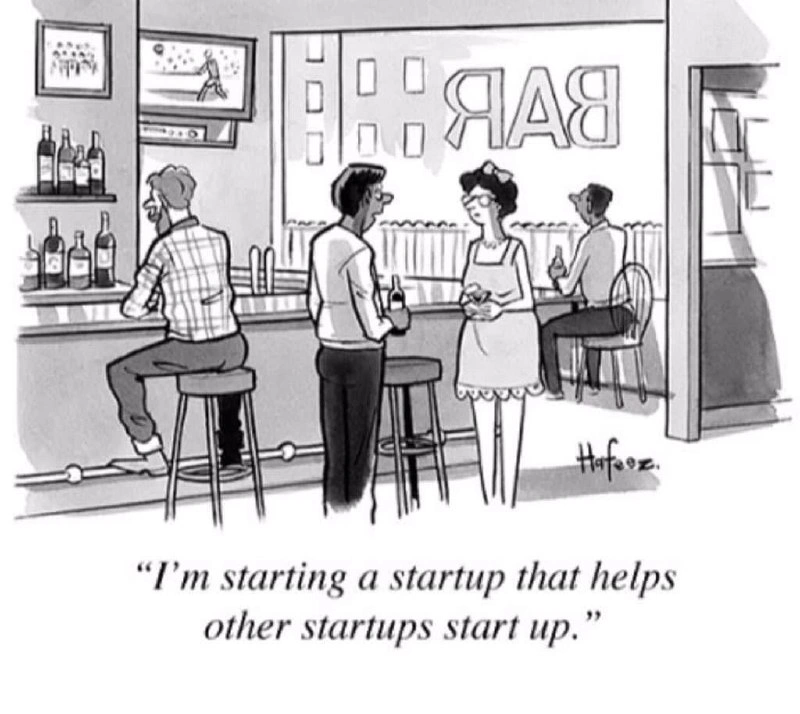
This meme is funny in a simple way because the man’s idea is clearly upside-down. He’s basically saying he’ll make money by helping others do the very thing he’s doing, in an endless loop. It’s like a teacher who only teaches people how to become teachers, who then teach more teachers, and so on – but no one ever actually teaches a real subject to students! The picture shows him excitedly sharing this idea in a bar, and the bartender listening politely. Even if you don’t know anything about tech startups, you can see the joke: the idea is ridiculously circular. There’s no real product or service for regular people – it’s a business about making more businesses, forever. It makes us laugh because it’s like a dog chasing its own tail; the poor dog thinks it’s onto something great, but we can see from the outside that it’s just going in circles. The man in the cartoon is that dog, super eager with his big idea, and the rest of us (like the bartender or the other customers in the bar) are smiling, thinking, “Wait, is this guy for real?” It’s a playful poke at grown-ups who get so caught up in fancy ideas that they forget the simple question a kid would ask: “What’s the point? What do you actually do?”

Level 2: Bar Napkin Blueprint

Stepping down to a more junior-friendly view, let’s unpack the jargon and humor. Startups are small companies built to grow fast, often by using new technology or business models. A classic part of StartupCulture is the enthusiastic pitch – that moment when a founder tries to sell you on their big idea. Here we have a founder so enmeshed in that culture that he’s literally pitching his idea at a bar, probably on the back of a napkin (a cliché for hastily planning a business idea over drinks). The reversed “BAR” on the window confirms the setting. It’s a casual scene: one guy on a stool watching TV, another sipping a beer by the window, and our would-be entrepreneur excitedly explaining his concept to the bartender. You can almost imagine him scribbling a blueprint or diagram on a napkin as he speaks. This informality hints that in the world of StartupLife, ideas can come anytime, anywhere – even after a couple of beers – and founders are always ready to spiel. The tag bar_napkin_pitch refers exactly to this kind of impromptu business planning in a bar.

Now, his idea: “I’m starting a startup that helps other startups start up.” He said startup four times in one sentence! A startup (by definition) is supposed to create some product or service that solves a problem or fulfills a need. But this guy’s company’s only purpose would be to help other new companies get started. It’s like a business about building other businesses. If that sounds a bit circular or self-referential (meta), that’s exactly the point. In tech lingo, something described as “meta” means it’s one level above or about itself – like a book about writing books, or in this case, a startup about startups. This is where the humor kicks in: it’s a recursive_business_model, meaning a business model that loops back into itself. The cartoon compares it to a programming function that calls itself. In programming, recursion is a technique where a function (or algorithm) calls itself to solve a problem. For example, a recursive function to compute factorial might call itself with a smaller number until it reaches 1 (the base case). A crucial concept in recursion is the base case – a condition that stops the recursion; without it, the function would call itself forever and never finish. That’s why the caption notes the idea is like a recursive function call with no base case – an endless loop where nothing ever gets done except continuing the loop.

So, imagine a function:

function launchStartup() {
    // Base case missing intentionally
    launchStartup(); // helps launch another "startup" by calling itself again
}

Without a base case (like if (noMoreStartups) return;), launchStartup() above would keep executing forever until the program crashes. In real life, a startup that just creates more startups without ever making a real product or profit would similarly burn out once it runs out of money or new recruits. The humor is that this founder’s plan sounds a bit like a perpetual motion machine for companies – something that keeps generating more of itself with no external input. Experienced folks in tech know that the real world doesn’t work that way: sooner or later you need paying customers or sustainable value.

Let’s clarify a few other terms packed into this meme. The tech industry’s hype cycle is a pattern we see often: a new trend (like social media, crypto, AI, etc.) gets everyone excited, tons of startups pop up riding the buzz (BuzzwordBingo, anyone?), investors throw money at them (that’s the venture capital or VC feeding frenzy), and you get a bubble of companies, many of which never find a viable business model. Hype means excessive publicity or excitement – not always matched by reality. Eventually, many hyped companies fail, and only a few survive after the bubble bursts – that’s the cycle. In the meme, the guy’s startup-of-startups idea is poking fun at how wild and inception-like these hype phases can get. (Yes, “Startupception” in the title is a play on the movie Inception, which was about dreams within dreams. Here it’s startups within startups.) It implies an almost absurd level of self-reference, like a mirror facing a mirror, creating infinite reflections. There’s even a tag startup_inception underscoring this layered concept.

The phrase “bootstraps other startups into existence” is interesting too. In startup lingo, bootstrapping means starting a company with very little money and without big outside investments – basically “pulling yourself up by your bootstraps.” It implies scrappiness and self-sufficiency. But here, saying a startup will bootstrap other startups is kind of paradoxical: if those other startups are being helped, are they really “bootstrapping” themselves? It sounds like this founder wants to provide the launching resources or framework so that others can spin up new companies easily – like an assembly line for startups. This could mean offering starter funding, tools, legal/incorporation help, maybe a template business model – essentially an incubator or accelerator program dressed up as a startup itself. (Incubators/accelerators are organizations that help new startups start up by providing mentorship, workspace, seed money, etc., usually in exchange for a slice of ownership). The cartoon is lampooning the idea that even that concept can be packaged as a standalone business deserving its own funding. It’s a bit like saying: “I have a startup-as-a-service platform” – a cheeky spin on the common tech term X-as-a-Service. We often joke about things like “Pizza-as-a-Service” or “Coffee-as-a-Service” to poke fun at how everything in tech gets turned into a service/platform model. Here we’re effectively looking at Startup-as-a-Service (StaaS) as a punchline.

The dry, deadpan tone of the caption (“I’m starting a startup that helps other startups start up.”) is key to the humor. It’s delivered totally straight, as if it’s a normal business idea, but the over-the-top self-referencing is what makes it ridiculous. The setting adds to the comedy: he’s not in a VC’s office or at TechCrunch Disrupt (a startup conference) – he’s at a local bar, pitching to a bartender who’s probably heard dozens of half-baked Silicon Valley dreams. This grounds the scene in reality: not every wild idea gets a glamorous showcase; many start as tipsy rants or enthusiastic rambles to whoever is within earshot. The lone TV-watcher and the other patron sipping his drink show that the world largely remains indifferent while our founder here is lost in his grandiose vision. That contrast is classic TechSatire: the founder thinks he’s got the next big thing, but to everyone else, especially outside the tech bubble, it just sounds ludicrous.

For someone early in their tech career, the meme is a gentle introduction to the IndustryIrony of tech entrepreneurship. You learn that not every startup idea is as brilliant or useful as it might initially sound – some are basically exercises in buzzwords and funding with no clear endgame. The cartoon exaggerates it to a humorous extreme: a company that literally only makes it easier to form... more companies. It invites the junior developer or budding entrepreneur to ask, “Wait, what value is this adding? Isn’t this just a house of cards?” And that pause – recognizing the emptiness behind the buzz – is exactly the insight the meme wants to spark, all while making you smirk at how silly it all is when said out loud in a plain bar.

Level 3: Recursion with No Return

At the deepest technical level, this cartoon exposes a recursive business model that would make any seasoned engineer chuckle and cringe. The founder’s pitch – “a startup that helps other startups start up” – is essentially a function calling itself with no end in sight. In computer science terms, that's recursion without a base case. Just like an infinite recursive function will eventually blow the stack or loop forever, an economic ecosystem of startups spawning startups ad infinitum is destined to collapse under its own absurdity. It’s a startup Ouroboros – a snake eating its tail – or perhaps a venture-funded Möbius strip that feeds on hype and produces nothing tangible. The humor here draws from the extreme of StartupCulture and the TechHypeCycle, where every new company tries to out-meta the last.

In software engineering, we’d never deliberately write a function that only calls itself without returning a result: that’s a one-way ticket to a crash (or a StackOverflowError). Yet in the frothy world of tech entrepreneurship, we actually see pitches that feel just like that. Consider a snippet of pseudo-Python illustrating this startup’s business plan:

def startupception():
    print("Launching a startup to help other startups launch...")
    # Warning: recursion with no base case – economic bubble ahead!
    return startupception()  # calls itself indefinitely

If you ran startupception(), it would keep spawning calls to itself until the program crashes. Likewise, a startup whose only product is spawning more startups is a loop with no exit – eventually the cash (or stack memory) runs out. The caption explicitly riffs on this idea, even using the phrase “start up” repeatedly like a tongue-twister, mirroring how a recursive function’s definition repeats. Seasoned developers might recall the Y Combinator (the theoretical function for recursion in lambda calculus) and smirk at the coincidence that Y Combinator is also the name of Silicon Valley’s famous startup accelerator – one that indeed helps startups start up. This cartoon is poking fun at the notion of a “Y Combinator of Y Combinators”, a self-referential meta_startup concept taken to comical extremes.

Beyond the coding analogy, the scene also jabs at IndustryTrends_Hype. The man is delivering his grand pitch not in a boardroom, but to a bartender in a quiet bar. The implication: tech pitches have become so ubiquitous and filled with BuzzwordBingo that even the local barkeep is getting an earful of startup inception ideas. The bartender’s polite stance and the other patrons ignoring the pitch suggest this isn’t the first wild idea floated over a beer. This frames the situation as an everyday absurdity in tech hubs – you can almost hear the guy bragging about “a disruptive platform for synergistic venture enablement” after a couple of IPAs. IndustryIrony drips from the idea that pitching a recursive_business_models startup might actually attract real VC (venture capital) interest during boom times. In every hype cycle, VCs sometimes back ideas that are essentially tech Escher drawings – fantastical loops that seem plausible when awash in buzzwords. The veteran engineer in us recognizes this pattern: during the dot-com bubble, dozens of companies made money by selling services to other dot-com companies, with no one ever reaching a profitability base case. It was turtles all the way down until the entire stack collapsed. This meme distills that hard-earned wisdom into one flawless line of dialogue.

The humor really lands for those of us who’ve witnessed these endless_seed_rounds of funding for increasingly abstract startups. It’s funny because it’s almost true – in boom times, you really do hear pitches one notch away from this. The cartoon underscores a systemic issue: a TechIndustryHumor version of “who actually builds the thing that people use?” It’s a send-up of a tech ecosystem chasing its own tail, where founders dream up new ways to monetize other founders, and the real economy is left wondering, “So... does anyone make a product people want, or just more startups?” The TechSatire bites because it captures that self-referential folly so perfectly. A senior developer or architect reading this will nod knowingly at how it lampoons the VC Escher pitch: a business model drawn like an impossible staircase where you climb and climb but never reach a solid floor. StartupLife veterans have seen enough bar_napkin_pitch scenarios and circular investor decks to know that whenever someone says, “It’s a platform for platforms,” you might be looking at an infinite loop with no base case (and likely no exit strategy other than finding a greater fool to invest). In short, this meme gets its laughs from deep-cut truth: a recursion joke wrapped in business jargon, reminding experienced techies of every over-hyped, foundationless startup that fizzled out when reality (or runtime) caught up.

Description

This is a single-panel cartoon, drawn in the classic black-and-white, ink-on-paper style reminiscent of The New Yorker. The scene is set in a bar, where a man holding a beer bottle is talking to a woman. Other patrons are visible in the background. Below the drawing, a caption reads: 'I'm starting a startup that helps other startups start up.' The artist's signature, 'Hafeez,' is visible in the bottom right corner of the panel. The humor is dry and satirical, targeting the insular and often circular nature of the tech startup ecosystem. It mocks the trend of creating B2B companies whose sole purpose is to serve other startups, rather than addressing a fundamental consumer or market need. For experienced tech professionals, this is a deeply relatable and cynical observation on the venture capital-fueled 'bubble,' where the business model can feel like selling shovels to other gold miners in an already saturated field
Comments

15
Anonymous ★ Top Pick Their platform is called Recursion-as-a-Service. The base case is when the VC funding runs out
  1. Anonymous ★ Top Pick

    Their platform is called Recursion-as-a-Service. The base case is when the VC funding runs out

  2. Anonymous

    Their cap-table is already a cyclic linked list that points back to itself - good luck dereferencing that at Series A

  3. Anonymous

    Ah yes, the classic Y Combinator combinator - a higher-order function that takes startups as input and returns a function that produces more startups. Stack overflow guaranteed when you realize your cap table is just pointers to other cap tables

  4. Anonymous

    It's a clean architecture: infinitely recursive value creation with no base case - VCs call that a 'platform play', engineers call it a stack overflow

  5. Anonymous

    Ah yes, the classic O(n²) business model - where your customer acquisition cost scales quadratically with ecosystem complexity. It's like building a compiler for a language that only compiles compilers, or launching a Kubernetes operator that manages other operators. Eventually you realize you've created a dependency graph so circular that even your cap table needs garbage collection. But hey, at least your pitch deck writes itself: 'We're the infrastructure layer for the infrastructure layer.' VCs love recursion until they hit the stack overflow

  6. Anonymous

    Infinite recursion in the startup stack - until the seed funding blows the call stack

  7. Anonymous

    We’re PaaS - Pivot‑as‑a‑Service - our business model is a circular dependency; CAC equals our carry on their seed round

  8. Anonymous

    So it’s a higher‑order startup - like a Y‑combinator - returning startups until runway hits zero and throws OutOfFundingException

  9. @zherud 4y

    But there is no startup that will help your startup startup...

  10. @cptnBoku 4y

    When will this startup start to help me make a startup that helps other startup start up

    1. @officialbishowb 4y

      The startup that will help you to make startup that helps other startup start up will startup soon

  11. Deleted Account 4y

    startup/100

    1. @SamsonovAnton 4y

      startup / 0 = infinite startup

      1. Deleted Account 4y

        I am afraid of this

      2. @callofvoid0 4y

        unavailable

Use J and K for navigation