Skip to content
DevMeme
6398 of 7435
When ML Research Officially Becomes Theology
AI ML Post #7015, on Aug 8, 2025 in TG

When ML Research Officially Becomes Theology

Why is this AI ML meme funny?

Level 1: It’s a Miracle

Imagine you built a super complicated robot that can talk and answer questions. You change one little part inside it, and suddenly the robot gets much better at talking. People ask you, “Wow, how come it’s so much better now?” If you just shrug and jokingly say, “I dunno – I guess a miracle happened,” that would be pretty funny, right? That’s basically what happened here, but with an AI language model instead of a robot. The scientists tried something new, it made their AI work better, and even they don’t know exactly why. So they joked that it must be thanks to “divine benevolence” – which is a fancy way to say a blessing from above, or simply good luck from the heavens. It’s funny because usually scientists give clever reasons for things, but here they’re basically saying, “Hey, we’re just as amazed as you are. Let’s just thank our lucky stars!” In other words, the super-smart computer model works amazingly well, and the only “explanation” is that it’s like magic. That mix of surprise and honesty – admitting that even the experts are a bit stumped – is what makes everyone laugh and share this meme. It’s like even the science wizards are saying, “yep, some things are beyond our understanding… thank goodness it turned out great!”

Level 2: Works Like Magic

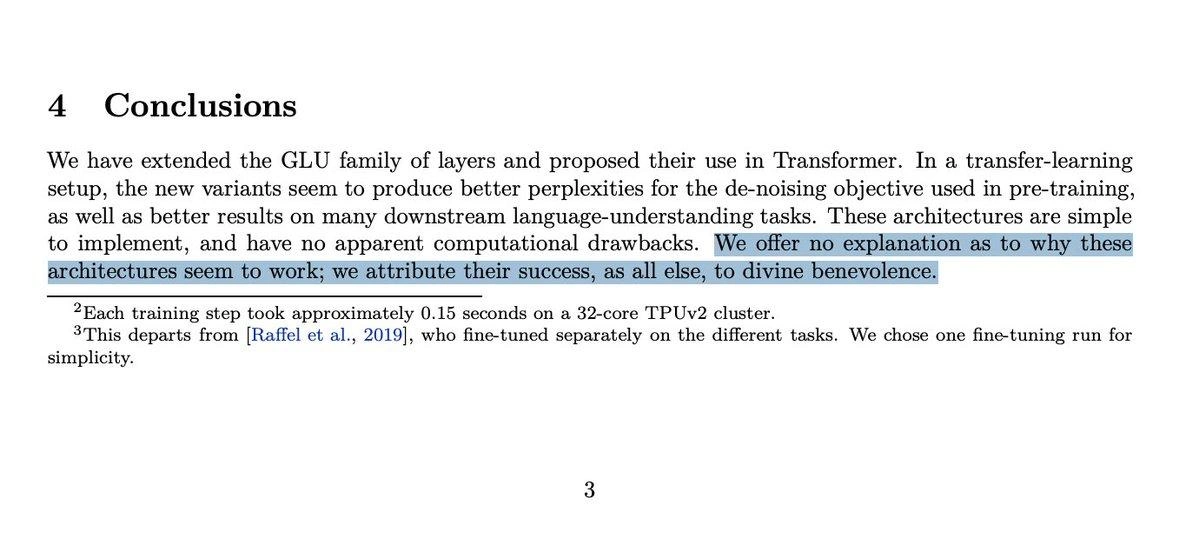
So what are we looking at here? It’s a screenshot from an AI research paper – specifically the conclusion section of a paper about Transformer models. Transformers are those powerful NeuralNetwork architectures used for language AI (like the tech behind chatbots and translation tools). In this paper, the authors say they made an improvement by adding something from the GLU family of layers. GLU stands for Gated Linear Unit. You can think of a GLU layer as a clever little gate in the network that decides what information to let through (kind of like a bouncer for data: it can let important signals pass and keep unhelpful ones out). They plugged this GLU component into the Transformer architecture to see if it helps the model learn better.

According to the authors, it did help. They report better scores – for example, lower perplexity on a de-noising task. Perplexity is a metric for language models that basically measures how “confused” the model is by the test data; lower perplexity means the model is doing a better job at predicting or understanding the text. They also mention improved results on various downstream tasks (these are specific applications after the model is trained, like answering questions, translating text, etc.). All of this was done in a transfer learning setup, which means they first train the model on a broad task or big dataset (here, a de-noising pre-training objective – likely something like masking words in sentences and having the model guess them, similar to how BERT or T5 are trained). Then they fine-tune that pre-trained model on different smaller tasks. Transfer learning is common in MachineLearning because it lets a model take general knowledge it learned from a lot of data and apply it to specialized problems.

The authors are keen to emphasize that these new GLU-augmented Transformer models are simple to implement and have no computational drawbacks. In plain terms, that means they didn’t make the model slower or more memory-hungry – always a good thing when you’re dealing with big neural nets. In fact, a footnote in the image (the tiny text labeled with a 2) says each training step took ~0.15 seconds on a 32-core TPUv2 cluster. A TPUv2 is a type of super-fast chip (Tensor Processing Unit, developed by Google) designed specifically to accelerate AI training. Having 32 cores of it means they used a lot of computing power, which is pretty normal for serious AI research. The fact that each step was 0.15s just gives readers a sense that “hey, even with our new layers, training was still quite fast on good hardware.” In another footnote (labeled 3), they mention doing one combined fine-tuning run for simplicity, whereas a referenced earlier study (Raffel et al., 2019, known for the T5 model) fine-tuned on each task separately. This is a minor detail about how they ran the experiments – basically they deviated slightly from a standard procedure to save time, and they want to be transparent about it.

Now, the highlighted sentence in blue is where things get funny. It reads: “We offer no explanation as to why these architectures seem to work; we attribute their success, as all else, to divine benevolence.” In normal English: “We don’t know why this works. We’re saying it’s thanks to a blessing from above (haha).” This is extremely unusual wording for a scientific paper! Researchers usually try to at least guess why their method worked better – maybe the GLU layer helps the model filter relevant features, or maybe it stabilizes training, something along those lines. But here they just outright say we have no clue and make a joke that basically credits a higher power. It’s a very formal setting to crack a joke, which is why it stands out.

For a junior developer or someone new to AI, here’s why that line is causing chuckles in the community: it’s highlighting the fact that AI models (especially big ones like Transformers) are so complex that even experts sometimes can’t pinpoint the reason for their success. It’s a bit like when you have a piece of code that suddenly starts working and you’re not sure which change fixed it – you might jokingly say “works by magic!” to cope. In AI, these models are often described as black boxes because we can see what goes in and what comes out, but the inner workings are hard to interpret. So saying “divine benevolence” is a tongue-in-cheek way to say “yeah, it feels like some mysterious magic inside helped it.” It’s funny and relatable because AIHumor often revolves around how unpredictable these systems can be.

This meme is essentially poking fun at AILimitations in understanding: the researchers achieved great performance (which everyone loves) but they’re openly admitting they don’t have a scientific explanation for it (which is kind of an “oops, oh well!” moment). The community finds it amusing because it’s a very honest thing to admit. It shows a bit of humility and humor in a field that’s usually very careful about claims. Plus, the phrase “divine benevolence” is so over-the-top formal and reverent-sounding that it makes for a perfect meme material. You can almost imagine weary AI engineers half-jokingly praying to the “AI gods” when they run a huge experiment: “Please let it converge this time.” In fact, people jest about prayer_driven_development – implying that beyond all our DeepLearning tricks, sometimes we just cross our fingers and hope the training process yields a miracle. This paper’s conclusion basically put that sly joke right into academic text. No wonder it got highlighted and shared – it’s a lighthearted Easter egg in the usually dry world of research papers.

Level 3: Prayer-Driven Development

From a seasoned ML engineer’s perspective, this meme is hilarious because it captures a familiar situation: you try a new trick to improve your model, it works, but you’re at a loss to explain why. In the AI/ML world, especially in cutting-edge AIResearch, we often find ourselves doing a bit of prayer-driven development. That’s the jokey term for when you run an experiment, wait, and pray that the metrics improve. Here, the authors struck gold with a tweak (extending the Transformer with a GLU layer variant) – better results all around – yet they admit they’re essentially as baffled as anyone about the root cause. The highlighted sentence is them cheekily saying, “Don’t ask us why it’s better; we’re just grateful it is!”

Why is this combination of elements so funny? For one, academic research papers are usually serious and cautiously worded. You’d expect a conclusion to say something like, “We hypothesize that GLU layers improve gradient flow or representational capacity, leading to better performance.” Instead, we get a deadpan punchline attributing success to divine benevolence. It’s the ultimate mic-drop for a conclusion section – essentially “It works because… well, God knows (literally).” This resonates with anyone who’s watched deep learning models produce uncanny results without a clear reason. It’s a communal inside joke in AIHumor: modern neural networks often feel like alchemy. We mix ingredients (architectures, hyperparameters, huge datasets) and something brilliant comes out, and we’re left scratching our heads saying “uh, cool, I guess?”

The meme’s image itself looks like a legit research PDF page (LaTeX font, numbered section 4 Conclusions). Seasoned folks have read hundreds of these. Seeing a line highlighted that basically throws scientific explanation out the window – that’s pure comedy gold for the initiated. It mocks the sometimes hype-driven nature of AI papers: we tout state-of-the-art results (like lower perplexity on language tasks) and celebrate new IndustryTrends_Hype architectures, but when it comes to answering the tough “why does it work” question, even the authors might just shrug. AIHypeVsReality in one sentence: hype gives us amazing performance charts, reality is we’re not quite sure what’s under the hood making it possible.

Real-world scenarios where this happens? Plenty. Think about the first time transfer learning was used in NLP: people took a Transformer pre-trained on tons of text, fine-tuned it for, say, a medical question-answer task, and it did an amazing job. Why did a model trained on general internet text know so much about biomedical questions? It wasn’t obvious at first – it almost felt like magic. Or consider when researchers discovered that very large models suddenly develop unexpected abilities (like some models spontaneously learning to do arithmetic or translate languages they weren’t explicitly trained on) – these emergent behaviors seem to come out of nowhere. In each case, engineers joked about “unauthorized divine patches” or “model gremlins.” This meme’s highlighted line is exactly that sentiment codified: we don’t have a concrete explanation, so we’ll humorously attribute it to a higher power.

The footnotes in the snippet add another layer of relatable humor. Footnote 2 calmly states each training step took 0.15 seconds on a 32-core TPUv2 cluster – an almost banal detail that tells experienced readers, “yep, we threw a lot of expensive hardware at this.” Footnote 3 notes a slight difference from a famous prior work (Raffel et al., 2019, the paper behind the T5 model) regarding how they fine-tuned tasks – basically saying they chose a simpler fine-tuning method. These are the kind of nuts-and-bolts details researchers obsess over: hardware timings, training procedures, baseline comparisons. The hilarious contrast is that they carefully document these minor things, but for the major question of why the new GLU-augmented Transformer works better, their answer is essentially, “¯\_(ツ)_/¯ Beats us!” (in fancy words). That juxtaposition strikes a chord with veteran developers: it’s like writing spotless documentation for your code’s installation steps, and then in the README admitting “the program might run better on Tuesdays for reasons unknown – please sacrifice a coffee to the debug gods.”

Moreover, this one-liner is a subtle commentary on AILimitations. As much as neural nets are high-tech and DeepLearning is driven by data and computation, at the end of the day, we’re often doing science by experimentation. Seasoned engineers have war stories of inexplicable fixes: the code only works if you add a seemingly irrelevant delay, or the model only converges with a learning rate that shouldn’t theoretically make sense. We joke about “gremlins in the system” or “cosmic rays” or, yes, “divine benevolence” because sometimes that’s honestly what it feels like. The highlighted sentence pokes fun at that shared experience. OverfittingModels and mysterious generalization issues can make us superstitious. Ever heard an engineer half-jokingly say, “We need to appease the demo gods” before a big live AI demo? The mindset behind that joke is exactly what this meme highlights in research form.

Finally, let’s not ignore the shout-out in the post text: “Just remembered that time Noam Shazeer dropped the hardest line ever written in an ML paper.” Noam Shazeer is a respected figure (one of the minds behind Google’s Transformer and other innovations). If he says “we can’t explain it – probably God’s kindness” in an academic paper, it’s an epic example of self-aware humor in a field that can sometimes take itself too seriously. Experienced folks love this because it humanizes AI research – even the gurus sometimes just throw their hands up and laugh at how little we understand relative to what we’ve created. In short, the meme is funny and a bit comforting: it tells us that behind all the polished conference talks and grand claims, even top researchers sometimes chalk up a win to a lucky mystery. And if they can do that, maybe it’s okay that the rest of us feel that way in our day-to-day ML work too.

Level 4: Black-Box Theology

Deep in the theory mines of Machine Learning, this meme touches on an almost metaphysical problem: we often lack formal explainability for why certain neural network architectures perform so well. Transformers, especially with fancy new layers like GLU (Gated Linear Unit) variants, operate as high-dimensional black_box_models. In theory, a Transformer is just linear algebra and calculus (matrix multiplications, nonlinear activations, gradient descent), all perfectly deterministic. Yet here we have researchers essentially throwing up their hands and saying, “we have no idea why this works better – it just does.” This is the epistemic mystery at the heart of modern AI: our practical results are outrunning our theoretical understanding.

It’s akin to invoking a higher power in a realm that’s supposed to be guided by math and data. The highlighted phrase “divine benevolence” is a tongue-in-cheek nod to the unexplained efficacy of these models. Academically, it’s jarring – conclusions in research papers usually try to conjecture why something worked. Instead, the authors abandon the search for a tidy theoretical explanation. This hints at a larger truth recognized by seasoned AIResearch folks: advanced DeepLearning systems often behave in ways we can observe and measure (like improved perplexity), but can’t yet fully prove or explain. We have some theories – e.g. Transformers’ attention mechanism is provably a universal function approximator under certain conditions, and GLU layers might be increasing model capacity or introducing an implicit regularization – but nothing concrete enough to predict these improvements from first principles.

There’s a whimsical parallel here to Clarke’s Third Law: “Any sufficiently advanced technology is indistinguishable from magic.” In this case, any sufficiently advanced model architecture is indistinguishable from a miracle until theory catches up. Researchers find that scaling up models or tweaking architectures (more heads here, a GLU gate there) leads to jumps in performance. We measure the jump (e.g. perplexity going down, meaning the model’s predictions are less “perplexed” by the data), but explaining the jump is as hard as deciphering a black box. We often rely on empirical trial-and-error and post hoc reasoning: train the model on a massive TPUv2 accelerator cluster, see what works, then try to piece together intuitive stories after the fact. The bold honesty of “divine benevolence” in a conclusion section lays bare that gap between empirical success and theoretical understanding. It implicitly challenges the reader: in an ideal world, we’d derive why GLU helps using learning theory or find an interpretability insight – but right now, even top experts are shrugging.

This one-liner also echoes the AIHypeVsReality of our time. Hype promises near-magical AI capabilities, and indeed models achieve impressive feats, but the reality is we often cannot articulate how or why in full detail. It’s not that researchers literally believe a deity is tuning their weights – it’s a witty admission that sometimes our NeuralNetworks work for reasons we haven’t pinned down, almost as if guided by a benevolent force. In academic terms, it’s a moment of humility and humor: acknowledging the limits of current theory. Deep learning literature has other examples of such honesty, where authors note something like “we leave understanding this phenomenon to future work.” But crediting “divine benevolence” tops the charts for memorable phrasing. It’s a playful pretense of mysticism that actually highlights a very real scientific unknown.

Description

A screenshot of the conclusion section from a formal academic research paper. The text is in a standard serif font, and a specific sentence is highlighted with a light blue background for emphasis. The highlighted sentence reads: 'We offer no explanation as to why these architectures seem to work; we attribute their success, as all else, to divine benevolence.' The surrounding text discusses GLU family layers and their use in Transformer models. This image captures a famously dry and witty line from an actual AI research paper, attributed to Noam Shazeer. The humor resonates deeply with senior engineers as it's a candid admission of the empirical, sometimes inexplicable, nature of cutting-edge machine learning. It perfectly encapsulates the 'it just works' phenomenon in complex systems where the theoretical understanding lags behind the practical results, humorously substituting rigorous explanation with a nod to faith or magic
Comments

12
Anonymous ★ Top Pick The SRE team has officially adopted this for our incident postmortems. Root cause? 'We attribute the system's self-healing, as all else, to divine benevolence.' Closes ticket
  1. Anonymous ★ Top Pick

    The SRE team has officially adopted this for our incident postmortems. Root cause? 'We attribute the system's self-healing, as all else, to divine benevolence.' Closes ticket

  2. Anonymous

    Finally, a peer-reviewed admission that our hyper-parameter tuning strategy is basically prayer-driven development

  3. Anonymous

    After 20 years in ML research, I've learned that 'divine benevolence' is just academic speak for 'we tried 47 different hyperparameter combinations until something worked, and now we're reverse-engineering a plausible theory for the reviewers.'

  4. Anonymous

    When your transformer variant outperforms baselines but you can't explain why in the ablation study, just invoke divine benevolence and hope the reviewers appreciate the honesty. It's the ML research equivalent of 'it works on my machine' - except here it's 'it works by the grace of the optimization gods, and we're not questioning it.'

  5. Anonymous

    Only in ML can the RCA for SOTA be 'divine benevolence'; cool, now please autoscale benevolence across the 32-core TPUv2 cluster

  6. Anonymous

    When “Conclusions” credits divine benevolence, that’s the ML version of “works on my cluster” - perplexity down, theory pending

  7. Anonymous

    ML papers' eternal truth: novel layers get the glory, but implementation details and divine benevolence handle the TPU magic

  8. @hafijuldev 11mo

    this is true😂 it works, we don't know how

  9. dev_meme 11mo

    Активист местный?

  10. dev_meme 11mo

    Ещё один

    1. _ 11mo

      English only please

    2. @Algoinde 11mo

      You were warned about not using English despite the rules of this chat, and didn't acknowledge this nor stopped doing so, so I assumed your comments were automated LLM comments for channel promotion. If that is not the case, again, please use English in this chat.

Use J and K for navigation