A Systems Programmer's Definition of a 'Thread'
Why is this OperatingSystems meme funny?
Level 1: Not That Kind of Thread
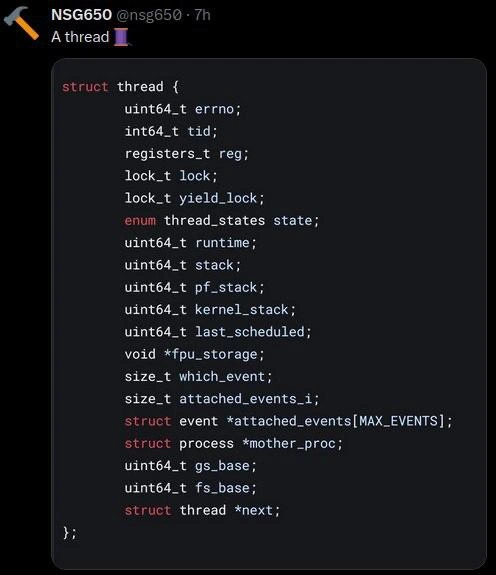
Think about the word “thread.” You might know it as a piece of string, and on the internet, people use “thread” to mean a series of connected messages or comments (like a story or discussion that unfolds post after post). Now imagine your friend says, “I’m going to start a thread about my day,” and you expect a story – but instead they hand you a spool of actual sewing thread and a detailed diagram of how it’s made! You’d probably laugh or roll your eyes, saying “Hey, not that kind of thread!” That’s exactly the joke here. The person said “A thread” on Twitter, which normally means a chain of tweets, but they gave everyone something completely different: a super technical description of a computer “thread” (the kind of thread that lives inside a computer program). It’s funny because it plays with our expectations. We were thinking of one meaning of the word “thread,” but they surprised us with the other meaning. In short, the meme makes us laugh by taking a common phrase and intentionally mixing it up with a nerdy twist – one thread turned out to be a totally different thread than we thought!
Level 2: Tale of Two Threads
This joke plays on a double meaning of the word “thread.” On social media (like Twitter), a “thread” means a series of posts or comments connected together, usually telling a story or explaining something step by step. The tweet here starts with “A thread 🧵,” which normally prepares readers for such a series of messages. However, what follows is not a story at all, but an entire chunk of C code defining something also called a “thread”! In computer science, a thread is a term for a unit of execution – basically a single sequence of programmed instructions that the operating system can manage independently (like one miniature process running inside a bigger program). The humor comes from the poster intentionally confusing these meanings. It’s as if they said, “I’m going to tell you a thread,” and then instead of a story, they dropped technical schematics on the audience.
Let’s unpack that code snippet in simpler terms. It’s written in C, a language often used for building operating systems and other low-level tools. In C, a struct (short for structure) is a way to group variables together under one name, creating a new type. Here we have struct thread { ... }; which defines what information an OS might store about a thread (the computing kind). Think of an OS as a manager in charge of many workers. Each thread is like a worker, and the struct thread is the file folder of details the manager keeps on that worker. Here are some of the important parts inside that folder:
errno: an error number specific to this thread. (In programs, each thread often keeps its own “last error” value so that errors don’t get mixed up between threads.)tid: the thread’s unique ID number (thread identifier).registers_t reg: a place to save the CPU registers for this thread. Registers are like the CPU’s small scratchpad; when the OS pauses one thread and switches to another, it saves the old registers here so it can restore them later.lock_t lockandlock_t yield_lock: some kind of locks. Locks are mechanisms to prevent threads from stepping on each other’s toes. For example, a lock might be used so that only one thread at a time can access a certain resource or section of code. These locks in the thread struct suggest the OS might need to protect parts of the thread’s data or coordinate thread switching (the name “yield_lock” hints at synchronizing the act of yielding the CPU).thread_states state: this is likely an enum describing the thread’s current state – for instance, is it running, is it ready to run but waiting its turn, or is it sleeping/waiting on something, etc.runtime: how much total time this thread has been running on the CPU (could be used to decide if it has run long enough and should yield to another thread, for fairness).stack(andpf_stackandkernel_stack): these are memory addresses related to the thread’s stack. A thread needs a stack, which is like its personal workspace for executing functions (holding local variables, function call information, etc.). The thread likely has one stack for normal code (stack, possibly the user-mode stack) and a separate one for when it’s executing in kernel mode (kernel_stack). The fieldpf_stackmight be a special stack (perhaps for handling page faults or interrupts – a detail some OSes have for safety). Essentially, these fields keep track of where the thread’s work-in-progress memory areas are.last_scheduled: probably a timestamp or counter from when the thread was last run. This could help the OS scheduler figure out if it’s this thread’s turn to run again (for example, “it hasn’t run in a while, let’s give it some CPU time”).fpu_storage: a pointer to where this thread’s Floating Point Unit context is stored. The FPU is the part of the CPU that handles decimals/heavy math. Not every thread uses it all the time, but if it does, the OS must save those registers too when switching threads. So this field holds that saved math state when the thread is not running.which_eventandattached_events[]: these suggest the thread can be hooked to certain events, likely for things like I/O or synchronization. The thread might be waiting for some event (like data from a disk or network).attached_eventscould be an array listing multiple things the thread is waiting on, andwhich_eventmight indicate a specific one that woke it up or is of interest. This is a bit specific and not every OS has this in the thread struct, but it hints at an event-driven design where threads can wait on multiple signals.struct process *mother_proc: a pointer to the process this thread belongs to (here lovingly called the “mother” process). In operating systems, a process is like the program (with its memory and resources), and a process can contain multiple threads (think of threads as mini-tasks all working within the same program). This pointer lets the thread refer back to its parent process and access shared stuff like the program’s memory or open files.gs_baseandfs_base: these are special CPU register values for this thread, used on x86_64 systems for thread-specific data. Without going too deep, they’re part of how the system keeps track of things like thread-local storage or per-thread variables. Each thread might need its own values for these when it’s running.struct thread *next: a pointer to another thread structure. This typically means threads can be linked together in a list or queue. For example, the OS might keep a linked list of all runnable threads, and each thread struct points to the next one in that list. It’s analogous to a chain – and humorously, it’s like how a Twitter thread links one tweet to the next! Here, in the code, it literally says “this thread’s next piece is over here,” just like a next tweet in a Twitter thread.
In simpler terms, this struct thread is a collection of all the info the OS needs to manage a thread’s life cycle. When a context switch happens (the OS stops one thread and starts another), it uses this data to remember where to pick up later. Fields like registers, stack pointers, and FPU state are about remembering the thread’s context (so it doesn’t lose its place in all the work it was doing). Fields like state, runtime, and events are about the thread’s status and scheduling (so the OS knows if it’s ready to run or waiting). And pointers like mother_proc and next tie the thread into larger structures (connecting it to its parent process and to other threads in scheduling queues).
Now, why is this funny to developers? Because the tweet set us up to expect a casual Twitter thread – maybe an explanation of some programming concept – but instead it delivered a hardcore piece of kernel data. It’s the absurdity of mixing a light, everyday context with very technical content. Imagine expecting a quick story and getting a dense tech schematic instead – the mismatch is the joke. Even if you didn’t know all the terms above, you can sense it’s highly technical. For a junior developer or someone new to this stuff, the humor is in the wordplay: thread as in posts vs thread as in computing. And tucked in that joke is actually a learning opportunity – the code shown is a peek into how threads really look inside an OS! It’s a fun reminder that our computing terms sometimes overlap with normal words, and here that overlap sparked a great bit of geeky humor.
Level 3: Double-Threaded Humor
For the seasoned developer, this meme operates on dual meanings and insider knowledge. It starts with the tweet text “A thread 🧵,” which normally indicates the author is about to start a multi-tweet story or explanation. But instead of a usual Twitter rant, the very next thing is a big C code snippet defining a kernel thread. The punchline is immediate: the word “thread” flips from its social media meaning to its low-level SystemsProgramming meaning. It’s a classic bait-and-switch wordplay. One moment you expect a Twitter discussion thread, and suddenly you’re looking at an actual OS thread’s data structure! That jarring switch is exactly why it’s funny. It’s as if someone said, “Let’s have a conversation,” and then dumped a full operating system code listing on the table. The humor is in that gear change from casual to extremely technical in the space of one tweet.
What really sells the joke to experienced folks is how legitimately detailed that struct thread is. This isn’t some pseudo-code or a simplistic example; it includes the kind of fields you’d find in a real kernel’s thread implementation. Seasoned programmers recognize each element and think, “Oh wow, this is the real deal!” The meme is essentially saying, “You wanted a Twitter thread? Here, have a kernel thread!” It highlights a kind of nerdy pride — only a developer would combine a social media pun with an accurate low-level code sample and expect people to chuckle. And we do! The developer humor lands because it’s so true to life. Many of us have seen or written similar structs in OS code (maybe in a college operating systems class or while hacking on a kernel), so encountering it in a tweet feels like an inside joke. It’s the kind of thing that makes you grin and think, “I see what you did there.”
One delightful touch is the last line: struct thread *next;. In kernel code, that’s how you link threads in a list (for scheduling queues, etc.). But in the context of a Twitter thread, having a “next” pointer is a clever wink. It mirrors the idea that in a Twitter thread you’d normally click “Next tweet” to continue the story. Here, the thread struct itself has a next—so the “thread” literally continues via a pointer! It’s a sly crossover between the concept of tweets chained together and threads chained in memory. Only a person fluent in both worlds will appreciate that parallel fully. It’s both punny and technically spot-on, which is a sweet spot for nerd humor.
Every field name in the code carries some weight in the joke. For example, errno being part of the thread struct reminds experienced devs that each thread keeps its own error state (so that the global error variable isn’t truly global in multi-threaded programs – a common gotcha and point of learning for newbies). Seeing tid (thread ID) is an immediate tip-off that this is about thread management. The inclusion of esoteric things like gs_base and fs_base is a chef’s kiss for kernel programmers – those are not randomly chosen; they’re there because real threads deal with segment registers on x86_64. It’s the kind of detail that says, “Yes, the person who wrote this meme really knows their stuff.” That makes the joke land even harder for veterans: it’s always funnier when the satire is accurate. In a way, the meme mocks Twitter’s simplistic format by injecting something highly technical and verbose into it, LanguageQuirks and all.
In summary, this meme shines as DeveloperHumor because it fuses two wildly different “threads” into one tweet. It’s the ultimate nerdy pun. The seasoned devs reading it nod and laugh because they’ve lived in both spaces: they’ve scrolled Twitter threads and they’ve grokked kernel thread structs. It’s a little celebratory moment of “If you know, you know.” The tweet takes a mundane phrase and unexpectedly twists it into a hardcore CS context, and that surprise – combined with the accuracy of the content – is what makes it so hilariously effective to those in the know.
Level 4: Context Switch Alchemy
At the deepest technical level, this meme dives into how an Operating System represents a thread of execution. The code block isn’t just random C gibberish – it’s basically a miniature thread control block (the kernel’s record for each thread) printed in a tweet. Each field in the struct thread corresponds to critical low-level context needed for managing a thread. For instance, registers_t reg would hold the CPU registers so the OS can perform a context switch (saving and loading CPU state when switching threads). The presence of uint64_t errno hints that each thread keeps its own error code (so one thread’s errors don’t trample another’s). All the integer types are explicitly sized (uint64_t, int64_t), indicating a 64-bit system and careful control over memory layout – classic LowLevelProgramming discipline to ensure the struct’s binary footprint is predictable. This is the kind of detail kernel developers live and breathe.
Look at void *fpu_storage; – that’s a telltale sign we’re dealing with real kernel design. It implies the thread has storage for FPU (Floating Point Unit) registers or context. In OS terms, when a thread using the FPU is swapped out, the kernel must save those extra registers (for SSE/AVX math, etc.) into a safe place. Many kernels optimize this with lazy FPU saving (only saving/restoring if the next thread actually uses the FPU), highlighting how performance and hardware details intertwine. The inclusion of fpu_storage in the thread struct shows awareness of this nuance. Similarly, the fields uint64_t gs_base and uint64_t fs_base correspond to the base addresses for special CPU segments on x86_64 architecture. Those are used for things like thread-local storage or quickly accessing per-thread and per-CPU data. In fact, on x86_64, the kernel will swap the GS/FS base on a context switch (via model-specific registers or instructions like SWAPGS or WRFSBASE) so that each thread’s segment registers point to the correct data (for example, thread-specific variables or the CPU’s current task structure). Including these in the struct underscores the meme’s attention to real hardware-level context switching concerns.
The struct also encodes scheduling and synchronization info. The enum thread_states state suggests each thread can be in states like RUNNING, READY, BLOCKED, etc., embodying classic scheduling theory (think of threads moving between ready queue, waiting on I/O, etc.). We see uint64_t runtime and uint64_t last_scheduled – these might be used for accounting and scheduling decisions (e.g. tracking how long the thread has run in total, and when it was last on CPU, perhaps to implement time slices or multi-level feedback queue algorithms). The two lock fields (lock_t lock and lock_t yield_lock) imply that threads might need locks to protect their internal data or to coordinate yielding the CPU without race conditions – a nod to the complexities of concurrency control in the kernel. And then there’s struct thread *next; at the end, pointing to the next thread in some linked structure. This is a classic way to maintain a linked list of thread control blocks, such as a run queue or a list of all threads. In many OS schedulers (from simple round-robin designs to more complex ones), threads are chained in lists or queues; a next pointer is how you link them. It’s a low-level implementation detail that screams “operating system internals.”
Altogether, the tweet is presenting a raw look at a kernel-space data structure: a complete thread descriptor with everything from CPU context to scheduling info and parent process linkages (struct process *mother_proc connects each thread to the process it belongs to). It’s an unexpectedly thorough snapshot of how an OS juggles multi-threading. For those versed in systems engineering, seeing such a faithful struct thread definition in a tweet is both surprising and impressive – it’s like stumbling upon a page from an OS textbook in the wild. The meme brilliantly intersects two completely different contexts here: the ephemeral world of Twitter chatter and the concrete world of OS KernelDevelopment. It’s a moment of deep technical truth wrapped in a social media pun, proving that even a simple meme can hide complex realities of how our computers work.
Description
A screenshot of a tweet from the user NSG650 (@nsg650). The tweet's text simply says 'A thread' followed by a thread emoji (🧵). Below this, the image displays a block of C code against a dark background with syntax highlighting. The code defines a 'struct thread', which contains numerous fields typical of a thread control block in an operating system kernel, such as 'tid' (thread ID), 'registers_t reg', 'lock_t lock', 'enum thread_states state', various stack pointers, and a pointer to the parent process 'struct process *mother_proc'. The final member of the struct is 'struct thread *next;', which creates a pointer to the next thread. The humor is a multi-layered pun for a technical audience: it plays on the word 'thread' as used on social media, the programming concept of a thread, and the implementation detail that these thread structs form a linked list - a literal 'thread' of threads

Comments
13Comment deleted
Most developers see a thread pun. A kernel developer sees a singly linked list and immediately gets anxiety about the O(n) complexity of deleting a thread from the middle of the run queue
Finally, a Twitter thread that actually needs a yield_lock and a next pointer - now if only @Platform could garbage-collect the rest
After 20 years in the industry, you realize the real thread safety issue isn't race conditions - it's explaining to management why their 'simple threading request' requires touching 17 different subsystems, three lock hierarchies, and a prayer to the scheduling gods that your yield_lock doesn't become someone else's deadlock
A thread about threads containing a thread pointer - the kind of recursive self-reference that makes you wonder if the real concurrency bug was the friends we made along the way. This TCB has everything: errno for when things go wrong, multiple stack pointers because one is never enough in kernel space, and that beautiful 'struct thread *next' at the end - proving that even in 2024, we're still just building linked lists with extra steps and calling it 'modern systems programming.'
Finally, a “thread” that actually needs scheduling - errno, two locks, three stacks, gs/fs bases, and an intrusive next pointer; try pinning that to the timeline
yield_lock: because even cooperative yielding needs mutex drama in your userspace scheduler fantasy
Finally, a Twitter thread with a yield_lock and a next pointer - if moderation had lock ordering, we’d get O(1) context switches instead of O(n) flamewars
What are those "scalar stack" fields? uint64_t stack; uint64_t pf_stack; uint64_t kernel_stack; Comment deleted
I guess author thinks "64 bits for systems is ought to be enough" Comment deleted
It's not about data size, but rather about storing a pointer inside a regular integer variable, which may violate pointer logic on some systems (where a pointer is not just a single number). Comment deleted
I know, and those pointers to stack memory tell that it is kernel threads which make it even more !!fun!! Comment deleted
I'm pretty sure those are handles to the stack not the stack pointer itself Comment deleted
mother_proc :D is there parent_1_proc and parent_2_proc? Comment deleted