Skip to content
DevMeme
128 of 7435
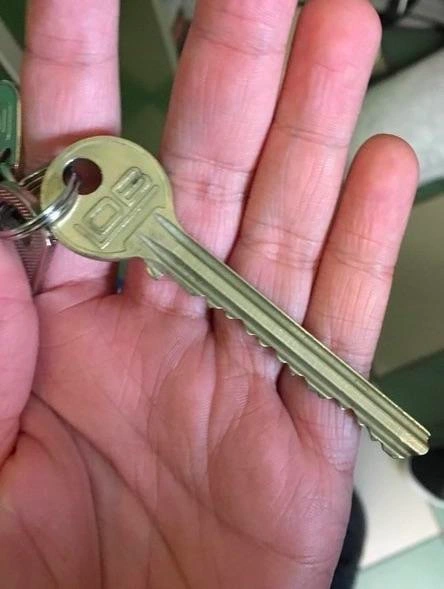
When the DBA hands you the literal database key for prod access
Databases Post #162, on Feb 22, 2019 in TG

When the DBA hands you the literal database key for prod access

Why is this Databases meme funny?

Level 1: The Ridiculous Key

You know how a normal key has a few bumpy teeth that fit the lock? Imagine someone handed you a key as long as your whole hand, covered edge to edge in tiny teeth, and said, "New rule — all keys must have sixteen bumps now. For safety." Would your house actually be safer? Probably not — but your pocket would be ruined and you'd drop the silly thing constantly. That's the joke: websites keep demanding longer and longer passwords, and to a programmer it feels exactly like being handed this ridiculous key.

Level 2: Locks, Passwords, and Why Length Is the Same Idea

The concepts this meme is playing with:

  • Password policy: rules a system enforces before accepting your password — minimum length, required symbols, uppercase, digits. "Must be 16 characters" is a length rule, on the strict end.
  • Why length matters: every extra character multiplies the number of guesses an attacker needs. A password from 70 possible symbols has $70^n$ combinations for length $n$ — so 16 characters is astronomically harder to brute-force than 8.
  • Key bitting: the pattern of cuts on a key's blade. Each cut lifts one pin inside the lock to a precise height; only the right pattern opens it. More cuts = more combinations = "longer password," which is exactly what the photo shows — a key with so many notches it looks like a saw blade.
  • The catch: attackers usually don't guess. They steal passwords through phishing emails, leaked databases, or malware. A 16-character password doesn't help if you typed it into a fake login page — just like a fancy key doesn't help if the burglar uses the window.

When you encounter your first corporate password policy, you'll understand this image immediately: the requirement feels less like security and more like being handed an unwieldy ceremonial sword to open your front door.

Level 3: Entropy You Can Hold in Your Hand

The photo is just an open palm holding a brass door key — but the blade is comically long, with a dense row of jagged cuts marching down its edge like a skyline of bad decisions. Paired with the caption — > Your password must be 16 characters! — the joke lands because the analogy is more technically accurate than the meme author probably intended.

A pin-tumbler key is a password. Each cut depth along the blade (the bitting) encodes one symbol from a small alphabet — typically 5 to 10 depth positions per pin. A standard house key has 5–6 pins, giving roughly $6^5 \approx 7{,}776$ to $10^6$ combinations. The monster in this photo, with its absurd run of notches, is the physical equivalent of an IT department cranking the minimum length slider: same threat model, more metal. And here's where the satire gets sharp for anyone who's worked in security: locksmiths learned long ago that adding pins hits diminishing returns, because real attackers don't brute-force the keyspace — they pick the lock (exploiting mechanical tolerances, the hardware equivalent of a side-channel attack), bump it, or just break the window. Likewise, attackers rarely brute-force a 16-character password; they phish it, replay it from a breach dump, or find the API token someone committed to a public repo.

This is the security theater critique embedded in the meme. Length mandates and complexity rules (P@ssw0rd2019! energy) optimize against the attack that's easiest to model, not the attack that actually happens. Even NIST's own guidance walked back mandatory composition rules and forced rotation, acknowledging that draconian policies push users toward predictable patterns and sticky notes — the human equivalent of hiding the giant key under the mat. The meme's visual punch is that physical security solved this debate decades ago: nobody carries a 30-cut key, because at some point the lock isn't the weak link anymore. Password policy committees, meanwhile, are still forging longer keys while the SSO session cookie sits unencrypted in a Slack message.

There's also a lovely UX subtext: that key looks annoying. It barely fits a pocket, it'll shred the lining, and you'll fumble it at the door — exactly how typing a 16-character password feels on a phone keyboard at a login wall, twice, because the first attempt had a typo you couldn't see behind the dots.

Description

A close-up photo shows an open hand holding a single brass house-style key on a small keyring. The round head of the key is stamped with the capital letters “DB”, and the long shaft has the usual jagged cuts along one edge. Skin lines, fingernails, and a blurred green-and-white floor are visible in the background. The visual gag relies on the double meaning of “DB key”: instead of a primary or foreign key in a relational schema, it’s an actual metal key, poking fun at database terminology and the occasional security misunderstandings developers joke about

Comments

7
Anonymous ★ Top Pick Infosec: “Rotate the DB key every 90 days.” DBA hands me a brass Schlage and says, “Talk to Facilities - our cron job is called ‘locksmith.’”
  1. Anonymous ★ Top Pick

    Infosec: “Rotate the DB key every 90 days.” DBA hands me a brass Schlage and says, “Talk to Facilities - our cron job is called ‘locksmith.’”

  2. Anonymous

    Finally, an API key that won't accidentally end up in your git history, but good luck rotating it when someone leaves the company

  3. Anonymous

    Sixteen cuts on the key, and the building still gets compromised through the window someone left open - just like the API token in the public repo

  4. Anonymous

    That moment when you're handed the production SSH key and suddenly understand why the previous senior engineer looked so tired. It's not just a key - it's a 24/7 on-call pager, a career-defining responsibility, and a constant reminder that `chmod 777` is never the answer, no matter how urgent the deployment

  5. Anonymous

    Physical DB key: zero-latency lookups, infinite durability, but still gets foreign key constraints from the wife

  6. Anonymous

    SecOps demanded quarterly “DB key rotation,” so I spun the keychain, closed the ticket, and our KMS aliases still point to prod-v1

  7. Anonymous

    Security asked for quarterly DB key rotation; Facilities handed me this - turn clockwise, call it encryption at rest, and mark SOC 2 compliant

Use J and K for navigation