Skip to content
DevMeme
1700 of 7435
The 'We're a Family' Software Startup Starter Pack
Startup Post #1900, on Aug 11, 2020 in TG

The 'We're a Family' Software Startup Starter Pack

Why is this Startup meme funny?

Level 1: Kids Run a Lemonade Stand

Imagine a group of kids deciding to set up a lemonade stand together – that’s like a simple analog to this startup scenario. One kid, let’s call him Tim, is 12 years old and it’s his first time running any stand. But since it was his idea and his backyard, he declares himself the “Head Lemonade Engineer.” Tim has never worked at any other lemonade stand, so he only knows his way of doing things. He’s very confident (arms folded, saying “I got this!”) but he might not actually know the best way to make or sell lemonade beyond what he’s seen in his own kitchen.

Tim’s older brother, Mike, is kind of like the boss (CEO) of this operation because he’s funding it and organizing supplies. Mike is a funny character: sometimes he’s super friendly, like “Hey buddy, you guys are awesome, let’s all get ice cream later!” (treating the team like his pals). But other times, when sales aren’t going well or the kids are goofing off, he gets strict and shouts, “Get back behind the stand, we need to sell more now!” (treating them like they’re just workers, almost like farm animals that must do work). The kids feel confused – is Mike their friend or just a bossy boss? It’s both! One moment he’s giving high-fives, the next moment he’s all business. This mix of nice and mean from the same person is weirdly funny to watch (as long as you’re not one of the working kids!).

Now, Tim (the lead) didn’t want to do this alone, so he brought in five friends to help – these are like the interns. They’re all around 10-11 years old. None of them have ever worked a lemonade stand either. One is in charge of taking money, another pours lemonade, another one calls out to attract customers, etc. They’re enthusiastic, but since they’re new, they sometimes make mistakes: like giving back the wrong change, spilling lemonade, or forgetting to stir the sugar. Tim is trying to guide them, but remember, Tim himself is also pretty new to this. So, it’s a bunch of kids learning by trial and error together. They’re giggling and trying hard, but if you peek in, you might see a bit of chaos. It’s cute, but also a little worrying if you really want that lemonade stand to make money!

They also have a girl named Jane who joined just yesterday to taste-test the lemonade (she’s the tester). Jane’s job is to sip the lemonade and say if it’s good or if it needs more sugar – basically to catch any “mistakes” in the lemonade before they sell it. But Jane only started doing this last week, so she’s still figuring out what to do. On her first day, she might miss that one batch was a bit too sour because she doesn’t know how sweet it’s supposed to be yet. It’s good they have Jane now, but for a while, they were selling lemonade without anyone checking the taste carefully! So some customers earlier might have gotten pretty sour lemonade. Oops!

The kids had drawn a chart on a poster to plan how many cups of lemonade they hoped to sell each hour (that’s like their lemonade “burndown” chart). In the morning, they said, “We’ll sell 10 cups by noon, 20 by 2 PM, and 30 by 4 PM,” drawing a line that goes down as they hit each goal. But as the day goes on, reality is different: sometimes no one comes in one hour, then a soccer team comes the next hour and they sell a bunch. They also decided mid-day to start selling cookies too, so they added that on the fly. Now their chart is all messed up – the line definitely isn’t going as planned. They scratched out some numbers and drew new lines. In short, their careful plan kind of went out the window once real life happened. That poster with the line doesn’t really match what’s actually happening anymore, but it’s still taped to the stand, flapping in the breeze, haha.

They set up their lemonade stand in Tim’s open garage, kind of like an open office. All the kids are in one space together, yelling and working. There’s a bicycle in the garage too because Tim’s family stores a bike there – so customers can see a bike and the kids running around in one big area. It’s a lively scene, but also a bit messy. Because it’s all open, when two kids start chatting or goofing off, everyone hears it and it can distract the one who’s measuring sugar or handling money. So while it’s fun to all be together, it’s not the most focused setup. If one kid needs a quiet moment to count change or fix a recipe, well, good luck – someone is likely shouting “Lemonade, 50 cents!” over their shoulder.

They also proudly put a ping-pong table at the side of the garage. Tim told everyone, “During breaks, we can play ping-pong! This stand is going to be so cool and fun to work at.” It’s like their special perk. For the first hour, no one used it because they were busy setting up. Then during lunch, they thought about playing, but oh no – a bus of summer camp kids arrived to buy lemonade, so break time was over! By the afternoon, the ping-pong table has cups and napkins resting on it because they ran out of space on the main table. In the end, none of the kids actually got to play ping-pong that day because they were occupied the whole time. The ping-pong table was mostly there to look fun, but when things got hectic, it didn’t really matter. It’s kinda funny: they bragged about having it, but work was too busy to allow any play.

At the end of the long day, let’s peek into the kitchen where they made all the lemonade. Wow – the sink is full of dirty pitchers and sticky cups! Remember all those cups of lemonade they sold? The used cups and the mixing jugs are piled up. There are lemon rinds on the counter, sugar spilled everywhere, and every mug in the house was used for tasting or sipping juice and left in the sink. Why? Because none of the kids thought about cleanup; they were so focused on selling lemonade. And when they finished, they were all exhausted and just went to play video games, leaving the kitchen a mess. Tim’s mom comes in and is like, “Seriously? Who’s going to clean this?!” This mess is exactly like the startup’s messy break room sink with coffee mugs. It shows that in all the excitement and rush, basic cleaning and organization got ignored. Everyone assumed “maybe someone else (or nobody) will handle it.” It’s a funny and relatable outcome – even though it’s not great, we can imagine it easily because kids (and let’s be honest, adults too) often neglect cleaning up when they’re busy or don’t have a rule for it.

Now, about that falling figure on the code – let’s translate that to our lemonade stand story. Imagine one of the kids was keeping the secret lemonade recipe written on a piece of paper (like code for the lemonade). Throughout the day they kept changing the recipe (add more sugar, no add more water, oh try a bit of orange juice, etc.). By the end, that paper is scribbled over, crossed out, and maybe even got dropped on the sticky floor. One kid trying to follow it might feel totally lost, like “This recipe is a mess, I don’t know what’s going on!” That feeling is like falling through the air, not sure where you’ll land. The silhouette of a person falling in the original meme is a dramatic way to show someone feeling overwhelmed or the project being in a free-fall. In our story, maybe Tim at some point feels like things are out of control (the recipe’s ruined, the kitchen is a disaster, the plan isn’t working) – he’s figuratively falling because it’s just too much happening without structure.

So in simple terms, this meme is funny because it takes a start-up company – which sounds super high-tech and cool – and shows that in many ways it can behave like a bunch of excited kids running a lemonade stand (with all the mess and confusion that might come with it). There’s lots of energy and good intentions, but also a lot of inexperience, which leads to humorous outcomes: fancy titles but not a lot of know-how, fun toys in the office but no time to use them, big plans but messy execution, and everyday chores (like cleaning up) getting ignored. People find it funny and relatable because it’s true that many startups have that mix of big dreams and little messes. Just like our group of kids who learned that doing a business is harder than just having a cool idea, folks in startups often discover that behind the cool office and casual dress code, things can get pretty chaotic. The meme makes us smile because it reminds us of that reality in a lighthearted way – you can almost hear someone saying, “Oh, I’ve seen this exact thing!” even if they’re talking about a tech office and not a lemonade stand. It’s basically showing the growing pains of a young team in a way anyone can understand.

Level 2: Hustle & Ping-Pong

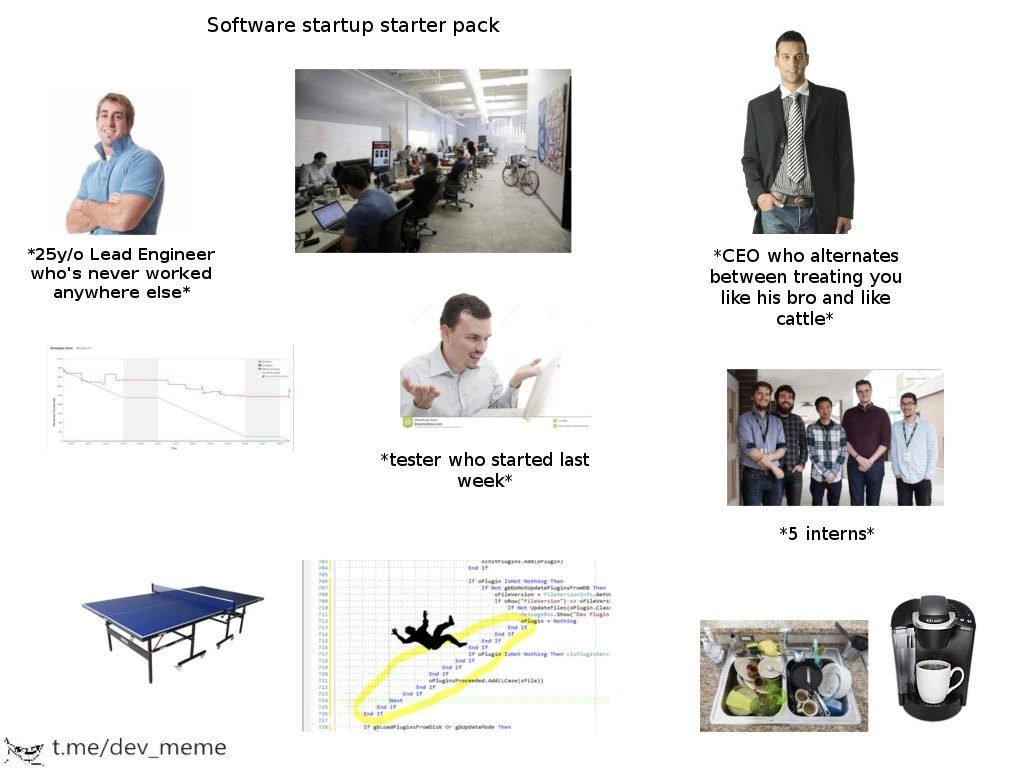
Let’s break down the meme’s elements in simpler terms. This image set is called a “Software startup starter pack.” A starter pack meme means it’s showing a bunch of things you almost always find in a certain scenario – here, a software startup company. Each picture in the collage represents a stereotype or common feature of life at a young tech startup. If you’re a junior developer or just starting out, you might not have seen all this yet, so let’s explain why each part is significant (and funny):

  • Young Lead Engineer (25 y/o, never worked elsewhere): This is a picture of a confident-looking young man, labeled as a 25-year-old Lead Engineer who’s never worked anywhere else. In a typical company, a Lead Engineer or tech lead is someone with a lot of experience (often 10+ years) who guides the team’s technical decisions. But in many startups, titles can be exaggerated – an early employee might become “Lead” just because the team is small and he’s been there the longest (even if he’s only 25 and it’s his first job!). The meme is poking fun at that. It suggests this person has only learned at this one company, so all he knows is the startup’s way of doing things. He might be very smart and talented, but he hasn’t seen how other companies solve problems. This can be a challenge for the team because he might not be aware of best practices used elsewhere, potentially leading to mistakes or a narrow approach. It’s a “starter pack” item because a lot of startups have a young “lead” like this, someone who grew with the startup but lacks outside mentorship.

  • Open-plan Office (with a bicycle): The top-middle image shows an open office – lots of developers working at long shared tables in one big room, and there’s a bicycle against the wall. Open-plan offices are extremely common in startups and tech companies. Instead of cubicles or private offices, everyone sits together. The idea is to encourage communication and make the space feel collaborative and energetic (plus, it’s cheaper than building individual offices). The bike adds to the trendy, casual vibe (maybe someone bikes to work, or it’s just decoration to look hip). However, open offices can be noisy and distracting since there’s no sound barrier. If you need to concentrate on coding, having people moving and talking around you can be tough. Many developers end up wearing headphones to get some quiet. The meme includes this to say, “Yup, startups love open offices!” – it’s basically part of the startup identity, even if it’s a bit annoying day-to-day. Seasoned folks roll their eyes at the bike and open space because it looks cool, but isn’t always the best for productivity.

  • CEO: alternates between “bro” and treating you like cattle: The top-right image is a guy in a suit, labeled as a CEO (Chief Executive Officer, the boss of the company) who sometimes treats you like his “bro” (slang for buddy or friend) and sometimes like cattle (livestock). This is describing a common experience in some startup cultures: the boss tries to be super friendly and informal – like, “Hey man, we’re all friends here, let’s grab a beer after work, haha!” – but then can quickly switch to being very impersonal or harsh when talking about work or deadlines, as if employees are just workers he owns. Being treated “like cattle” means being treated as a resource or a number, not an individual. So one day the CEO might be in t-shirt and jeans saying “We’re a family!”, and the next day he’s all about “numbers, productivity, you guys need to work harder”. For a junior employee, this is confusing: Are we buddies or am I just an underling? The meme pokes fun at that inconsistent corporate culture. The CEO calling you “bro” is part of what people call bro culture – a very casual, sometimes fraternity-like atmosphere common in some startups (often with young male leadership). It can create a fun vibe, but it can also be unprofessional or even toxic if taken too far. So this CEO character embodies that mix of Hey, we’re cool and Get back to work that many find ironic in startups.

  • Burndown Chart (Agile metric graph): In the middle of the left column, there’s a little chart image that looks like a graph going downwards with some bumps. That’s a burndown chart. It’s used in Agile software development, specifically in Scrum (a popular project management framework). Here’s how it works: a team plans a “sprint” (say 2 weeks of work) and the burndown chart is supposed to track how many tasks or how much work is left each day. If things are on track, the line goes steadily down to zero by the end of the sprint (meaning all planned work is done). If the line isn’t going down, it means tasks are not being completed as expected (maybe tasks are harder than thought, or new tasks were added). The chart in the meme is likely showing a not-so-great burndown – maybe it’s flat or goes up at points – implying the team’s progress is off track. Including this in the starter pack suggests that the startup is trying to use Agile/Scrum practices (like good tech companies do), but in reality, their planning might be chaotic. Often startups claim they’re “Agile” but then change priorities constantly, which messes up the chart. For a junior developer, this is a sign that what you learned about Scrum in theory isn’t always how it works in practice. The meme is using the burndown chart as a symbol of the project management chaos: it’s there, but it’s not really making things smooth.

  • Tester who started last week: The middle-center image shows a person (maybe a QA engineer or tester) pointing at a monitor, with the caption that they started last week. This highlights that the Quality Assurance (QA) or testing role in this startup is very new. Possibly, they only hired a tester recently. In a robust development process, QA testers are important from early on – they catch bugs and ensure the product works correctly before it reaches customers. If a tester just joined, it implies that for a long time there might have been no dedicated tester at all. Maybe developers were testing their own code (which can miss a lot of issues), or testing was neglected due to speed. For you as a newcomer, if you join such a startup, you might notice that testing isn’t very thorough yet because the person responsible is still literally learning the product themselves. The humor here is subtle but clear to those in tech: a brand-new tester means “we didn’t bother with proper QA until recently, oops.” It’s both a warning sign and a common reality in fast-paced startup environments where delivering features quickly is often priority one.

  • 5 Interns (group of five juniors): The middle-right picture shows five casually dressed young people (probably in their early 20s), labeled as interns. Interns are typically students or very fresh graduates who work for a short period (a summer, a few months) to learn and assist on projects. Having five interns suggests the startup has hired a bunch of junior folks to help with work. On one hand, interns can be bright and bring new energy. On the other hand, because they’re inexperienced, they need training and oversight. The meme including “5 interns” highlights a phenomenon: some startups rely heavily on interns (or entry-level developers) because they’re cheaper to employ than seniors and often willing to work hard for experience. The joke is that if basically a chunk of your team are interns, who’s teaching them? It might end up like “the blind leading the blind” if your lead is also very young. For a junior developer just out of intern stage, it might actually sound fun to have lots of peers, but it also means few mentors around. It’s both funny and a bit concerning — you can imagine a scenario where five interns are building crucial parts of the product with only one or two experienced people in the whole team. Things might work, but there will be a lot of learning through mistakes along the way!

  • Ping-pong table: The bottom-left image shows a ping-pong (table tennis) table. This is a well-known symbol of startup and tech company culture. A lot of tech offices, especially startups, have games like ping-pong, foosball, video game consoles, etc., in the office. These are meant to give employees a way to relax, have fun, and bond with colleagues during breaks. It’s part of creating a “cool, fun workplace.” However, it’s become a bit of a cliché or stereotype — so much so that seeing a ping-pong table in an office tour is almost expected in tech. The meme includes it because no “startup starter pack” would be complete without the token ping-pong table! The funny (or sad) reality is sometimes everyone is too busy to actually use these fun perks. Many developers joke that the ping-pong table just collects dust or is used maybe during the first month and then forgotten when deadlines loom. So as a junior dev, if you join a startup, sure, you might have these cool perks around, but don’t be surprised if the culture is still extremely work-focused. The ping-pong table here represents that promise of a laid-back culture that might not actually materialize once you’re swamped with work. It’s there to make the office feel fun and youthful — which is definitely a thing in StartupCulture — but whether people get to enjoy it is another story.

  • Code editor with a falling person silhouette: The bottom-middle panel is a bit abstract. It shows a screenshot of a code editor (where code is written) with some lines highlighted, and over it a black silhouette of a person falling backward. This likely symbolizes something like the codebase or project falling apart or someone “falling into” a mess. In other words, it’s a metaphor for things going wrong in the code. Perhaps the highlighted code lines indicate an error or a piece of tricky code, and the falling silhouette is a dramatic way to say “the project is in free-fall” or “someone is spiraling trying to fix this code.” If you’re new to development, imagine feeling like you’re falling when you look at confusing or badly written code — it’s overwhelming. This visual is a creative addition to the meme to imply that the software’s quality or stability is not great. With all those interns and a newbie tester, it wouldn’t surprise anyone that the code might be full of bugs or quick-and-dirty solutions that could cause crashes. So the falling figure could be a developer who’s lost control of the situation, or the project itself plummeting in quality. It’s a humorous way to depict that sense of “uh oh, things are not under control!” which, again, is relatable in fast-moving startups.

  • Overflowing sink with dirty mugs (and coffee machine): The bottom-right image shows a kitchen sink in the office, piled high with dirty coffee mugs and dishes, next to a single-serve coffee maker. This is a very down-to-earth detail. Many offices offer free coffee (hence the coffee machine, likely a Keurig or similar). People drink coffee to stay productive (especially if they’re working long hours). But who cleans the cups? In a big company, maybe there are cleaners or a culture of cleaning up after yourself. In a scrappy startup, there often isn’t a formal system for this – everyone is expected to handle their own dishes. But if folks are extremely busy or not used to tidying up, you get a messy kitchenette, just like in the picture. The pile of dirty mugs suggests that no one is taking the time to wash up – perhaps everyone thinks “someone else will do it” or they’re too tired from coding to care. It’s a small example of how some basic organization can fall through the cracks. The meme uses it to represent the less glamorous side of startup life: sure, you have free coffee, but also a sink full of gross, stained mugs because there’s no office janitor and people haven’t developed a cleaning routine. For a new worker, this scene is both funny and telling – it shows that this startup is so focused on their work (or so lacking in office management) that even cleaning up is neglected. It contributes to the overall picture of a chaotic, youthful workplace where structure and cleanliness might not be priorities.

So, putting it together in plain terms: this meme is highlighting the reality of many startups in a humorous way. A startup might offer cool perks and have energetic young staff, but it often comes with inexperience and chaos. The “starter pack” includes youthful leadership (lots of energy but not much experience), an overly casual but demanding boss, lots of junior staff/interns, basic Agile tools like charts that might not actually fix their planning issues, fun stuff like ping-pong tables that symbolize the marketed culture, and overlooked everyday issues like messy sinks and shaky code.

For a junior developer, it’s funny because you might imagine joining a startup will be all fun and games and rapid success. The starter pack meme playfully warns: you’ll indeed get ping-pong and a chill vibe on the surface, but you’ll also get sudden crunch times, leaders learning to lead, potentially messy code to deal with, and yes, you may have to wash your own coffee mug (if you can find a clean one). It’s relatable humor for anyone who has seen the inside of a startup or is about to – a mix of exciting and messy all at once. Essentially, StartupLife in a nutshell.

Level 3: Ping-Pong Driven Development

At the highest level, this collage lampoons a typical startup culture that experienced engineers know all too well. It's basically a checklist of startup clichés: an overconfident 25-year-old Lead Engineer (who has only ever worked at this one company), a “bro” CEO with mood swings between buddy and boss, a small army of interns doing much of the coding, token Agile artifacts like a burndown chart that’s not actually helping, and of course the obligatory open office with a bike and a lonely ping-pong table. Seasoned developers see the humor because these elements often travel together in real life, setting the stage for chaotic projects and hefty technical debt.

Take that young Lead Engineer who’s never worked anywhere else: in a veteran’s eyes this screams bus factor = 1 (only one person deeply understands the system). He’s likely a self-taught prodigy of the product, but with no outside experience he might be reinventing the wheel (or reinventing a square wheel) in the codebase. Such a lead often ends up making critical architecture decisions based on a narrow perspective. There’s no older mentor around to say, “Actually, we tried a pattern like that at BigCorp and it failed spectacularly.” The result? The code may be held together by enthusiasm and quick fixes, but lacking the seasoned foresight that prevents future bugs and scaling issues. This is how technical debt accumulates: shortcuts made by bright devs who just don’t have the scar tissue yet. A cynical senior knows that a year or two down the line, that proud 25-year-old might be drowning in late-night hotfixes because of decisions made in blissful naïveté.

Now add the CEO who alternates between treating you like his bro and like cattle. This is a classic bro culture management anti-pattern. One minute the CEO is slapping your back saying, “Hey bro, we’re a family here, let’s crush some code and celebrate with beers!” The next minute, he’s eyeing burn rate and demanding, “Why aren’t you coding faster? I need this done yesterday,” as if engineers are just replaceable parts. This inconsistent leadership style creates whiplash. It’s fake camaraderie mixed with pure pressure. Seasoned devs have seen it: the boss who touts a “chill startup vibe” to lure you in, only to pivot into corporate drill-sergeant mode when investors demand results. The meme nails this absurdity by literally captioning the CEO’s fickle persona. The dark humor here is that being treated as both a buddy and a beast of burden inevitably leads to confusion, low morale, and often burnout – something many of us cynically expect from these environments.

Meanwhile, the actual work falls to an overworked lead and a band of 5 interns. Yes, five! The middle-right panel showing “5 interns” is a wink at how startups often staff up with loads of junior developers or college interns to save money and fuel the hustle. The intern army approach means there are many eager hands on the keyboard but not a lot of experience guiding them. Any senior engineer can tell you that throwing more untrained people at a problem doesn’t linearly speed things up – often it creates management overhead and inconsistencies. Each intern might write code in a different style, possibly introducing the kind of bugs or “creative solutions” that make you mumble “What were they thinking?” during code review. With one harried 25-year-old lead overseeing five newbies, you can bet there’s minimal code review or mentorship happening. The codebase can turn into a patchwork quilt of half-implemented features and // TODO comments. It’s funny in a painful way: we’ve seen production code with intern fingerprints all over it and wondered if the QA team (if one exists) was praying more than testing. In short, the meme’s interns panel symbolizes a well-known startup scenario: lots of raw talent and energy, very little structure – a perfect recipe for “learning by making mistakes in production.” 🧨

Speaking of QA, notice the “tester who started last week”. To a seasoned observer, this screams afterthought. It’s like the company said, “Oops, maybe we should test this thing?” only very late in the game. This poor tester is brand new, meaning the testing process is immature or even nonexistent up to that point. A veteran immediately thinks of all the bugs that likely slipped to users because there was no dedicated QA until now. And if the tester is as green as the interns, well… the bugs are probably having a field day. This panel highlights a common startup trait: focusing on churning out features fast (often by junior devs) and leaving quality assurance under-resourced. It’s ironic – they might have a burndown chart suggesting they follow Scrum or Agile processes, but what good is a burndown if half the “done” work is untested? The burndown chart image itself (bottom-left of the top row) likely shows something telling – perhaps a line that should slope steadily down as work is completed, but instead is jagged or flat. If tasks keep getting added (scope creep) or not finished, a burndown line can even go up or plateau. The meme includes it to represent how chaotic the project management probably is behind the scenes. To any experienced Agile practitioner, a funky burndown is a red flag: maybe the team is skipping retros, or the Product Owner (maybe our hyper CEO) changes priorities mid-sprint daily. The meme deliberately leaves this chart caption-less, as the image alone is a universal symbol of sprint drama to those in the know. It’s the irony of startups: they adopt Agile ceremonies like daily stand-ups and sprint boards, but often don’t truly stick to the discipline, resulting in charts that basically say “we have no idea if we’ll finish on time.”

Now, let’s talk about the open-plan office snapshot (top-middle). To a seasoned dev, this picture triggers memories of noise-cancelling headphones and trying to debug while someone two desks over is loudly discussing weekend plans. Open offices are practically the default in startup land – partly to save money (no cubicle walls or private offices), partly because of the belief that open space = more collaboration. In theory, it’s meant to foster spontaneous teamwork; in practice, it often fosters distraction. But startups flaunt it as part of their culture: “Look how cool and transparent our workspace is!” The photo even has a random bicycle against the wall – an almost comically stereotypical detail. (Who knows, maybe an employee bikes to work, or maybe it’s just there for vibes). Veteran engineers smirk at that because it epitomizes the StartupLife aesthetic: quirky decor and a casual feel, which is nice until you realize an open floor means taking your Zoom call in the hallway because there’s no meeting room. The open office layout in the meme is a nod to that DeveloperExperience (DX) trade-off: you get a trendy space and the energy of a bullpen, but sacrifice quiet concentration. It’s funny because nearly every startup claims an open office “improves communication,” yet developers often find themselves slinking off to a quiet corner (or wishing for a cubicle) when crunch time hits.

Ah, and behold the ping-pong table (bottom-left panel). The ping_pong_table_cliche is perhaps the most iconic of all startup tropes in this meme. It’s such a known joke that even non-developers associate tech startups with ping-pong or foosball tables in the break room. Here it stands alone in the image, almost like a shrine to forced fun. The humor is that this supposed stress-relief perk often sits unused while everyone is too stressed to take a break! A ping-pong table is management’s way of saying, “See, we have fun and balance!” even if developers haven’t seen a real lunch break in weeks. Seasoned folks wink at this because we’ve seen ping-pong tables gather dust or become makeshift stand-up meeting tables. It’s WorkplaceHumor 101: trivial perk vs. actual workload. The presence of the ping-pong table in the “starter pack” suggests that the company advertises a playful culture, but given everything else (crunch, interns, bug charts), nobody has time to play. In other words, it’s culture theater. We joke that ping-pong is the microservice that always times out – you intend to play after work, but work never actually ends. It’s a symbol of how startups often promise a fun, laid-back environment as a recruiting tool, while the reality is all-hands-on-deck chaos.

Finally, the bottom-right image: the overflowing kitchen sink with dirty mugs and that single-serve coffee machine (hello, Keurig). This one might seem like just office comedy, but it’s surprisingly on point. Many of us who’ve been in small companies recognize exactly this sight: lots of enthusiastic coffee drinking to fuel coding marathons, and a sink full of messy kitchenette carnage because… well, who’s responsible for cleanup in a “flat” organization? 🤷‍♂️ The startup probably doesn’t have facilities or cleaning staff, and everyone’s working 12-hour days, so dirty dishes pile up. It’s a running joke in corporate culture that the office kitchen reveals the true health of the workplace. Here, the messy kitchen shows a lack of basic organization and personal responsibility – possibly the same kind of neglect that might be happening in the code (no one “cleans up” the technical debt either!). The coffee machine itself hints at another reality: people are practically living on caffeine (typical startup hustle mode), but no one has five minutes to rinse a mug. A senior dev might quip, “They have time to implement a new feature overnight, but not to implement a dishwashing schedule.” It’s relatable and slightly gross humor that underscores the immaturity of the setup: a company rushing to build the next big app, yet ignoring the little things that keep a workplace sane (like clean cups or stable code).

When you put all these pieces together, the meme paints a hilariously accurate composite of startup life’s dark underbelly. Each panel is funny on its own, but combined, they tell a story: youthful enthusiasm, minimal experience, big ambitions, chaotic execution. The seasoned perspective appreciates the meme as more than random jokes – it’s basically an insider’s roast of startup culture. We nod along (perhaps with a slight cringe) because we’ve been in those open offices, we’ve dealt with that “cool” CEO who turns on a dime, we’ve cleaned up interns’ code at 2 AM, and yes, we’ve seen the ping-pong table become a coat rack during crunch time. It’s developer humor with a sting of truth: a relatable mash-up of workplace realities that many in tech have survived. Below is a tongue-in-cheek summary that contrasts the glossy startup image with the underlying reality:

Startup Showpiece Unspoken Reality
25 y/o "Lead Engineer" – touted as a prodigy
("young genius in charge")
Only knows this codebase; learning on the job.
Architecture held together by youthful optimism and quick patches.
CEO: “We’re all family, bro!”
(casual vibes)
“You’re units of productivity.”
Expects 80-hour weeks and weekend deployments because passion, bro.
5 Eager Internscheap labor FTW 5 newbies who need guidance.
Senior mentorship = near zero, mistakes in code = many.
Agile/Scrum Board & Burndown“We use Agile!” Agile theater: scope creeps, deadlines slip.
Burndown chart looks like a plate of spaghetti 🍝 (just like the code).
Open Office and Hip Decorcollaborative space 🚲 No quiet space to focus.
Constant interruptions; at least the bike looks cool collecting dust.
Ping-Pong Table & Perks“We play hard!” 🏓 Nobody has time to play.
Ping-pong paddles lost under a pile of sprint printouts and stress balls.
Brand-new QA Tester“Quality is important!” Product mostly shipped untested until now.
QA still figuring out what the product does (bugs sneak through).
Free Coffee & Snacksfuel for creativity Also free dirty dishes.
No one assigned to cleanup; cups and code both left dirty for someone else to fix.

Every line of that table is essentially what a jaded engineer reads when seeing the meme’s images. It resonates with the RelatableDeveloperExperience of anyone who’s been through a scrappy startup or a “glorified frat house” tech company. The humor hits home because it’s rooted in truth: these aren’t just random jokes, but the common structural problems in startup workplace culture. In sum, Level 3 exposes why the meme is hilarious to industry veterans – it’s an accurate satire of the startup starter pack, where idealism and reality collide in amusing (and often frustrating) ways. We laugh so we don’t cry, basically. 😅

Description

A 'starter pack' meme titled 'Software startup starter pack' that satirizes the common tropes and stereotypes of early-stage tech companies. The meme is a collage of nine images with captions on a white background. Clockwise from top left: a confident young man captioned '*25y/o Lead Engineer who's never worked anywhere else*'; a chaotic open-plan office; a CEO in a suit and jeans described as '*CEO who alternates between treating you like his bro and like cattle*'; a group of '*5 interns*'; a messy kitchen sink full of dirty dishes; a coffee maker; a screenshot of extremely nested 'If' statements with a silhouette of a person falling through them, representing technical debt; a ping pong table; a flatlining burndown chart; and at the center, a confused man captioned '*tester who started last week*'. The meme humorously critiques the chaotic, under-resourced, and often dysfunctional environment of startups, from inexperienced leadership and reliance on interns to the accumulation of tech debt and the illusion of perks like ping pong tables
Comments

7
Anonymous ★ Top Pick Our startup has two infinite loops: the CI/CD pipeline trying to build the legacy module, and the debate over whose turn it is to empty the dishwasher
  1. Anonymous ★ Top Pick

    Our startup has two infinite loops: the CI/CD pipeline trying to build the legacy module, and the debate over whose turn it is to empty the dishwasher

  2. Anonymous

    The 25-year-old ‘lead’ just split the monolith into five intern-written microservices; the burndown chart says we’re ahead, the CEO bro-hugs everyone, and I’m penciling in the eventual-consistency outage for Q3

  3. Anonymous

    The real startup starter pack: a 25-year-old 'senior' architect who learned system design from YouTube, a CEO who pivots between 'we're a family' and 'KPIs aren't suggestions,' and a production codebase that's 70% commented-out experiments from the last three pivots. But hey, at least the ping pong table works better than the CI/CD pipeline

  4. Anonymous

    Ah yes, the classic early-stage startup composition: a lead engineer whose entire architectural worldview was formed in a college dorm, a CEO oscillating between 'we're all family here' and 'why isn't this shipped yet,' a QA engineer thrown into the deep end with zero context, an intern platoon compensating for the lack of senior talent, and a ping pong table that's seen more action than the CI/CD pipeline. The declining metrics chart and production crash screenshot tell the real story, while the sink full of dishes serves as a leading indicator of organizational dysfunction. The Keurig is the only thing working reliably - because unlike the codebase, it came with documentation and a support contract

  5. Anonymous

    Startup starter pack: org chart is CEO → 25‑year‑old “lead” → five interns → prod; QA is the sink, observability is circling a stack trace, and the office bike is the only thing with reliable velocity

  6. Anonymous

    Scaling a startup monolith is trivial when your 'lead engineer' treats Kubernetes like a beer pong variant

  7. Anonymous

    Nothing says production‑ready like a bus factor of one, five interns with prod access, QA onboarded yesterday, and a burndown trending like runway - good thing the ping‑pong SLO is the only metric green

Use J and K for navigation