When a MySQL bug survives long enough to earn its driver’s license
Why is this Bugs meme funny?
Level 1: When a Bug Grows Up
Imagine you had a toy that was broken when you were very little. You told an adult about it, and they said, “I’ll fix it soon.” But days passed, then months, then years... and nobody ever fixed that toy. You grow older – you finish elementary school, then middle school – and the toy is still sitting there with the same broken part. By the time you’re a teenager, you hardly play with that toy anymore, yet amazingly it’s still not fixed. You might joke, “Wow, this toy has been broken for so long, it’s old enough to start driving a car!”
Sounds silly, right? That’s exactly what happened with a computer problem (called a “bug”) in a program that many people use. The problem was noticed a long time ago, but nobody fixed it for such a long time that the problem itself became as old as a teenager. People found this both frustrating and funny. They started making jokes about the “old bug” – like pretending the bug is a person having a 15th birthday, ready to get a driver’s license. Even the person who first complained about the problem years ago chimed in to say, “Hey, I’m still here, and it’s still not fixed!” Everyone laughed because it’s crazy for a mistake to stick around that long.
So, why is this funny? It’s the contrast – we expect mistakes to be corrected quickly, not to hang around until they’re “grown up.” When something small is neglected for a very long time, it becomes a big joke. It’s like if a leak in your ceiling never got fixed and 15 years later you’re like, “Hello, old friend, you’ve been dripping since I was a kid!” It’s a way to laugh about something that’s actually a bit annoying. In short, this meme is saying: “Can you believe this little problem has been around so long? It’s practically a teenager now!” And that idea is so absurd that it makes people smile.
Level 2: Legacy Lesson
Let’s break this down in simpler terms. MySQL is a very popular database system – think of it as a big electronic filing cabinet for websites and applications to store information (like usernames, posts, or product data). In any software like MySQL, a bug means something isn’t working correctly: maybe a certain command causes an error or a calculation comes out wrong. Typically, when people find a bug, they report it on a bug tracker – an online forum where developers keep track of problems that need fixing.
Now, in a perfect world, bugs get fixed fairly quickly, especially in important software. But in reality, some bugs are not so easy to squash. They might be tricky, low priority, or just forgotten over time. This meme is about one of those stubborn bugs – a MySQL bug that has been sitting unfixed for 15 years! To give you context, 15 years is an eternity in tech. (15 years ago, the iPhone didn’t even exist yet.) That’s why people are joking that the bug is “old enough to take driving lessons”. It’s a funny exaggeration: usually only people (or maybe pets) have ages in years like that; we don’t normally talk about software issues in terms of growing up. So when a developer quips that a bug can nearly get a driver’s license, they’re highlighting just how absurdly old and unresolved this problem is.
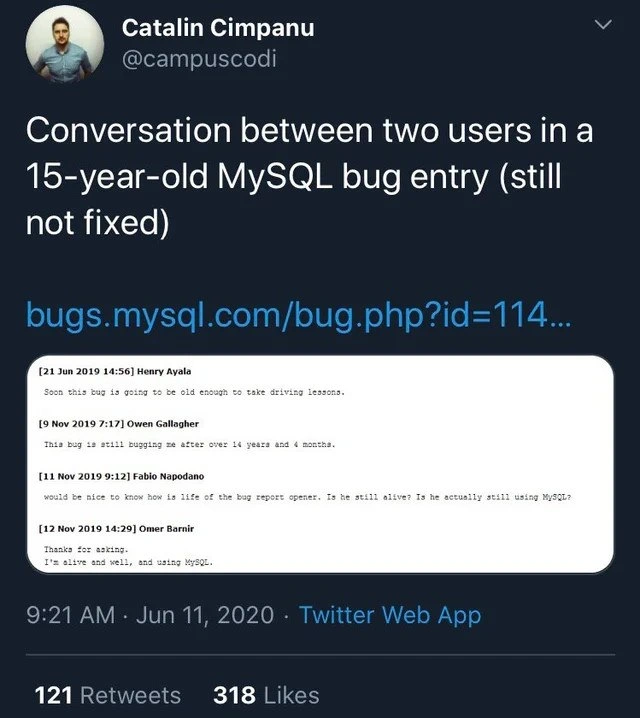
The image in the meme is a screenshot of a Twitter post which in turn shows comments from MySQL’s bug tracking website. Let’s unpack those comments:
- Henry Ayala (June 2019) said: “Soon this bug is going to be old enough to take driving lessons.” He’s humorously noting the bug’s 15th “birthday” is coming up. In many places, around 15 or 16 years old is when a teenager can start learning to drive. So he’s comparing the bug’s age to a teenager’s milestone.
- Owen Gallagher (November 2019) added: “This bug is still bugging me after over 14 years and 4 months.” He’s half-joking, half-complaining that he’s been affected by this bug for over 14 years. That shows he either has code that runs into this bug or he’s been following the bug report for that long – either way, that’s some serious patience!
- Fabio Napodano (also November 2019) wondered, “Would be nice to know how is life of the bug report opener. Is he still alive? Is he actually still using MySQL?” Here Fabio is being playfully dramatic – 15 years is such a long time that he’s joking about whether the person who originally reported the bug is even alive or still using this software. It’s hyperbole (exaggeration for effect), but it conveys the surprise at how long this has dragged on.
- Finally, Omer Barnir (the original bug reporter, as it turns out) responds: “Thanks for asking, I’m alive and well, and using MySQL.” This is the punchline of the whole thread. Imagine everyone speculating whether the guy who filed the bug way back in the mid-2000s is still around, and he pipes up to say, essentially, “Hey guys, I’m still here and yep, I still use MySQL (and the bug is still annoying me).” It’s a mic-drop moment because it confirms the ridiculousness – the person who first found the bug stuck around 15 years waiting, and nothing changed.
So, why does this happen? How can a bug last 15 years? There are a few reasons:
- Priority: Not all bugs are equal. Some are critical (like security flaws or major crashes) – those get fixed ASAP. Others are minor – maybe the bug only happens in rare situations or there’s an easy workaround. Those might get put off. This MySQL bug might have been considered minor enough that each year, other bigger issues or features always took precedence.
- Complexity: Sometimes a bug is a symptom of a deeper problem in the software’s design. Fixing it might require a huge overhaul or could risk breaking other things. In a complex database engine like MySQL, a seemingly small bug could be intertwined with fundamental code. Developers might hesitate to touch it without a really good reason.
- Legacy Behavior: After such a long time, oddly enough, people might rely on the bug’s behavior. This sounds weird, but if users discovered the bug and found a workaround, they might write their applications expecting the buggy behavior. If an update suddenly fixes it, those applications could behave differently or break. It’s the unintended consequence of leaving a bug around: it becomes part of the system’s character.
- Resource Limits: MySQL has a dedicated team, but like any project, they have limited time. They focus on things that affect many users or align with new features. If this bug was affecting only a niche case, it may have continually fallen to the bottom of the to-do list. Over 15 years, teams changed, new folks came in, and this item possibly kept getting overlooked or pushed to “next release” again and again.
All of this ties into the concept of technical debt. Think of technical debt as like chores you delay in software. If you postpone cleaning up a mess in your code (or fixing a bug) because it’s not urgent, it’s like taking on a debt – you save time now, but the interest is that it might cause bigger headaches later (or simply stick around as an annoyance for ages). Over years, technical debt can pile up as unresolved bugs and clunky code that everyone just tolerates because it’s been that way forever. In our case, this 15-year-old bug is a prime example of technical debt that was never paid off. It’s actually kind of funny in a sad way – by now the “debt” was so old that developers joke about it the way you’d joke about a stubborn old grandfather who refuses to change his ways.
Legacy software is another term that’s useful here. Legacy software means older software that is still in use. MySQL has been around since the mid-90s, so by 2020 it had a lot of legacy – parts of the system that were designed a long time ago. Working on legacy software can be challenging because the original developers might be gone, documentation might be lacking, and the code can be very fragile. Picture trying to add a new room onto a 100-year-old house – you have to be careful not to disturb the existing structure. Similarly, fixing a longstanding bug in MySQL’s core might be like pulling at a thread in an old tapestry: you’re afraid a whole section might unravel. So sometimes, teams decide, “if it’s not causing too much trouble, better to leave it alone for now.” “If it ain’t broke (too badly), don’t fix it.” That mentality can lead to a bug surviving for a decade or more.
The meme is a lighthearted take on this serious problem. It’s basically developer humor where we laugh to keep from crying. Seeing those comments, any programmer who’s dealt with legacy systems will chuckle and think, “Oh boy, I know that feeling.” It’s a mix of schadenfreude (finding humor in someone else’s trouble) and commiseration (we’re all in this together). DatabaseHumor like this often becomes kind of niche-famous – e.g., many people in tech might remember “that one MySQL bug that lasted 15 years.” It’s similar to how gamers talk about a glitch in a game that the developers never patched; it gains folklore status.
To a newer developer or someone learning about software, this meme also carries a gentle lesson: not everything in real-world software development goes as planned. You might think every bug you report will be fixed in the next update, but sometimes you’ll find a bug report older than your little cousin. It teaches patience and also a bit of skepticism – you learn to work around issues and not always expect a quick fix. It also shows the importance of good maintenance practices. The MySQL team surely had reasons, but ideally, you don’t want to be the developer known for maintaining a bug until its “sweet sixteen” birthday party.
In summary, at this level we understand the meme as a commentary on bugs in software that just persist forever in big, important systems like MySQL. The driver’s license joke is there to emphasize the absurdity of a 15-year wait. It’s both a funny anecdote and a cautionary tale about how legacy software can carry issues for a very long time. If you’re starting out in programming, take note: today’s small bug could become tomorrow’s legendary annoyance if you keep kicking it down the road! Better to fix things when you can – otherwise your bug might end up old enough to legally drive itself to your office and complain. 😅
Level 3: TechDebt on Cruise Control
In the world of MySQL (a hugely popular database), it's disturbingly common to find a bug report so ancient that it predates the junior devs assigned to fix it. This meme highlights a 15-year-old MySQL bug that’s literally old enough to enroll in driver’s ed. It's the perfect storm of LegacySystems and TechnicalDebt: an issue lurking in the code base for a decade and a half, gathering dust (and witty comments) instead of a fix. Seasoned developers recognize this dark humor immediately – we've all seen that one ticket in the backlog older than some interns, its priority perpetually set to “low (later)” as years roll by.
Why would a bug remain unresolved for so long in a critical system like a database? The cynical truth: if a bug isn’t a showstopper, it often gets kicked down the road release after release. Maybe the original code is so fragile that touching it is scarier than living with the bug. Perhaps the bug only affects an edge case or an old configuration, so each new team of maintainers says “we’ll get to it eventually”. Over 15 years, MySQL changed hands (from MySQL AB to Sun Microsystems to Oracle) and priorities shifted. New features took the spotlight while this bug languished in the shadows, surviving corporate acquisitions and even major version overhauls. By now, the bug’s quirk might be considered “expected behavior” – the classic LegacySoftware phenomenon where today’s won’t-fix bug becomes tomorrow’s “feature”.
The meme screenshot shows a tweet highlighting a real conversation on MySQL’s official bug tracker. Developers vented their incredulity through humor:
Henry Ayala (Jun 2019): “Soon this bug is going to be old enough to take driving lessons.”
Owen Gallagher (Nov 2019): “This bug is still bugging me after over 14 years and 4 months.”
They’re personifying the bug as if it’s a teenager growing up – a database bug with a birthday. Another commenter, Fabio Napodano, even wonders if the original bug reporter is “still alive and still using MySQL” after all this time. In a punchline straight out of a sitcom, the original poster (Omer Barnir) replies:
Omer Barnir (Original Reporter): “Thanks for asking, I’m alive and well, and using MySQL.”
Imagine the absurdity: Omer filed this bug when perhaps MySQL 4.x was around; 15 years later, MySQL 8.0 is out, and Omer’s still waiting – alive, well, and presumably a lot more patient than most of us. This exchange is DatabaseHumor gold, but it also underscores how persistent some BugsInSoftware can be. It’s a shared industry joke: everyone has war stories of some bug that just would not die.
From a senior developer’s perspective, this scenario is both funny and painfully relatable. Every large codebase has these “immortal bugs” that survive multiple product managers, code refactors, and even whole paradigm shifts. The longer a bug lives, the more likely everyone assumes someone else has a good reason why it’s not fixed. It becomes an undying part of the system’s lore. TechnicalDebt accumulates interest over time; a bug unaddressed for 15 years is like a loan you forgot about – by the time you check again, it’s ballooned into a grotesque monument of neglect. Fixing it now might require untangling layers of changes and workarounds built on top of the original flaw. There’s even a risk users have unknowingly come to rely on the buggy behavior. (“If we fix it, we might break someone’s hacky script that expects the bug!”) So the bug lingers, simultaneously notorious and ignored, getting older and more embarrassing with each release.
This MySQL bug likely started as a minor niggle – perhaps a weird edge-case in query parsing or an off-by-one error in date handling. Something small enough to live with, but real enough to annoy anyone who encounters it. At first, developers probably intended to patch it quickly, but as new priorities rolled in, it was deferred. After a few years, it slipped into that infamous category: “known issue, low priority.” By year 10, it’s a running joke among the team, and no one wants to risk breaking stable code for a fix. After 15 years, the bug has achieved legendary status – it’s basically part of the furniture in the code. As one might say tongue-in-cheek, “Not a bug, but a feature, right?” 😏
To put it in perspective, here's how the dialogue around such a bug tends to evolve over time:
| Bug Age | Typical Response (Maintainer Inner Monologue) |
|---|---|
| 1 year old: | "Oops, slipped the last release. We’ll patch it in the next update, promise." |
| 5 years old: | "We really should fix this. It’s getting a bit embarrassing... but not today." |
| 10 years old: | "Is this still a thing? It’s survived two rewrites. Touching it might awaken ancient demons." |
| 15 years old: | "At this point, removing it might break more than it fixes. It's practically tradition!" |
You can see how a bug transitions from a to-do item to a ghost story told to new team members. The meme nails this progression with the driver’s license joke – by comparing the bug’s age to a human teenager, it highlights how surreal it is for a software flaw to persist that long. The shared laughter comes from mutual pain: every veteran dev has felt the frustration of an eternal bug that just keeps resurfacing release after release. It’s the kind of bug you mention in job interviews to test if a candidate knows the realities of maintaining LegacySystems beyond the textbook ideals.
Now, MySQL is an interesting case because it’s an open-source project with corporate backing. One would think bugs get ironed out quickly in such widely used software (MySQL runs innumerable websites and apps!). But the reality is that any complex system has layers of assumed behavior. If a bug isn’t crippling, it can slip through the cracks for years, especially if fixing it might alter results that applications have come to expect. There’s also prioritization: new features and critical security patches will always trump an old cosmetic bug. Over 15 years, how many PMs or maintainers likely looked at this bug and said “not worth the risk right now”? Probably every single one. This is how TechnicalDebt accumulates: small “later” decisions adding up to a major backlog of unresolved issues.
Consider the human side: by 2019, developers are so exasperated that they resort to humor on the bug tracker – it’s a coping mechanism. It’s both a way to draw attention (and maybe shame the maintainers a bit) and to bond over shared suffering. It’s cathartic sarcasm. Henry’s quip about driving lessons and Fabio wondering if the original poster is “still alive” are jabs at how ridiculous the wait has been. And Omer’s confirming he’s “alive and well, and using MySQL” is the cherry on top – the original reporter essentially saying, “Yep, I’m still here, guys, still waiting.” That might have stung the MySQL team a bit, who knows. The tweet gained traction (hundreds of likes) because it’s a perfect example of DatabaseHumor that transcends MySQL: it’s about any project’s bureaucratic sluggishness and the BugsInSoftware that time forgot.
In a darker comedic sense, one might say this bug has achieved a kind of immortality. It outlived various MySQL patch releases, possibly multiple project managers, and maybe even outlasted the careers of some original developers. We often joke that software years are like dog years – technology moves so fast that 15 years feels like a century. A bug from 2005 showing up in 2020 is like a ghost from the past haunting the present. It survived the era of PHP forums into the era of containerized microservices – talk about adaptability! At 15, it can get a learner’s permit; give it a few more years and it’ll be old enough to vote or drink 🍺. (If it hits 21 years unfixed, someone better throw that bug a party 🎉 in the bug tracker comments.)
On a serious note, this meme exposes a truth: legacy bugs are a symptom of growing software complexity and competing priorities. It’s a cautionary tale for engineers – the longer you leave a bug, the harder it becomes to justify fixing it. It’s also a subtle nod to the unsung persistence of user communities; people like Omer Barnir who stick around and keep using the software despite the flaws, occasionally poking the developers, “Hey, remember me? Still broken.” In a way, it’s almost heartwarming – the original reporter didn’t rage quit MySQL; he adapted or worked around the bug and carried on. That’s what many of us do with legacy systems: find workarounds, document the quirk, warn new team members, and maybe joke about it to ease the pain. This shared understanding – that TechnicalDebt and old bugs are inevitable – is what makes the meme resonate. Everyone laughing at this tweet has their own “15-year-old bug” story (or at least a 5-year-old one) from some project.
In conclusion (without actually concluding 😜), this meme isn't just poking fun at MySQL; it’s shining a light on a universal software engineering reality. The humor works on multiple levels: surface-level absurdity (a bug as old as a teenager) and deeper commentary (the slow grind of enterprise software maintenance). It’s equal parts funny and cringe-worthy, especially to the battle-scarred devs who have been on the wrong side of a “we’ll fix it later” promise. The next time you stumble on a bug that’s old enough to have its own LinkedIn profile, you’ll remember this meme and think, “well, at least it’s not alone.”
// Pseudocode: how teams handle a long-standing bug over time
function handleBug(bug) {
if (bug.age < 1) {
console.log("Log bug in tracker. Fix coming soon!");
} else if (bug.age < 5) {
console.log("Still reproduces. Pushing fix to next release...");
} else if (bug.age < 10) {
console.log("Tricky issue. Maybe addressed in a major refactor later.");
} else if (bug.age < 15) {
console.log("Legacy alert! Document the workaround and pray.");
} else {
console.log("Bug status = FEATURE; announce its anniversary edition 🎂.");
}
}
(The final line in the code above is, of course, tongue-in-cheek – when a bug lives this long, sometimes all you can do is celebrate its persistence.)
Description
The image is a screenshot of a tweet from user “Catalin Cimpanu @campuscodi.” The tweet text reads: “Conversation between two users in a 15-year-old MySQL bug entry (still not fixed) bugs.mysql.com/bug.php?id=114…”. Below that, a white clipped box shows comments from the old bug tracker: [21 Jun 2019 14:56] Henry Ayala: “Soon this bug is going to be old enough to take driving lessons.” [9 Nov 2019 7:17] Owen Gallagher: “This bug is still bugging me after over 14 years and 4 months.” [11 Nov 2019 9:12] Fabio Napodano: “would be nice to know how is life of the bug report opener. Is he still alive? Is he actually still using MySQL?” [12 Nov 2019 14:29] Omer Barnir: “Thanks for asking, I’m alive and well, and using MySQL.” The tweet footer shows “9:21 AM · Jun 11, 2020 · Twitter Web App” and engagement metrics “121 Retweets 318 Likes.” Visually it follows the dark-mode Twitter UI with a blurred avatar. Technically, the meme highlights long-standing unresolved issues, database bug tracking, and the accumulation of technical debt in legacy MySQL installations, poking fun at how some bugs outlive entire developer careers

Comments
6Comment deleted
Patch the 15-year-old MySQL bug? We can’t - four acquisitions, twelve microservices, and our entire BI pipeline now depend on the undefined behavior
This MySQL bug has outlived three LTS versions, two major architectural rewrites, and at least one engineer's entire career arc from junior to burnout to management - yet somehow it's still marked as "triaged" instead of "working as intended by now."
A 15-year-old MySQL bug that's 'still bugging' users after over 14 years - at this point, it's not technical debt, it's a legacy family heirloom passed down through generations of DBAs. The original reporter is still alive and using MySQL, which says less about the bug's severity and more about the Stockholm syndrome that comes with enterprise database commitments. When your bug report is old enough to get a learner's permit, maybe it's time to accept it's a feature
A 15-year-old MySQL bug isn’t a bug anymore; it’s a compatibility guarantee - fix it and you’ll break half the ORMs and a decade of StackOverflow answers
MySQL bug triage: Confirm it's broken, then gatekeep with 'You still using it?' - because nothing fixes legacy pain like victim-blaming
A 15‑year MySQL bug is basically an ABI now - change it and you’ll summon every schema that grew around its undefined behavior