Skip to content
DevMeme
1676 of 7435
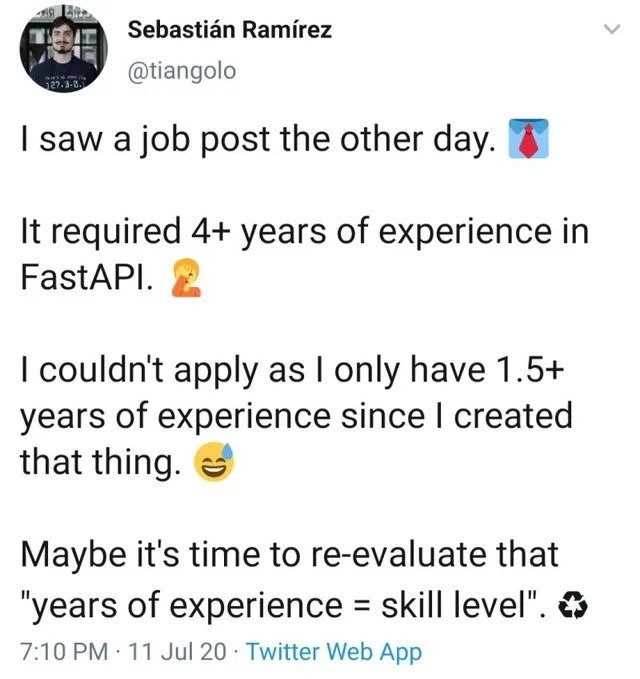
FastAPI creator can't apply to job demanding 4+ years FastAPI experience
Career HR Post #1872, on Aug 6, 2020 in TG

FastAPI creator can't apply to job demanding 4+ years FastAPI experience

Why is this Career HR meme funny?

Level 1: The Impossible Rule

Imagine you invented a new game just last year. You know all the rules because, after all, you made the game! Now you see a club announcement that says: “You can only join if you have 4 years of experience playing this game.” 🤔 That’s a pretty silly rule, right? Your game has only been around for 1 year, so nobody in the whole world could have 4 years of experience with it yet. Not even you, the creator! It’s like they made a rule that nobody can ever meet unless they time-travel to the past. It’s funny in a goofy way because the rule doesn’t match reality at all. Even though you’re the best at this new game, a rule like that would unfairly keep you out. This meme is joking about that kind of situation in real life: sometimes people ask for experience that’s impossible, and everyone who sees it goes, “Huh? That makes no sense!” It teaches us that just because someone writes a rule or requirement doesn’t mean it’s logical – and we can all see the humor when they get it so wrong.

Level 2: Experience ≠ Expertise

Let’s break down why Sebastián’s tweet made developers laugh (and sigh). FastAPI is a modern web framework for Python, used to build APIs (the back-end part of websites or services). It’s called “FastAPI” because it’s designed for speed and high performance. Importantly, FastAPI is quite new – it was first released around late 2018. By the time of this tweet in mid-2020, FastAPI had been around for roughly a year and a half. Sebastián Ramírez is the creator of FastAPI; he started the project and knows it inside-out. So when he saw a job posting asking for 4+ years of FastAPI experience, it immediately stood out as odd. Why? Because nobody could have four years experience with FastAPI at that time — the framework itself wasn’t even four years old! Not even Sebastián, who had been working on FastAPI since day one, could claim “4+ years” with it. It’s like asking for a driver’s license before cars were invented – an impossible ask.

This situation highlights a common quirk in hiring practices within tech. Many job advertisements list requirements like “X years of experience in [Technology]”. It’s a quick way for companies to signal they want someone who’s not brand new to that tech. However, this can turn into a hiring humor scenario when the numbers don’t make sense. In this case, the company likely wanted someone experienced in FastAPI (perhaps because it’s a hot new framework and they planned to use it). They might have defaulted to “4+ years” because that sounds like a seasoned candidate — maybe they use a template or think “senior = 4 years or more”. But they didn’t double-check the reality of FastAPI’s age. The result is a job_posting_fail: a requirement so out-of-touch that it accidentally excludes all possible qualified candidates. It’s an embarrassing mistake, but unfortunately not an isolated one in the tech world.

The tweet also touches on the years_of_experience_myth – the idea that the number of years you’ve been doing something equals your skill level. In theory, more years might mean more exposure and practice, but it’s not a guarantee. For example, one person could spend 2 intense years mastering FastAPI (building real projects, reading the source code, maybe even contributing to it) while another person might list 5 years of FastAPI on a résumé but only have used it occasionally on small tasks. Who is actually more skilled? Possibly the one with 2 intense years. That’s why Sebastián suggests we “re-evaluate ‘years of experience = skill level’.” He’s politely pointing out that just counting years can be misleading.

Experience_gatekeeping is the term for when companies set a years-of-experience bar that screens people out, sometimes unfairly. It can discourage great candidates who maybe haven’t racked up that magic number of years yet, even if they have the talent. In fast-evolving tech, a tool might not even exist for “X years” in the first place! Developers often share stories about these unrealistic requirements as a form of tech humor. It’s both funny and educational: funny because the mistake is obvious, and educational because it reminds everyone (including other hiring managers) to be a bit smarter when writing requirements. The industry irony here is clear: the developer of FastAPI – the expert who built it – wouldn’t qualify for a job using his own tool, because of a goofy HR rule. That contradiction makes you chuckle, then think, “Wait, that’s actually a problem.” The lesson for junior developers is: don’t be discouraged by crazy job requirements. Sometimes the requirements are written by people who don’t fully understand the tech. If you know your stuff and can demonstrate your skills, that often matters more than just the number of years on paper.

Level 3: HR's Time Paradox

We’ve hit peak irony: a company’s job posting is demanding 4+ years of experience in FastAPI — a framework that didn’t even exist 4 years ago. The punchline? This requirement would disqualify the one person who’s arguably the most qualified user on the planet: FastAPI’s creator, Sebastián Ramírez (known as @tiangolo). In the tweet, Sebastián shares that he has about 1.5 years of experience with FastAPI (since, you know, he wrote it) and even he doesn’t meet the 4+ year bar set by some overzealous HR filter. It’s a classic case of MisalignedExpectations in tech hiring, served with a side of IndustryIrony.

How does such an absurd experience_gatekeeping scenario happen? Often, non-technical HR staff or automated resume filters will slap a “X+ years” rule onto every skill in a job ad, even if the technology itself is too new to have that many candles on its birthday cake. In many postings, 4+ years is the magic number meant to signify a “senior” level. But applying that formula blindly to a brand-new framework leads to nonsense. The result is a job_posting_fail so blatant it’s comedic: the company is essentially asking for a time traveler who started using FastAPI years before its initial release. The developer community immediately recognizes this as HiringHumor gold. It’s the kind of TechHumor where you laugh, then groan, because it’s so true. We’ve all seen résumés and requirements that don’t align, but this one takes the cake.

Let’s put it in pseudo-code, just for laughs, to see why it’s so ridiculous:

required_years = {"FastAPI": 4}
candidate_years = {"FastAPI": 1.5}  # Sebastián's experience since he created FastAPI
if candidate_years["FastAPI"] < required_years["FastAPI"]:
    reject_candidate("Not enough FastAPI experience")
# Oops... this would reject the actual FastAPI creator!

In a sane world, you’d never want to auto-reject the developer who built the tool you’re hiring for. This highlights the years_of_experience_myth at play: the false belief that more years using a technology always equals higher skill. Sure, experience is valuable, but beyond a certain point years != skill level. Someone deeply involved in a project for 1-2 years (like an open-source framework author) can easily have more expertise than someone who’s listlessly “used” it for 5 years. Yet, hiring practices often reduce competence to a simple integer in a requirements list. These resume_screening_flaws lead to absurd outcomes. It’s not the first time, either: seasoned devs swap war stories about postings asking for 10+ years of experience in Kubernetes (an orchestration tool open-sourced only in 2014) or 5 years of Swift right after Apple’s new language turned 3. Each time, the community’s reaction is a mix of laughter and facepalms.

The tweet’s final line nails the lesson: “Maybe it’s time to re-evaluate that ‘years of experience = skill level’.” This meme resonates because it exposes a painful truth with humor. It calls out HiringPractices that prioritize checkboxes over actual capability. The IndustryIrony here is hard to miss: if even the developer_created_tool guy can’t satisfy the criteria, maybe the criteria itself is flawed. For experienced developers, this is both funny and frustrating — funny because of how blatantly off-base it is, and frustrating because many have been filtered out by such one-size-fits-all requirements. In short, the joke highlights a very real issue: skill isn’t just a number, and a hiring system that can’t tell a genius from a newbie because of an arbitrary year count might need an update (♻️ re-evaluate, as the tweet says). Until then, we’ll keep our time machines on standby for the next job post.

Description

Screenshot of a tweet by Sebastián Ramírez (@tiangolo) on a white Twitter interface. The tweet reads: “I saw a job post the other day. 👔 It required 4+ years of experience in FastAPI. 🤔 I couldn't apply as I only have 1.5+ years of experience since I created that thing. 😅 Maybe it's time to re-evaluate that 'years of experience = skill level'. ♻️” A timestamp below shows “7:10 PM · 11 Jul 20 · Twitter Web App.” Visually, the content is black text on a white background with several emoji and standard Twitter layout elements. Technically, the tweet highlights the absurdity of hiring processes that demand more years of experience with a framework than the framework has existed - here, FastAPI’s own creator lacks the required tenure - underscoring flawed HR filters equating calendar years with proficiency
Comments

6
Anonymous ★ Top Pick Love when the ATS filters out the person who wrote the framework for lacking “4+ years of FastAPI” - proof our hiring pipeline is eventually consistent, it’s just running with infinite replication lag
  1. Anonymous ★ Top Pick

    Love when the ATS filters out the person who wrote the framework for lacking “4+ years of FastAPI” - proof our hiring pipeline is eventually consistent, it’s just running with infinite replication lag

  2. Anonymous

    Somewhere a recruiter is explaining how they need someone who worked on FastAPI before it was open-sourced, because "startup experience with pre-release frameworks shows real initiative."

  3. Anonymous

    When you literally invented the framework but HR's ATS filters you out because you don't have enough experience with your own creation. Classic case of 'years of experience' being a proxy metric that breaks down spectacularly when the technology is younger than the requirement. It's the technical equivalent of asking Guido van Rossum for 30 years of Python experience in 1995 - a beautiful illustration of how hiring processes often optimize for easily measurable proxies rather than actual competence, leaving us with the delicious irony of gatekeeping the gatekeeper

  4. Anonymous

    Only in tech can the person who built FastAPI be “underqualified” to use it - our hiring pipeline is eventually consistent with reality

  5. Anonymous

    When your own framework outpaces job reqs faster than its Pydantic validation - talk about premature seniority

  6. Anonymous

    ATS DDL: CHECK(years_with_tool >= 4); when age(tool) < 2 it's a constraint violation - authorship still gets a 403 at the API gateway

Use J and K for navigation