Skip to content
DevMeme
1678 of 7435
Summing Up Developer Work in One Ridiculously Long camelCase Word on Twitter
DevCommunities Post #1874, on Aug 6, 2020 in TG

Summing Up Developer Work in One Ridiculously Long camelCase Word on Twitter

Why is this DevCommunities meme funny?

Level 1: One Long Word

Imagine your teacher asks everyone in class to describe their day using just one word. That’s pretty hard, right? One clever kid decides to play by the rules in a silly way: they mash all their activities into one super long “word” by removing the spaces. They say: “IWokeUpAteBreakfastWentToSchoolPlayedWithFriendsAndSometimesIPayAttention.” It looks like nonsense at first, but if you add spaces and read the capital letters, you see it’s actually a whole sentence about their day! Everyone giggles because it’s technically one word, but it’s ridiculously long and funny.

That’s exactly what happened in this meme. A programmer was asked to sum up their job in just a couple of words. Instead of answering normally, they made one giant word out of a whole sentence: “iWriteCodeUsingCamelCaseOrPascalCaseAndOftenButNotAlwaysTheCodeWorks.” It’s like a secret code language where each capital letter starts a new word. This is something programmers do when naming things in their code (since they can’t have spaces in names). The joke is funny because the programmer found a cheeky way to fit a big answer into the one-word limit. They’re basically saying, “I spend my day writing code (with fancy capitalized names) and a lot of the time it works... but not always!” It’s a playful, honest answer about their job, hidden inside one very long word. Even if you’re not a coder, you can laugh at how over-the-top that one word is and how proud they are for coming up with it!

Level 2: CamelCase vs PascalCase

Let’s break down what’s going on for those newer to coding. The tweet’s answer looks like gibberish at first, but it’s actually a sentence written in a special coding style. Programmers often name their variables or functions without spaces, capitalizing each word to make it readable. This is known as CamelCase or PascalCase, which are types of naming conventions. A naming convention is just an agreed-upon way to name things in code so everyone on the team is consistent. Consistency makes code easier to read (and to catch mistakes).

  • CamelCase typically means you start with a lowercase letter and then capitalize each new word, like the humps of a camel. For example, a variable for a user’s first name might be named firstName in CamelCase. See how the N in Name is capitalized to show a new word? It’s easier to read than firstname all in lowercase.
  • PascalCase is very similar, but you start with an uppercase letter. Each new word is capitalized as well. For instance, FirstName in PascalCase (notice the F is also capital). PascalCase is often used for things like class names or project names.

In the tweet, the developer wrote: iWriteCodeUsingCamelCaseOrPascalCaseAndOftenButNotAlwaysTheCodeWorks. This is one long identifier that follows the CamelCase style (it starts with a lowercase i in iWrite and then each word after starts with a capital letter). Let’s decipher it in normal English with spaces: “i write code using CamelCase or PascalCase and often but not always the code works.” It’s basically a whole sentence squashed into one variable-like word!

Why would someone do this? In programming, you can’t use spaces in names of variables or functions. If you want a descriptive name, you either run the words together or use some separator like an underscore. For example, in Python you might use snake_case which looks like this_is_snake_case (all lowercase with underscores). But in languages like Java, JavaScript, or C#, the style guides prefer CamelCase/PascalCase without underscores. So developers get used to reading and writing mashed-together words with capital letters as word boundaries. It becomes a second language for us. The tweet is funny because the developer treats a normal sentence (describing his job) as if it were a variable name in code. It’s like he’s writing code in a place where you normally wouldn’t.

The content of that mega-variable is also a joke about developer life. It says he writes code using proper naming styles (CamelCase or PascalCase), and admits that oftentimes the code works, but not always. New programmers quickly learn that getting code to run correctly is not guaranteed on the first try. Bugs, errors, and unexpected behavior are everyday occurrences. When he says “often but not always the code works,” he’s poking fun at the fact that programmers spend a lot of time debugging and fixing things that didn’t work as expected. It’s a humble admission: even professionals have code break on them regularly.

This meme also reflects developer culture on Twitter and other DevCommunities. Developers bond over shared experiences like wrestling with naming conventions or fixing broken code at 2 AM. The question “describe what you actually do in 1-3 words” was meant to be a fun little prompt. Some people might answer with their official role (like “build websites” or “data analysis”). But this developer answered with playful honesty: “I code in a particular style and my code isn’t perfect.” By cramming that into one CamelCase word, he’s both following the directions (one word, technically) and showing off a bit of nerdy humor. The follow-up tweet “One word! 💪” with the strong arm emoji shows he’s proud he kept it to one word, as if it were an achievement or an inside joke that other coders will appreciate.

For a junior developer, the takeaway is: naming things in code is super important (you’ll hear this a lot!). Whether it’s CamelCase, PascalCase, or another convention like snake_case, each programming language community has guidelines (called code style guides) for how to name variables, classes, and functions. Following these makes your code cleaner and helps others read it. And as you’ve probably started to experience, writing code is more than just getting things to work on the first try. There’s a lot of tweaking and fixing when things don’t work. So this tweet captures those two truths in a fun way. Think of it as a fellow programmer saying: “I spend my days writing code with proper capitalization... and debugging when that code doesn’t run!” 😁 It’s a lighthearted summary of what software development feels like.

Level 3: CamelCase Overload

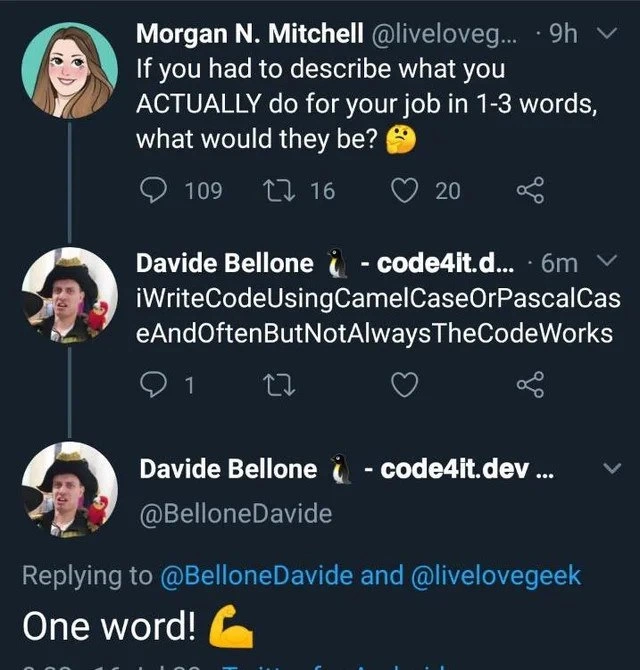
In this meme, a developer on Twitter answers a playful challenge with an absurdly long CamelCase string that describes their job. The original tweet asks, “If you had to describe what you ACTUALLY do for your job in 1-3 words, what would they be?” Instead of a normal answer like “write code” or “fix bugs,” the developer compresses a whole job description into one giant “word”:

iWriteCodeUsingCamelCaseOrPascalCaseAndOftenButNotAlwaysTheCodeWorks

This single string is a tongue-in-cheek one-word job summary. It’s written in CamelCase (each new word capitalized, no spaces) just like a long variable name in code. The humor comes from bending the rules – he technically used “one word” as required, but it’s ridiculously lengthy. This is a nod to how programmers think literally and find clever loopholes (like squeezing a sentence into one identifier). Experienced devs chuckle because reading run-together words with random capital letters is second nature to us. We do it every day when scanning code variables and function names!

Naming conventions like CamelCase and PascalCase are a big part of coding style guides, especially in languages like Java, C#, and JavaScript. By explicitly mentioning CamelCase and PascalCase in his “word,” the developer highlights a common aspect of our daily work: obsessing over how to name things. In many projects, teams enforce consistent naming because it’s crucial for CodeQuality and readability. For example, Java developers typically use camelCase for methods/variables and PascalCase for class names. The tweet exaggerates this by implying the dev spends a lot of time writing code with the right naming style – and subtly hints at the endless debates over naming in programming. (“Should this be UserID or userId or user_id? 🤔”)

Another layer of humor is the phrase “AndOftenButNotAlwaysTheCodeWorks” at the end of that mega-word. This is classic developer self-deprecation: admitting that sometimes our code doesn’t work. Every programmer knows the pain of code that almost runs perfectly – except when it doesn’t. It’s a wink to all those bug-fixing sessions and failed deployments. In the Dev community, we often joke about how getting code to work is an uphill battle. The tweet’s author basically says: “I write code (with proper casing) and often – but not always – it actually runs.” This is funny because it’s true: no matter how carefully we follow best practices (naming conventions, design patterns, etc.), something inevitably breaks.

This meme also pokes fun at how we describe our jobs. The question was asking for 1-3 words, perhaps expecting broad roles like “build software” or “solve problems.” But the dev’s answer drills down to the nitty-gritty: “I write code” (and sometimes it works 😅). By jamming that into one CamelCase variable-like word, he’s parodying the way we often think in code. It’s like he named his own job as if it were a function or variable! This resonates with other programmers because we’ve all seen or even written ridiculous variable names that try to explain everything. (Ever encountered thisVariableNameIsWayTooLongButSeemsNecessary in a codebase? You're not alone.)

The self-reply “One word! 💪” with a flexing arm emoji adds an extra chuckle for seasoned devs. It’s the poster patting himself on the back for meeting the challenge literally. There’s an implied geeky pride here: he managed to obey the letter of the request (one word) while simultaneously skirting its spirit by using a massive CamelCase concoction. This is very much in line with developer humor on Twitter: show off your clever solution with a bit of sarcasm and an emoji for flair. It highlights a cultural thing in DevCommunities – we love to play with the rules of language and code.

Underneath the joke, there’s an echo of a famous saying in software development: “There are only two hard things in Computer Science: cache invalidation, naming things, and off-by-one errors.” Naming things (like variables, functions, or even describing our job) is notoriously tricky. This giant CamelCase word humorously illustrates that challenge. The developer basically had to name his job in one word – and ended up with a comically verbose result. The fact that he includes the caveat “OftenButNotAlwaysTheCodeWorks” is a wink to every senior engineer who knows that reality all too well. It’s a perfect cocktail of DeveloperHumor: combining an inside joke about coding style (CamelCase vs PascalCase) with the everyday truth of debugging fiascos. In short, this meme encapsulates the developer experience in a nutshell (or rather, in one long variable name): we write code following style guides, and sometimes it even runs as expected.

Description

Dark-mode Twitter screenshot with three stacked tweets; profile photos and handles are partially blurred for privacy. Tweet 1 (Morgan N. Mitchell @liveloveg…, 9h) reads: “If you had to describe what you ACTUALLY do for your job in 1-3 words, what would they be? 🤔” and shows 109 replies, 16 retweets, 20 likes. Tweet 2 (Davide Bellone 🐧 - code4it.d…, 6m) answers with a single, very long camel-cased string: “iWriteCodeUsingCamelCaseOrPascalCaseAndOftenButNotAlwaysTheCodeWorks”, poking fun at variable-naming conventions and imperfect code. Tweet 3, a self-reply from the same account, simply says: “One word! 💪”. The humor arises from abusing CamelCase/PascalCase to compress an entire job description into one ‘word’, highlighting developer culture around naming, code style guides, and the reality that code only *sometimes* works
Comments

6
Anonymous ★ Top Pick renameAllTheCamelCaseLeftoversFromThe2008MonolithWhilePretendingItCountsAsDeliveringBusinessValue
  1. Anonymous ★ Top Pick

    renameAllTheCamelCaseLeftoversFromThe2008MonolithWhilePretendingItCountsAsDeliveringBusinessValue

  2. Anonymous

    After 20 years in the industry, I've realized the hardest problem in computer science isn't cache invalidation or naming things - it's explaining to stakeholders why 'iWriteCodeUsingCamelCaseOrPascalCase' technically counts as one word in our sprint retrospective

  3. Anonymous

    Every senior engineer knows the three-word job description: 'It depends, actually.' But Davide's camelCase monstrosity perfectly captures the reality - we spend more time debating whether it's `getUserById` or `GetUserByID` than actually solving the problem, and even when we finally ship, there's that nagging 'OftenButNotAlwaysTheCodeWorks' disclaimer we're all too familiar with. The real flex? Convincing yourself that camelCase without spaces technically counts as one word in your PR description

  4. Anonymous

    Requirements: “1 - 3 words.” Implementation: one 80-character CamelCase identifier. Lesson: if the spec doesn’t define the tokenizer, engineering will

  5. Anonymous

    Spec said “1 - 3 words,” so we shipped a single identifier - perfectly compliant, unreadable, and destined to fail the naming review and the canary alike

  6. Anonymous

    CamelCase for humble APIs, PascalCase for grandiose classes - either way, prod decides if it works

Use J and K for navigation