How to Achieve 100% Code Coverage with Zero Effort
Why is this Testing meme funny?
Level 1: A+ on an Easy Quiz
Imagine you had a super simple quiz in school with just one question: “What is 1 + 1?” You answer “2”, of course. You get it right, and the teacher gives you a 100% score on the quiz. You’re so happy that you run around telling everyone you got a perfect score. 🎉 Sure, it’s technically true — you did get 100% — but everyone knows that a one-question quiz about very easy math doesn’t really prove you’re a math genius. It was just too simple to begin with.
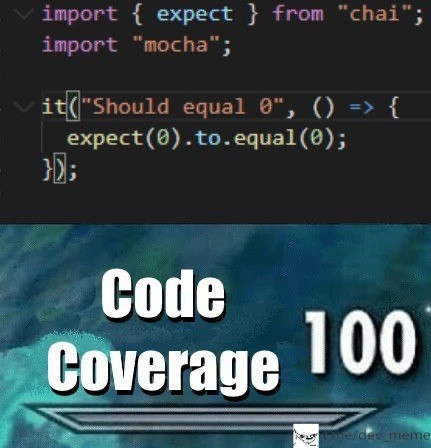
That’s exactly what’s happening in this meme. The developer wrote a test for their code that was as easy as that 1+1 question. In the test, they basically checked “Does 0 equal 0?” (which is always yes). The test passed with flying colors because, well, 0 is always equal to 0. Then they looked at their code coverage report (which is like a score for how much of the code was tested) and it showed 100%, the maximum! They started bragging like they just aced a huge exam, saying “Look, all my code is tested perfectly!” But in reality, their test was so trivial that it doesn’t prove the program works at all – just like that easy quiz doesn’t prove you studied the whole textbook.
The funny part that makes us laugh is the contrast: the big proud 100% (like a perfect score or a video game high score) versus the tiny amount of actual work done by the test. It’s as if someone did a tiny chore and then gave themselves a gold medal for “100% house cleaned.” 🤭 It shows the silliness of bragging about a perfect number when that number came from something that was basically meaningless. In simple terms, the meme is telling a little joke: getting a perfect score was easy if you cheat by making the test super easy – so don’t be fooled by just the score!
Level 2: One Weird Trick for 100%
Let’s unpack this for a newer developer. In software, a unit test is a small block of code that checks if another part of your code (usually a single function or module) works correctly. Here, the test is written using Mocha (a JavaScript testing framework) and Chai (an assertion library). Mocha provides the structure – for example, the it(" description ", testFunction) syntax to define an individual test case. Chai gives us the expect(...).to.equal(...) style so we can read assertions almost like English. In the top half of the meme, the code:
it("Should equal 0", () => {
expect(0).to.equal(0);
});
means “It (the test) should equal 0: expect 0 to equal 0.” This is the entire test. It imports the necessary libraries (import 'mocha'; import { expect } from 'chai'; not shown in snippet) and then defines one test case. The content of the test is expect(0).to.equal(0). Chai’s expect is checking that the value on the left (0) is equal to the value on the right (0). Unsurprisingly, this assertion will always pass because 0 is equal to 0. In other words, the test is trivial – it doesn’t involve any real code from the application, it’s just testing a basic fact of math/logic that was never in doubt. This is what we call a trivial_assertion. It doesn’t exercise any function or logic you wrote; it’s equivalent to writing expect(true).to.be.true. The test framework will run this and mark it as “passed” because, well, there was nothing that could possibly fail.
Now, onto code coverage – another term mentioned in the meme. Code coverage is a code quality metric that tells you what percentage of your codebase is executed by your tests. For example, if you have 100 lines of code and your tests run through 90 of those lines, you have 90% coverage. Tools generate this by instrumenting the code (basically, adding counters to every line or branch) and seeing which ones get hit during test execution. It’s common for teams to use coverage as a rough indicator of how well-tested the code is. High coverage can mean you’ve at least looked at most parts of the code with tests. 100% coverage means every single line was executed during tests – which sounds great in theory. However, coverage doesn’t tell you how well something is tested, only that it was run. This is why the meme is funny: you can reach 100% by running all the code without actually verifying it did the right thing. In extreme cases like this meme’s test, you might not run any real code at all, yet you technically have 100% coverage of... basically nothing significant! It’s a meaningless_100_percent_coverage scenario.
The bottom half’s imagery shows “Code Coverage 100” in a stylish game HUD (heads-up display). This is a video_game_ui_reference for sure – it looks like those RPG status bars showing a stat at max value. The meme creator is visually exaggerating how some developers brag about coverage as if it’s their high score. Think of it like seeing 100/100 on a progress bar and popping a “Achievement Unlocked: Testing Guru” badge. In reality, writing just one test that says 0 is 0 is like playing a game on tutorial mode. You technically completed a level, but you didn’t face any real challenge. Yet the code coverage metric doesn’t know that – it’s just a dumb number. So it gives you a full 100% because, hey, you ran one test and it executed whatever code was there (in this case, maybe only the test itself). It’s the ultimate one weird trick to satisfy the coverage tool.
For a junior developer, it’s important to learn the right lesson here: tests are supposed to check meaningful behavior in your code, not just bump numbers. Using Mocha and Chai is great – they’re common tools for UnitTesting in JavaScript, and the expect syntax reads nicely. But your test should usually call a function or method from your actual code and verify the result. For example, if you had a function add(x, y) that returns the sum, a real test might look like:
// Suppose this is part of your application code
function add(x, y) {
return x + y;
}
// A meaningful test using Mocha & Chai:
it("adds 2 and 2 to make 4", () => {
expect(add(2, 2)).to.equal(4);
});
This test actually exercises the add function and checks that it works. If add were broken (say it mistakenly multiplied instead), the test would catch it. That’s a useful test! In contrast, expect(0).to.equal(0) doesn’t involve any application code or logic – it’s just always true. It’d be like testing a calculator by saying “check that 1 is 1” instead of checking that the calculator can add or subtract. You do get TestCoverage from it (since the line expect(0)... ran), but you haven’t tested your calculator at all. So you could claim “100% tests passed, 100% coverage” while the calculator might fail to add 2+2 correctly – and you’d never know, because your tests never tried that!
In summary, the meme highlights a bit of TestingHumor: having a perfect coverage score with an utterly useless test. It’s poking fun at the practice of writing tests just to satisfy a metric. As a new developer, take it as a gentle warning: don’t write tests just to make coverage 100%. Write tests to catch mistakes and prove your code works. High coverage will often come naturally when you do that, but it’ll actually mean something. And if someone ever shows off about 100% coverage, feel free to respond with a good-natured, “Awesome, but what did you really test?” 😅.
Level 3: 100% Coverage, 0% Confidence
At first glance, an experienced developer will smirk at this scenario: a unit test that literally checks if 0 === 0 and then proudly proclaims “Code Coverage: 100”. This juxtaposition is dripping with irony. In real projects, code coverage is supposed to measure how much of your code is exercised by tests – ideally a high number means you’ve tested most cases. But here, the team achieved the holy grail of coverage using a single trivial assertion. It’s the ultimate case of metric worship: chasing the 100% test coverage statistic while completely missing the point of testing. We’ve essentially got meaningless 100 percent coverage. A veteran developer has seen this movie before – someone writing a no-op test just to make a report turn green. Goodhart’s Law haunts these situations: when a metric (like coverage) becomes a target, it loses its usefulness. In other words, hitting 100% coverage means nothing if your tests assert nothing of substance.
Let’s break down the code in the top half: it’s using the JavaScript testing duo Mocha and Chai. Mocha provides the it() function to define a test case, and Chai gives us the nice expect assertion style. The test reads:
it("Should equal 0", () => {
expect(0).to.equal(0);
});
This is a textbook trivial assertion. It verifies that 0 equals 0 – a statement that is universally true and doesn’t exercise any real application code. There’s no function or logic under test here at all. It’s as if the developer said, “I need a test, any test... okay, how about checking that JavaScript’s basic math works!” It’s a chai_mocha_setup used to do absolutely nothing meaningful. In a real codebase, such a test would execute zero lines of the actual app’s code, yet a coverage tool might still count the test file itself as “covered.” It’s the software equivalent of padding your résumé with obvious statements.
Now, why is this so funny (or cringeworthy) to seasoned devs? Because we know how code coverage tools can be gamed. For example, Istanbul/NYC (common JS coverage tools) will instrument your code and report what percentage of statements ran during tests. If your only “code” is the test itself, guess what – you’re at 100% coverage of something, technically. We’ve seen teams brag about near-100% coverage and then discovered half the tests are basically expect(true).to.be.true; 🙄. It’s a metric_worship trap: you feel victorious seeing that 100 on the dashboard, like a maxed-out RPG stat, but your tests aren’t actually catching bugs. In fact, trivial tests can lull teams into a false sense of security. A senior engineer might quip, “Our test coverage bar is full, yet our code quality HP is still at risk.”
Speaking of RPGs, the meme’s bottom half mimics a video_game_ui_reference – specifically an RPG-style status bar with “Code Coverage 100” in bold. It’s presenting that metric like a character with maxed-out experience points or health. The humor hits home because in gaming, a level-100 character is a powerhouse… but here our “level 100” testing hero gained all that XP by defeating the weakest enemy imaginable (the number 0 🤣). It’s max stats, no skills. Every seasoned dev knows that 100% code coverage doesn’t automatically mean bug-free code. You could write a million trivial tests and still not catch the critical edge cases. Real testing isn’t about achieving a vanity score; it’s about writing assertions that actually verify behavior. This meme is a tongue-in-cheek reminder that coverage is a useful tool only when it’s backed by meaningful tests. Otherwise, that shiny 100 is just an overinflated number – much like a character who power-leveled without ever fighting a real boss.
Description
This is a two-panel meme that humorously critiques the software development metric of code coverage. The top panel displays a screenshot of a code editor with a JavaScript unit test. The code imports 'expect' from 'chai' and 'mocha', and defines a single test case: 'it("Should equal 0", () => { expect(0).to.equal(0); });'. This test is a tautology, as it only asserts that the number 0 is equal to itself, providing no value in verifying actual application logic. The bottom panel uses the 'Skyrim 100' meme format, showing a skill progress bar from the video game The Elder Scrolls V: Skyrim, with the text 'Code Coverage 100' prominently displayed. The joke is that by writing such useless, tautological tests, a developer can artificially inflate their code coverage metrics to 100% to satisfy project requirements or automated quality gates, without actually improving the quality or reliability of the software
Comments
14Comment deleted
Management wanted 100% test coverage, so I gave them 100% test coverage. They never specified the tests had to actually *test* anything
Just hit 100% coverage with `expect(0).to.equal(0)` - SonarQube’s ecstatic, the board’s impressed, and the mutation tests just handed in their resignation
After 15 years of watching teams celebrate 100% coverage while production burns, I've learned that 'expect(0).to.equal(0)' has the same coverage impact as actual integration tests but takes 1000x less time to write - which explains why our Q4 metrics look fantastic and our on-call rotation looks like a war crime
Ah yes, the classic 'expect(0).to.equal(0)' test - because nothing says 'production-ready' like verifying that JavaScript's type system hasn't fundamentally collapsed since the last CI run. This is the testing equivalent of a load-bearing comment: technically it increases your coverage metric, satisfies that arbitrary 80% threshold your architect mandated, and gives you just enough plausible deniability when the actual business logic explodes in production. Bonus points if this test is the reason your team celebrates hitting 100% coverage in the sprint retrospective while the bug backlog grows exponentially
100% coverage achieved: because asserting 0==0 scales better than any integration suite ever will
100% coverage, 0% mutation score - the perfect KPI for confidence theater
OKR unlocked: 100% code coverage via a Mocha/Chai test asserting 0 === 0 while importing every module - turns out we’re testing the metric, not the software
Explanation brigada plz Comment deleted
0 === 0, this suite just compares static numbers and not the functionality of the application itself Comment deleted
Didn't ponyal Comment deleted
Sometimes you have to do unit tests for every function you have in app. If you don’t do it one, code won’t be covered in 100%. Comment deleted
Damn Comment deleted
Srazu vidno - svoy chelovek Comment deleted
Import names are ochen interesniy Comment deleted