Your Forgotten Pot Has Achieved Neural Architecture
Level 1: Dinner Learned to Think
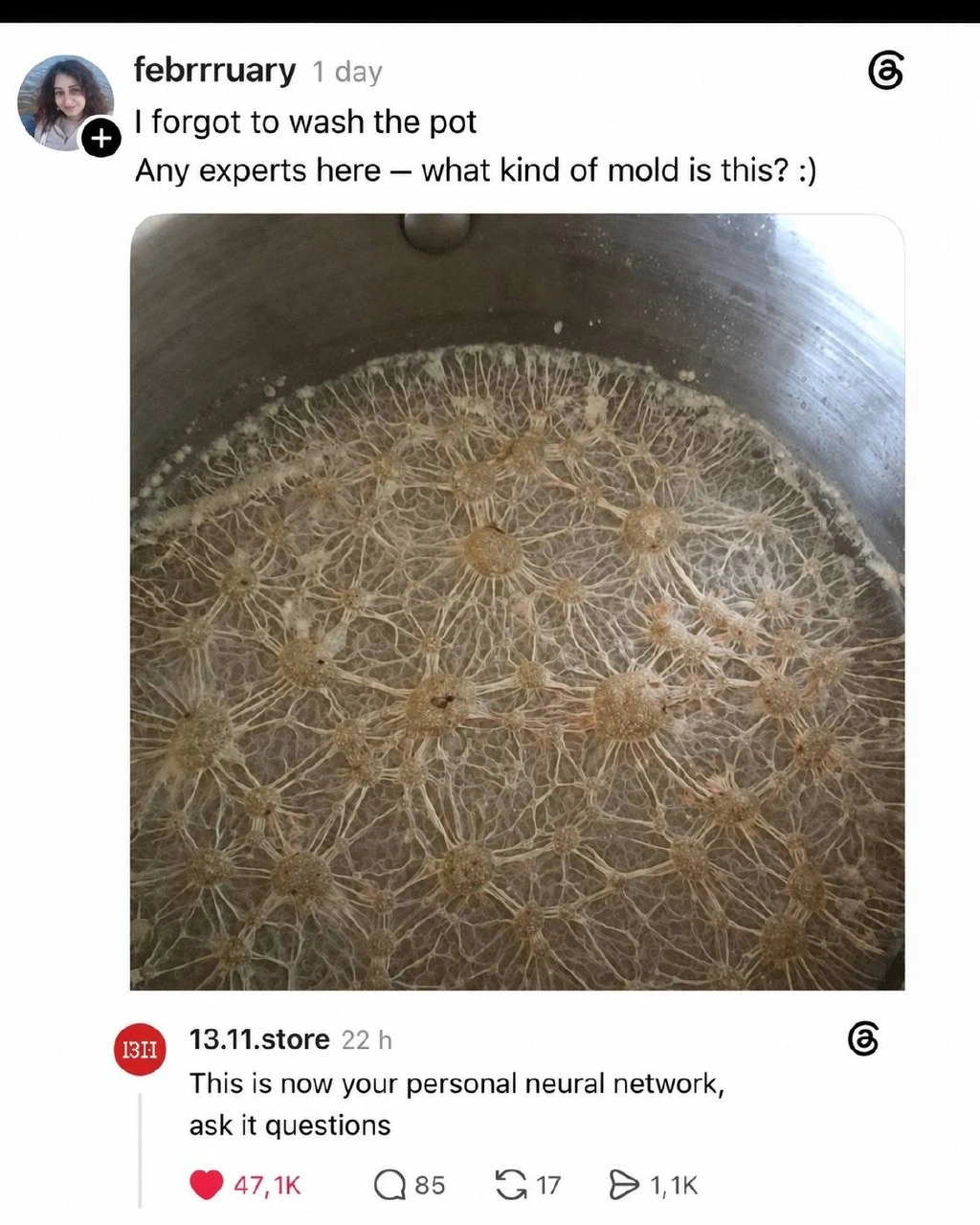
It is like leaving a plate alone until the mess grows lines and blobs that look exactly like a drawing of a brain. A commenter pretends that looking brain-shaped is enough to make it smart and tells the owner to ask it questions. The joke is that the pot appears to have skipped washing, school, and computer training and gone straight to becoming a personal assistant.
Level 2: Nodes, Strands, No Chatbot
A neural network in machine learning is a program made from connected layers of small mathematical units. Each connection has a numerical weight. During training, the program sees examples, makes predictions, measures its error with a loss function, and adjusts the weights so later predictions improve.
A simplified artificial neuron behaves like this:
inputs × weights → add them → activation → output
The round patches and connecting strands in the photo resemble the circles and arrows used to draw that process. They also resemble biological neurons, which communicate through structures including dendrites, cell bodies, axons, and synapses. The resemblance is visual rather than functional: nothing visible shows inputs being encoded, weights being trained, or answers being produced.
If the growth is fungal, the threads could be part of a mycelial network. Hyphae spread across or through nutrient-rich material, branch, and absorb digested nutrients. That is a living transport and growth system, not an artificial model. And because many organisms and residues can look similar in one photograph, naming the exact growth would require more evidence than the post provides.
The reply’s command to “ask it questions” borrows the behavior of conversational AI. A chatbot needs a trained model plus software that converts text into numerical tokens, runs the model, and converts predicted tokens back into text. The pot supplies none of that. It has nodes, edges, and excellent visual metaphor coverage; product engineering remains on the roadmap.
For someone new to machine learning, the important distinction is that network shape does not equal intelligence. Road maps, tree roots, blood vessels, fungal growth, and computer networks all contain connected structures. What matters is what travels along the connections, how the system changes, and what task it can perform. The image offers a great analogy for topology and a terrible deployment target.
Level 3: Backpropagation by Neglect
The setup asks for one kind of expertise and receives another:
I forgot to wash the pot
Any experts here – what kind of mold is this? :)
The attached surface is covered by pale branching strands that connect tan, roughly circular hubs. Visually, those hubs resemble cell bodies in a textbook neuron diagram while the radiating filaments resemble dendrites and axons. The reply exploits that resemblance:
This is now your personal neural network, ask it questions
It is a three-way category error delivered with complete confidence. A possible microbial growth is mistaken for nervous tissue; nervous tissue supplies the metaphor for an artificial neural network; and an artificial neural network is treated as though it automatically comes with a chatbot interface. The pot has acquired the visual branding of AI without any of the less photogenic requirements such as training data, loss functions, optimized weights, compute, or an input channel.
The biological identification should remain uncertain. A photograph of an old food surface is not enough to determine a species—or even to guarantee that every visible structure has the same cause. Filamentous fungi can form branching threads called hyphae, whose collective network is a mycelium. Slime molds can also form vein-like networks, while bacterial films and ordinary food residues can create other patterns. Reliable identification can require microscopy, culture characteristics, or molecular testing. The safe expert answer is not “definitely organism X,” and it certainly is not to begin a prompt-engineering session over the saucepan.
The visual analogy is nevertheless stronger than a random tangle. Biological growth often produces graph-like structures from local rules. A tip extends toward favorable conditions, branches, encounters neighboring growth, and reallocates resources. No central architect needs to place every strand. The resulting network can balance exploration, transport efficiency, robustness, and the cost of maintaining connections. That is emergent behavior: an organized global pattern arising from many small interactions.
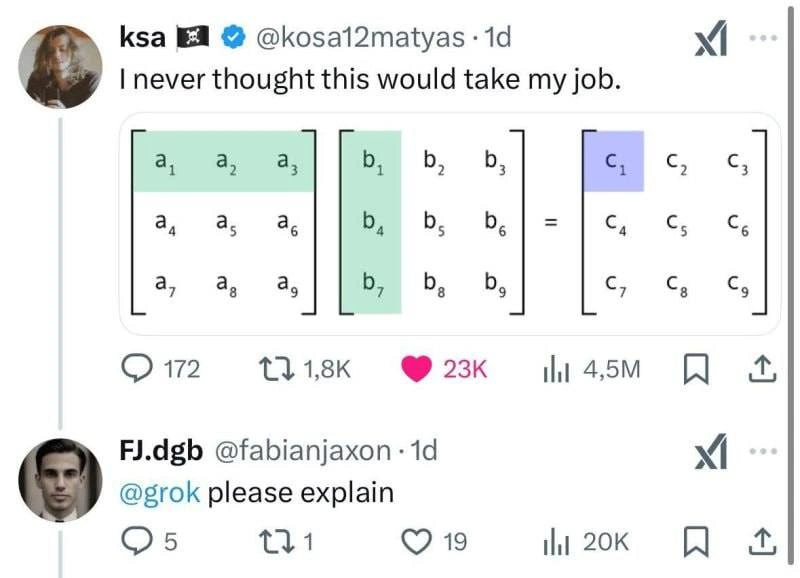
Artificial neural networks also produce complex behavior from many simple components, but their mechanism is different. A typical artificial “neuron” computes a weighted combination of numerical inputs, adds a bias, and applies a nonlinear activation. Training adjusts the weights to reduce a chosen error on examples. The lines in popular diagrams represent flows of numbers, not physical fibers growing through soup. Modern models usually store those connections as dense tensors, so the real system looks less like the pot and more like large blocks of numbers being multiplied at alarming speed.
The joke also pokes at AI literalism. Online explanations routinely say that a model “learns like a brain” or that a fungal network “solves” a maze. Those comparisons can be useful at the right level, but repeated casually they turn any branching pattern into proto-intelligence. The reply takes that habit to its absurd endpoint: if it looks like the stock illustration on an AI startup’s landing page, it must be ready for questions.
The word personal adds another layer. “Personal AI” usually implies a model customized with a user’s data, preferences, or local context. This one is personal only because the owner cultivated it accidentally in private cookware. It has perfect access to yesterday’s dinner and no documented benchmark performance. The displayed 47,1K likes reward the reply for doing exactly what pattern-recognition systems do: notice a familiar shape and assign it the funniest available label, with no concern for whether the classification generalizes.
There is a human lesson hiding beneath the microbial one. People are powerful pattern matchers and eagerly anthropomorphize structure. We see faces in outlets, constellations in stars, intelligence in fluent text, and neurons in branching mold. That instinct produces metaphors, jokes, and scientific hypotheses; it also produces overconfident claims. The meme is funny because the visual match is immediate enough that “neural network” feels right for one second, then every functional detail of the proposed system collapses. Its only current output is a compelling argument for doing the dishes.
Description
A light-mode Threads screenshot shows user "febrrruary" with "1 day", a profile photo and follow-plus badge, posting "I forgot to wash the pot" and "Any experts here – what kind of mold is this? :)". The attached close-up looks down into a stainless-steel pot whose brown surface is covered by a dense cream-and-tan web of branching filaments connecting many round hubs, visually resembling a network diagram or biological neurons. A reply from "13.11.store" marked "22 h" says "This is now your personal neural network, ask it questions"; Threads logos appear at right. The reply footer shows a red heart with "47,1K", a comment icon with 85, a repost icon with 17, and a share icon with "1,1K", turning accidental kitchen growth into a visual AI-architecture joke.
Comments
1Comment deleted
The model's weights are organic, and the loss function is whatever dinner used to be.