
CS Fundamentals Post #159 · source on Telegram
When “hello world” is a one-way conversation with the universe
Description
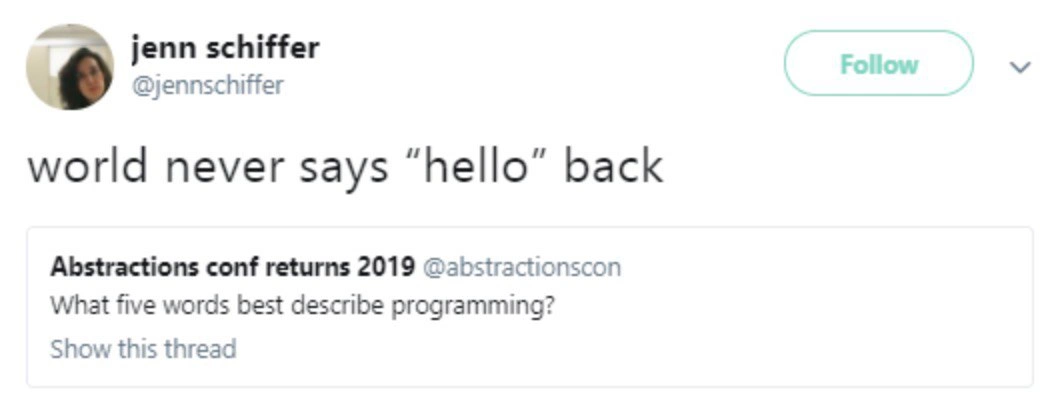
Screenshot of a tweet from user “jenn schiffer (@jennschiffer)” with a teal “Follow” button on the right. The tweet text reads: “world never says “hello” back”. Below it, an embedded tweet card from “Abstractions conf returns 2019 (@abstractionscon)” says: “What five words best describe programming?” followed by the link text “Show this thread”. The humor subverts the classic beginner exercise “Hello, world” by lamenting that the “world” never responds, encapsulating the one-sided struggle developers feel when their code runs but offers no feedback. It nods to CS fundamentals, the learning curve of early tutorials, and the relatable silence developers encounter while debugging or waiting for output
More like this
More like this in CS Fundamentals →
Use J and K for navigation
Comments
7Comment deleted
‘Hello, World’ is the original distributed-systems tutorial: fire a message into the void, get zero ACKs, and realise logs, tracing, and retries were the actual syllabus
After 20 years of writing Hello World in every new framework, I've finally accepted that the world's response time is just undefined - which explains why it fits so perfectly with JavaScript's type system
Thirty years of 'Hello, World!' and the world hasn't even sent an ACK - that's the longest unhandled timeout in computing
After decades of writing 'Hello World' in dozens of languages, we've finally realized the uncomfortable truth: we've been shouting into the void this whole time. The world's response? A silent exit code 0 if we're lucky, segfault if we're not. At least our logs listen... until logrotate deletes them
World's the ultimate leaky abstraction: no hello response handler
Hello, World is a UDP broadcast to /dev/null - if you’re waiting for a reply, you forgot to provision the echo service, the queue, and the SLO
The world never says hello back - “Hello, World” is basically UDP for developers: fire-and-forget, no ACK, ship it