
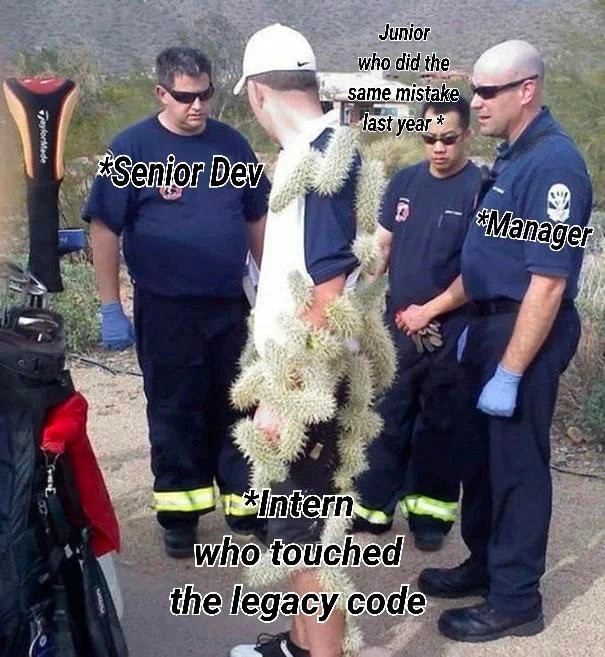
Intern touches legacy code; the team arrives like paramedics to assess damage
Description
The meme is a real-world photo of three uniformed paramedics standing around a fourth man who is completely covered in dozens of cholla-cactus segments. Over each person is overlaid white, italic text: the left responder is labeled "*Senior Dev", the middle responder "Junior who did the same mistake last year", the right responder "*Manager", and the cactus-covered victim "*Intern who touched the legacy code". The intern’s body language is slumped in painful resignation while the others look on with mixed concern and quiet judgment, visually mirroring how production veterans gather when a newcomer breaks fragile, undocumented legacy systems. The cactus spines represent the hidden side-effects, tight coupling, and technical debt that punish anyone who attempts changes without guidance. For developers, the image humorously warns that meddling with legacy codebases can be as unexpectedly painful as hugging a cactus, and that senior engineers and managers often act as first responders to contain the fallout
Comments
7Comment deleted
Every undocumented C module is basically a cactus: touch one line, 17 hidden globals latch onto you, and now the incident bridge is debating anesthesia versus rollback
The only difference between this and actual legacy code extraction is that with the cactus, you can at least see all the pain points up front, whereas legacy code reveals new thorns every time you think you've safely refactored something
The intern discovered why that 15-year-old Perl script has a comment saying 'DO NOT MODIFY - LAST PERSON WHO TRIED IS NO LONGER WITH THE COMPANY.' Turns out it wasn't about job performance - it was a warning about the psychological trauma of debugging regex written by someone who's now retired in Bali. The senior dev's seen three juniors fall into this trap; the manager's just calculating the incident report's impact on next quarter's velocity metrics
Legacy code is a cholla optimized for side effects - touch a “one‑line change” and hidden global state replicates everywhere; extraction is O(n^2) and still leaves needles, yet the estimate stays 15 minutes
Our monolith implements tight coupling literally: touch a ‘helper’ and a swarm of global singletons, ORM triggers, and the Friday cronjob cling like cholla - ask the junior, he remembers the postmortem
Legacy code: the one artifact where 'hands-off architecture' is battle-tested wisdom, until an intern ignores the warning labels
Whay in the name of god this is anyway? Comment deleted