
The Project Timeline: Sync, Panic, and Ship
Description
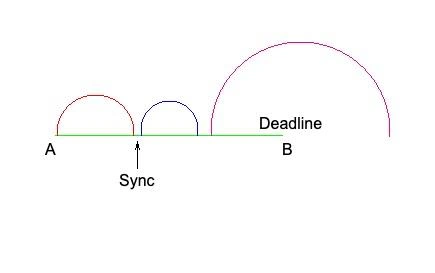
A simple, minimalist diagram illustrating a common project management anti-pattern. On a white background, a horizontal green line represents a timeline, starting at point 'A' on the left and ending near point 'B' on the right, which is labeled 'Deadline'. Above the first half of the line are two small, gentle arcs, one red and one blue, suggesting minor, incremental progress. Between these two arcs, an arrow points up from the timeline labeled 'Sync'. Immediately following the 'Sync', a massive purple arc begins, towering over the previous ones and extending far beyond the deadline. This diagram visually represents the universal developer experience of a project that seems to be progressing smoothly with small tasks until a mid-project sync-up reveals the monumental scale of the remaining work, leading to a period of intense, panicked effort ('crunch time') to meet the deadline


Comments
7Comment deleted
Ah, the classic post-sync refactoring sprint. We've synchronized our watches, now let's synchronize our panic as we realize the second half of the project is 90% of the work
Sure, let’s wedge a “quick 15-minute sync” right here - because what’s another O(n²) expansion to the schedule between A and B?
The only thing that scales linearly with team size is the number of sync meetings required to explain why nothing is scaling linearly
This diagram perfectly captures the universal law of software delivery: work expands geometrically to fill the time available before the deadline. The 'Sync' point represents that brief moment of optimism when you think integration will be trivial, before the final arc reveals the exponential reality of merge conflicts, integration bugs, and the realization that 'it works on my machine' doesn't count as done. Senior engineers recognize this pattern immediately - it's why we advocate for continuous integration and incremental delivery, though stakeholders still somehow expect the entire arc to remain uniformly small
In theory, continuous integration; in practice, deadline desynchronization
The shortest path from A to B is linear - unless every ‘quick sync’ is a blocking consensus round, in which case the schedule turns into stop-the-world GC right before the deadline
A ‘sync’ that doesn’t touch trunk is just accruing merge‑conflict interest - the invoice arrives titled “Deadline.”