
Fragile Production Code
Description
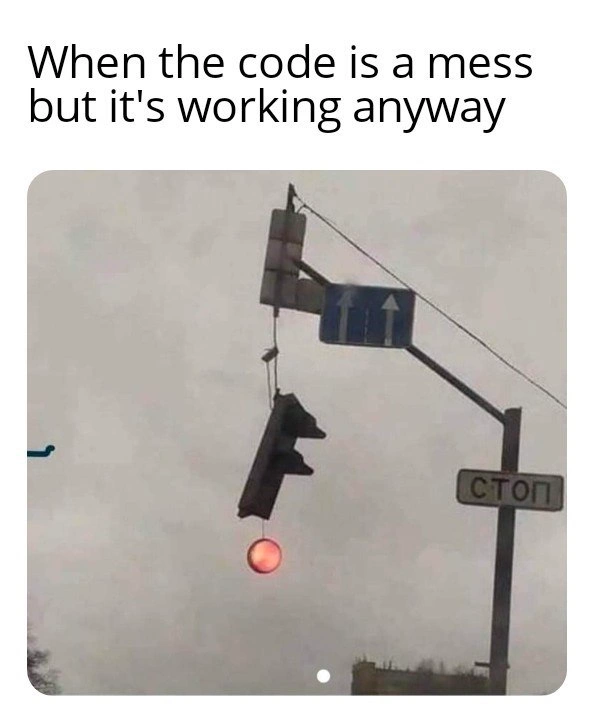
A meme with the caption 'When the code is a mess but it's working anyway.' Below the text is a photograph of a traffic light in a state of severe disrepair. The main housing of the light is broken off its pole and hangs precariously from a single cable, tilted at a sharp angle. Despite the physical damage, the bottom red light is clearly illuminated against a gloomy, overcast sky. In the background, a road sign with the Cyrillic word 'СТОП' (STOP) is visible. The image serves as a powerful visual metaphor for a legacy system or a piece of poorly written code that is fragile, chaotic, and seemingly on the verge of collapse, yet inexplicably continues to function correctly in a production environment. For senior developers, this resonates deeply with experiences of inheriting 'spaghetti code' or systems held together by technical debt, where any attempt to refactor or even understand the code is fraught with the risk of causing a complete system failure
Comments
7Comment deleted
That code is held together by a single deprecated library and the fear of the one person who knows how it works. We don't deploy on Fridays because we're pretty sure the server is only stable due to the gravitational pull of the moon
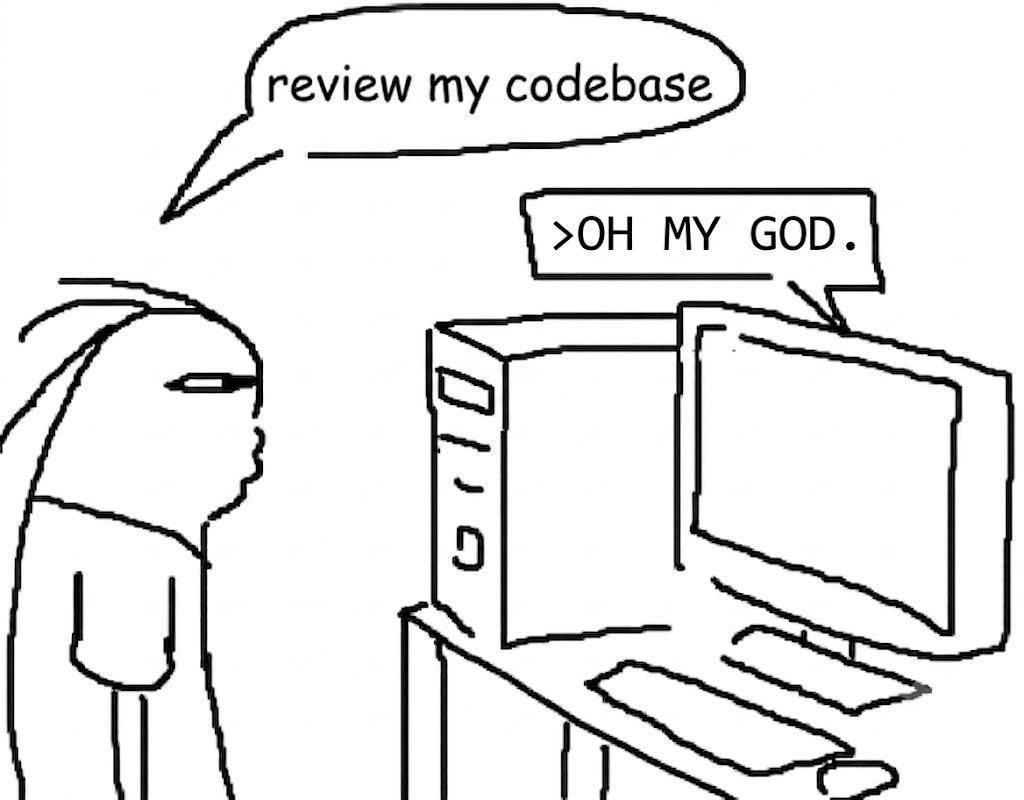
That moment when the architecture review board gasps, but the uptime dashboard stays green - guess we’re refactoring in FY Never
This is what happens when you deploy on Friday afternoon and the senior engineer who wrote the critical infrastructure code left the company three years ago - but hey, the monitoring dashboard is still green, so we're calling it a microservice architecture pattern
This is the architectural equivalent of that 10,000-line God class with no tests that's been in production for 8 years - everyone's terrified to touch it, the original author left the company in 2016, it violates every SOLID principle, and somehow it's still the most reliable part of the system. You know the one: it's held together by global state, has cyclomatic complexity off the charts, and the last person who tried to refactor it triggered a P0 incident. So now it just sits there in the codebase with a comment that says '// DO NOT MODIFY - LEGACY CODE' while the red light dutifully blinks on, processing millions of transactions a day
That’s our payment service - dangling from a global mutex and a Friday hotfix, still meeting SLOs; nobody wants to be the hero who “refactors” it into a Sev1
The ultimate legacy pattern: defies gravity, flunks SonarQube, nails 99.999% uptime
Like that dangling light, our service hangs off a global singleton and two cron jobs - SLOs are green, so the JIRA for refactor stays red forever