Are You Sure? Handing Your Hideous Project to Claude Code
Why is this AI ML meme funny?
Level 1: The Messy Room Trick
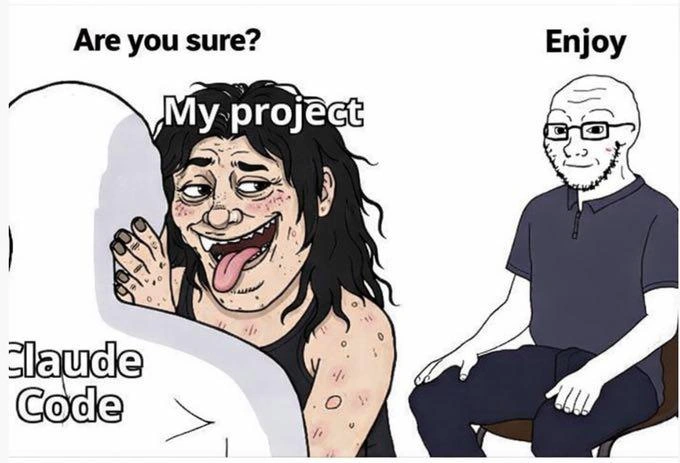
It's like a kid whose bedroom is a disaster — old food, dirty clothes, things growing in cups — who invites a very polite, very tidy robot inside, says "have fun cleaning!", then plops down on the couch with a big grin. The joke is the pure smugness: the kid feels zero guilt sending the innocent, spotless robot into the disaster zone he made himself. Everyone laughs because every programmer has a "room" like that, and now there's finally someone — well, something — that can't refuse to clean it.
Level 2: What's Actually Being Handed Over
Terms behind the panels:
- Claude Code / AI coding agent — a tool where an AI doesn't just autocomplete lines but autonomously reads your repository, plans changes, edits files, and runs commands. You give it a goal ("add auth to this endpoint"); it explores the codebase and does the work.
- Legacy codebase — old code, still business-critical, that nobody fully understands anymore. The classic markers: no tests (so you can't verify changes safely), no docs (so you learn by archaeology), and spaghetti code — logic so tangled that touching one part breaks three others.
- Wojak meme format — the white-faced characters; the smug glasses-wearing one represents the developer who has cleverly (he thinks) escaped consequences.
The relatable junior experience: your first job rarely involves greenfield code. You inherit something exactly like the left panel — and your first instinct in the agent era is the right panel. The hard-won lesson is that delegation doesn't remove the need for understanding. If you can't review the agent's changes, you've replaced "I don't understand my code" with "I don't understand my code or the changes being made to it," which is strictly worse during an outage.
Level 3: Zero-Remorse Delegation
The two panels do all the work. Left, under "Are you sure?": a pristine, featureless white figure labeled "Claude Code" being enthusiastically embraced by a creature labeled "My project" — greasy black hair, blotched skin, dirty fingernails, tongue out, the full wojak-grotesque treatment. Right, under "Enjoy": the developer, a smug bespectacled wojak in a polo, sitting back with hands folded and the serene expression of a man whose problems are now someone else's. The format originally satirized handing off something shameful to an unsuspecting party; recast with an AI coding agent, it becomes documentary footage.
What the meme nails is the asymmetry of the new workflow. For two decades, the horror of a legacy codebase was contained by social friction: you couldn't onboard a contractor onto the 400-file PHP/jQuery/cron-job hairball without weeks of apologetic walkthroughs, and you certainly felt shame during code review. Agents deleted the shame. The agent doesn't sigh at the 3,000-line utils.js. It doesn't ask why there are four functions named processData2_final_FIXED. It doesn't quit when it finds business logic in a database trigger that contradicts the business logic in the frontend. So developers do exactly what this comic depicts: point the clean, eager thing at the monstrosity, type "fix it," and feel nothing.
The deeper satire is about what the grotesque figure is. "My project" isn't ugly by accident — it's the compounded residue of rational short-term decisions: skipped tests because of deadlines, dependencies pinned to versions with known CVEs because upgrading broke the build, commented-out code kept "just in case," documentation that describes the system as it was in 2021. Technical debt personified, lovingly. And here's the part the smug wojak hasn't considered: agents perform best precisely where codebases are clean — typed, tested, documented, consistently structured. On spaghetti, the agent confidently pattern-matches its way into plausible-looking changes that break the one undocumented invariant holding everything together. The "Enjoy" panel is the calm before a very specific storm: a green diff, a merged PR, and a production incident three weeks later that nobody can bisect because the agent touched 47 files.
There's also a quietly funny inversion of the review dynamic. The question "Are you sure?" is what the tooling traditionally asks the human before destructive operations. Here it's the meme asking the agent for consent it cannot give — the project, meanwhile, has never been approached this willingly in its life.
Description
A two-panel comic based on the 'Are you sure? / Enjoy' wojak meme format. Left panel, captioned 'Are you sure?': a pristine white featureless figure labeled 'Claude Code' is being eagerly embraced by a grotesque, disheveled character labeled 'My project' - greasy black hair, blemished skin, dirty fingernails, tongue lolling out. Right panel, captioned 'Enjoy': a smug bespectacled wojak in a polo shirt sits calmly, having gladly handed off the monstrosity. The meme captures the developer ritual of unleashing an AI coding agent onto a horrifying legacy codebase - no tests, tangled dependencies, years of accumulated hacks - and feeling zero remorse while the clean, innocent agent has to intimately deal with it
Comments
12Comment deleted
Claude Code read the repo, paused, and asked for explicit consent - the project hasn't been touched that gently since the original author left in 2017
Six fingers is a tell it's already been there Comment deleted
swap “My project” and “Claude code” Comment deleted
Nope Comment deleted
He couldn't handle the Big L and gave up 🙂 Comment deleted
What does "Big I brother" even mean? Comment deleted
L Comment deleted
Like, Death Note?? Comment deleted
breh Comment deleted
What Comment deleted
explain big l thing pls Comment deleted
I'll assassinate you Comment deleted