Skip to content
DevMeme
849 of 7435
Crafting the Perfect Tech Job Ad
Career HR Post #959, on Jan 5, 2020 in TG

Crafting the Perfect Tech Job Ad

Why is this Career HR meme funny?

Level 1: Candy-Coated Broccoli

Imagine someone promises you the tastiest candy ever, but when you take a bite, there’s a piece of broccoli hidden inside. Yuck! You’d probably feel pretty tricked, right? This meme is making the same point, but about jobs. The bosses in the picture are like people who cover up something boring or unpleasant (the broccoli) with sweet, yummy words (the candy coating) to make you excited. They say the job will be so amazing – like telling you a meal will have ice cream, cake, and all your favorite treats. But once you start, you find out it’s mostly plain vegetables and not at all what you thought. The reason it’s funny (in a kind of mean way) is because the bosses are standing there laughing, knowing they’ve done this little bait-and-switch. It’s like they’re giggling, “Hehe, we said it’s all candy, but it’s really broccoli!” So the whole joke is about promises vs. reality: what you’re told isn’t what you actually get. Even if you’re not into tech, you know how that feels – like when a friend hypes up a game or a toy and it turns out super lame. Here, the job ad is hyped up, and the meme is winking and saying, “Don’t be fooled by the shiny wrapper; it might just be veggies inside.”

Level 2: Decoding HR Hype

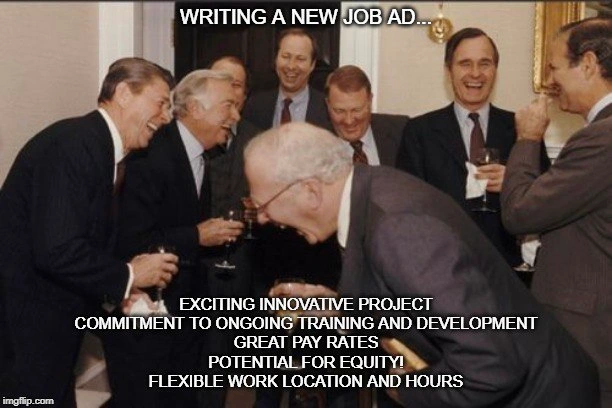
At first glance, this meme shows a group of business executives laughing as they put together a new job advertisement. For a newcomer to the tech industry, it might look like just some happy old guys in a room. But the reason they’re laughing is the key to the joke: they’re filling the job ad with big promises and trendy buzzwords that sound amazing to someone job-hunting. The image is actually a famous template for poking fun at corporate behavior – typically used when bosses or higher-ups are knowingly saying something unrealistic or ironic. Here, the text they’re writing has a list of glowing benefits meant to attract developers. If you’re an early-career developer reading a job posting like this, each item sounds fantastic on the surface. Let’s break down those phrases so they’re easier to understand:

  • “Exciting innovative project” – This suggests you’d be working on something new, cutting-edge, maybe using the latest technology or building a brand-new product. Innovative means novel or original. Companies put this in ads to make you think you won’t be bored – you’ll be doing something fresh and important. If you’re just starting out, that phrase probably makes you imagine working on the next big app or a cool high-tech system that will change the world. Who wouldn’t want to join an exciting project, right?

  • “Commitment to ongoing training and development” – This line is promising that the company will support you in growing your skills. Ongoing training and development means things like workshops, courses, mentorship programs, or conference attendance to keep learning new things even after you’re hired. It’s the company saying “we won’t let your skills go stale; we’ll invest in making you better.” For a junior programmer, that’s really appealing because the tech world moves fast and you always need to learn. You’d read that and think, wow, they’ll actually help me learn new frameworks or languages continuously, maybe even pay for certifications or give me time to study.

  • “Great pay rates” – Simply put, this means a high salary or hourly pay. If a job ad claims great pay, they’re trying to tell you that you’ll be compensated above the usual market rate. For someone early in their career, seeing “great pay” is like a green light – it implies you won’t have to struggle on a low starting salary. Of course, it’s a bit vague (they aren’t listing a number), but it creates the expectation that you’ll be paid really well for your work.

  • “Potential for equity!” – Equity means an ownership stake in the company, usually in the form of stock shares or stock options. When a listing mentions potential for equity, it’s often targeting roles at startups or tech companies where, besides your regular pay, you might get some shares in the company. For instance, they might give you stock options that could become valuable if the company grows or goes public (think of early employees at companies like Google or Facebook who got rich from their shares). For a newcomer, this sounds like you’re not just an employee, but could also become a partial owner of the company. It hints at the dream scenario: if the company succeeds, your equity could be worth a lot, and you’ll profit beyond your salary.

  • “Flexible work location and hours” – This phrase indicates you’ll have freedom in where and when you work. Flexible location suggests options like working from home (remote work) or choosing which office you work from. Flexible hours means you don’t necessarily have to work 9-to-5; you might be able to start earlier or later, or arrange your schedule as long as you get the work done. To a job seeker, especially in tech, this is a big plus: it implies trust and a good work-life balance. You might picture being able to go to a doctor’s appointment in the afternoon or work from a coffee shop or your home office without the boss freaking out. It’s basically saying the company isn’t super rigid about you being at your desk at strict times, as long as the work is completed. In today’s terms (even around 2020 when this meme was posted), flexible work arrangements are common and attractive – think remote-friendly jobs or companies that let you occasionally work from anywhere.

Now, all these terms sound pretty ideal, especially if you’re looking for a developer job and perhaps haven’t been in the industry long. The meme’s humor, however, comes from the idea that these promises might be too good to be true. It’s showing a contrast between expectations and reality. Why would the executives be laughing if everything they wrote was sincerely true? The hint is that they know something the reader doesn’t – perhaps that these promises are exaggerated marketing speak. In real life, many developers discover that some job ads use these phrases loosely.

For example, a company advertising an “exciting, innovative project” might in reality put you on maintaining an old application (maybe it was innovative 10 years ago, but now it’s legacy code). If you’re a junior dev who’s been excited to work on cutting-edge tech, that would be a letdown. Similarly, “commitment to training” could turn out to be just a line in the HR brochure – when you join, you might find there’s no formal training program, and everyone’s too busy to mentor you, so you end up learning things on your own. “Great pay” is a relative term – perhaps they pay a bit above average, but you might also be expected to work many extra hours, which isn’t explicitly stated. The “potential for equity” might mean you get some stock options, but if the company is small or doesn’t do well, those shares might not end up being worth much (equity is not a guaranteed bonus; it’s more like a lottery ticket that could pay off later). And “flexible hours” might not mean a relaxed schedule; sometimes it’s code for “we may need you to work at odd hours”. For instance, if there’s a big project deadline or a production issue, a “flexible” job might expect you to log on late at night or over the weekend to tackle it. The phrase sounds like freedom, but it can also hide an expectation of constant availability (being reachable on Slack or email all the time).

So what this meme is really doing is winking at those of us in tech, saying: “Haven’t we seen this play out before?” The CareerHumor in it comes from that recognition. Early in your career, you might take those promises at face value. Later on, you learn to read between the lines. The laughing businessmen image emphasizes that those making the promises (the executives or HR folks) might sometimes be fully aware that they’re painting a much rosier picture than reality. It’s a bit of a cynical take on TechRecruiting practices: the people writing the job ad are practically shown laughing behind the scenes, as if even they can’t believe they’re advertising things so idealistic. It’s like they’re in on a joke that the applicant won’t discover until later.

For a junior developer or someone new to the industry, the takeaway is: be a little cautious with buzzwords and grand promises in job ads. It doesn’t mean every company is lying, but this meme is a lighthearted reminder that phrases in ads are easy to say and not always fully delivered. It’s important to ask questions during interviews, talk to current or former employees if possible, and get specifics. If they say “ongoing training,” you can ask “Can you give examples of the training programs or professional development opportunities you provide?” If they promise “flexible hours,” it’s fair to ask “What does flexible mean – do people often work nights or weekends, or is it more about shifting your daily schedule?” These kinds of questions can help you figure out if the reality matches the buzzwords. The meme resonates with developers because so many of us have felt the sting of MisalignedExpectations: thinking we’re getting one thing, and ending up with something else. It’s basically a friendly warning packaged as a joke.

Level 3: Boardroom Buzzword Bingo

Picture a mahogany-paneled boardroom where writing the truth is optional but sounding good is mandatory. That’s exactly what this meme delivers: a circle of well-fed executives in suits, champagne flutes in hand, laughing uproariously as they compose a new job posting. The top caption shouts “WRITING A NEW JOB AD…”, and the suits can barely keep a straight face while stuffing it with every cliché perk imaginable. They’ve basically turned the hiring process into a game of Buzzword Bingo, checking off squares like “Exciting project,” “Ongoing training,” “Great pay,” “Equity,” and “Flexible hours” one by one. Seasoned developers know these buzzwords all too well – and know exactly why the suits are chuckling. It’s Industry Satire at its finest, highlighting the disparity between CorporateCulture marketing fluff and on-the-ground reality in tech jobs.

Those stacked promises in the meme – “EXCITING INNOVATIVE PROJECT”, “COMMITMENT TO ONGOING TRAINING AND DEVELOPMENT”, “GREAT PAY RATES”, “POTENTIAL FOR EQUITY!”, “FLEXIBLE WORK LOCATION AND HOURS” – read like a recruiting fairy tale. The executives writing them clearly understand the joke: each phrase is a generously sugar-coated version of a less glamorous truth. This scene lampoons the typical TechRecruiting strategy of luring candidates with grandiose claims. Why are they laughing? Because they know what they’re really offering and it’s not quite what the ad promises. It’s the classic bait-and-switch: say whatever sounds enticing to get talent in the door, then watch the poor developer discover the catch. The humor here comes from shared experience – anyone who’s fallen for a buzzword-stuffed job ad before can practically hear the wink and snicker behind these lines. The meme leans into TechIndustryIrony: those at the top (the stakeholders drafting the ad) expect applause for these perks on paper, but the folks in the trenches have learned to be skeptical.

Let’s decode each flamboyant promise through a cynical engineer’s lens. The contrast is so stark it’s equal parts funny and painful. In true veteran fashion, we can translate the HR marketing spin into real-world terms:

What HR Promises What It Actually Means
“Exciting, innovative project” A dusty, legacy monolith older than your GitHub account. It’s “innovative” the same way a 10-year-old codebase with duct-tape fixes is exciting. Expect more refactoring than cutting-edge R&D.
“Commitment to ongoing training” Good luck finding the training budget. 😏 You might get a Pluralsight login or an outdated wiki. Mostly you’ll be learning on your own, fixing chaos as your “development”.
“Great pay rates” Competitive salary (maybe), but not that great once you factor in the 60-hour weeks. The pay is “great” only in the job ad; in reality it’s pretty average for the industry (and you’ll earn every penny in stress).
“Potential for equity!” A handful of stock options that vest in four years—likely Monopoly money unless the company turns into the next Amazon. They dangle “equity” hoping you’ll imagine a future windfall, but don’t count on buying a yacht anytime soon.
“Flexible work location and hours” You can work from home… and the office… and basically everywhere, because you’ll be on call via Slack 24/7. “Flexible hours” means they’ll flex your hours right into your weekends. Hope you didn’t have plans.

Each line of the ad is essentially an in-joke. The execs are listing every HiringHumor buzzword that job seekers love to hear, and they’re in on the fact that reality won’t measure up. Notice how “Potential for equity!” even has an exclamation mark – they’re really laying it on thick, and the higher-ups find that hilarious because they know those stock options are likely to be a mirage (or a sliver so small you need a microscope to see it). The phrase “Flexible work location and hours” is particularly rich – in startup land, that often translates to “work whenever we need you, from wherever you are, no boundaries.” The meme’s context tag jokes about flexible_hours_mean_24_7_slack, and it’s spot on. Many developers have discovered that “flexible hours” basically means you get to choose which 80 hours a week you work. The top brass clink their champagne glasses because calling it flexibility is their little joke – they’ll get commitment round the clock, and you’ll get to pretend it was your free choice to answer emails at midnight.

From an insider perspective, this meme nails the MisalignedExpectations between management and developers. The people drafting these ads (HR and executives – the stakeholders in filling the role) operate on the assumption that rosy language will attract talent, even if it borders on fiction. They’re laughing because, to them, it’s almost comical how easily one can dress up a tough job as a dream role with just a few keyboard strokes. Meanwhile, experienced engineers reading such an ad have very different expectations – their BS detectors are already pinging. They’ve seen how “exciting projects” often come with 5 layers of approval gates that smother any real innovation, or how “ongoing development” support vanishes the moment deadlines hit. The meme gets its bite from that gap: the execs see a clever marketing tactic, the devs see a red flag. It’s a form of CareerHumor born from hard-earned lessons. In the end, the champagne-toast irony is clear: the only ones truly having a blast with those “great” perks are the execs writing them. Everyone else in on the joke (the developers) laughs to keep from crying, because we’ve all been there, reading a job listing that promises the moon and realizing it’s made of green cheese.

Description

A well-known meme format, often called 'And Then They All Laughed' or 'Laughing Politicians,' showing a group of men in dark suits, including former U.S. presidents, laughing uproariously in a formal setting. The top text overlay reads 'WRITING A NEW JOB AD...'. At the bottom, a list of common, often exaggerated, corporate buzzphrases is displayed in all caps: 'EXCITING INNOVATIVE PROJECT', 'COMMITMENT TO ONGOING TRAINING AND DEVELOPMENT', 'GREAT PAY RATES', 'POTENTIAL FOR EQUITY!', and 'FLEXIBLE WORK LOCATION AND HOURS'. The humor stems from the cynical implication that the leadership or hiring managers writing these job descriptions find their own promises to be absurd and unbelievable. For senior developers, this meme is highly relatable, as it reflects a deep-seated skepticism toward the often-inflated language used in tech recruitment to attract talent, which rarely matches the reality of the job
Comments

7
Anonymous ★ Top Pick The job ad promises a fast-paced environment on an innovative project. We all know that translates to a legacy monolith with no documentation, and the only thing fast-paced is the developer turnover
  1. Anonymous ★ Top Pick

    The job ad promises a fast-paced environment on an innovative project. We all know that translates to a legacy monolith with no documentation, and the only thing fast-paced is the developer turnover

  2. Anonymous

    Pro tip: if the posting shouts ‘innovative stack’ but the CTO won’t name the language, prepare your CVS client for some fresh SVN history

  3. Anonymous

    After 20 years in tech, I've learned that 'exciting innovative project' means legacy PHP migration, 'ongoing training' is a Udemy subscription, 'great pay rates' is below market with promises of future raises, 'potential for equity' is 0.001% fully vesting after you've already left, and 'flexible work location' means you can choose which corner of the open office to cry in

  4. Anonymous

    Senior engineers know that 'exciting innovative project' translates to 'undocumented legacy codebase with no tests,' 'commitment to training' means 'here's a Udemy coupon,' 'great pay rates' is 'competitive with 2015 salaries,' 'potential for equity' equals 'worthless options in a pre-revenue startup,' and 'flexible hours' actually means 'we expect you on-call 24/7.' The real innovation here is how many red flags they managed to fit into one job posting while keeping a straight face - though clearly, they couldn't even manage that

  5. Anonymous

    Translation: “exciting, innovative project” usually means migrating a 12-year monolith to microservices during a return‑to‑office push - where “flexible hours” are defined by the pager and the “equity” vests right after the next reorg

  6. Anonymous

    'Equity' vesting after five pivots: the ultimate test of your commit tolerance before the repo gets archived

  7. Anonymous

    My recruiter-to-JSON parser translates ‘exciting innovative project’ to ‘brownfield rewrite under a hiring freeze,’ ‘equity’ to ‘0.02% with a one-year cliff,’ and ‘flexible hours’ to ‘follow-the-sun on-call.’

Use J and K for navigation