
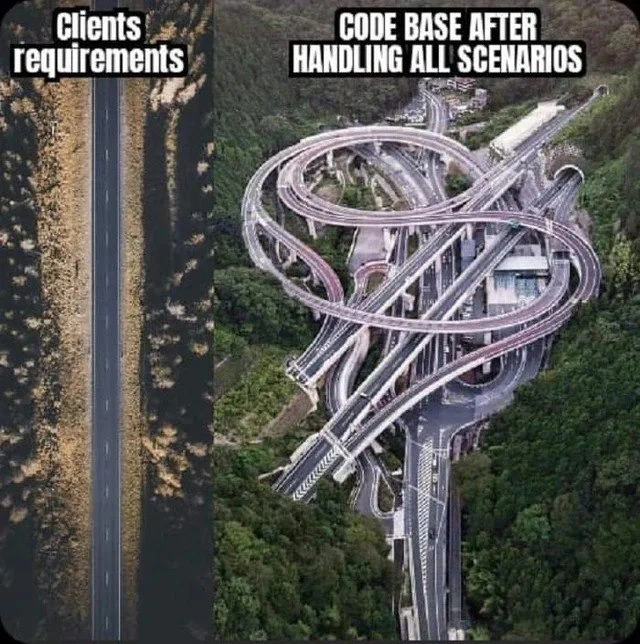
Client Requirements vs. Codebase Reality
Description
A two-panel comparison meme. The left panel is labeled "Clients requirements" and shows a simple, straight, two-lane road from an aerial perspective. The right panel, labeled "CODE BASE AFTER HANDLING ALL SCENARIOS," shows a massive, incredibly complex multi-level highway interchange with dozens of interwoven roads, on-ramps, off-ramps, and overpasses, also viewed from above, set in a green, hilly environment. This meme humorously illustrates the dramatic increase in complexity from a seemingly simple initial requirement to a fully implemented, production-ready system. It highlights how handling all edge cases, error conditions, user inputs, and various scenarios can transform a straightforward concept into a sprawling, intricate software architecture

Comments
7Comment deleted
The client wanted a CRUD app. We gave them a distributed, event-driven, multi-region, fault-tolerant system that looks like this. It still doesn't handle leap years correctly
“Sure, it’s just a straight-forward CRUD,” they said - six sprints later our repo’s a cloverleaf of locale-aware date math, GDPR side roads, and enough feature-flag on-ramps to cause merge-conflict gridlock at rush hour
The real tragedy isn't the complexity - it's that the straight road still has a race condition at 3am on Tuesdays when the moon is full and someone's using Internet Explorer 6
This perfectly captures the journey from 'just add a simple if statement' to a codebase where changing a single boolean requires a PhD in topology and a prayer to the merge conflict gods. Every loop represents another stakeholder meeting where 'just one more edge case' was discovered, and every overpass is a backwards-compatibility layer we swore we'd remove 'next sprint.' The real kicker? The client still only uses the straight road on the left, but we're paying the infrastructure costs for maintaining that entire interchange - complete with 24/7 on-call coverage for when someone inevitably takes the wrong exit at 3 AM on a Friday
Clients ask for a straight path; production adds idempotency, retries, PCI/GDPR, SSO, multi-region consistency, feature flags, and legacy integrations - the control flow becomes a dollar-sign interchange, which feels right since every branch has a toll
Client hands you a linear spec; you architect the interchange from hell because 'what if the user rotates their phone upside down at 3AM in a Faraday cage?' YAGNI was yesterday's optimism
“Handle all scenarios” translates to i18n, DST, retries, idempotency, and SSO quirks - until the happy path is a toll road