
Cloud Post #318 · source on Telegram
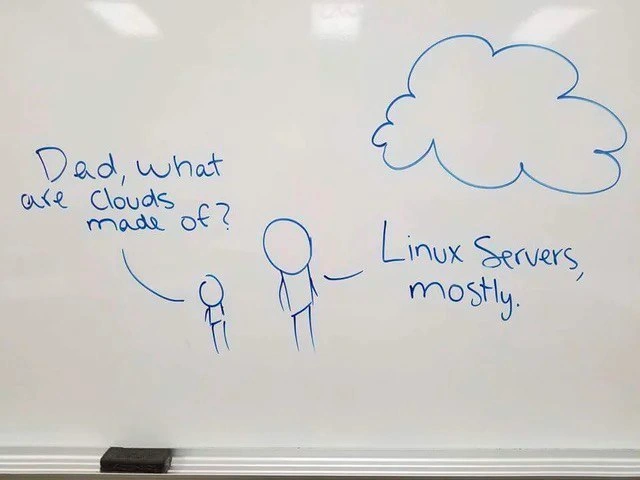
Explaining cloud computing to kids: it's mostly Linux servers up there
Description
On a whiteboard, a simple blue-marker doodle shows two stick figures: a small child on the left asking, “Dad, what are clouds made of?” and a taller adult responding, “Linux Servers, mostly.” A fluffy cloud outline hovers in the upper right corner, visually linking the conversation to modern ‘cloud’ iconography. The humor plays on the double meaning of ‘clouds,’ revealing that today’s internet ‘cloud’ is fundamentally clusters of Linux machines running in data centers. For engineers, it’s a lighthearted reminder that behind abstract cloud-native architectures and DevOps tooling lie very real operating systems - predominantly Linux - quietly powering the infrastructure
More like this
More like this in Cloud →

Use J and K for navigation
Comments
7Comment deleted
Cumulus are Ubuntu, cirrus are RHEL, and when it rains that’s just the AWS bill precipitating out of the abstraction layer
"Linux servers, mostly. And the tears of engineers who thought 'lift and shift' meant their legacy monolith would magically scale horizontally."
Accurate, though the kid should follow up: 'And what holds them together?' - 'Bash scripts nobody dares to touch, son.'
The real cloud computing explanation: it's just someone else's Linux servers, but with better marketing and a 99.9% SLA that somehow still allows for that one Friday afternoon when everything goes down because someone fat-fingered a Terraform config in us-east-1
Cumulus? More like 'cumu-Linux' - explains why every autoscaling group begs for more apt repos
The cloud is just Linux with an SLA and an egress line item
Clouds are mostly Linux servers - the rest is a billing layer that translates “kernel panic” into “elevated error rates” and an egress fee