Classic help-desk acronyms that secretly blame the user, not the code
Why is this Communication meme funny?
Level 1: Not the Computer’s Fault
Imagine you’re trying to play a video game, but it’s not working. You’re getting upset at the game, saying “This game is broken!” Now imagine a friendly older sibling or a teacher comes by, takes one look, and simply plugs in the controller that you forgot to connect. Suddenly, the game works perfectly. Oops! The problem wasn’t the game at all – it was that the person (you) missed something. In a fun way, that’s exactly what this meme is about: computer experts have silly secret codes to say “the computer isn’t the problem, the person using it is.” It’s like if a toy isn’t rolling because you didn’t flip the ON switch, and someone winks and says, “Haha, the toy is fine – the user just made a goof.” These acronyms (like PICNIC, which jokingly stands for “Problem In Chair, Not In Computer”) are basically a nerdy way of saying “nothing’s actually wrong with the machine, it’s just human error.” It’s funny because we’ve all been that person at some point – blaming the device, when really we just needed to read the instructions or press the right button. The joke here is that tech folks made a whole list of code words to gently tease those simple mistakes, without directly yelling, “It’s your fault!” So in plain terms: the meme is poking fun at those times when the computer isn’t broken – the user just didn’t use it correctly, and how tech support people playfully talk about it among themselves.
Level 2: Decoding Helpdesk Humor
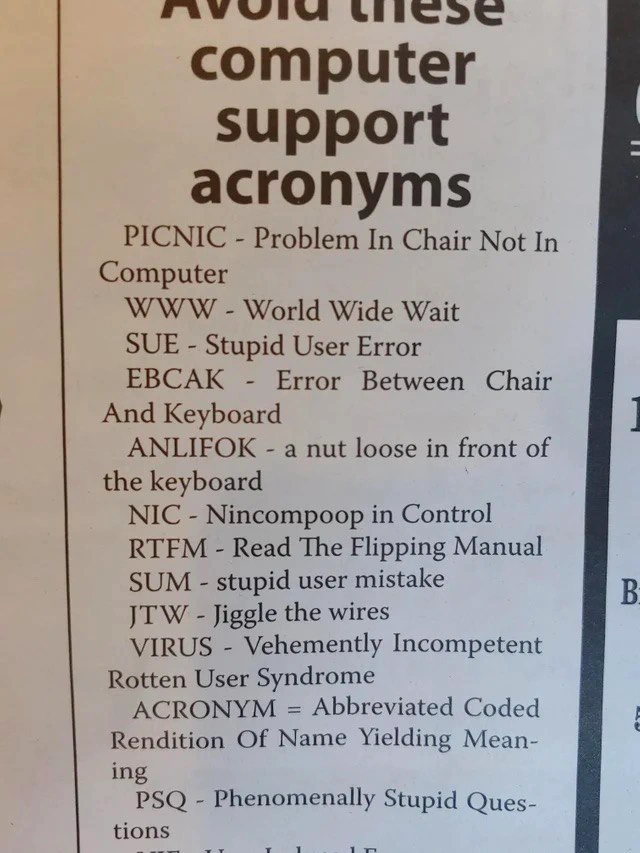
Let’s break down these tongue-in-cheek support_acronyms and what they mean in plain IT terms. If you’re newer to tech or haven’t worked on a helpdesk, some of these might sound baffling at first. Essentially, each one is a little inside joke pointing out that sometimes the problem isn’t the code or the computer at all – it’s the person using it. This is a common theme in IT troubleshooting: many “mystery bugs” turn out to be user misunderstandings. The acronyms evolved as a sly way for tech folks to label such situations without outright saying “user error” in official logs or conversations. Here’s a closer look at a bunch of them from the meme:
- PICNIC – Stands for “Problem In Chair, Not In Computer.” This is a witty way of saying “the real issue resides with the person sitting in the chair (the user), not with the computer itself.” IT support might jokingly use this when a user’s mistake (like not turning on the power switch) is the actual cause of a problem.
- EBCAK – Stands for “Error Between Chair And Keyboard.” This is basically the same idea as PICNIC, just phrased differently. The “chair and keyboard” frames the space where the user sits and types. If there’s an “error” in that space, it means the user did something wrong. (A more popular variant you’ll hear is PEBKAC – Problem Exists Between Keyboard And Chair – but it means the exact same thing. Different letters, same snarky blame placement.)
- SUE / SUM – “Stupid User Error” and “Stupid User Mistake.” These are pretty blunt. If someone says a problem was a SUE or SUM, they mean the user did something, well, not so bright. For example, clicking on a obviously fake “You won a million dollars!” pop-up might earn a SUE label behind the scenes. It’s the tech equivalent of facepalming at an avoidable mistake.
- NIC – Stands for “Nincompoop In Control.” A “nincompoop” is a silly or foolish person, so here it’s just a playful insult aimed at the user who’s currently in control of (and messing up) the computer. It’s not a term you’d ever say to a user’s face, of course – this is the kind of thing support techs chuckle about only among themselves when dealing with a particularly exasperating call.
- ANLIFOK – This long one expands to “A Nut Loose In Front Of the Keyboard.” It’s a bit of a vintage-sounding phrase – calling someone “a nut loose” means they’re acting crazy or clueless. So this acronym implies the person at the keyboard is a “loose nut,” hinting that they are the shaky component causing the issue. Imagine someone frantically mashing keys or doing something wild that breaks the system – an old-school tech might shrug and say, “ah, there was ANLIFOK causing the crash.”
- WWW – Usually we know this as “World Wide Web,” but here it’s jokingly rebranded as “World Wide Wait.” This is a classic bit of nerd humor about slow internet speeds or sluggish web pages. It pokes fun at how, in the dial-up days (or anytime your network is slow), the World Wide Web felt like an interminable wait for pages to load. A helpdesk might use this term when a user complains that “the internet is broken,” when in reality the site is just loading slowly or the user’s connection is bad. In other words, nothing’s wrong with their computer – the world is just slow at that moment.
- JTW – Stands for “Jiggle The Wires.” This is a tongue-in-cheek “technical advice” often given humorously. It stems from real life: many times, a loose cable or poor connection is the culprit behind a device not working. The semi-sarcastic solution? “Have you tried jiggling the wires?” In helpdesk terms, JTW implies the fix was incredibly basic – like reseating a cable or power-cycling a device. It humorously reduces a complex support ticket to the image of someone literally wiggling cords until the lights come on. (And yes, sometimes that really is all it takes!)
- RTFM – This famously stands for “Read The Flipping Manual.” The word “flipping” is a polite substitution; originally, it’s a more R-rated F-word in there. RTFM is what support folks mutter when a user asks a question that’s clearly answered in the product manual or documentation. For example, if a user calls asking how to reset their password and the instructions are printed on page 1 of the guide they got, the exasperated tech might later vent to a coworker, “They should have just RTFM.” It’s basically saying “the info was there, they just didn’t bother to read it.” This one is very common in developer and IT circles — so much that it’s practically its own meme about users (or newbies) not doing their homework.
- VIRUS – In this list, it’s an acronym for “Vehemently Incompetent Rotten User Syndrome.” This one is TechHumor cranked up a notch, mockingly diagnosing the user as if their ineptitude were an actual virus infecting the system. It strings together a bunch of harsh descriptors (“incompetent” and “rotten”) to dramatize how bad a user’s skills are. Of course, in reality when a computer has a virus, it’s a serious technical problem – but here the joke is that the real virus in the system is just an awful user operating it. It’s an extreme way to say “this user consistently messes things up.”
- PSQ – Stands for “Phenomenally Stupid Questions.” This wraps up the list with a direct jab at the kinds of questions tech support agents hate getting. You’ve probably heard the saying “there are no stupid questions” – well, PSQ boldly disagrees. It implies “yes, some questions are just that dumb.” For example, if a user asks, “My computer is off, how do I turn it on?” for the tenth time, a support rep might later label that a PSQ. It’s a sarcastic acknowledgment that some queries feel painfully obvious or silly, especially when you’ve answered them a hundred times before.
Finally, there’s ACRONYM itself, jokingly defined as “Abbreviated Coded Rendition Of Name Yielding Meaning.” This one is meta – it’s humor about the concept of acronyms. It basically defines what an acronym is in a tongue-twister sort of way. Including this in the list is like the author winking at us, saying “we know we’re throwing a lot of abbreviations at you, so here’s one more that literally spells out A.C.R.O.N.Y.M.” It doesn’t blame the user like the others, but adds a nerdy punchline to the collection.
All these terms reflect a bit of Communication gap between users and techies. In a professional setting, support teams are trained to be patient and helpful. But behind the scenes (in internal chats, or on a sticky note on the IT office wall), you’ll find this kind of WorkplaceHumor. They’re a way for tech workers to bond over the sometimes absurd situations they deal with. If you’re a junior developer or just starting out, you’ll quickly encounter the idea that not every “bug” is a real bug – many are user slip-ups or a misunderstanding of how the system is supposed to work. When that happens repeatedly, teams develop slang like this to describe the scenario. It’s a form of relatable camaraderie: every dev or IT support person can recount a story of a so-called bug that turned out to be a PICNIC case.
For a newcomer, the takeaway is twofold. First, these acronyms are a part of tech folklore – little reminders that sometimes the fix is as simple as checking the power cable or rereading the instructions. “Did you turn it off and on again?” became a running gag (from TV shows like The IT Crowd) for a reason: it often does solve the problem when the problem isn’t a deep technical failure. Second, there’s an underlying lesson in empathy (and perhaps a warning) here: users will make mistakes – lots of them – and while it’s okay to blow off steam with a joke among colleagues, a good support tech or developer also tries to make things easier so those “stupid mistakes” happen less. After all, every RTFM moment is a hint that maybe the manual could be clearer, or every JTW incident (loose cable) could be prevented by better hardware design or training. But in the heat of the moment, when you’re faced with yet another user_error_blame situation, these acronyms are just a nerdy way to sigh and say, “It’s not a code bug this time – it’s a PICNIC, folks.”
Level 3: The Layer-8 Lexicon
At first glance, this monochrome list of acronyms reads like a page ripped from an old IT helpdesk manual – a secret lexicon of blaming the user hidden behind technical-sounding jargon. For seasoned engineers, the humor lands immediately: each abbreviation shifts fault from the software or hardware to the person at the keyboard. It’s essentially the support-desk culture codifying what we cynically call a “layer-8 issue” (an OSI model joke adding a mythical eighth layer for “user error”). The meme lampoons how tech support pros, jaded by countless absurd tickets, create insider shorthand to vent their frustration. Instead of admitting “our app is buggy,” the reflex in many triage war rooms is to suspect a user_error_blame scenario first. And indeed, the acronyms here – from PICNIC to EBCAK – are long-standing InsideJokes that translate roughly to “the real bug sits between the chair and keyboard.”
This list is essentially the CynicalVeteran glossary for troubleshooting: why scramble to debug code when the simpler explanation is human error? The bold heading “Avoid these computer support acronyms” drips with irony, because everyone on the IT floor knows these terms by heart (even if officially they’re verboten in customer communication). We see classics like PICNIC – Problem In Chair, Not In Computer – a snarky diagnosis meaning “nothing is wrong with the machine; it’s the person using it.” Likewise, EBCAK (better known in its variant form PEBKAC) spells out Error Between Chair And Keyboard, pointing to the same culprit: the hapless user. These are the kind of codes techs whisper to each other or scribble in internal notes when dealing with repetitive “no-fault” support calls. It’s a CommunicationBreakdown safety valve – a way for staff to commiserate without openly insulting anyone.
Notice how the acronyms get progressively cheekier: SUE and SUM bluntly expand to “Stupid User Error/Mistake,” not mincing words about where the fault lies. NIC outright calls the person a “Nincompoop In Control,” and ANLIFOK is so baroque it’s funny – “a nut loose in front of the keyboard,” conjuring an image of a wacky user rattling around causing chaos. This kind of gallows humor thrives in CorporateCulture IT departments: when you’ve spent an afternoon on a wild-goose chase only to find a cable unplugged, you earn the right to deploy some sarcasm. RTFM, of course, is the banner acronym for documentation frustration: “Read The Flipping Manual.” It’s what every exasperated developer and sysadmin has wanted to retort when a user raises a ticket for something clearly explained on page one of the guide. (The “F” technically stands for something a bit spicier than “Flipping,” highlighting the raw frustration behind the phrase.) In practice, no good support rep would actually fire off an “RTFM” to a client, but around the IT department the phrase becomes a grim joke about the eternal struggle of Documentation vs. Questions. It’s shorthand for “the answer is out there, if only they’d bothered to look.”
The meme strikes a chord because it’s painfully relatable: anyone who’s done tech support or debugging in a corporate environment has had those tickets that make you facepalm. The user’s Phenomenally Stupid Question (PSQ) about why the “ANY” key on the keyboard isn’t working, or the “World Wide Wait (WWW)” complaint about a slow internet connection – these are real-world deja vu moments. The humor comes from recognition. Seasoned devs laugh (perhaps a bit darkly) because they’ve been there – rebooting a perfectly fine server at a user’s insistence only to discover the real issue was, as suspected, layer 8. It’s the same cathartic laughter you hear after hours when the team swaps war stories of bizarre support calls: “Remember that 3 A.M. outage that turned out to be a PICNIC situation? The CEO’s laptop wasn’t charging because it wasn’t plugged in. Classic.” These acronyms are coping mechanisms. They turn Communication breakdown and frustration into a kind of code language that only the in-group (tech staff) understands. It’s a way of saying “the system is fine, it’s the operator who’s buggy” with a dash of wit. Instead of cursing or quitting, you chuckle and mutter “ID-10T error” under your breath (spelling out “idiot”), and then carry on politely guiding the user through jiggling the wires or reading the manual.
Crucially, the meme is also poking at the perennial tension between user error and genuine bugs. In theory, support should never assume the user is at fault – but in practice, after the hundredth flipped caps-lock or mistyped password, even saintly patience wears thin. The list acknowledges this bias: how often have we all joked “it’s not a code issue, it’s a code-18 issue – 18 inches from the screen”? Yet, buried in the humor is a real commentary on Debugging_Troubleshooting best practices: check the simple causes first. Is it plugged in? Did they follow the setup steps? These acronyms exist because an astounding number of “tech problems” do boil down to human mistakes or CommunicationBreakdown mismatches (the user did X, but the software expected Y). So while it’s tongue-in-cheek, there’s a grain of truth: a lot of “bugs” are actually user misunderstandings. The meme’s comedic sting comes from that shared knowledge and the absurdly elaborate ways IT folks express “not our fault” without saying it outright. In the end, Classic helpdesk slang like this is both a venting tool and a cultural artifact – a reminder that behind every seemingly inscrutable computer problem, there might just be a tired support engineer silently translating it into an acronym that means “not the computer, the user.”
Description
Black - and-white clipping shows a bold heading that reads “Avoid these computer support acronyms.” Beneath it is a left-aligned list of twelve tongue-in-cheek abbreviations with their comedic expansions: “PICNIC - Problem In Chair Not In Computer, WWW - World Wide Wait, SUE - Stupid User Error, EBCAK - Error Between Chair And Keyboard, ANLIFOK - a nut loose in front of the keyboard, NIC - Nincompoop in Control, RTFM - Read The Flipping Manual, SUM - stupid user mistake, JTW - Jiggle the wires, VIRUS - Vehemently Incompetent Rotten User Syndrome, ACRONYM = Abbreviated Coded Rendition Of Name Yielding Meaning, PSQ - Phenomenally Stupid Questions.” The paper’s simple serif font and narrow margins evoke a bulletin-board flyer or internal newsletter. Technically, the image lampoons support-desk culture, where triaging tickets often devolves into shorthand that shifts blame from software to end-users; terms like PICNIC and EBCAK are long-standing IT inside jokes analogous to layer-8 issues. Senior engineers will recognize the implicit commentary on communication, documentation (RTFM), and the perennial tension between user error and genuine bugs
Comments
7Comment deleted
Support keeps closing tickets as PICNIC, but the post-mortem pegs every outage on TEA: Twenty-year-old Enterprise Abstraction - aka the COBOL service nobody’s had the courage to git blame since 2003
After 20 years in tech, I've realized these acronyms are outdated - now we just call them "stakeholder requirements" and bill accordingly
The acronyms exist so support can file the root cause honestly while the ticket remains HR-compliant
Every senior engineer knows the hardest part of distributed systems isn't CAP theorem or consensus algorithms - it's the PICNIC layer. You can architect for Byzantine fault tolerance, but there's no Paxos protocol for 'Error Between Chair And Keyboard.' The real production incident is when you realize your most critical dependency is a user who thinks 'WWW' stands for 'World Wide Wait' and your SLA is measured in how long until they ask a PSQ
Compliance banned PEBKAC, so we log it as a Layer 8 outage - root cause: docs microservice 404; mitigation: rebrand RTFM as “self-serve enablement”
EBCAK: The CAP theorem of support tickets - you pick two, but never get the knowledgeable user
All these are just different serialization formats for the same root cause: a Layer 8 incident; the L1 runbook maps PICNIC -> JTW -> RTFM -> resolved, preserving the SLA while the user assumes we upgraded the NIC