When "clearing the table" at dinner terrifies every DBA in the room
Why is this Databases meme funny?
Level 1: Clear Dishes, Not Data
Imagine you have a big box of all your favorite toys neatly arranged. If someone said, “Let’s clear the toy box,” you might panic and think they mean throwing all your toys away! But really they might just mean “tidy up and put the toys back on the shelf.” This joke works the same way. At a normal dinner, “clear the table” just means cleaning up the plates and cups so the table is nice and empty for dessert or for later. Nothing scary about that! But to a person whose job is taking care of important information (like a librarian for books or a gamer with a save file, or here a database person with data), the words “clear the table” sound like “wipe out everything on the table permanently.”
In the meme, when one person says they’ll clear the dinner table, all the database experts suddenly act super shocked and frightened – eyes wide, like in a cartoon when a character hears bad news. They look scared because they’re accidentally thinking about a computer command that erases a whole bunch of important data, not the dinner kind of clearing. It’s like if a librarian heard someone say “let’s shred these books” when they really meant “let’s return these books to the shelf.” The librarian would gasp in horror by mistake. The joke here is that the database people momentarily mix up normal life with their tech life. So, the funny part is seeing them terrified of someone simply picking up dishes, because in their world “clearing a table” is a disastrous thing. In simple terms: they’re relieved to realize, “Oh phew, you meant clear the plates, not delete our data!”
Level 2: Dinner vs Database
Let’s break down why this joke scares database people but not everyone else. In normal life, “clearing the table” means cleaning up after a meal: you remove all the plates, cups, and cutlery so the table is nice and empty. No big deal, right? But in the world of databases, a “table” is not made of wood – it’s a structure inside a database that holds a bunch of organized information (kind of like a super-powered spreadsheet). Each table stores important data in rows and columns (for example, a users table might have a row for each user, with columns like name, email, etc.). Now, if someone says they want to clear a database table, that usually means deleting every single record in that table. It’s like erasing an entire spreadsheet of data at once. Yikes!
Database professionals, especially DBAs, are responsible for keeping all that data safe, accurate, and available. They know that commands like TRUNCATE TABLE or mass DELETE statements are powerful and dangerous. These SQL commands can instantly empty out a table. For example, the SQL command TRUNCATE TABLE orders; would instantly remove all orders from the orders table, with no easy “undo” button. So “clearing a table” in SQL is essentially a quick way to throw all the data in the trash. If this happens accidentally on a production database (the live database serving a real application or website), it can cause a major crisis. Customers might be unable to log in, records vanish, dashboards break – a true ProductionIssue. That’s why even the thought of unplanned data deletion gives DBAs the sweats.
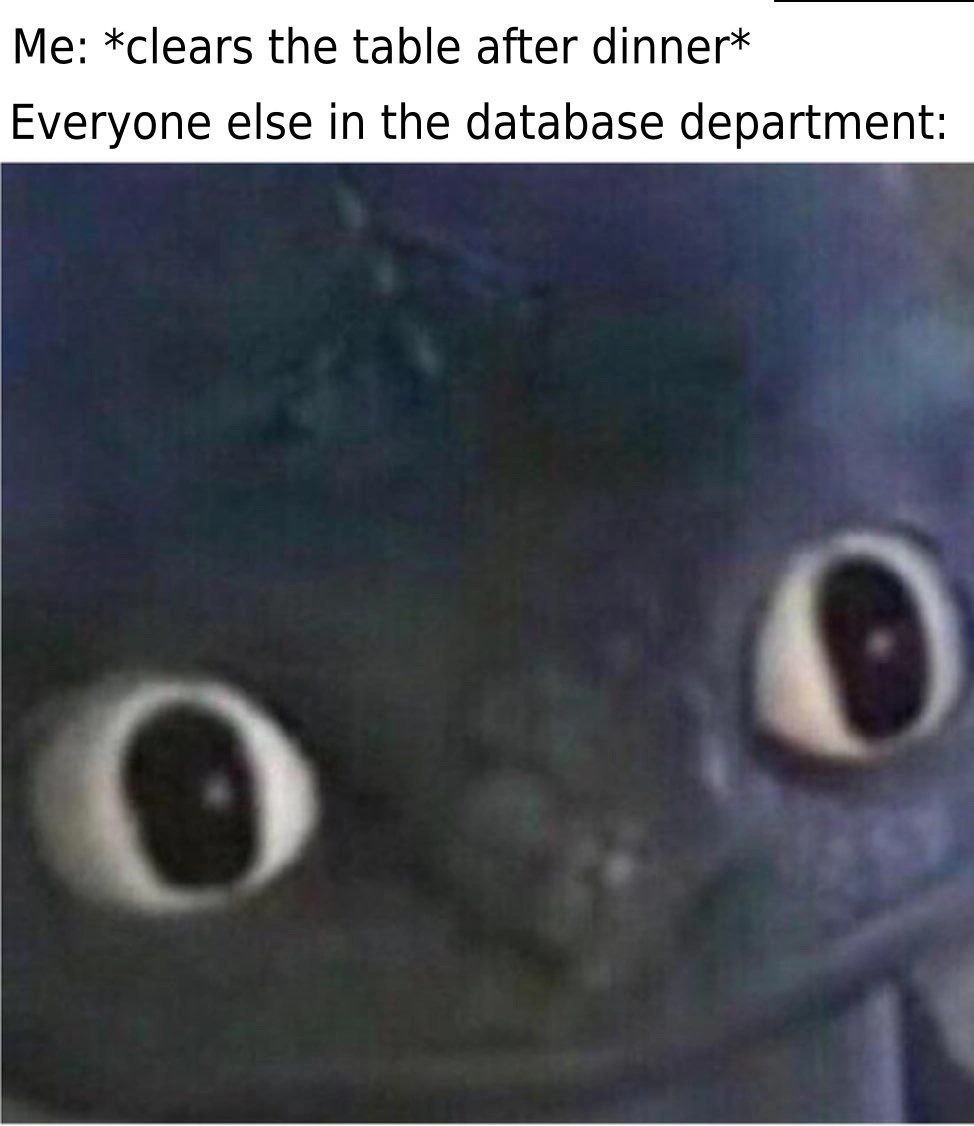
Now, the meme sets up a play on words – a dinner_table_wordplay. The top text says:
Me: clears the table after dinner
Everyone else in the database department:
The joke is that when you innocently clear the dining table of dishes, all the database folks around interpret “clears the table” in the SQL sense. They immediately think you just issued a destructive command on a database. The bottom half shows a zoomed-in image of a blue creature with huge, alarmed eyes. That exaggerated, alarmed expression represents the database team’s face: utter shock and horror at what they think just happened. It’s an exaggerated scenario, of course – in reality, DBAs know the difference when they’re not at a keyboard. But it’s funny because people who work deeply with certain technologies sometimes can’t help but react to trigger words. Here “clear” + “table” are exactly those trigger words for a DBA, invoking accidental_data_deletion nightmares of someone typing the wrong command.
For a junior developer or someone new to databases, it’s worth understanding those key terms:
- Database Table: A set of data organized into rows and columns, like an Excel sheet or a labeled grid, within a database. For example, a table
Customersmight list all customer records. - DBA (Database Administrator): The person or team who manages the databases. They worry about things like backups, performance, and preventing data loss. They’re the guardians of the data.
- Clear/Delete/Truncate: In SQL, you don’t typically say “clear” but you might say “delete all rows” or use the
TRUNCATEcommand.DELETE FROM table_name;removes data row by row (and you can specify which rows to delete using aWHEREclause).TRUNCATE TABLE table_name;is like a more brute-force approach that quickly empties the whole table. It’s faster but also often cannot be rolled back if not inside a transaction, and it doesn’t care about triggers or anything – it just zaps everything to empty. Both are dangerous if run on the wrong table or without proper conditions. - Data Integrity: This means keeping the data correct, consistent, and safe from being corrupted or lost. DBAs care a lot about this. Accidentally deleting all your records definitely breaks data integrity!
So, when the meme shows “Everyone else in the database department” reacting, it’s showing a bunch of DBAs or database engineers collectively freaking out. Why? Because in their minds, someone just “cleared a table” full of precious data without warning! It’s a playful exaggeration of how one phrase can mean two completely different things in two contexts. And for developers or DBAs, it’s extremely relatable: many have had that oh no moment where a slip of the keyboard or a miscommunication led to a serious error, like wiping out data.
This meme also highlights a bit of the dark humor in IT. We often joke about catastrophic Bugs or mistakes (like dropping a production database) to cope with the stress of preventing them. The image of the wide-eyed blue creature is a funny way to show pure panic. It’s the same face a DBA would make if a developer said, “Oops, I think I ran that on prod...” So, the next time you hear a casual phrase that overlaps with tech jargon (like “dump the table” or “execute the chef” – okay, that one’s extreme), remember this meme and why the techies might be nervously chuckling! They’re imagining some unfortunate ProductionIssue that thankfully isn’t actually happening at the dinner table.
Level 3: TRUNCATE Table Trauma
In the world of databases, the phrase “clear the table” has a very different connotation than tidying up after dinner. It immediately evokes the specter of a TRUNCATE TABLE or DELETE * FROM table command – those blunt-force SQL operations that wipe out every row in a database table. To a seasoned DBA (Database Administrator), hearing “clear the table” out of context is like hearing someone yell “format the hard drive” at a family gathering. It triggers an instant truncate_table_panic: heart skipping a beat, eyes widening (just like that wide-eyed blue creature in the meme), and perhaps a sudden urge to double-check the last backup.
Database folks are notorious for guarding data integrity with almost religious zeal. They’ve lived through (or heard war stories of) the horrific consequences of an accidental_data_deletion in production. Imagine a junior developer on Friday evening running:
-- A nightmare in one line:
DELETE FROM users;
with no WHERE clause by mistake. Everyone in the database department has either cleaned up a mess like this or loses sleep knowing they might have to someday. This meme brilliantly taps into that collective trauma. The innocuous act of removing dinner plates sounds identical to a ProductionIssue of the highest order – dropping or truncating a table – which is why all the DBAs at the table are suddenly looking like that petrified, wide-eyed meme character. The humor is a classic sql_pun: an everyday phrase turns into a tech double-entendre, producing equal parts laughter and DataLoss anxiety. It’s funny because it’s true – every DBA knows the stomach-drop feeling of hearing the word “clear” anywhere near the word “table.” They’re thinking: “Please, not the customer data!” even if it’s just Grandma clearing dishes.
This ties into a broader inside joke in IT: simple words can have terrifying meanings. Much like “It’s always DNS” in networking or “just force push it” in Git, saying “clear the table” around database people is asking for trouble. The Relatability factor is huge – even developers who aren’t DBAs smirk at this because they recall tense moments around production databases. The meme’s wide-eyed creature (a classic wide_eyed_reaction_meme image) perfectly captures that oh no shock. It’s the look of a database team envisioning a disaster: critical records gone, business teams screaming, on-call pagers blowing up. They’d probably politely respond, “Haha… good one,” while internally running a diff on yesterday’s data backups. In short, this meme hits on a very real data_integrity_fear. It humorously reminds us that, in databases, “clearing a table” is not something to take lightly – and it’s certainly not something you want to hear outside of a very controlled migration script with plenty of backups handy.
Description
The meme is split into two parts. The top white section contains black text that reads: "Me: *clears the table after dinner*\nEveryone else in the database department:". Below the caption is a zoomed-in, low-resolution image of a wide-eyed blue creature staring forward in alarm, its pupils enlarged as if witnessing disaster. The humor hinges on the double meaning of "clear table": in everyday life it means removing dishes, but in SQL it evokes a TRUNCATE or DELETE command that wipes all rows, striking fear into database engineers who guard data integrity. The exaggerated shocked face represents DBAs envisioning accidental mass data loss and frantic production incidents
Comments
7Comment deleted
When my spouse says “clear the table,” my DBA reflex opens a change ticket, verifies the PITR snapshots, and prays the dishes aren’t bound by ON DELETE CASCADE
The same visceral panic when someone casually mentions they "cleaned up" the database, and you're frantically checking if they meant vacuum analyze or if your entire customer_transactions table is now a fond memory
He cleared the table without a transaction - the only rollback available now is his career
The DBA's fight-or-flight response is permanently calibrated to trigger on any phrase containing 'clear,' 'drop,' or 'truncate' - even at Thanksgiving dinner. Years of production incidents have taught them that the difference between 'clearing the dinner table' and 'TRUNCATE TABLE dinner' is just one misplaced terminal window and a lack of WHERE clause discipline
Say 'clear the table' near a DBA and watch them mentally grep the audit log for TRUNCATE CASCADE in prod, then double-check backups, PITR, and the RPO
DBAs hearing 'clear the table': instant flashback to that one prod DELETE sans WHERE - and no recent full backup
Say “clear the table” near the DB team and you’ll get a risk assessment: DELETE…WHERE (polite), TRUNCATE (fast, skips triggers, goodbye audit), or DROP CASCADE (also removes the dining room)