
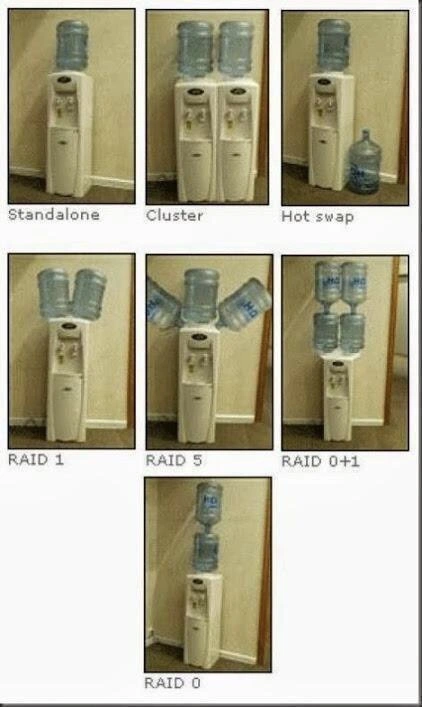
RAID Levels Explained with Water Coolers
Description
A seven-panel image grid that humorously explains server and storage concepts using water coolers as a visual analogy. The post is captioned 'RAID cheetsheet'. Each panel shows a different configuration: 'Standalone' (one cooler), 'Cluster' (two separate coolers), 'Hot swap' (one cooler with a spare water jug nearby), 'RAID 1' (one cooler with two jugs feeding it, representing mirroring), 'RAID 5' (one cooler with three jugs, representing striping with parity), 'RAID 0+1' (a four-jug, two-level setup representing a stripe of mirrors), and 'RAID 0' (one cooler with two jugs stacked vertically, representing striping). This meme is a classic in the IT community, beloved by senior engineers and sysadmins for its clever and intuitive simplification of complex data storage and redundancy concepts. The humor lies in the absurdity and accuracy of the analogy

Comments
10Comment deleted
The RAID 0 water cooler configuration offers incredible hydration throughput, but it's all fun and games until a single leaky jug brings down the whole office
Great RAID walkthrough - mirrors, parity, hot-swap bottles - yet the whole “five-nines” story still relies on a single $40 compressor. Classic enterprise HA
The only RAID configuration missing is RAID 10 - probably because nobody wants to explain to facilities why we need four water coolers for the same number of people, just like explaining to finance why we need double the storage for 'redundancy'
Finally, a RAID explanation that makes sense to management: 'It's like having backup water bottles, but some configurations mean everyone dies of thirst when one bottle fails.' Though I'm concerned about the RAID 0 setup - that's basically balancing your entire database on a single point of failure while telling stakeholders you've 'optimized for performance.'
Looks fine until the 14TB RAID 5 rebuild hits a URE - bring towels
Product chose RAID 0 for “more flow rate” - great throughput, catastrophic MTBF
RAID 5 stack: Lose one jug to a spill, parity saves the day - lose the bottom one, and your whole array cascades into a dehydrated outage
Raid shadow legends Comment deleted
Lol Comment deleted
U r a legend Comment deleted