Database Security: The Canine Infiltration
Why is this Databases meme funny?
Level 1: The Good Boy List
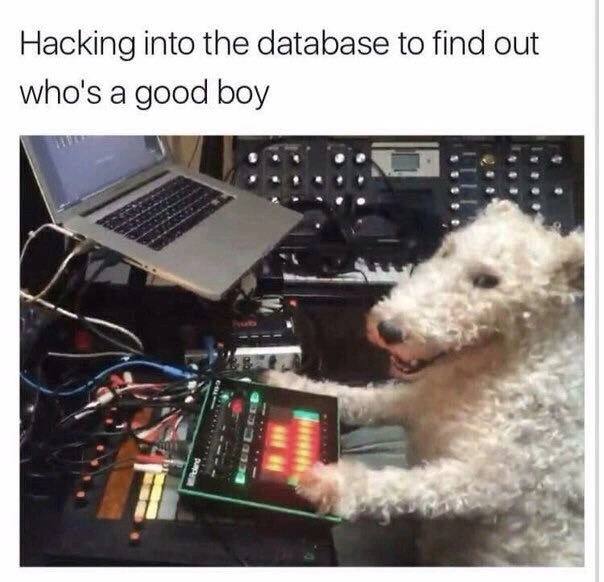
Imagine there’s a secret list on a computer that says who has been good. Now imagine a dog really, really wants to see that list to find out if he is on it. In this funny picture, the dog isn’t waiting for a human to tell him “You’re a good boy!” Instead, he’s doing a sneaky mission to check for himself. It’s like a kid trying to peek at the teacher’s notebook to see if they got a gold star, or trying to hack into Santa’s "nice list" to make sure they’re on it. The dog has managed to get in front of a laptop with lots of wires and glowing lights, which makes it look like he’s doing some big important spy work. He’s pressing buttons and looking back at us with a big happy grin, almost as if saying, “I found it! I know who the good boy is!” The joke is that dogs don’t use computers (of course!), and there’s no real database of good boys – it’s just love and affection. But picturing a cute dog going on a high-tech adventure to confirm he’s loved and good is heartwarming and silly. In simple terms: the dog is acting like a little hacker detective, all just to hear the words “Good boy!” directed at him. It’s funny and sweet because it mixes something very innocent (a dog wanting praise) with something very out-of-character (a dog messing with a computer).
Level 2: SQL for Paws
At this level, let’s break down what’s happening in simpler terms. The meme shows a dog in front of a bunch of tech equipment, and the caption says: “Hacking into the database to find out who’s a good boy.” This is a classic example of developer humor mixing with a cute dog meme. Here’s what all that means:
Database: Think of a database as a big electronic filing cabinet or a spreadsheet where information is stored. For example, a database at a pet store might have a table (like a spreadsheet tab) listing all dogs and whether each one is a good boy 😄. In nerdy terms, maybe there’s a column in a table for
good_boystatus (true/false).Query: A query is just a question or request we ask the database. We use a special language called SQL (Structured Query Language) to ask these questions. For instance, an SQL query could be: “Show me all the dogs who are good boys.” In SQL syntax that might be
SELECT name FROM dogs WHERE good_boy = TRUE;. This would retrieve the names of all dogs marked as good boys in the database. So in the meme, when they say “find out who’s a good boy,” they’re referring to running exactly this kind of question on the data. It’s like the dog is performing a search for the official list of good boys.Hacking / Unauthorized Access: Normally, not just anyone (and certainly not any dog 🐕) can access a database’s information. Databases are usually protected by passwords, user accounts, and other security measures. “Hacking into the database” means breaking those rules or finding a trick to get in without permission – that’s what makes it unauthorized. It’s like picking a lock to sneak into a room with confidential files. In cybersecurity, this could involve finding a software vulnerability. One common example is SQL injection, which is a hacker’s trick: it means inputting crafty text into a form or URL that fools the database into running your own query. The meme hints that the dog might be using such tricks (thus the tag
sql_injection_doggo), which is a funny thought – imagine the dog typing'; DROP TABLE treats;--with his paws to get secrets! In reality, SQL injection is something developers learn to prevent early in their careers, but here it’s referenced in a silly way (since the dog’s not actually typing code, he’s just adorably poking at a control panel).The Dog’s Tech Setup: In the image, our furry “engineer” has an open laptop and lots of wires and blinking lights. To a junior developer or someone new to tech, it looks impressive – almost like the dog built his own mini data center or is in a hacker’s den. In truth, you don’t need all those blinking LED panels to run a database query; usually just a computer and the right software will do. The extra gadgets are there to exaggerate the scenario and make it visually clear that “hacking” is taking place. It’s poking fun at how movies show hacking: with fancy graphics, rapid typing, and techno music, whereas real hacking or querying often just looks like typing commands on a plain screen. The synth-like knobs and audio mixer-looking device are unconventional for database work (they look more like music gear), which adds to the silliness – it’s as if the dog said, “I don’t have a proper hacking console, so I’ll use whatever equipment I can find!” This MacGyver style makeshift command center is part of the joke.
"Who’s a good boy?": This phrase is something people lovingly say to dogs (usually their dog) to praise them. The dog usually responds with tail wags, basically understanding the tone if not the words. It’s never meant to be a literal question with a factual answer – it’s more of a feel-good phrase. The meme takes this literally and humorously: suppose there really was a factual answer stored somewhere (like in a database of all dogs, each tagged as “good” or not). The dog wants to retrieve that information. The innocent, happy expression on the dog’s face in the image shows he’s excited to finally get proof of the answer. It’s a cute reversal: instead of a human pet owner validating the dog, the dog goes self-service and looks it up in the system!
For a junior developer or someone just learning, the meme also sneakily introduces the idea of mixing contexts. You have a Cyber Security context (hacking, breaking into systems) mashed with a pet context (cute dog doing something for validation). It’s educational in that you see terms like database, query, SQL, and even hacking used in a fun, non-threatening way. You might even learn something: e.g., What is SQL? or Why shouldn’t I expose my database to the internet? (Because apparently even a dog might try to get in, haha!). It also highlights a common trope in tech jokes: anthropomorphizing, which means giving human-like qualities to animals or objects. Here, the dog is anthropomorphized as a developer/hacker. That’s a popular pattern in developer memes and tech humor because it creates a humorous disconnect – dogs are lovable and straightforward, whereas hacking and databases are complex and serious. Mixing them results in an endearing kind of comedy.
So in simpler terms, Level 2 explains that our furry friend is doing something very out of the ordinary for a dog: using computers and code to satisfy his curiosity. It’s like a scene from a cartoon where the pet secretly knows how to use the technology. This brings a smile to techies and non-techies alike. If you understand the basics of what databases are and how hacking works, the image of a dog going on a digital heist to find a wholesome answer is both absurd and memorable. It’s a reminder that even in the serious world of IT, we love to be playful and not take ourselves too seriously. After all, why just ask “Who’s a good boy?” when you can open the database and prove it with a query!
Level 3: Pen-Testing Pup
At first glance, this meme shows a seemingly innocent dog acting as a full-blown hacker. The white, curly-haired pup is parked in front of a cluttered workstation that resembles a makeshift command center. There's an open laptop with code on the screen, a tangle of patch cables, synth-style knobs, and a control surface covered in blinking LEDs. It’s the kind of funny hacking setup you’d see in a movie: overly complex and delightfully impractical. But the joke here is pure tech humor. The bold caption "Hacking into the database to find out who's a good boy" sets the stage: our canine friend is performing an unauthorized query on a database. In other words, this doggo is breaching a data system to answer the ultimate question every dog owner jokingly asks their pet, “Who’s a good boy?”
From a seasoned developer’s perspective, the humor operates on multiple levels. First, it merges cybersecurity memes with classic database humor. The dog is effectively doing a penetration test (a pen-test) on a “pet database,” searching for the coveted “good boy” field. This is a playful nod to real-world hacking scenarios: an attacker (or ethical hacker) breaking into a database to retrieve secret information. Here the secret is adorably trivial – confirming the dog’s good-boy status – which makes the high-tech breach absurd and hilarious. The phrase “unauthorized query” hints at techniques like SQL injection or other exploits. In fact, one of the context tags is sql_injection_doggo, suggesting our furry hacker might be using the classic "' OR '1'='1" trick or some paw-crafted exploit string to bypass authentication. It’s as if the dog sniffed out a SQL vulnerability (maybe literally sniffed, since dogs are good at that!) and is now exfiltrating the table of Good Boys. This mashup of a security breach with a wholesome pet query is something seasoned devs and security engineers find paw-some. It satirizes how even the most innocent question can become “malicious code” in the right (or wrong) paws.
Real-world developers might chuckle because they’ve seen how unauthorized database access is a serious issue. Data breaches happen when someone finds a way in – be it via weak credentials, misconfigured permissions, or injection flaws. Here, picturing a dog triumphantly grinning after bypassing the login prompt is a comical relief. It’s developer humor blending with pet antics. The dog’s happy grin and paw on the glowing panel screams, “I have root access, and I found the answer!” – root access being the highest level of control, a cheeky concept if you imagine the dog now effectively owns the system (truly a "good boy" with root privileges). This also riffs on the term “audit” in databases – the dog is essentially auditing canine records in a forbidden way. We can imagine a table of pets with a boolean column is_good_boy. The dog’s query is basically: find all entries where is_good_boy is TRUE. In SQL, that might look like:
-- Doggo's sneaky SQL to list all Good Boys in the database
SELECT name
FROM pup_records
WHERE good_boy = TRUE;
In a real database, this query would return the names of every dog tagged as a good boy. Our hacker dog is likely hoping to see his own name in that result set. The code comment above explains the joke: the dog wrote a SQL query to get the good boy list! The humor is intensified when you realize how over-the-top the hardware is for such a simple task – he’s got an entire data center’s worth of blinking lights just to run one query. It’s a playful jab at the cinematic portrayal of hacking (all flashing LEDs and frenetic keyboard clacking), whereas actual SQL injection attacks often just happen in a web text box with no spectacle.
Another layer of humor is the anthropomorphism of the pet. In developer culture, there’s a longstanding gag of anthropomorphizing pets as coders or hackers (think of cats walking on keyboards or, in this case, a hacking dog). By casting a dog in the role of the hacker, the meme triggers a shared joke: we treat the dog’s curiosity and desire for approval as if it were a serious cybersecurity mission. Who needs an admin account when you have paws and determination? 🐾 The innocent expression of the dog contrasts with the illicit nature of the act (database breach), creating a comedic dissonance. Security professionals might jokingly wish actual hackers were this cute and fluffy. And database admins might chuckle (or shudder) at the thought of a rogue “SQL for Pets” situation unfolding in their server room.
Ultimately, the meme is a lighthearted spin on both developer and security tropes. It exaggerates a simple, heart-warming concept – a dog wanting to be called a good boy – by framing it as a high-tech espionage adventure. For the experienced folks, it’s a tongue-in-cheek reminder that yes, even “finding out who’s a good boy” could be considered a data query! And if that query were unauthorized, well, you’ve got a pet database breach on your hands. The next time someone jokes about “auditing the good boy table,” you can bet they’re picturing this exact scenario of the pen-testing pup proudly discovering the ultimate truth hidden in the database logs.
Description
A popular meme featuring a fluffy, white dog sitting in front of a complex setup of electronic equipment, including a laptop, a mixing board, and various audio interfaces with many cables. The dog has its paws on a glowing control panel, appearing to be operating the machinery. The caption above the image reads, 'Hacking into the database to find out who's a good boy'. The humor comes from the juxtaposition of a serious, technical activity ('hacking into the database') with a wholesome, innocent motive that is stereotypically associated with dogs. For experienced developers, it's a funny and relatable personification of data retrieval, turning a potentially stressful task into a lighthearted quest for validation
Comments
18Comment deleted
SELECT name FROM pets WHERE behavior = 'good' AND species = 'dog'; -- He's not just a good boy, he's a good boy with read access
Incident report: the canine service account bypassed RBAC, ran `SELECT good_boy FROM kennel WHERE id = SELF;` and got 1 row. Please enforce the principle of least rubs before SOC2 does
After 15 years of optimizing queries and dealing with N+1 problems, I finally understand this dog's approach - sometimes the most critical database query isn't about performance metrics or user analytics, it's the existential SELECT * FROM good_boys WHERE name = 'ME' with no index needed because we already know it returns true
When your database normalization is so good that even the dog table has a 'goodness' column with proper indexing. Though I suspect this query is running with elevated privileges - clearly a case of privilege escalation to root-level belly rubs. The real security concern here is the lack of audit logging; we'll never know which records were marked as 'good boy' without proper transaction history
Turns out the 'good_boy' field is a computed column (treats_count > 0), so with insert access to Treats the dog pulled a textbook privilege escalation to VeryGoodBoy - not a zero‑day, just sloppy RBAC
Least privilege is so optional here that a drum machine just ran SELECT good_boy FROM prod as db_owner and the SIEM filed it under “analytics.”
The only SQL injection worth the ban: '1=1 -- good boy'
SELECT * FROM BOYS WHERE ALIGNMENT=GOOD Comment deleted
pretty sure I got something wrong there, I can't write SQL commands Comment deleted
You missing quotes and semicolon at the end. Other than that you've done it right. Comment deleted
nice Comment deleted
Though I'm not an expert myself, lol Comment deleted
I see Ableton Push there. Nice. Comment deleted
DJing, programming - who cares? 😆 same same but different Comment deleted
Yeah, there's actually quite a lot of similarities between those two processes 😁 Comment deleted
Of cource, programming music Comment deleted
Then mushrooms must be an AI Comment deleted
A friend of me is DJ he does the Pioneer schooling rn Comment deleted