Skip to content
DevMeme
3201 of 7435
The Classic Light Bulb Problem
Hardware Post #3522, on Aug 10, 2021 in TG

The Classic Light Bulb Problem

Why is this Hardware meme funny?

Level 1: Not My Job

Imagine you ask your friend to help fix your lamp that won’t turn on. Your friend is a computer programmer. They look at the lamp, then smirk and say, “Nah, I can’t help – that’s a hardware problem.” In plain terms, they’re joking that changing the light bulb isn’t their job because they only deal with computer code, not physical light bulbs. It’s like if a chef was asked to change a kitchen light and the chef replied, “I just cook the food, I don’t do the electrical stuff!” The humor comes from someone refusing to do a simple task by saying it’s outside of what they do. We laugh because the programmer is basically saying, “This isn’t in my field, so I won’t even touch it.” It’s a playful way to highlight how people can draw strict lines around their responsibilities. In everyday life, it would be silly if someone avoided changing a burnt-out bulb by claiming it’s somebody else’s problem – and that silliness is exactly why this joke is funny.

Level 2: Hardware vs. Software 101

This meme plays on a well-known joke format and the divide between hardware and software roles. First, the format: "How many X does it take to change a light bulb?" is a classic joke setup. Usually, the answer humorously exaggerates something about that profession. For example, a common tech joke answer is, "How many programmers to change a light bulb? None – that’s a hardware problem." The humor here is that a programmer, who writes code (software), is dodging a simple physical task by saying it’s not their responsibility at all. Changing a light bulb is literally a hands-on, physical fix (the bulb is a physical object, part of hardware), so the programmer claims zero programmers are needed – you should call a hardware person or an electrician instead.

Let’s break down the roles: Software refers to the code and programs that run on devices, while hardware is the actual physical equipment (circuits, wires, light bulbs, etc.). A programmer’s job is to create and debug code. They typically aren’t expected to grab a screwdriver and fix electrical issues in the real world. In big tech teams, there might be separate hardware engineers for the device electronics, and software engineers for the code. When something isn’t working, a common step in troubleshooting is figuring out whether it’s a software bug or a hardware failure. This meme jokingly shows a programmer immediately saying “It’s a hardware problem,” meaning “I think the physical device is at fault, not my code.” It’s a tongue-in-cheek way of avoiding blame (or work) by putting it on the other domain.

The mention of GPIO pins in the title is useful context. A General Purpose Input/Output (GPIO) pin is a small electrical pin on a computer board or microcontroller that software can control. For instance, imagine a smart lamp: the program sends a signal through a GPIO pin to turn the bulb on. If the bulb doesn’t light up, there are two possibilities: either the code didn’t send the signal correctly (software issue), or the bulb is burned out / wiring is wrong (hardware issue). When the programmer says “None – it’s a hardware problem,” they’re effectively assuming “My code is fine; the signal went out. So if it’s dark, the bulb must be bad.” In other words, they claim their responsibility stops at the GPIO pin – beyond that (the actual light), it’s on the hardware side. Scope in this context means the boundary of responsibility. The programmer is joking that their scope is only the code and maybe the output pin, and anything past that (the actual lighting up of the bulb) is outside their scope.

This reflects a real scenario new developers learn about: debugging across domains. Let’s say you wrote a program to blink an LED light. If the LED isn’t blinking, you have to ask, is my code wrong, or is the LED wired incorrectly/fried? It’s easy for a software developer to initially think “my code logic is correct, maybe the LED is dead or the circuit isn’t powered.” Conversely, a hardware person might first assume “the circuit is fine, maybe the software never sent the signal.” In real life, solving the issue means checking both. But in jokes, each side will playfully insist it’s the other side’s fault. This is what we call “hardware vs. software responsibility” banter. It’s a form of friendly teasing or sometimes just frustration.

The term “ticket ping-pong” mentioned earlier refers to what happens in companies when a bug report (a “ticket” in a tracking system like JIRA) gets reassigned back and forth. One team assigns it to another team saying “Not ours, must be on your side.” Then that team bounces it back, “Nope, we think it’s on your side.” Nothing gets fixed initially because everyone’s busy deflecting blame. It’s a scenario many developers find relatable, which is why a simple meme like this gets a laugh. It’s developer humor born from shared experience. Even if you’re new to coding, you might appreciate the silliness: the programmer basically says, “I’m not going to change that bulb because I deal with code, not light bulbs.” It pokes fun at the tendency of specialists to avoid tasks outside their own niche. In a collaborative project, though, we eventually learn that hardware and software have to work together. But it’s much funnier (and less work!) to quip that any bulb issues must be someone else’s problem.

In summary, the meme is an inside joke for IT folks about how problems get triaged. It uses the familiar lightbulb joke setup so even a newcomer can parse it: normally you expect some number of people and a funny procedure, but here you get “zero” and an immediate buck-passing. It’s highlighting the idea that a programmer’s instinct (in jest) is to say: “This isn’t code-related, so I’m off the hook.” It’s both a light-hearted jab at programmers and a nod to that real sentiment of sticking to one’s domain. For anyone who’s been the new developer on a team, consider it a cautionary chuckle: you’ll see this happen in real bug meetings, but hopefully you’ll also see folks eventually roll up their sleeves and solve the problem together (after the jokes are done).

Level 3: Ticket Ping-Pong

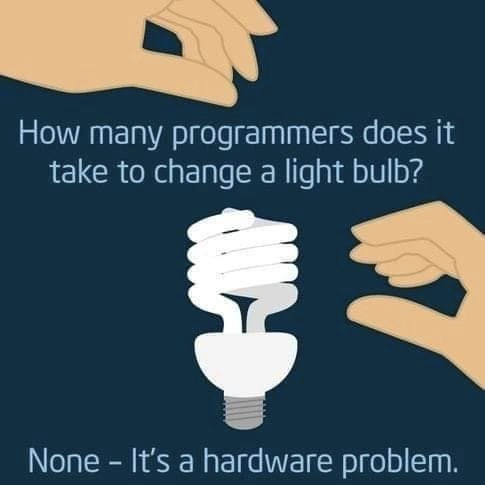
At the senior engineer level, this meme hits home as a satire of cross-team blame games. The classic question "How many programmers does it take to change a light bulb?" gets a snarky answer: "None – it’s a hardware problem." This punchline perfectly captures the not-my-problem mentality that often creeps in when troubleshooting complex systems. Seasoned developers have seen this ticket ping-pong: a bug gets bounced between the software team and the hardware team like a hot potato. Each side insists the fault lies beyond their scope. In this case, the programmer refuses to even touch the light bulb because changing it is “outside of software.”

We’re essentially laughing at the perennial boundary dispute between hardware and software teams. Picture a late-night outage: the application folks swear the circuit or device must be faulty, while the hardware/firmware folks insist the code is buggy. This meme condenses that standoff into one dry one-liner. It’s developer humor, so the joke lands with anyone who’s experienced that exasperating back-and-forth in real life. Shared pain is what makes it funny – we’ve all heard some version of “Works on my end; must be the other guy’s problem.” Here, the programmer is saying, “Don’t look at me, the light bulb itself is busted.”

The phrase in the title “Scope Ends at the GPIO Pin” nails the sentiment. A GPIO pin (General Purpose Input/Output) is the literal interface between code and the physical world – the last stop for software signals before they turn into electrical pulses. A battle-hardened embedded programmer might quip that their responsibility ends at that pin. In other words, “My code sets the output high; if the bulb doesn’t glow beyond that point, well, that’s on the hardware side.” It’s a cynical way to draw a line in the sand. Veteran devs chuckle because they’ve used (or heard) similar borderline absurd reasoning to dodge blame.

This meme also riffs on the legendary “lightbulb joke” format known in office culture, but gives it a nerdy twist. Instead of some elaborate process or a funny number of people, it flatly says “None.” Why none? Because the programmer is humorously refusing to partake – after all, changing a bulb is a physical fix, not a coding task. That deadpan answer subverts expectations and pokes at the stereotype of programmers who won’t deal with real-world hardware issues. It’s the same energy as the classic “It’s always DNS” joke in DevOps: blame the usual suspect (in this case, hardware) and declare the code blameless.

In practice, experienced engineers know the truth is usually more nuanced – often you have to collaborate across the stack to solve tricky bugs. But the joke exaggerates the silo mindset for comedic effect. It reminds those of us in the trenches of all the times we’ve tossed a problem “over the wall” to another team. Not my circuit, not my problem, right? The humor has a bite of truth: software and hardware folks do sometimes act like their realms are completely separate universes. This meme gets a knowing laugh because it echoes that frustrating reality in one clean, cheeky line. After years of 3 AM troubleshooting sessions where everyone insists “our part is fine”, you either cry or you laugh – and this joke chooses laughter.

// In embedded code: turn on the light via a GPIO pin
digitalWrite(LIGHT_PIN, HIGH);  // If the room stays dark...
// ...clearly the bulb or wiring is busted, not my code (wink).

Description

An illustration depicting a classic programmer joke. Against a dark blue background, two cartoon hands are shown reaching for a compact fluorescent light bulb. The text is split into a question and an answer. The top text reads: 'How many programmers does it take to change a light bulb?'. The bottom text provides the punchline: 'None - It's a hardware problem.'. This meme is a timeless piece of developer humor that plays on the stereotype of software engineers deferring any issues outside of their code to other departments. For senior developers, it's a relatable and amusing take on the strict division of responsibilities (and blame) between software and hardware teams, perfectly encapsulating the 'not my department' mindset that can be prevalent in tech organizations


Comments

22
Anonymous ★ Top Pick Why don't programmers change light bulbs? Because they'd first have to write a 30-page RFC, debate the merits of LED vs. incandescent in a two-hour meeting, and then ultimately decide to create a ticket for the facilities team to handle the physical layer
  1. Anonymous ★ Top Pick

    Why don't programmers change light bulbs? Because they'd first have to write a 30-page RFC, debate the merits of LED vs. incandescent in a two-hour meeting, and then ultimately decide to create a ticket for the facilities team to handle the physical layer

  2. Anonymous

    Sure, it’s a hardware problem - right up until the firmware team asks why your JSON config turned the bulb off in prod

  3. Anonymous

    After 20 years in the industry, I've learned the real answer is: one to open a JIRA ticket, three to debate whether it's a P1 or P2, two to argue it's actually a feature request for smart bulbs, and an entire DevOps team to implement Infrastructure as Code for automated bulb replacement - only to discover the real issue was someone forgot to flip the switch

  4. Anonymous

    The real answer is that it takes one programmer to open a JIRA ticket titled 'Light bulb replacement' with priority P4, assign it to the facilities team, add it to the infrastructure backlog, and then spend three sprint planning meetings discussing whether this should be handled by DevOps or if it requires a cross-functional working group to establish a Light Bulb Replacement Framework (LBRF) with proper observability and rollback capabilities

  5. Anonymous

    Blameless postmortem: the lumen service failed at Layer 1, so we opened a Facilities Jira, marked the bulb as an external dependency, and preserved our error budget

  6. Anonymous

    How many engineers to change a light bulb? Zero - it's outside our bounded context; we ship ToggleLight(), mock it in tests, and let Facilities own the side effects

  7. Anonymous

    None - we'd deploy a Kubernetes pod to simulate photons via shaders before admitting it's not a software abstraction leak

  8. Sultanahamer Mohammed 4y

    Not now. Iot

  9. @kyrylo22 4y

    10. First one changes a bulb, second one tries to understand the joke.

    1. @teleus3r 4y

      11. third one explains the joke to the second n00b

      1. @kyrylo22 4y

        Too complicated and dragged out, Mr. Boring Man.

    2. @thisisluxion 4y

      this was actually pretty good lol

    3. @ZgGPuo8dZef58K6hxxGVj3Z2 4y

      There are 10 types of people in this world. First: who understand binary numbers. Second: who don't.

      1. Deleted Account 4y

        I almost fell for that

      2. @RiedleroD 4y

        there are 26ab0db90d72e28ad0ba1e22ee510510 types of people in this world: those who understand hashing, and those who don't.

        1. @adhdnigga 4y

          did you really hash 2...

          1. @RiedleroD 4y

            yes md5sum

            1. @UQuark 4y

              MD5 = 💩

              1. @RiedleroD 4y

                only for cryptographic purposes, for everything else it's actually quite nice since it's quite fast

        2. @ZgGPuo8dZef58K6hxxGVj3Z2 4y

          Holy f did you really hash 2?

  10. @Harel_Brodai 4y

    Soooooo old

  11. @cringle_flex 4y

    NaN

Use J and K for navigation