Valve Names a Boolean for Its Dataminers
Level 1: The Note in the Drawer
Imagine children secretly opening a teacher's desk to look for tomorrow's surprise, only to find a note inside that says, “Why are you looking in my desk?” They immediately show the note to the whole school, proving the teacher knew exactly what they would do. That is funny here because the game developers hid the message inside a code name, and the people who inspect code found and advertised it almost at once.
Level 2: Reading Between Builds
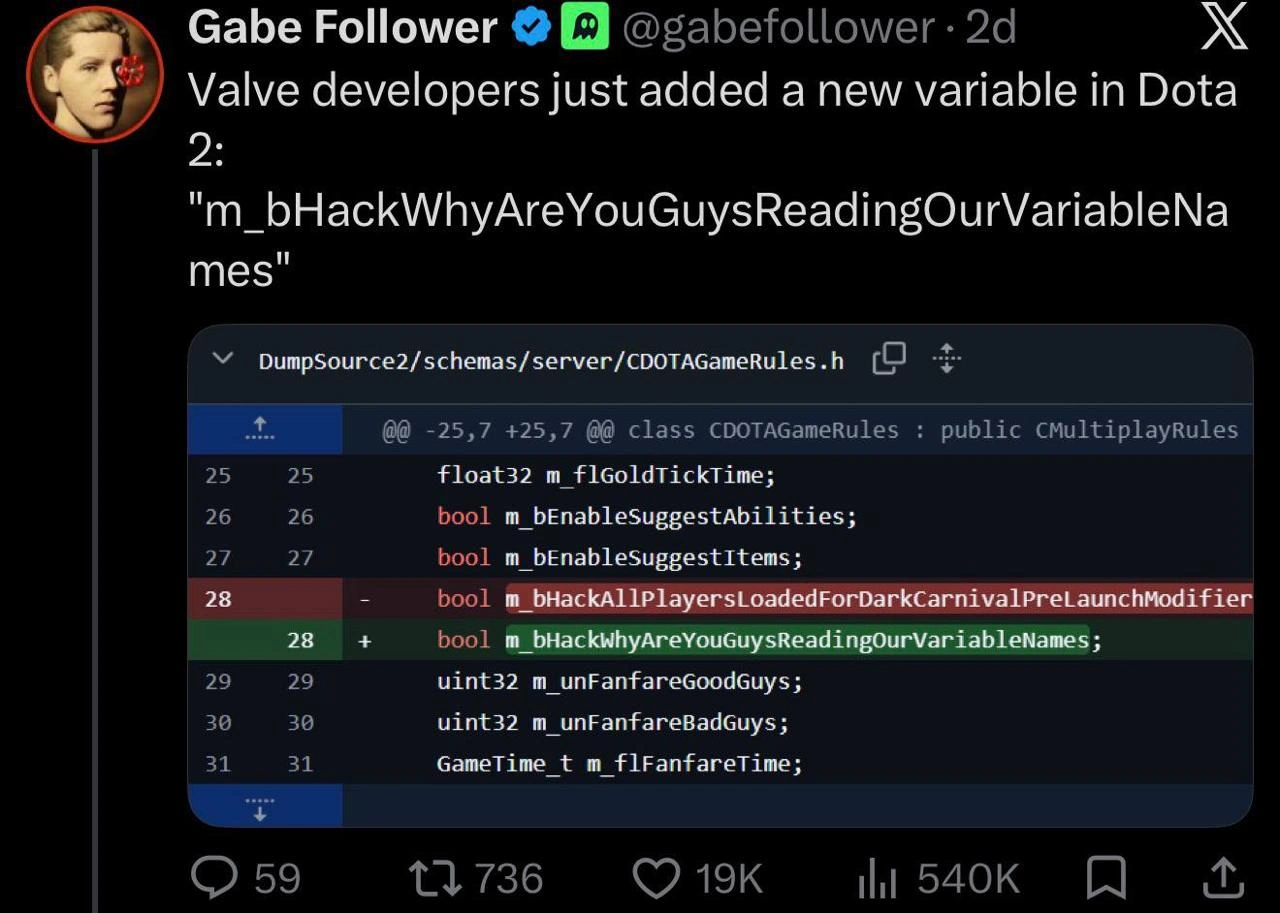
Data mining means extracting useful clues from data a product ships. In a game, that can include filenames, localization strings, models, configuration values, and reflected code structures. Reverse engineering goes further by studying a program's artifacts or behavior to understand how it works without access to its original private source. Here, the visible artifact is a generated C++-style schema and a diff between two versions.
A diff marks what changed:
- bool m_bHackAllPlayersLoadedForDarkCarnivalPreLaunchModifier…;
+ bool m_bHackWhyAreYouGuysReadingOurVariableNames;
Red with - means the old line was removed; green with + means the new line was added. Because both occupy line 28 among the same neighboring fields, the most natural reading is a rename or replacement. The screenshot alone cannot prove that only the text changed inside Valve's real source, but it clearly shows the exposed schema name changed.
A class groups data and behavior for a kind of object. CDOTAGameRules plausibly represents shared state governing a Dota match, while : public CMultiplayerRules means it inherits accessible behavior or structure from a more general multiplayer-rules class. The nearby declarations illustrate common types:
| Visible declaration | Plain meaning |
|---|---|
float32 m_flGoldTickTime |
A decimal-valued time associated with a gold tick |
bool m_bEnableSuggestItems |
A true/false switch for item suggestions |
uint32 m_unFanfareGoodGuys |
A non-negative 32-bit integer related to one side's fanfare |
GameTime_t m_flFanfareTime |
A game-specific time value for fanfare |
Developers choose descriptive names so humans can maintain code. Dataminers exploit the same descriptions because feature_coming_soon reveals more than field_1048. Replacing the Dark Carnival wording with a direct taunt acknowledges this accidental information channel. It also demonstrates codebase archaeology: people learn history not from a polished announcement but from sediment layers left by successive builds.
The post's verified “Gabe Follower” account is part of the visual joke because the audience is not hypothetical. The account posts the discovery, and the engagement counters show the community enthusiastically circulating proof that it reads exactly what Valve asked it not to read. It is a feedback loop between game developers, update trackers, rumor communities, and players waiting for new content.
The useful beginner's caution is that names are clues, not contracts. A variable called EnableSomething may never be enabled. A feature can be renamed, postponed, abandoned, or guarded entirely on the server. Datamining can reveal possibilities and preparation; only shipped behavior or an official announcement establishes what players actually receive.
Level 3: The Boolean Talks Back
The post presents the cleanest possible example of developers using implementation metadata as a public message:
Valve developers just added a new variable in Dota 2: “m_bHackWhyAreYouGuysReadingOurVariableNames”
The embedded diff makes the punchline self-authenticating. A red line with a long DarkCarnivalPreLaunchModifier… name disappears, and a green line appears in its place:
bool m_bHackWhyAreYouGuysReadingOurVariableNames;
The question is embedded in precisely the place only someone inspecting internal schemas would find it. Then a dataminer finds it, posts it, and the screenshot accumulates a visible 540K views, 19K likes, 736 reposts, and 59 replies. Valve asks why people read the names; half a million views answer, “Because sometimes you do this.” The boolean does not even need a value. Its existence evaluates the joke to true.
The file shown is DumpSource2/schemas/Server/CDOTAGameRules.h, and that path matters. It looks like C++, with CDOTAGameRules inheriting from CMultiplayerRules, but DumpSource2 strongly suggests a reconstructed schema dump, not Valve casually publishing its private source repository. Source 2 exposes type and field metadata needed by engine systems, tooling, serialization, or networking. Community trackers can extract that metadata from shipped builds and render it as header-like declarations. Comparing successive dumps reveals added, removed, or renamed fields even when the original implementation remains unavailable.
Ordinary optimized C++ machine code does not have to preserve every local variable name. Those names are usually irrelevant after compilation unless debug symbols are shipped. A runtime reflection or schema system is different: it deliberately retains names and type information so code can discover fields dynamically. That makes a descriptive member name operationally useful—and makes it an excellent little billboard aimed at anyone diffing the schema. The developers knew the audience because the mechanism that serves the engine also serves the archaeologists.
The deleted name supplies the deeper context. Its visible prefix refers to all players being loaded for a DarkCarnivalPreLaunchModifier, making it sound like a temporary gate for unreleased event behavior. The corpus post appeared on June 23, 2026, two days before Valve officially unveiled the Dark Carnival event. At posting time, therefore, the old identifier was exactly the kind of pre-announcement clue dataminers hunt: not a complete feature description, but a meaningful name attached to an imminent content path. The later launch explains the reference; it does not mean observers already knew every event detail from this one field.
Renaming the member is clever because it both hides and advertises. It removes a highly descriptive spoiler from later schema dumps, yet the diff preserves the old line for anyone already watching. That is the Streisand effect in miniature: an attempt—or theatrical attempt—to stop attention becomes the most shareable artifact in the update. Given Valve's long culture of opaque schedules, hidden clues, and community speculation, the codebase becomes another surface on which developers and players conduct a very asynchronous conversation.
The name also obeys enough house style to make the nonsense feel official:
m_marks a member field belonging to an object.bindicates a Boolean, a value conceptually representing true or false.Hacksignals a special-case workaround or deliberately inelegant path.WhyAreYouGuysReadingOurVariableNamesabandons domain language and addresses the observers directly.
Nearby fields—m_flGoldTickTime, m_bEnableSuggestAbilities, m_unFanfareGoodGuys, and m_flFanfareTime—reinforce the convention. The joke line is syntactically ordinary and semantically ridiculous. It occupies the same class layout as gold timing and fanfare state, as though “community caught reading our homework” were a formal game rule.
There is an engineering caveat beneath the fun: a renamed field does not prove what code executes, whether the member is still read, or whether its original behavior survived. Schema diffs expose structure, not complete control flow. The field could be a functional flag, an unused compatibility slot, a deliberate decoy, or a temporary name chosen to preserve layout while obscuring intent. Inferring an entire release from one identifier is how datamining becomes fan fiction with hexadecimal footnotes.
This creates a recurring tension in game development. Players want roadmaps and clues; studios want freedom to test, cancel, or revise unfinished work without turning every internal experiment into a promise. Shipped clients necessarily reveal assets, strings, types, network messages, and feature flags needed to run the game. Dataminers convert those traces into news. Developers then spend effort minimizing spoilers, using neutral identifiers, separating server-only material, or—as here—leaving a sarcastic note for the people who will inevitably inspect the next depot update before breakfast.
From a code-quality perspective, m_bHackWhyAreYouGuysReadingOurVariableNames would be an awful long-term production name: it describes neither state nor invariant, and future maintainers would have to reconstruct the joke. As a short-lived community in-joke, however, its poor naming is the point. The social meaning is far clearer than the technical meaning. The diff is less a refactor than developer graffiti preserved by an automated museum curator.
Description
A dark-mode X post from the verified account "Gabe Follower" (@gabefollower, "2d") says, "Valve developers just added a new variable in Dota 2: ‘m_bHackWhyAreYouGuysReadingOurVariableNames’." The embedded diff is labeled `DumpSource2/schemas/Server/CDOTAGameRules.h` and shows `class CDOTAGameRules : public CMultiplayerRules`, with nearby fields `m_flGoldTickTime`, `m_bEnableSuggestAbilities`, `m_bEnableSuggestItems`, `m_unFanfareGoodGuys`, `m_unFanfareBadGuys`, and `m_flFanfareTime`. A red deleted line beginning `bool m_bHackAllPlayersLoadedForDarkCarnivalPreLaunchModifier...` is replaced by the green line `bool m_bHackWhyAreYouGuysReadingOurVariableNames;`, turning a C++-style schema identifier into a direct taunt aimed at people mining Dota 2 updates for unreleased content. Along the bottom, the post shows 59 replies, 736 reposts, 19K likes, and 540K views, underscoring how quickly the audience proved Valve's point by circulating the diff.
Comments
1Comment deleted
The flag evaluates to true the moment it appears in a diff.