Pirate Platypus Coverage Blocks Production Again
Why is this Testing meme funny?
Level 1: Testing the Wrong Thing
Imagine checking a school backpack again and again before a trip, then staying awake so long that you mistake a pizza box for the backpack and start worrying whether it is safe for a pirate animal. The funny part is that the person trying to catch every possible mistake has become too tired to notice the huge mistake right in front of him. Sometimes the safest next check is getting some sleep.
Level 2: Meet the Edge Case
An edge case is a situation near an input or operating boundary where software may behave differently: zero items, the maximum file size, a lost internet connection, or two users editing at once. A pirate platypus is a comic corner case, a bizarre combination of traits used to show how far testing can drift from realistic needs.
Quality assurance, or QA, is the broader practice of building confidence that a product meets its requirements. It includes planning, reviews, testing, and process improvement. Common test layers include:
- Unit tests, which check a small function or component in isolation.
- Integration tests, which check that components or services work together.
- End-to-end tests, which exercise a complete user journey through a deployed system.
- Performance tests, which measure behavior under load or constrained resources.
- Exploratory testing, in which a person actively investigates behavior beyond scripted checks.
Each layer catches different failures and has a different maintenance cost. Adding tests without considering value can become overengineering: the suite grows slow and fragile, developers stop trusting failures, and releases become harder without becoming proportionally safer. A test that can never fail for a meaningful reason is merely a tiny program demanding lifelong attention.
Production is the real environment used by customers. “Production-ready code” should meet an explicitly agreed bar, not a developer's feeling after an all-night session. One simple risk table can make the decision less emotional:
| Scenario | Likelihood | Impact | Sensible action |
|---|---|---|---|
| Invalid password attempts | High | Medium | Test and monitor |
| Payment submitted twice | Medium | High | Design for idempotency and test thoroughly |
| Database unavailable | Low to medium | High | Test failure handling and recovery |
| Pirate platypus uses pizza box | Unclear | Unclear | Sleep, then clarify requirements |
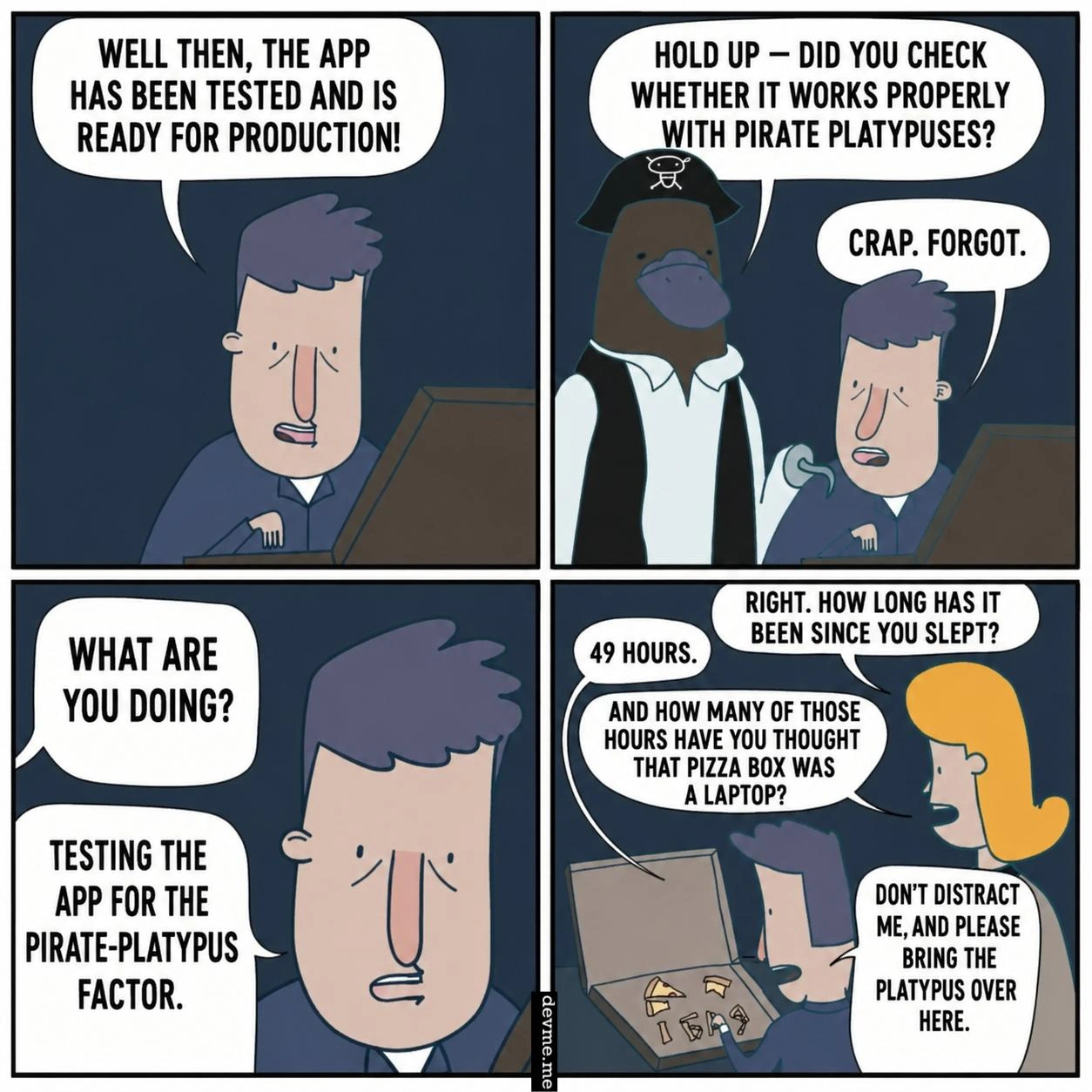
The blonde colleague is doing the most valuable QA in the comic. She tests the tester by checking sleep duration and whether he recognizes his equipment. Those observations reveal a higher-priority defect than anything in the app: the current human process cannot produce trustworthy results. Pausing work, handing off, and returning rested is not a failure of commitment; it is defect prevention.
The visual progression reinforces this. In panel one the developer sits before what appears to be a brown monitor. By the last panel, the open brown object visibly contains crusts and scraps. His hunched posture and narrowed eyes were not just generic programmer tiredness; they were evidence. The audience receives the test result before he accepts it.
Level 3: Coverage Has a Bill
The comic begins with the most dangerous sentence in software delivery:
WELL THEN, THE APP HAS BEEN TESTED AND IS READY FOR PRODUCTION!
That confidence survives for approximately one panel. A platypus dressed as a pirate asks whether the app works properly with pirate platypuses, and the developer immediately answers, CRAP. FORGOT. The absurd animal represents an edge case so specific that no reasonable requirements document would contain it. Yet the engineer treats the question as a legitimate release blocker, because teams often confuse “someone imagined a scenario” with “we must test that scenario before shipping.”
The final panel makes the joke much darker. The developer says he has been awake for 49 HOURS, and a colleague asks how long he has mistaken an open pizza box for a laptop. He refuses the interruption and requests the platypus. That reveal retroactively destabilizes the whole test case: the pirate platypus may be no more real than the computer. The person responsible for validating reality can no longer reliably identify the test device, the stakeholder, or possibly Australian wildlife with maritime ambitions.
Software testing always operates inside a state-space problem. Even a modest app may vary across inputs, user roles, browsers, devices, locales, time zones, permissions, network conditions, dependency versions, concurrent actions, and failure modes. Their combinations multiply quickly:
$$ N_{cases} = N_{inputs} \times N_{platforms} \times N_{states} \times N_{failures} \times \cdots $$
No practical team can exhaustively test every combination. “Complete coverage” is therefore not an achievable pile of test cases; it is a risk decision. Good teams prioritize scenarios by likelihood, impact, and the cost of detecting or recovering from failure. A rare possibility with catastrophic consequences—incorrect medical dosage, lost money, broken authorization—can deserve intense attention. A scenario involving an imaginary pirate platypus probably needs one clarifying question before it gets its own sprint.
The comic satirizes what happens when that prioritization mechanism collapses. Any new concern triggers more testing because nobody wants to be the person who approved a release and missed something. The incentive is asymmetric: delaying for one more hypothetical case looks cautious, while saying “that risk is irrelevant” creates personal accountability. Without explicit acceptance criteria and an agreed definition of done, quality assurance becomes a ritual for transferring blame. The test plan grows until the deadline, the budget, or the engineer's nervous system fails first.
The phrase PIRATE-PLATYPUS FACTOR is perfect fake technical language. Naming a concern makes it sound measurable even when nobody has defined the user, environment, expected behavior, or failure consequence. A real test case needs those things:
Given: a supported user and documented environment
When: a specified action occurs
Then: an observable result should follow
“Works properly with pirate platypuses” provides none of them. Can the animal create an account? Is the eye patch an accessibility constraint? Does the app process bills or bills? Forty-nine hours into the incident, these are apparently roadmap questions.
The production-readiness claim is also too narrow. Passing tests is necessary but not sufficient. A service may behave correctly in a test environment and still fail under real traffic, expired credentials, partial outages, unexpected data, or operational mistakes. Readiness normally includes security review, deployment automation, database migration safety, monitoring, alerts, capacity, backups, rollback or roll-forward plans, ownership, and a way to limit damage. Tests reduce uncertainty; they do not confer immortality.
Nor does test coverage answer everything. Statement or branch coverage reports which code executed during tests, not whether the assertions were meaningful or the requirements were correct. A suite can reach every line while checking the wrong outputs. Conversely, carefully chosen boundary, integration, and failure tests may provide high confidence without touching every defensive path. The useful question is not “Did we achieve a sacred percentage?” but “Which important failures would this suite detect, and which risks remain?”
Sleep deprivation corrupts the very control system making those judgments. Fatigue can reduce attention, working memory, emotional regulation, and error detection; more hours do not translate linearly into more reliable work. An exhausted engineer may add brittle tests, misread failures, approve dangerous changes, or spend hours validating a pizza box. Crunch culture nevertheless rewards visible sacrifice because time at the desk is easier to count than decision quality. The comic's grim punchline is that the app's liveness check passed while the developer's clearly did not.
The healthier engineering response is not to mock all edge cases. Real edge cases—empty collections, Unicode, leap days, retries, duplicate messages, clock changes, full disks—cause real incidents precisely because happy-path thinking ignores them. The discipline lies in deriving them from the system's boundaries and threat model rather than accepting every anxious improvisation. A rested reviewer who asks “What evidence makes this relevant?” contributes more to quality than an exhausted hero who writes test number 4,812 for a hallucinated customer segment.
Description
A four-panel cartoon in muted navy, purple, tan, and orange shows a tired developer at what appears to be a computer, announcing, "Well then, the app has been tested and is ready for production!" A platypus wearing a black pirate hat and vest interrupts, "Hold up – did you check whether it works properly with pirate platypuses?" and the developer replies, "Crap. Forgot." Asked "What are you doing?" in the third panel, he answers, "Testing the app for the pirate-platypus factor." In the final panel a blonde colleague asks, "Right. How long has it been since you slept?" and, after "49 hours," asks, "And how many of those hours have you thought that pizza box was a laptop?"; the developer, hunched over an open box containing crusts and scraps, says, "Don't distract me, and please bring the platypus over here," satirizing pathological edge-case testing, false production-readiness confidence, and sleep-deprived engineering judgment.
Comments
1Comment deleted
The platypus passed; the engineer failed the liveness probe.