Skip to content
DevMeme
7436 of 7506
The Game Developer's Three-Hour Work-Life Balance

The Game Developer's Three-Hour Work-Life Balance

Why is this GameDev meme funny?

Level 1: Two Fun Doors

Imagine standing between two doors: behind one is a game you love, and behind the other is a toy you love building. You spend so long wondering which fun door is best that both rooms close, and then you take a tiny nap on the floor. The next day your friends cheer as if you discovered a brilliant trick. That is why it is funny: he tried so hard to choose the perfect evening that he lost the evening and called three hours of sleep the successful plan.

Level 2: Play, Build, or Rest

A side project is software someone builds outside their primary job or studies. For game developers, it can be a small prototype, a game jam entry, a new engine experiment, or the dream project that has quietly acquired a roadmap longer than the day job’s. Side projects can teach valuable skills, but they still consume attention and time.

Procrastination means delaying an intended action even when the delay is likely to make things worse. In this comic, the character does not choose gaming, development, or timely sleep. He keeps comparing options until little night remains. Decision fatigue describes how repeated or effortful choices can make later decisions harder, especially when someone is already tired.

The game-development context makes the options blur:

  • Playing a game may be genuine rest, but it can also feel like research.
  • Making a game may be joyful, but it still involves difficult problem-solving.
  • Staying at the same desk preserves the cues and posture of work.
  • An open-ended task has no natural signal that the session is complete.

A simple way to avoid the loop is to make the choice smaller. Instead of “make a game,” choose “spend thirty minutes adjusting the jump,” and write down where to resume. Instead of treating play as failed productivity, choose a game and a stopping time on purpose. Most importantly, sleep is not the leftover option after entertainment and work finish competing. It is part of the equipment required to do either well tomorrow.

The coworkers’ praise is deliberately backwards. Healthy work–life balance is not squeezing work, a work-like hobby, entertainment, and sleep into one night. It means having enough boundaries and recovery that one activity does not continuously consume the resources needed for the others.

Level 3: The Unrendered Evening

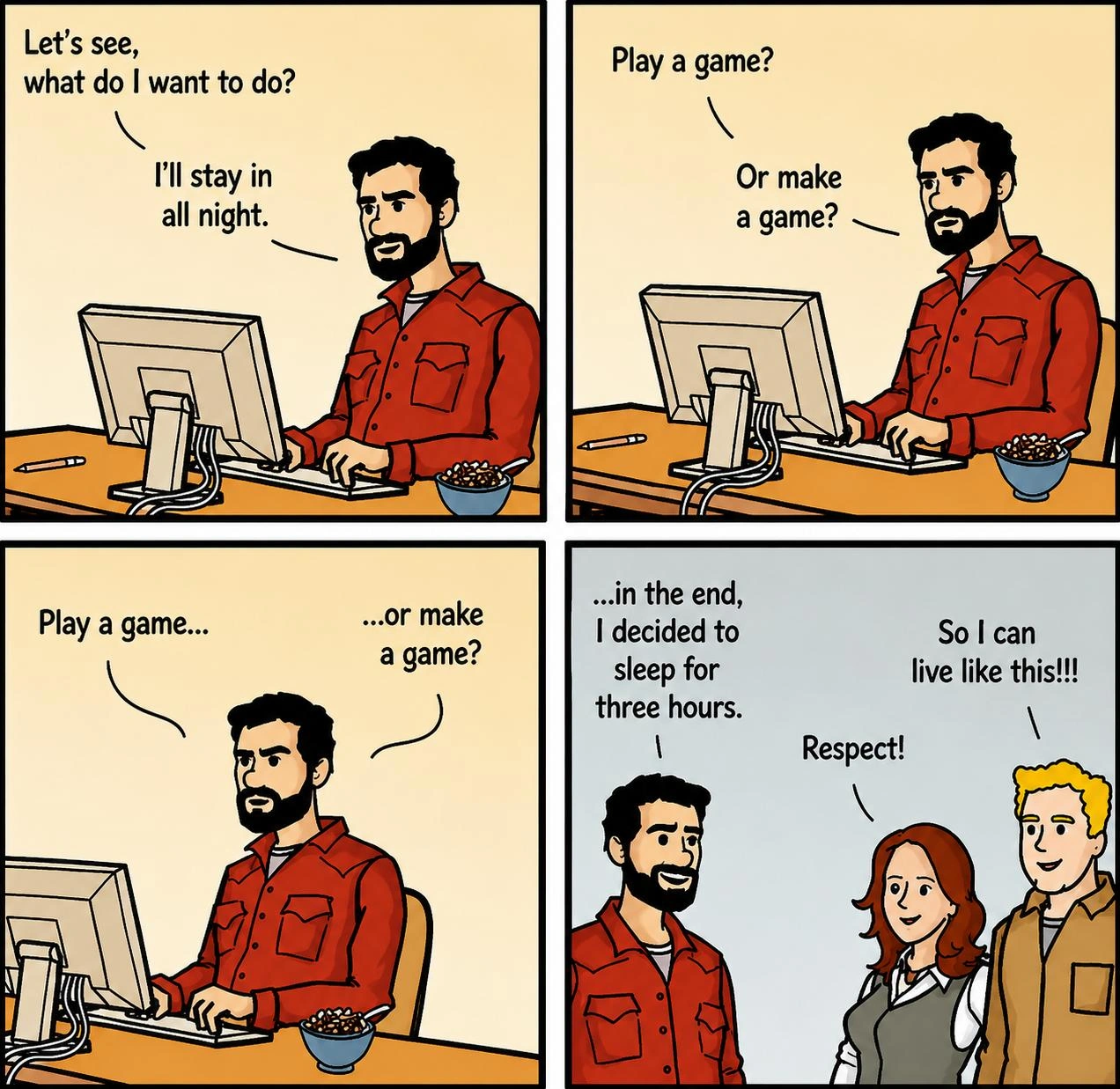
The comic presents leisure as an unresolved product decision. The bearded developer announces, I’ll stay in all night, then gives himself two options:

Play a game?
Or make a game?

Both choices are attractive, both happen at the same computer, and both are tied to the same identity. He cannot use a change of place or activity to break the tie, so the third panel simply repeats the question while time disappears. The final outcome—I decided to sleep for three hours—reveals that the choice was never between play and creation. It was between several ways of spending tomorrow’s attention in advance.

This is a particularly sharp game-development dilemma because consumption and production feed each other. Playing can be relaxation, social life, inspiration, market research, or an uncomfortable reminder of the polished game the side project is not yet becoming. Making a game can be creative play, professional practice, personal ambition, or a second unpaid shift. When one hobby supplies both recovery and work, the brain never receives an obvious “off” state. The desktop remains office, workshop, arcade, and guilt shrine.

The indecision resembles decision fatigue, but the deeper mechanism is an approach–approach conflict: there is no clearly bad option to reject. Each choice carries an opportunity cost. If he plays, he may feel he should have built. If he builds, he may resent sacrificing leisure. Delaying the choice briefly avoids both regrets, so delay becomes rewarding even while it destroys the time available for either activity. Procrastination is often less about laziness than about escaping an unpleasant emotion attached to starting.

Game creation magnifies that trap because “make a game” is not one task. It may mean programming mechanics, producing art, tuning controls, repairing an import pipeline, writing dialogue, testing a build, or discovering that the engine update has converted the evening into dependency archaeology. A vague aspiration forces the tired developer to choose both the project and the next action. By contrast, a concrete note such as fix jump buffering; reproduce with test scene gives the next session a doorway instead of another menu.

The final panel widens the satire from individual habit to developer culture. One colleague answers Respect!; another exclaims So I can live like this!!! The gray background and standing conversation suggest the next social setting, where three hours of sleep is retold as an achievement rather than a failed evening. That praise turns self-neglect into status. It echoes crunch culture’s oldest accounting trick: treat exhaustion as evidence of passion while assigning its errors, burnout, and recovery time to somebody else’s budget.

For most adults, three hours is far below the generally recommended nightly amount. Sleep loss is associated with poorer sustained attention, slower and more variable responses, more mistakes, and difficulty adapting decisions when feedback changes. Those are not abstract health concerns for a developer. They are the faculties used to trace state, remember constraints, notice regressions, and stop digging when a debugging hypothesis is wrong.

That creates a self-reinforcing loop:

  1. Indecision pushes work or play later.
  2. Short sleep weakens attention and decision quality.
  3. Development takes longer and produces more mistakes.
  4. The unfinished work creates pressure for another late night.
  5. Colleagues call the visible sacrifice “dedication.”

No game engine exposes sleepDebt.collectGarbage(). Weekend recovery can feel helpful, but it does not make chronic three-hour nights a sustainable workflow. The joke lands because the character technically chose sleep, allowing everyone to celebrate “balance,” while the number makes that victory absurd.

The bowl of snacks, fixed seated posture, and unchanged computer scene reinforce the loop visually. Nothing external interrupts him; the only movement across the first three panels is the wording of the same internal argument. Even the supposedly recreational option keeps him in the exact environment associated with production. The comic does not say that playing or making games is unhealthy. It shows how a passion becomes draining when every free hour is evaluated for maximum identity-consistent output.

A more durable practice is deliberately unromantic: decide the evening’s mode before fatigue peaks, define a tiny next action for a side project, give play equal legitimacy, and set a stopping condition rather than waiting to “feel done.” Teams can help by refusing to reward sleep deprivation, planning without routine crunch, and measuring sustainable outcomes instead of heroic hours. Passion is a renewable resource only when the schedule allows renewal.

Description

A four-panel comic follows a bearded man in a red shirt sitting at a desktop computer with a bowl of snacks. In the first panel he says, "Let’s see, what do I want to do? I’ll stay in all night," before considering "Play a game? Or make a game?" in the second panel. The third panel repeats his unresolved loop as "Play a game... ...or make a game?" while he remains frozen at the keyboard. In the final gray-background panel he tells two coworkers, "...in the end, I decided to sleep for three hours," prompting "Respect!" and "So I can live like this!!!"; the joke captures game developers sacrificing sleep because both work and leisure pull them toward the same machine.

Comments

1
Anonymous ★ Top Pick The scheduler found a three-hour maintenance window and called it sleep.
  1. Anonymous ★ Top Pick

    The scheduler found a three-hour maintenance window and called it sleep.

Use J and K for navigation