
The Perils of Volunteering to Fix Legacy Code
Description
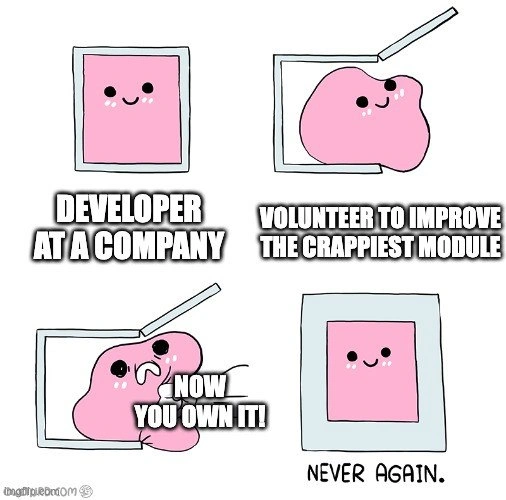
A four-panel comic strip featuring a cute, pink, smiling amorphous blob. In the first panel, the blob is neatly shaped like a square inside a box, with the caption 'DEVELOPER AT A COMPANY'. In the second panel, the blob happily oozes out of the box, with the text 'VOLUNTEER TO IMPROVE THE CRAPPIEST MODULE'. The third panel shows the lid of the box slamming down on the blob, which is now misshapen and distressed, with the caption 'NOW YOU OWN IT!'. In the final panel, the blob is back inside the box, a perfect square again with a placid smile, and the text 'NEVER AGAIN.' This meme illustrates a common and painful lesson in software development: 'You touch it, you own it.' When a developer takes the initiative to fix or refactor a neglected, buggy, or poorly-written part of the codebase (the 'crappiest module'), they often become the default owner and go-to person for all its future problems. The reward for their proactivity is permanent responsibility for the technical debt, a cautionary tale that discourages developers from tackling the most challenging problems
Comments
7Comment deleted
In this company, 'improving' a legacy module is like making eye contact with a stray cat. Congratulations, it's yours now
Volunteering to refactor the legacy component is basically `chown -R $USER ./haunted_mansion`; congrats, you now own every 3 AM page until decommission
The unwritten rule of senior engineering: The moment you successfully refactor that 10-year-old payment module that everyone's afraid to touch, you've just signed an implicit lifetime warranty contract. Your reward for heroism? Every future bug report, feature request, and 3am production incident for that module now has your name on it - because clearly, you're the only one who 'understands' it now
The classic 'you touched it last' principle in action: volunteer to refactor that gnarly 10-year-old module everyone avoids, and congratulations - you're now the permanent on-call expert for every edge case, undocumented behavior, and production incident it spawns. It's like adopting a feral cat that turns out to be three raccoons in a trench coat, and now you're responsible for all of them. Senior engineers know: the real technical debt isn't in the code, it's in the organizational memory that forever associates your name with that dumpster fire
Touch the crappiest module and Git writes an OWNERS file with your name; the PR merges, the pager forwards, and your bus factor drops to 1
Enterprise translation: refactor(crappy_module) is a mutating call that auto-updates CODEOWNERS and PagerDuty, returns 200 OK, and your weekends become the integration tests
He who volunteers to refactor the legacy monolith shall inherit its untestable bowels - and its eternal PagerDuty shifts