
Juniors Post #851 · source on Telegram
Every Programmer's First Rite of Passage
Description
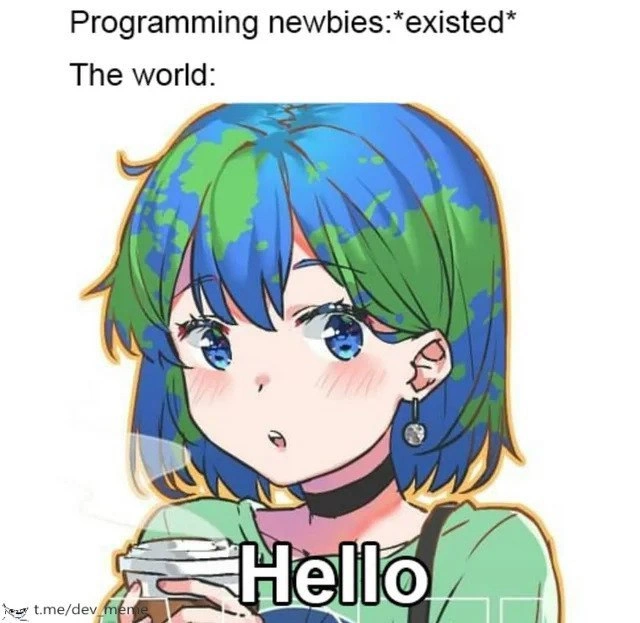
An anime-style meme featuring the character Earth-chan, an anthropomorphic representation of the planet Earth with blue and green hair resembling continents and oceans. The text at the top reads 'Programming newbies:*existed*' and 'The world:'. Earth-chan is shown holding a cup of coffee with a slightly surprised expression, and the word 'Hello' is written at the bottom, implying she is speaking. A watermark for 't.me/dev_meme' is in the bottom-left corner. The meme is a wholesome visual pun on 'Hello, World!', the traditional first program written by beginners when learning to code. The 'world' literally says 'Hello' to new programmers, referencing this universal starting point in a developer's journey
More like this
More like this in Juniors →
Use J and K for navigation
Comments
7Comment deleted
The junior's 'Hello, World' is a single print statement. The senior's 'Hello, World' is a three-day struggle with a YAML configuration file just to get the service to start in the Kubernetes cluster
Proof that software scales: juniors print “Hello World” in one line; seniors need 18 microservices, two Helm charts, and a post-mortem to get the same string into prod
Meanwhile, the same world after six months: "Why can't you center a div? Have you tried reading the documentation? No, not that documentation, the other one. Actually, just rewrite it in Rust."
After 20 years in the industry, I've realized 'Hello World' is the only program that's never had a breaking change, never needed a hotfix, and somehow still compiles on every platform. It's the one piece of code that's achieved true cross-generational compatibility - from COBOL mainframes to Kubernetes clusters. Perhaps the real technical debt was the friends we made along the way, starting with that first console.log
Newbies *existed* - Earth grabs coffee, knowing the tech debt singularity just got event-horizoned
Senior take: if saying hello needs a scaffold, container, sidecar, OAuth token, and a 2GB SDK, we didn’t onboard a newbie - we shipped vendor lock‑in
Welcome, newbie - “Hello, World” remains the only thing in our stack that doesn’t need OAuth, an API gateway, a service mesh, three YAMLs, and a change approval