
Dora the Abstraction Explorer
Description
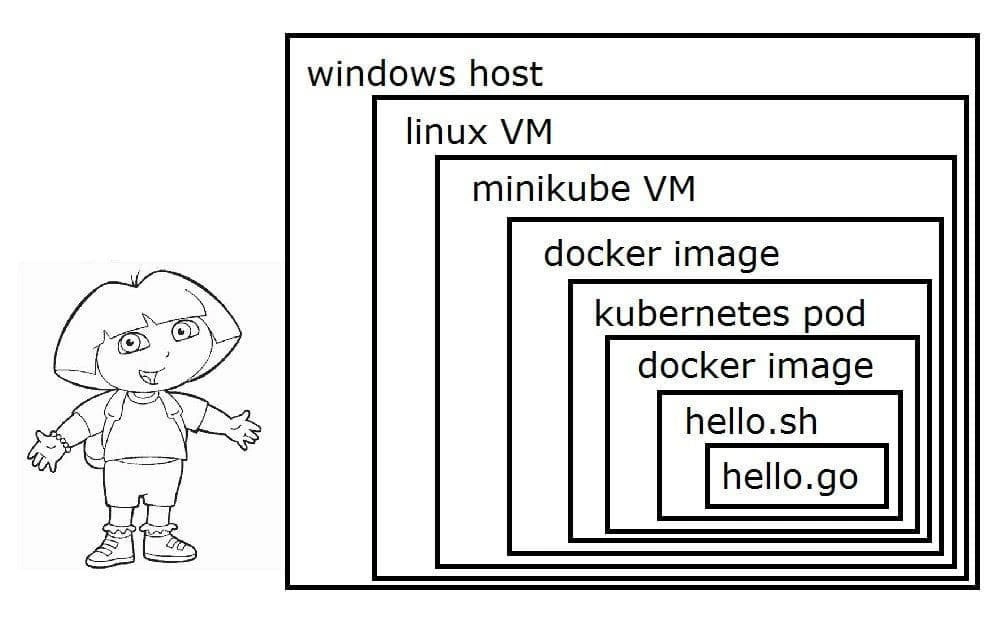
The meme is composed of two parts. On the left, there is a black-and-white outline drawing of the children's cartoon character, Dora the Explorer, looking cheerful. On the right, there is a diagram of eight nested black boxes, representing layers of technological abstraction, similar to Russian nesting dolls. The outermost box is labeled 'windows host', followed by 'linux VM', 'minikube VM', 'docker image', 'kubernetes pod', another 'docker image', 'hello.sh', and finally, the innermost box is labeled 'hello.go'. The humor stems from the juxtaposition of Dora the Explorer with the comically excessive number of layers required to run a simple 'hello.go' program. It satirizes the often-overwhelming complexity of modern local development environments, particularly in the cloud-native and containerization space. For experienced engineers, this is a relatable depiction of 'yak shaving' or over-engineering, where setting up the environment to run a simple application becomes a monumental task in itself. The joke is that one has to 'explore' through countless layers just to find where their code is actually executing
Comments
26Comment deleted
We call this 'résumé-driven development': the art of touching every possible technology just to run a single binary
Senior dev rule #42: if your 12-byte “Hello, world” needs a Windows host, a Linux VM, Minikube, two Docker layers, and a pod spec, congratulations - you’ve successfully rebuilt printf as a distributed system
Remember when deploying 'Hello World' just meant compiling and running? Now it requires a PhD in distributed systems and enough RAM to simulate the Matrix. At this rate, we'll need a Kubernetes cluster just to open Notepad by 2030
When your local development environment has more layers than your production infrastructure, and you need 32GB of RAM just to run 'hello world' because you're virtualizing a VM inside a VM running containers inside containers. The real question isn't 'does it scale?' but 'can my laptop even boot this?' - a perfect illustration of how we've achieved the remarkable feat of making a simple shell script require more compute resources than the Apollo moon landing
Local dev nirvana: five layers to echo 'hello' - because one more VM ensures it *definitely* won't work anywhere else
We gave hello.go a control plane - its runtime complexity is now O(CNCF)
Nothing like printing 'hello' after paying the hypervisor tax twice and scheduling a single-pod cluster to run a bash wrapper for a Go file
And using rust you get zero-cost abstractions Comment deleted
What is this ? Comment deleted
> hello.go exec.Command(«hello.sh») Comment deleted
"Rust is a thing everyone likes to talk about, but almost nobody is using it in production" Change my mind. Comment deleted
I use Rust in production :/ Comment deleted
does it count? https://github.com/linkerd/linkerd2-proxy Comment deleted
Linkerd is quite popular is some workloads so it definitely counts Comment deleted
My company uses Rust for most of our projects Comment deleted
>discord At least quote a good software Comment deleted
Are you working in discord? Comment deleted
I think you understand that if I worked in Discord, then I would not be able to tell anything because of the NDA Comment deleted
But agree, it still doesn't mean rust is widely used in big products Comment deleted
I mean it can be a single internal service written in Rust Comment deleted
Нет нихуя, они бэкенд с гошки на раст переписывали, на Хабре почитать можешь Comment deleted
>russian Comment deleted
Похуй абсолютно Comment deleted
Nobody knows their internal infrastructure except themselves Comment deleted
Current working setup: Ubuntu host, vmware, windows guest with hyper-V, Visual Studio + Docker. Comment deleted
I hope at some point there will be a superset in rust which is easier for beginners and fits well in enterprise-level projects Comment deleted