Skip to content
DevMeme
1347 of 7435
Choosing secure jails over insecure riches
Security Post #1516, on May 8, 2020 in TG

Choosing secure jails over insecure riches

Why is this Security meme funny?

Level 1: Better Safe than Cheap

Imagine you have a pet hamster that you need to take on a car trip. You have two choices:

  • Choice A: Let the hamster roam freely inside the car so you don’t spend any money on a cage. Sure, you save some cash, but the hamster could get lost under the seat or, worse, crawl by the pedals and cause trouble while you’re driving.
  • Choice B: Buy a sturdy travel cage for your hamster to ride in. It costs a bit of money, and the hamster might have less freedom to roam, but inside the cage it’s safe and can’t cause any chaos in the car.

Most of us would choose B, right? We’d rather pay a little money to make sure our beloved pet is safe and our trip goes smoothly. It’s a classic “safety first” situation. We know that a free-roaming hamster (while it might seem happy or save a few bucks) could lead to a big mess or an accident – which would cost a lot more to deal with than the price of a cage.

This meme is joking about the same kind of choice, but with computers and money. The people who run computer systems (like DevOps engineers) are like the pet owner who cares about the hamster. They have to decide: do we run our software in a secure container (which is like the hamster’s cage – it keeps everything safe and contained), or do we try to save money and run it “free-range” on a server with no extra protection? The funny picture shows that the engineers happily pick the “cage” for the software, and wave away the pile of money that represents the savings they could have had. In simple terms, they’re saying, “We care more about things running safely and predictably than we do about saving money.” It’s amusing because in real life, turning down money is hard – but for these tech folks, the peace of mind of a secure setup is worth it. They know that it’s better to be safe now than sorry later. So just like a careful pet owner buys the cage, a careful engineer “cages” their app in a container. The meme makes us smile because it’s a bit exaggerated but carries a truth: being safe and prepared can be more valuable than a quick cash save, whether you’re protecting a hamster or a web server!

Level 2: Containers vs Costs

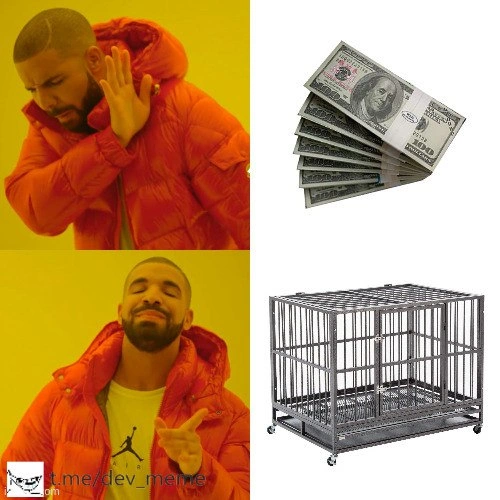
Let’s break down what’s going on here in simpler terms. The meme shows Drake (the famous rapper) in the well-known format where in the first image he’s rejecting something, and in the second image he’s approving something else. This format has been used a million times in internet culture – here it’s applied to a DevOps scenario. In the top, Drake is saying “no way” to a stack of money (literally a fan of $100 bills). That money represents “lucrative project budget savings” – basically, cutting costs or saving a lot of money on a software project. In the bottom, Drake is happily pointing at a big metal cage on wheels. That cage represents secure containers in a computing sense – not actual physical containers, but the idea of running applications in isolated, containerized environments (kind of like a high-tech sandbox or jail for your app). The joke is that DevOps engineers would rather put their software in a safe, locked-down container than pocket extra cash by doing things the cheap/easy way. It highlights how strongly tech folks value security and reliability.

Now, what exactly is a “secure container” in tech? In software, containerization is a method of packaging an application along with all its dependencies (libraries, runtime, system tools) into one standardized unit. Think of it like putting your app in a shipping container. Just like a real shipping container lets you transport goods anywhere – truck, ship, train – without worrying about how they’ll be handled, a software container (like a Docker container) lets you move an app between servers (your laptop, a test server, the cloud) and have it run the same way everywhere. This solves the classic "it works on my machine" problem – because inside the container, it is your machine, in miniature. The container acts as a sandbox: from the app’s perspective, it has its own isolated little world (its own file system, its own network interfaces, etc.). If the app tries to do something crazy or bad, ideally it can’t affect the outside system – it’s stuck in its box (the cage metaphor!). This isolation is what we mean by ContainerSecurity: even if one container is hacked or crashes, it’s less likely to take down the whole system around it.

Common tools related to this are Docker and Kubernetes. Docker is a popular technology that developers use to create and run containers easily. You might hear people say “Docker container” – in fact, Docker made containers so accessible that “Docker” is almost synonymous with containerization. In practice, you’d write a Dockerfile (a short script) that sets up the environment for your app, building an image (like a template) which can run as a container. Kubernetes (often abbreviated “k8s”) is another tool – it’s like a container orchestration system, which simply means it helps manage and run lots of containers across many machines. If Docker is about putting one app in one container, Kubernetes is about running and coördinating hundreds of those containers for a big application or across a company. Using Kubernetes (or similar platforms) can improve reliability and scaling, but it also can be complex and sometimes expensive (you might pay for managed Kubernetes services or powerful servers to run it).

So, why would there be a choice between containers and budget savings? Imagine a scenario: your team can either deploy the new project the fast and cheap way (for example, just run the app directly on an existing server, no containers, fewer tools) or the safe and robust way (containerize everything, invest in proper infrastructure, maybe even use Kubernetes to handle it gracefully). The “fast and cheap” route could save a lot of money – fewer servers, no new software licenses, less initial setup time. That’s the stack of cash in the meme. But it comes with risks: without containers, maybe your app will run slightly differently on each server (causing bugs), or one app could hog resources and crash others, or a security flaw in one part could spread more easily. It’s kind of like having all your apps “loose” on one system versus each in its own fenced area. The safe-and-robust route (the cage in the meme) means each app is in its own container, nicely isolated. This typically leads to more consistent performance and fewer nasty surprises – at the cost of using more computing resources or spending more time setting things up. You might need to pay for extra cloud instances to host the containers separately, or spend developer hours building the Docker images and configuring things.

DevOps engineers (the people who handle deployment, scaling, and infrastructure – basically ensuring the software keeps running smoothly in production) love consistency and safety. They often have a mindset of “ automate it, standardize it, lock it down.” So the meme jokes that a DevOps person will gladly give up the big shiny budget cut (the cash) if it means they can run the project in sturdy containers with strong security. They’d rather spend the money to do it right. It highlights a bit of culture in tech: engineers prioritize reliability, sometimes even above business cost-saving goals. This can lead to humorous friction in companies – e.g., a finance manager might say “why are we spending so much on all these servers and container services?” and the DevOps team responds “so we don’t get paged at midnight when something breaks!” This meme is precisely about choosing security over budget.

The cage photo is a funny literal representation of a container. It looks like an empty animal crate on wheels. In computing, we obviously don’t use physical cages 😄, but the idea of a “jail” or “sandbox” is commonly used to describe containers. In fact, early container-like tech in Unix was called “chroot jail,” implying the process was stuck in a certain directory as its whole world. The meme takes that imagery and says: This cage = a secure container environment. And Drake (the DevOps engineer) is pointing like “Yes, this is the good stuff!” Meanwhile, money flying around = cutting costs. And Drake is like “No, not worth it.” It’s a lighthearted way to show the DevOps mindset.

In summary, containerization (using things like Docker and Kubernetes) provides a reproducible, isolated environment for apps, which greatly enhances security and reliability – at some expense. The meme jokes that engineers will choose that safe route, even if a “quick savings” option is dangled in front of them. It’s a popular theme in DevOps humor because it rings true: short-term savings can lead to long-term pain, and most engineers with a bit of experience will choose a stable system over a risky shortcut any day. After all, it’s better to prevent a problem now than fix a disaster later!

Level 3: Security vs Savings

For experienced engineers and DevOps/SRE veterans, this meme hits a nerve. It humorously captures that familiar showdown between doing things right versus doing things cheap. In countless war stories from tech companies, management will eye a project budget and suggest, “Maybe we don’t need all these new containers and security add-ons… think of the savings!” Meanwhile, the DevOps team – the folks on call at 3 AM if something breaks – are like Drake in the top panel, hand up, “Nope.” They’ve learned (often the hard way) that skimping on proper infrastructure and isolation is a false economy. The engineer priorities depicted here are crystal clear: reliability and security trump short-term cost-cutting.

The Drake Hotline Bling meme format is a perfect vessel for this message. In the top half, Drake’s disgusted face rejecting the fan of cash represents the DevOps engineer’s reaction to purely monetary incentives. It’s a comedic exaggeration of an engineer saying, “Big budget savings? No thanks, not if it compromises my system’s integrity.” In the bottom half, Drake is all smiles pointing to the rugged metal container cage – symbolizing a secure, isolated container environment. This is the DevOps team happily choosing a confined but safe sandbox for their application. As the description notes, it’s like they’d rather live in a self-imposed jail that’s secure and predictable, than enjoy a windfall that comes with strings (or risks) attached. This cage–container metaphor brilliantly visualizes how containers can feel like a protective cage: restrictive, yes, but also comforting in the way they constrain chaos. The wheels on the cage even evoke the portability of containers (you can roll that environment anywhere!). The whole scene screams DevOps humor: only in DeveloperHumor circles would embracing a “jail” be portrayed as the desirable option. 😅

Why is this so funny to those of us in the field? Because it’s so true. Seasoned developers and SREs have repeatedly seen what happens if you prioritize cost or speed over sound engineering:

  • Skip containerization to save a few bucks, and a deployment inevitably blows up because “it worked on dev, not in prod.”
  • Loosen security to move faster, and you end up on the front page of r/DevOpsHumor with a story about how an open S3 bucket or an ill-configured server cost the company millions.
  • Squeeze multiple applications onto one server to minimize cloud instances, and one app’s memory leak brings down everything (been there, done that – never again!).

In other words, experienced DevOps folks have a long memory for these anti-patterns. They know that what looks like a “lucrative saving” can quickly turn into a technical debt nightmare or a critical security incident. It’s a bit like refusing to buy insurance: sure, you save money… until disaster strikes and that decision looks incredibly foolish. The meme distills that wisdom into a simple image. Drake’s emphatic “no” to the cash reflects the battle-hardened Ops engineer’s attitude: We are not trading resilience for a short-term budget win.

We can imagine a real-world scenario that fits this meme perfectly. The CTO proposes, “Let’s cut cloud costs by running everything on one big server without Docker or Kubernetes overhead.” The CFO nods vigorously (all they see is the money). But the DevOps lead – picturing the vendor lock-in and single point of failure that would create – just channels Drake’s hand-wave: “Not gonna happen.” They’d probably counter with something like, “Would you rather save a few thousand now, or avoid a $100k outage later?” In one corner, you have finance folks high-fiving over reduced spend; in the other, engineers visualizing a future incident report titled “Post-mortem: Lack of container isolation leads to cascade failure.” It’s a classic DevOps vs. CFO tug-of-war. And this meme humorously sides with the DevOps ethos.

To highlight the contrast, consider the differences in a quick table of priorities:

Shortcut (No Containers) Best Practice (Secure Containers)
Save money on fewer servers or tools 💰 Spend budget on container platform and security 🛡️
Apps share environments (risky coupling) Apps isolated in separate containers (fault isolation)
“It might work... probably” deployments Reproducible deployments (works the same everywhere)
Faster setup initially (less tooling) More upfront work (Dockerfiles, CI/CD pipelines)
Higher risk of “works on my machine” bugs Environment parity eliminates those bugs 🎯
One outage can domino all services Outage in one container stays contained (limits blast radius)
CFO sleeps well (budget intact) 😉 DevOps sleeps well (system stable) 😴

The right column is clearly where the meme’s heart lies. It’s poking fun at how engineers will enthusiastically cage themselves in with best practices if it means avoiding late-night emergencies. There’s an implicit “We know what happens otherwise” underneath Drake’s smirk. Indeed, many in the DevOps community have a bit of scar tissue from past incidents. This shared experience fuels the meme’s relatability. It’s not really anti-money or anti-business; it’s pro-sanity. It’s saying: Remember that time we tried to save money and ended up spending way more fixing the fallout? Let’s not do that again.

So, within DevOps humor, Drake rejecting the cash is a lighthearted jab at penny-pinching decisions. And Drake embracing the beefy metal container is a celebration of doing things properly — using Docker/Kubernetes or other container tech to sandbox apps for Security and consistency. The meme takes an everyday corporate friction (budget vs. engineering) and boils it down to an image that every ops engineer can laugh at knowingly. Even if our non-engineer colleagues don’t immediately get why someone would turn down money for a “jail,” we in tech get it: that “jail” might just save our bacon in production. In summary, the meme humorously affirms a key DevOps mantra: “Better safe (and containerized) than sorry.” Or, as Drake might put it, zero-dollar outages > five-figure savings. 😁

Level 4: Chroot or Loot

At the deepest technical level, this meme riffs on core containerization concepts versus raw cost-saving. In operating systems, a container is essentially a lightweight process jail – like an advanced form of chroot. Under the hood, tools like Docker leverage Linux kernel features (especially namespaces and cgroups) to create isolated environments. Namespaces partition system resources (process IDs, network interfaces, mounts, etc.) so that processes inside a container can’t see anything outside their little “cage.” Cgroups (control groups) strictly allocate CPU, memory, and I/O, ensuring one container can’t hog all resources. Together, these mechanisms form a secure sandbox, often called a “chroot jail” (hence the literal jail-like cage image). The meme’s cage on wheels visually nods to this idea: a portable jail that you can wheel from one server to another, much like you’d port a container image across environments. It’s a playful acknowledgement that DevOps engineers willingly lock down their applications in a controlled box for the greater good of stability and security.

This choice speaks to a fundamental engineering trade-off. By embracing container isolation, the DevOps team gains a deterministic runtime environment. Determinism here means the software behaves the same way wherever it runs, because the container carries its OS libraries, configs, and dependencies with it. No more “But it worked on my machine!” – the container is your machine, encapsulated. This is essentially applying the principles of consistency and determinism from theoretical computer science to real-world deployments. (It’s like enforcing a miniature functional programming environment at the system level – eliminating external side effects by enclosing the app in a pure context.) The end result is highly predictable behavior: if it runs in the container on your laptop, it will run in the container on the server. The sandboxing preference shown in the meme stems from this desire for mathematical-like consistency in software deployment.

However, as any systems engineer knows, nothing comes for free – not even newfound consistency. Containers introduce some overhead and complexity. There’s a bit of performance cost to that kernel isolation (though far less than full VMs), and significant operational complexity in managing many containers (hello, Kubernetes). The “lucrative project budget savings” Drake is rebuffing might refer to skipping all that and running the app directly on a host to save money on infrastructure or licensing. In purely economic terms, opting for secure containers means investing more up front (more engineering hours, possibly more servers or cloud resources, maybe buying enterprise container management tools) in exchange for reduced risk and smoother operations later.[^1] It’s a classic engineering economics scenario: spend resources to reduce entropy. In fact, we can draw a parallel to thermodynamics – reducing chaos (random production issues) in a system requires an input of energy (engineering effort and budget). Here, containerization is that energy: it imposes order on the chaotic world of software deployments by standardizing environments at scale. DevOps folks embrace this “pay now, save later” approach because they understand the physics of software entropy.

The humor at this level comes from recognizing how deeply rational (almost scientific) that choice is. It’s a bit absurd yet admirable: engineers are effectively saying, “We’ll gladly step into a well-engineered cage (a contained sandbox) because it obeys the laws of computing hygiene, rather than roam free in an unpredictable wilderness just to save a quick buck.” The meme exaggerates this contrast by picturing money versus a metal cage. It’s as if Drake (the DevOps team) has read all the whitepapers on container security, knows about Linux kernel syscall filtering (e.g. seccomp profiles dropping risky system calls), understands multi-tenancy risks, and thus emphatically waves away the loot (short-term profit) for the sweet assurance of a locked-down container. In essence, the meme encodes a mini manifesto: better to embrace rigorous isolation and ContainerSecurity best practices than to gamble with a flimsier, albeit cheaper, setup. The technical subtext is clear to those in-the-know: robust containerization is like an unglamorous fortress – not flashy like a stack of Benjamins, but rock-solid when it counts.

[^1]: Ironically, containerization was also promoted for cost savings via better resource utilization (packing apps more densely than VMs). But here the “savings” Drake rejects likely refers to cutting corners on security or skipping containers entirely to save money. DevOps engineers know that downtime or breaches cost far more than any upfront savings.

Description

This is a classic two-panel 'Drake Hotline Bling' meme. In the top panel, the musician Drake, wearing a bright orange puffer jacket, holds up a hand in a gesture of rejection towards a fanned-out stack of hundred-dollar bills. In the bottom panel, Drake points with a smile of approval at a large, heavy-duty metal cage on wheels, resembling a secure animal crate or a small holding cell. A watermark for 't.me/dev_meme' is visible in the bottom left corner. The meme is a clever technical pun, playing on the term 'jail,' which in systems administration and security refers to a mechanism for isolating processes from the rest of the system, like FreeBSD jails or a chroot jail. The joke is that an experienced engineer would prefer a secure, isolated environment (the 'cage') over a monetary incentive that might come with a less secure, problematic project
Comments

7
Anonymous ★ Top Pick Your business folks offer a bonus to ship faster. I hear 'unrestricted root access for a third-party binary.' I'll take the cage, thanks
  1. Anonymous ★ Top Pick

    Your business folks offer a bonus to ship faster. I hear 'unrestricted root access for a third-party binary.' I'll take the cage, thanks

  2. Anonymous

    Budgets reboot quarterly; reputations after a root escape never do - so yes, I’ll take the seccomp-locked, read-only cage over your five-figure “savings,” thanks

  3. Anonymous

    After 15 years in tech, I've learned that developers will literally choose Kubernetes complexity hell over a simple pay raise - because at least the cage has proper observability and we can debug why we're trapped

  4. Anonymous

    When your architect says 'we need container orchestration' but the CFO hears 'we need to put our budget in a cage.' Turns out both were right - just ask anyone who's tried to escape a Kubernetes cluster after three years of custom operators and CRDs

  5. Anonymous

    Keep the cash - give me a cache that invalidates correctly across regions and doesn’t trigger a thundering herd on deploy; that upgrade pays for itself

  6. Anonymous

    Ask for a raise and it’s “runway is tight”; propose OPA/RBAC guardrails on a shiny Kubernetes platform and the CFO approves instantly - nothing gets funded faster than a well-branded chroot

  7. Anonymous

    Rejecting the corporate cash monolith for containerized pup bliss - finally, a pod with zero OOM kills and perfect isolation

Use J and K for navigation