
The Irrational Triangle of Debugging
Description
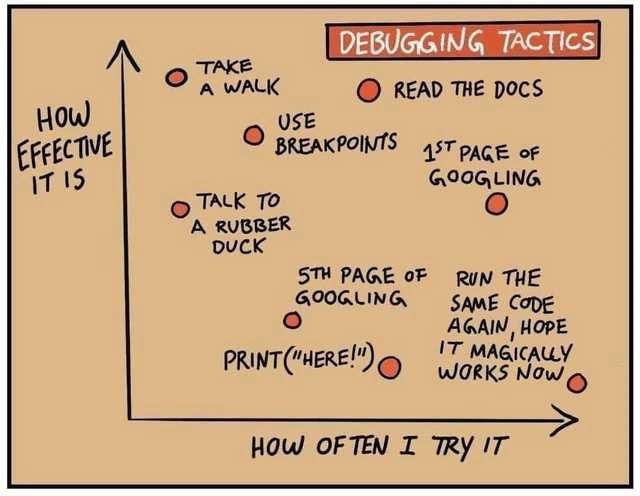
A hand-drawn chart titled 'DEBUGGING TACTICS' on a beige background. The chart is a scatter plot with two axes. The vertical Y-axis is labeled 'HOW EFFECTIVE IT IS', and the horizontal X-axis is labeled 'HOW OFTEN I TRY IT'. Various debugging methods are plotted as red circles. Highly effective but seldom-used tactics in the top-left include 'TAKE A WALK'. Highly effective and moderately used tactics include 'READ THE DOCS' and 'USE BREAKPOINTS'. In the middle are 'TALK TO A RUBBER DUCK' and '1ST PAGE OF GOOGLING'. Towards the bottom right, representing low effectiveness but high frequency, are '5TH PAGE OF GOOGLING', 'PRINT("HERE!")', and, furthest to the right, 'RUN THE SAME CODE AGAIN, HOPE IT MAGICALLY WORKS NOW'. The chart humorously illustrates a common developer anti-pattern: favoring low-effort, often ineffective debugging methods over more disciplined and effective ones. It's a relatable commentary on the psychology of problem-solving under pressure, where developers often choose repetition and hope over stepping back or consulting documentation



Comments
7Comment deleted
The junior developer lives in the bottom-right quadrant. The senior developer lives in the top-left, but still makes frequent nostalgic trips to the bottom-right just to feel something
I added a Prometheus alert on (google_page >= 2); when it fires, Slack reminds me to take the walk that actually fixes the bug
After 20 years in the industry, I've finally accepted that the correlation between debugging technique effectiveness and usage frequency follows an inverse power law - which explains why my git history is 40% 'fixed typo' and 60% 'please work this time'
This chart perfectly captures the senior engineer's paradox: we know breakpoints and documentation are the right answer, yet we still find ourselves on page 5 of Google at 2 AM, adding print statements like breadcrumbs in a forest of our own making. The rubber duck sits judgmentally on our desk, knowing we'll eventually come crawling back after the third 'run it again and pray' attempt fails. It's not that we don't know better - we wrote the debugging guidelines - we're just temporarily convinced that *this time* the code will work differently without any actual changes
Print('here') owns the high-frequency low-efficacy quadrant because after 20 years, we know persistence beats perfection - until the walkaway Heisenbug whisperer appears
Senior debugging truth: rerun-and-hope only “fixes” Heisenbugs by shifting the race window; reading the docs fixes the actual bug - so naturally we do the former ten times more
My debugging pipeline is tracing + docs + a long walk; rerun‑and‑pray only “fixes” Heisenbugs because the race condition times out before my coffee does