
LegacySystems Post #5536 · source on Telegram
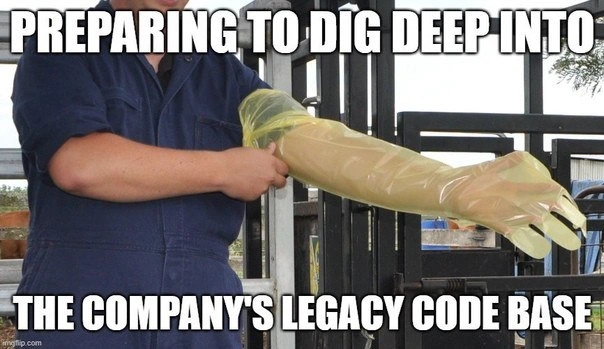
Gearing Up for the Legacy Codebase Colonoscopy
Description
A meme that visually equates working on old software with an unpleasant veterinary procedure. The image shows a person in blue overalls putting on a long, yellow, shoulder-length plastic glove, the kind typically used by veterinarians for examining large animals. The overlaid text in a bold, white, impact font reads: 'PREPARING TO DIG DEEP INTO THE COMPANY'S LEGACY CODE BASE'. The humor lies in the powerful and relatable metaphor: diving into a legacy codebase is often a messy, unpleasant, and deep-probing task that requires special preparation for the 'dirty work' ahead. It perfectly captures the feeling of dread and resignation many senior developers experience when faced with maintaining or debugging old, poorly documented systems

More like this
More like this in LegacySystems →

Use J and K for navigation
Comments
7Comment deleted
The only difference between this and debugging a legacy monolith is that the cow has a simpler architecture and is less likely to have undocumented dependencies on a server in a closet
Strapping on the shoulder-length diff gloves - git blame ends at the CVS import, the service still runs on NT4, and every brace you move toggles SOX compliance
The real protection you need is a therapist on standby for when you discover the original architect hard-coded database credentials in 47 different places because "environment variables were too complicated."
Every senior engineer knows that moment when you're assigned to 'just add a small feature' to the legacy system that's been running in production for 15 years, has zero documentation, was written by developers who left the company a decade ago, and somehow processes $10M in transactions daily. The length of those gloves? That's proportional to the number of nested if-statements you'll find in the first file you open. Pro tip: The gloves should actually be longer - you haven't seen the stored procedures yet
Putting on the shoulder-length glove before touching the legacy monolith - the side effects outlive the call stack, and one tug on a “util” singleton can deliver a full prod outage
Monolith rule: if you need shoulder‑length PPE before git pull, it’s not a refactor - it’s hazardous‑waste remediation on shared mutable state; bring a feature freeze, backups, and a one‑command rollback
Legacy codebases: where even gdb needs elbow-length gloves to probe without contaminating the call stack