Skip to content
DevMeme
5057 of 7435
The Senior Developer's Existential Dread: Becoming a Manager
Career HR Post #5535, on Sep 29, 2023 in TG

The Senior Developer's Existential Dread: Becoming a Manager

Why is this Career HR meme funny?

Level 1: Chores Instead of Playtime

Imagine you love playing with LEGO blocks, building whatever you want. That’s like writing code for a programmer – it’s the fun, creative part. Now imagine one day your playtime gets replaced by chores. Instead of building LEGO houses, you have to clean your room (that’s like attending meetings), do your homework report (that’s the Excel spreadsheet), and organize the toy shelf (that’s updating tasks in JIRA). You spend all day doing those chores, and you barely get to build anything with your bricks. You’d probably feel upset, right? You might even think, “Oh no, I’m turning into a grown-up who only does boring stuff!” In a kid’s world, that’s the moment you realize you’re acting more like a parent or teacher than a kid having fun.

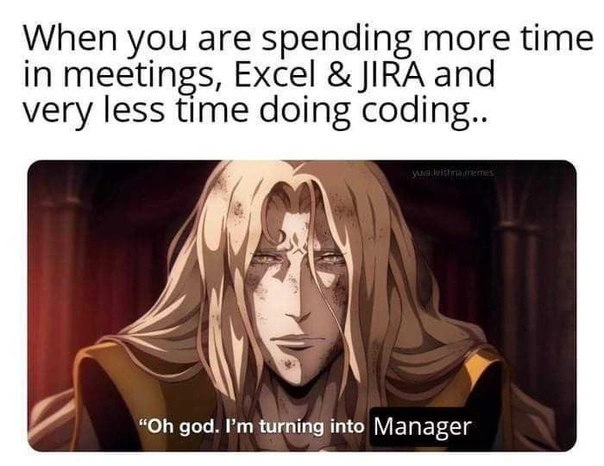
That’s exactly the feeling this meme jokes about, but in the world of software. The developer just wants to “play” by writing cool programs, but instead they’re stuck doing “chores” like meetings and paperwork. Saying “I’m turning into a manager” is like a kid saying “I’m turning into my parents!” – it’s a funny, exaggerated way to express that feeling of losing the fun part of what you love to do. The picture from the meme shows a cartoon character looking shocked and horrified, which is how the developer feels inside. We laugh because we all know that feeling a little: when what used to be fun starts feeling like work, and we worry we’re not the “hero with the toys” anymore but the “boss telling others to clean up.” In simple terms, the meme is just comparing coding (fun, like playtime) with meetings and reports (boring, like chores) and finding humor in how a person can accidentally end up doing the boring stuff more than the fun stuff.

Level 2: Meetings vs Code

In simpler terms, this meme is highlighting the conflict between writing code and doing managerial work in a developer’s day-to-day life. Let’s break down the pieces. First, the mention of meetings: developers generally need long stretches of focused time to program, but meetings chop the day into little pieces. Common meetings in software teams include daily stand-ups (each person briefly says what they’re working on), planning meetings (discussing what tasks to do next), retrospectives (talking about what went well or badly in the last work period), and many more. When you have too many meetings, there’s very little time left to actually code. Developers often joke about “meeting overload” – it’s a frustrating situation where they spend more time talking about work than doing the work.

Next, Excel refers to Microsoft Excel, the ubiquitous spreadsheet software. Why would a developer be in Excel instead of coding? Well, Excel is often used for tracking and reporting. For example, a manager might ask for a progress report or a bug list in a spreadsheet. If a developer finds themselves copying lists of issues into Excel, updating project timelines, or maintaining some kind of status sheet, that’s time not spent coding. It feels a bit odd because developers have powerful tools and programming languages at their disposal, but corporate teams still love their spreadsheets for summaries. Imagine being a chef who suddenly spends most of the day not cooking, but filling out inventory forms – that’s what coding vs. Excel can feel like.

Then there’s JIRA. JIRA is a popular software tool (made by Atlassian) for tracking issues and tasks in projects. Think of JIRA as a giant to-do board for development teams: each task or bug is a “ticket” that moves through steps (To Do -> In Progress -> Done, for instance). It’s very common in Agile software development (especially Scrum methodology). Developers use JIRA to pick up work and update progress. But, updating JIRA can become a job of its own: writing comments, changing statuses, estimating story points, linking tickets – these things help keep everyone informed but don’t directly produce any new feature or fix. If a developer is spending “more time… in JIRA” it implies they’re busy managing tickets rather than writing code. This could happen if the person has a role like team lead or scrum master, or simply that the team’s process demands a lot of administrivia. JIRA is practically a symbol of process and organization in tech teams. Many junior devs first encounter JIRA and realize coding isn’t only about code – there’s planning and coordination too.

So the meme’s text basically lists three “work activities” – meetings, Excel, JIRA – that are not coding, and says the person is spending more time on those than on actual programming. That alone sets up the feeling of “something is wrong here.” It resonates with anyone who went into software excited to build things, but then discovered a lot of time goes into meetings about features, updating tasks, and reporting progress upward. It’s a known friction in DeveloperProductivity: too many interruptions or extra tasks can slow down coding significantly. A new developer might not expect that they’ll have to, say, attend a marketing meeting or compile data for a client report, but those things pop up in real jobs.

Now, the image itself (the anime-style character with a horrified face) and its caption “Oh god. I’m turning into Manager” drive home the point with a bit of humor and drama. In a software team, managers (like project managers, engineering managers, product managers) are typically the people who handle coordination: they live in meetings, Excel, and JIRA. Those tools are basically a manager’s everyday toolkit. Managers often don’t write code; their job is to make sure the project is on track, which involves lots of communication, planning, and tracking – hence meetings and spreadsheets and ticket systems. So when a developer – who’s supposed to be coding – realizes they’re doing all these manager-type tasks, they jokingly say “I’m turning into a manager.” It’s a bit of a role reversal or loss of one’s expected role. Developers often pride themselves on creating and problem-solving with code, whereas they might stereotype managers as people who just talk about work. So the meme is a playful way of expressing dismay: the person came to work to build software, but now they feel like their role has shifted to something else.

For a junior developer or someone new to tech, it’s useful to understand that this is poking fun at real career dynamics. As developers become more senior, they often take on additional responsibilities: maybe you start mentoring others, planning sprints, talking to other departments, or providing estimates for timelines. Those things inevitably reduce the time you personally spend coding. It’s not necessarily bad – it can help the team and it’s part of growth – but it can be surprising and sometimes uncomfortable if you really love coding. Some people do move into official management positions (like becoming an engineering manager or tech lead) and then coding becomes a much smaller part of their job. The meme’s author is basically caught in that awkward phase where they haven’t formally changed jobs, yet their day-to-day looks a lot like a manager’s. That’s why it’s funny and a bit sad at the same time. It’s DeveloperHumor with a slice of truth: you sign up to be a builder of software, but suddenly find yourself being an organizer and communicator more than a builder.

In summary, at Level 2 we can say: this meme jokes about a software engineer who barely has time to code anymore because they’re swamped with meetings, updating Excel spreadsheets, and managing tasks in JIRA. It’s using an exaggerated “Oh no, I’m becoming a manager!” punchline to highlight how their role feels flipped. This speaks to MeetingHumor (making fun of too many meetings) and ManagementHumor (lightly teasing the manager role as something a developer might become by accident). It’s a way of laughing at a scenario that many developers find themselves in as they advance in their careers or work in larger organizations. Even if you’re new to the field, you can probably relate if you’ve ever had a day full of school group project meetings or paperwork when all you wanted was to work on the actual project. The meme says: “I became what I once mocked, a person who schedules things and updates trackers instead of doing the main work.” It’s exaggeration, of course, but like a lot of humor, it exaggerates a real feeling to make a point.


Level 3: The Manager Mutation

This meme hits a nerve in tech culture: it portrays the lurking horror of a developer realizing they’ve become more of a paper-pushing manager than a coder. The top text sets the scene: “spending more time in meetings, Excel & JIRA and very less time doing coding.” Any experienced engineer reading that line will likely groan in sympathy. It’s a classic case of developer frustration where coding time evaporates, replaced by status meetings, spreadsheet reports, and endless JIRA ticket grooming. The punchline subtitle on the image > “Oh god. I’m turning into Manager” is both funny and painfully relatable. It’s the tech equivalent of a mid-life crisis – a developer identity crisis – where one catches themselves doing managerial tasks and panics: When did I stop coding and start herd­ing spreadsheets like cattle?

At a deeper level, this meme satirizes a common corporate culture pitfall: talented developers gradually drifting into management or bureaucratic overhead, sometimes without even wanting to. We’ve all seen it or lived it. One day you’re debugging memory leaks and writing code, the next day you’re color-coding cells in Excel for a quarterly report and updating a JIRA board all afternoon. It’s an accidental career pivot many in the industry dread. The humor bites because it’s management humor told from the coder’s perspective – basically saying “Look what I’ve become, the very thing I swore to resist!” There’s an implied irony that in tech companies, the better you get at your job, the more you get pulled away from actually doing it: a great coder is often “rewarded” with a team lead role that spawns more meetings and paperwork. Developer humor often pokes at this absurdity, because so many of us have joked about how being promoted felt like being demoted from coding.

This scenario is a textbook case of meeting overload. Instead of solving bugs or building features, the developer’s calendar is jammed with recurring meetings: stand-ups at 9, project sync at 10, planning at 11, then a surprise “quick chat” at 2 (which of course isn’t quick). Each meeting chips away at the focus time needed to code. And between meetings, our coder is likely updating project trackers: filling out an Excel spreadsheet of progress or tweaking JIRA tickets’ status and description so the stakeholders are happy. It’s the classic Excel vs coding conflict – are we programming software or just programming spreadsheets? Many of us have felt this: when you spend more time formatting cells in Excel than writing functions in your editor, something has gone terribly wrong. JIRA, the issue-tracking system, becomes both vital and loathed in this story. On one hand it’s a necessary tool for Agile workflows, on the other it can feel like a second full-time job: updating tickets, splitting tasks, assigning story points. It’s the epitome of what older devs call “JIRA hell” – when moving cards on a board overtakes moving actual code in the repository.

What makes this meme too real is that it reflects a widespread industry pattern. Agile methodologies introduced lots of “ceremonies” (daily stand-ups, sprint plannings, retrospectives) meant to improve team communication. But in practice, especially in large organizations, these can balloon into a meeting monster that devours hours every day. A developer might start the week thinking they’ll write a cool new feature, and end the week realizing they mostly attended Zoom calls and edited Excel sheets for status updates. The unspoken trauma here is the loss of maker’s joy: coding is a creative, absorbing activity, and it’s frustrating to have that replaced by what feels like administrative busy-work. The meme nails that emotional beat: “Oh god” (dread), “I’m turning into a Manager” (shock and self-realization). It’s funny because many devs semi-jokingly view management as “the dark side.” There’s a long-standing tongue-in-cheek rivalry: developers vs managers – one wants to hack on code, the other wants reports and predictability. When a developer catches themselves acting like the latter, it’s like a Jedi sensing the pull of the Dark Side. 🌑

On a systemic level, this image points out a DeveloperProductivity problem that isn’t about slow computers or tough bugs, but about process overhead. Why does fixing this seem impossible? For one, as projects grow, coordination is needed – some meetings and planning are useful to avoid chaos. But companies often go overboard: layers of project management, excessive metrics tracking, and requiring engineers to constantly justify their work in dashboards and spreadsheets. It’s a trade-off: a little process can help a team run smoothly, but too much process and the team grinds to a halt under its own weight. Here we see the latter. It highlights an incentive issue too: many workplaces still equate career growth with moving into management roles. The result? Engineers who love coding get pulled into managerial tasks to advance their careers (or simply because nobody else is doing it), and they become reluctant managers. They might not have formally changed titles, but day by day, meeting by meeting, they find themselves turning_into_manager in all but name. It’s a gradual osmosis where manager expectations seep into the engineering role. The tragedy (layered under the humor) is that these skills – updating Excel reports, attending back-to-back meetings – are orthogonal to writing great code. A brilliant programmer can suddenly feel less competent or happy because success has put them in a role where they’re a novice again (project coordination, people management). No wonder they look as dismayed as that long-haired anime character with the thousand-yard stare.

To seasoned devs, this image also brings back war stories of lost_coding_time. It’s reminiscent of those crunch periods where instead of crunching code, you’re crunching numbers in a spreadsheet for upper management’s status meeting. Many of us have had a week where the only “code” we wrote was an =SUM() formula in Excel. 🙃 The DeveloperFrustration is real: you end up working late (when the office is finally quiet) to do the actual coding you couldn’t get to during 9–5 due to all the bureaucratic overhead. Then you show up to the next meeting half-asleep because you were coding at midnight. It’s a vicious cycle that the meme captures in one despairing caption. And let’s not forget the JIRA_meeting_overload combo – a particularly potent mix. Some days it feels like your actual product isn’t the app or system you’re building; it’s the JIRA board updates and Excel sheets that get passed around. You basically become a human API feeding status data to managers who themselves are drowning in meetings – a chain reaction of meeting overload all the way up.

In true cynical veteran fashion, one might say: “This is how coding careers die, with thunderous applause of Outlook calendar reminders.” The humor here is dark because it’s rooted in truth – a truth we laugh at to keep from crying. Every developer who’s been around a few years can recall that startling moment of self-awareness: noticing you haven’t opened an IDE in days, but your Outlook calendar and Excel are always open. The meme exaggerates it to an anime drama moment – highlighting the word Manager like it’s a villainous title – which perfectly matches the internal scream of the coder’s soul. It’s a joke, but one that carries a caution: beware the slow creep of non-coding tasks. The audience laughs, then sighs, knowing that in modern corporate tech life, the struggle to stay coding (and not just coordinating) is absolutely real.

// A darkly humorous pseudo-schedule of a developer-turned-manager:
for (int hour = 9; hour < 17; ++hour) {
    if (hour == 9) attendMeeting("Daily Stand-up");        // morning status meeting
    else if (hour == 10) updateJiraTickets(teamBoard);     // triage backlog in JIRA
    else if (hour == 11) fillExcelReport("% Done = 0%");   // weekly progress Excel sheet
    else if (hour == 14) attendMeeting("Project Sync");    // afternoon sync meeting
    else /* any spare time */   reviewEmails();            // catch up on endless emails
}
// No time left for writeCode(); today 😢

In the pseudo-code above, notice there’s no writeCode() function call during working hours – it’s all meetings and project admin. That’s the joke in a nutshell. The code comments read like a MeetingOverload nightmare, and the sad "% Done = 0%" status in the Excel report is a cheeky nod: if you spend all day reporting, of course 0% of the actual coding gets done! This little code block is a satirical illustration of what the meme is conveying. Seasoned engineers will chuckle (or groan) at this because they’ve lived some version of it. They know the Manager by Meeting phenomenon is no mere myth.

Ultimately, the meme’s humor works on multiple levels of seniority. For the grizzled veterans, it’s a knowing laugh at a recurring industry folly – they’ve battled the meeting monster and bear the scars (and calendar invites) to prove it. They recall the first time they accidentally said something managerial like “Let’s circle back on that” and shuddered. For mid-level devs, it’s a warning wrapped in a joke: value your coding time and guard it, because the pull of “process” is strong. And for anyone who’s ever picked up the phone and said, “Hello, IT? Yeah, I can’t make the code today, I’m stuck in meetings” – this meme is your life. It perfectly combines DeveloperProductivity commentary with a dash of existential dread, making it a staple of DeveloperHumor feeds.


Description

A meme capturing the moment a developer realizes their career is shifting towards management. The top text reads, 'When you are spending more time in meetings, Excel & JIRA and very less time doing coding..'. Below this is an image of the weary, long-haired anime character Alucard from the Castlevania series, looking down with a pained expression. The bottom caption articulates his inner monologue: '“Oh god. I’m turning into Manager”'. The humor stems from the relatable horror many senior engineers feel as their responsibilities transition from hands-on coding to administrative tasks. The progression into management is framed not as a promotion, but as an unfortunate transformation, a loss of the core identity of being a builder
Comments

7
Anonymous ★ Top Pick The final stage of developer evolution is realizing your primary language is no longer Python, but Jira Query Language, and your most-used hotkey is 'Mute'
  1. Anonymous ★ Top Pick

    The final stage of developer evolution is realizing your primary language is no longer Python, but Jira Query Language, and your most-used hotkey is 'Mute'

  2. Anonymous

    My IDE just started auto-completing “Let’s take this offline” - pretty sure I’ve been silently rebased onto the management branch

  3. Anonymous

    The scariest part isn't becoming a manager, it's realizing your code reviews now consist of "looks good to me" because you haven't touched the codebase in three sprints and you're just trusting the CI pipeline like it's your last connection to engineering

  4. Anonymous

    The classic IC-to-manager pipeline: first they take your terminal, then they give you a calendar. Before you know it, you're optimizing sprint velocity instead of Big O complexity, and your most complex algorithm is finding a meeting slot that works for six people across three timezones. The real tragedy? Your GitHub contribution graph goes from a beautiful green forest to a barren wasteland, while your Outlook calendar becomes a Tetris game you're losing

  5. Anonymous

    You know you’ve crossed to management when the only hot path you optimize is the meeting agenda - queuing theory still applies, but the orchestrator is Outlook and the merge conflicts live in JIRA, not Git

  6. Anonymous

    The moment you realize you’re management: your hot path is JIRA, your persistence layer is Excel, and your deployable is a slide deck

  7. Anonymous

    The ultimate context switch: from kernel panics to stakeholder syncs, with JIRA as the inescapable ISR

Use J and K for navigation