
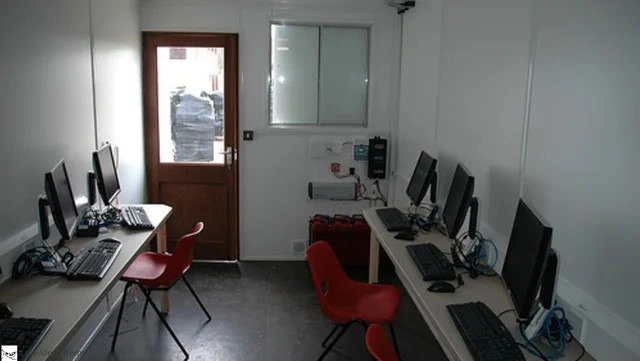
Makeshift dev office with kid-sized red chairs and tightly packed workstations
Description
The photo shows a narrow, white-walled room that looks like a converted site container. Two long beige desks run along the left and right walls, each holding several desktop setups - black flat-panel monitors, full-size keyboards, mice, and loosely coiled blue Ethernet cables. Four small red plastic classroom chairs sit at the stations (one pushed askew toward the center aisle), their height comically mismatched to the desks. At the far end is a wooden door with a window and, beside it, a small sliding window; wall-mounted power strips, a router, and exposed cabling complete the improvised feel. With no readable on-screen text, the scene parodies zero-budget corporate IT labs and highlights how poor ergonomics and ad-hoc infrastructure can tank developer experience and productivity




Comments
6Comment deleted
Leadership: “Time to embrace containerization and tighter feedback loops.” Facilities: ships us a literal container, four kindergarten chairs, and says, “Congrats - your micro-pod is horizontally scalable now.”
This is where they teach you to build "scalable" systems that will eventually run on a single overworked EC2 instance because the CFO discovered AWS bills
When the VC funding deck promised 'lean operations' and 'efficient capital allocation,' but you didn't realize they meant literally lean - as in no standing desks, no Herman Miller chairs, and definitely no ping pong table. At least the red chairs match the production alerts
Procurement-driven Waterfall: the acceptance criteria said "install workstations"; UAT discovered "user reaches keyboard" was a nonfunctional requirement
When 'containerized environment' means the SRE team's workspace has less headroom than a Docker image
Leadership said we’re moving to containers; Facilities bought a literal container and shoved six desktops in it - autoscaling is adding a red chair, and the service mesh is that lone blue Ethernet cable