Skip to content
DevMeme
984 of 7435
Developers react like apocalypse prophets when GitHub unexpectedly goes down
VersionControl Post #1106, on Mar 6, 2020 in TG

Developers react like apocalypse prophets when GitHub unexpectedly goes down

Why is this VersionControl meme funny?

Level 1: When Wi-Fi Goes Out

Think about a time when your internet or Wi-Fi went down at home. Everything gets quiet and frustrating really fast, right? If you were about to watch your favorite show or play an online game and suddenly there’s no connection, it might feel like the end of the world (even though it’s probably just for a short time). You might even joke, “Oh no, the world is ending!” because you can’t do anything you planned.

This meme is just like that, but for people who write code. GitHub is a place online where they keep all their code and work together on projects, kind of like a shared Google Drive but specifically for code and tech stuff. When GitHub goes down, programmers feel stuck and dramatic, just like when the Wi-Fi goes out. In the picture, a cartoon character (Homer Simpson) is running around with a sign that says “THE END IS NEAR,” acting like a doomsday prophet. That’s a silly way to show how developers react when they can’t access their code online. It’s funny because it exaggerates the feeling: deep down they know the service will come back soon, but in the moment they act as if nothing can go on. Just like you might dramatically sigh, “I guess I’ll never play my game again!” when the internet blips out, developers joke that a GitHub outage is the apocalypse. The truth is, everyone just has to be patient for a little while, but it feels huge at the time. This meme makes us laugh at how we all can overreact to our important tools suddenly not working – whether it’s Wi-Fi for everyday fun or GitHub for coding – and that shared over-the-top reaction is what makes it humorous.

Level 2: Locked Out of Code

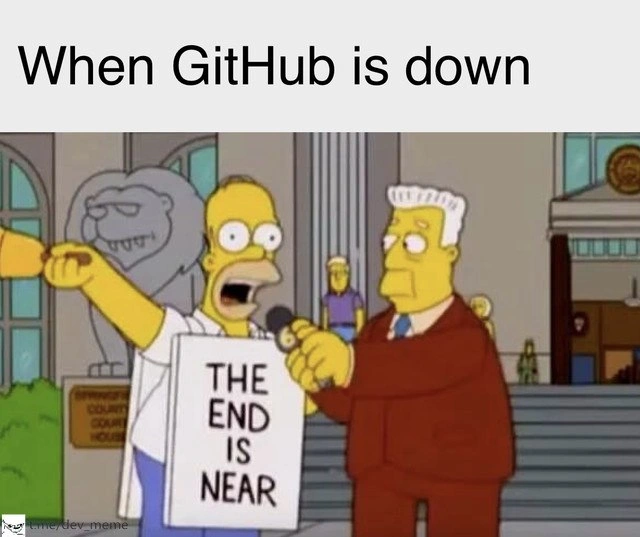
This meme shows a scene from The Simpsons with Homer on the courthouse steps wearing a sandwich board sign that reads “THE END IS NEAR.” A news reporter holds a microphone to him as he shouts in alarm. The caption at the top says “When GitHub is down.” In developer terms, GitHub is a hugely popular website where code is stored and shared using Git, a version control system. Version control is a way to keep track of changes in code, kind of like Google Docs revision history but for software projects. GitHub adds a ton of collaboration tools on top of Git: you can review code changes (via pull requests), run automated tests, track issues, and more. It’s basically the central hub for many development teams’ work.

“GitHub is down” means that this online service is temporarily unavailable (an outage). When that happens, developers suddenly can’t do a lot of their normal work. Imagine you try to save or fetch your code changes and the server doesn’t respond – that’s what a GitHub outage feels like. Homer’s dramatic sign “THE END IS NEAR” is an exaggeration of how devs react internally. It’s poking fun at how dependent developers have become on this one platform. For a junior developer who has just started using these tools, here’s why people freak out when GitHub goes offline:

  • Can’t Push Code: Normally, you’d use git push to send your local code changes up to the GitHub repository (so others can see your work or so it triggers a build). During downtime, this command fails. You’re effectively locked out of sharing your code with the team.
  • Pull Requests on Hold: A pull request (PR) is a way to ask to merge your changes into the main code. On GitHub, PRs are where code review and approvals happen. If GitHub is down, nobody can view or give feedback on those pending PRs. It’s like the code review meeting suddenly got canceled without warning.
  • CI Jobs Fail to Start: Many projects use CI (Continuous Integration) services that run tests and builds automatically when you push code or open a PR. These CI pipelines (like CircleCI, GitHub Actions, Jenkins, etc.) often need to fetch the latest code from GitHub to do their job. If they can’t reach GitHub, you’ll see broken builds or jobs stuck waiting. Developers feel frustration because their continuous integration hooks aren’t running, possibly blocking deployments.
  • Dependency Download Issues: Projects frequently pull in libraries or modules from the internet. Some of those might be hosted on GitHub (for example, a direct Git URL in a package.json, or a Go module that references a GitHub repo). During an outage, those downloads will error out. It’s as if your project’s supply of building materials got cut off. You can’t compile or run your app if it can’t grab its dependencies.
  • General Productivity Freeze: Beyond code, teams use GitHub for issue tracking (keeping track of bugs/tasks) and documentation (in README files or wikis). If GitHub is inaccessible, you might not even be able to read the docs or update an issue status. Communication moves to chats like Slack with “Anyone else can’t push? GitHub down?” messages. It’s a big distraction and people often literally stop and wait.

So, the meme is highlighting a bit of Developer Dependence Drama. It’s a form of tooling frustration every dev can relate to: your critical tool/service is unavailable right when you need it. Since so much of a developer’s daily workflow (coding, collaboration, deployment) flows through GitHub, even a short downtime can feel catastrophic. Homer’s doomsday sign is a humorous exaggeration of that anxious feeling. Everyone knows the outage is likely temporary – GitHub has a pretty good track record and a status page to keep us updated – but in the heat of the moment, work comes to a standstill. It’s like a mini tech apocalypse in the office: people jokingly tweet things like “Time to pack it up, GitHub is down, see you all tomorrow,” as if the world really might end. The VersionControlHumor here is that a service glitch shouldn’t be such a big deal (you can still code locally, and Git itself works offline), but because of how we’ve set up our collaboration, it feels huge. This meme resonates with developers’ shared experience of suddenly realizing just how much we rely on that one website for everything. It’s funny and a bit frightening – a reminder that even our developer tools have an off day occasionally, and when they do, we all run around like Homer yelling the sky is falling (while secretly checking if we somehow tripped a wire, until the real cause – the GitHub outage – is confirmed).

Level 3: Gitpocalypse Now

When GitHub hiccups, the modern development world practically stops spinning. This meme nails a core irony: we use distributed version control (Git) precisely to avoid single points of failure, yet we’ve collectively re-centralized on GitHub as our one-stop hub. The image of Homer Simpson proclaiming “THE END IS NEAR” lampoons how developers react to a GitHub outage with almost religious fervor. In a senior engineer’s eyes, this is darkly funny because it’s painfully true – a minor GitHub downtime triggers company-wide paralysis and Slack channels lighting up in panic.

Why such melodrama over a few minutes of downtime? Consider the cascade of dependencies:

  • Code Collaboration Collapses: Pull requests (proposed code changes) can’t be reviewed or merged. Teams that practice trunk-based development or any workflow with PRs are stuck in limbo.
  • CI/CD Pipelines Pause: Continuous Integration hooks (automated builds/tests) often pull code from GitHub on each commit. An outage means no new builds, deploys, or even automated testing – it’s like the factory assembly line suddenly grinding to a halt.
  • Dependency Retrieval Fails: Projects fetching packages or modules directly from GitHub (think Go modules, npm Git dependencies, CocoaPods, etc.) start erroring out. If your build grabs a library from a GitHub URL, boom – you’ve got failing builds and unhappy developers.
  • Issue Tracking & Docs Inaccessible: Many teams use GitHub Issues and Wikis for project management. During an outage, bug reports and documentation become read-only or vanish, adding to the frustration.

In practice, a GitHub outage feels like a mini production outage for developers. Even though your customer-facing app might still be up, your development and deployment process is dead in the water. It’s a classic case of an external service dependency turning into a single point of failure. Architects preach about avoiding SPOFs, yet here we are with essentially the entire dev universe leaning on one platform. The humor has an edge of truth: our pipelines and workflows have been optimistically designed assuming GitHub is always there, so when it’s not, it’s as if the power grid failed.

There’s a historical twist here too. Back in the day, older version control systems like SVN or CVS were often hosted in-house; if they went down, your own ops team could scramble to fix it or you had local backups. With Git, every developer’s machine has a full copy of the repo (a true distributed design), which in theory should mitigate downtime. In theory. 😅 But modern development isn’t just Git repos – it’s pull requests, CI integration, project boards, release automation, and team collaboration features that live in the cloud. We’ve traded the robustness of standalone Git for the convenience of a centralized platform. As a result, when github.com goes dark, it’s a monoculture meltdown: thousands of orgs simultaneously stuck, developers posting frantic memes on Twitter (#GitHubDown trending), and teams joking about taking an early lunch. The shared trauma is real – even if the outage lasts only 5 minutes, everyone has that “Is it just me?” moment followed by shock and horror as they realize it’s a global blink-out. The meme exaggerates it as an apocalypse, but from a DevOps perspective, it does highlight genuine fragility in our tooling ecosystem. We’ve built a Developer Experience (DX) so dependent on cloud services that a single hiccup feels like doomsday. Homer’s wild-eyed prophecy is funny because it’s how a lot of us feel on the inside during a GitHub outage: part of us knows it’s temporary, but part of us is running in circles screaming anyway.

To seasoned engineers, this image also whispers a cautionary tale: reliability and contingency planning. Sure, GitHub’s uptime is stellar 99.9% of the time, but that 0.1% leads to all-hands chaos. Some grizzled veterans might chuckle and say, “Kids these days, hosting everything on someone else’s computer… back in my day we kept local mirrors.” Others (between nervous F5 refreshes of the status page) will recall every time an external service outage derailed a sprint or caused a deploy freeze. Ultimately, we laugh because if we didn’t, we’d cry – the meme is a comedic release valve for all that collective dependency anxiety. It’s telling us something every engineer knows but hopes not to experience today: when your single source of truth goes offline, even briefly, it sure feels like the end is near.

Description

The meme is a blurred still from The Simpsons showing Homer Simpson on courthouse steps, shouting while holding a white sandwich-board sign that reads “THE END IS NEAR.” A news reporter in a red suit holds a microphone to Homer. Super-imposed at the top in bold black text is the caption “When GitHub is down.” The humor plays on developers’ over-reliance on GitHub: a brief outage feels apocalyptic because source control, pull-requests, CI hooks, and dependency mirrors suddenly vanish. The exaggeration captures tool fragility and the collective panic that ensues whenever the central version-control hub is unreachable
Comments

6
Anonymous ★ Top Pick Nothing exposes how “Git is distributed” is mostly a philosophical statement like a GitHub outage and 20 senior engineers squinting at their local clones trying to decide which fork is the real timeline
  1. Anonymous ★ Top Pick

    Nothing exposes how “Git is distributed” is mostly a philosophical statement like a GitHub outage and 20 senior engineers squinting at their local clones trying to decide which fork is the real timeline

  2. Anonymous

    GitHub goes down and suddenly we're all forced to confront the terrifying reality that our entire disaster recovery plan was "it's in the cloud, what could go wrong?"

  3. Anonymous

    The real disaster isn't that GitHub is down - it's realizing your entire CI/CD pipeline, documentation, issue tracking, project management, and team's institutional knowledge all live in one place. Suddenly that 'distributed' version control system feels awfully centralized when the only remote that matters returns a 503

  4. Anonymous

    When GitHub goes down, you discover DVCS is only distributed for commits - auth, Actions, and the OIDC to prod are still one giant SaaS-shaped SPOF

  5. Anonymous

    GitHub going down is the annual pen test of our multi‑cloud story - turns out the whole architecture is one fat arrow to origin that also issues our AWS OIDC creds

  6. Anonymous

    GitHub down? The ultimate CAP theorem demo: choose two, but Microsoft picked 'Panic' and 'Refresh'

Use J and K for navigation