Skip to content
DevMeme
982 of 7435
When every shiny balloon is a tempting new side project
DeveloperProductivity Post #1104, on Mar 5, 2020 in TG

When every shiny balloon is a tempting new side project

Why is this DeveloperProductivity meme funny?

Level 1: Too Many Toys

Imagine you’re a kid in a room full of toys, and every few minutes you see another new toy that looks super fun. You grab one toy and start to play, but then — oh look! — you spot a shiny action figure across the room. You drop the toy in your hand and run to the next one. Then you see a cool puzzle game, then a flashy robot, and you grab those too. Pretty soon, your arms are so full of toys that you can’t hold them all, and you’re not really playing with any of them! In fact, you might even trip and spill everything because you’re trying to carry way too much at once. This cartoon is funny in the same way: the person keeps grabbing every “balloon” (each balloon is like a new fun toy or idea) until he has so many that they lift him off the ground. It shows in a silly way that when you get excited by too many new fun things at the same time, you might lose touch with the ground (meaning you forget to finish or enjoy any one of them). The feeling behind the joke is something we can all understand: it’s hard to focus on one thing when there are so many exciting things around, and chasing all of them at once usually doesn’t end well. It’s like trying to eat all your favorite candies in one go – instead of enjoying one treat properly, you end up with a tummy ache and a lot of unfinished candy. This meme makes us smile because we’ve all been that person wanting every cool thing, only to realize we grabbed more than we could handle.

Level 2: Juggling New Projects

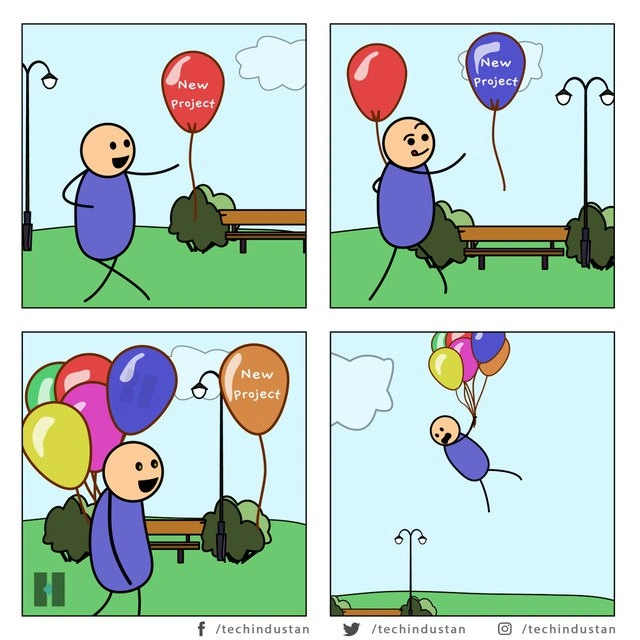
At a simpler level, this meme is about trying to do too many things at once and how that can backfire. The developer in the cartoon is picking up balloon after balloon, and each balloon has “New project” written on it. Those balloons represent side projects or new ideas. In real life, a side project is any extra project a developer works on besides their main job or main assignment – for example, coding a personal app on weekends or learning a new programming language by making a small game. The joke here is that our developer can’t resist grabbing every new idea (every shiny balloon) that comes along. We see him initially holding one red balloon (one project). In the next panel, he’s so tempted by another idea that he grabs a blue balloon, and casually lets it go floating away while still holding the first one. This could be interpreted as him already dropping one project as soon as another catches his eye. By the third panel, he has accumulated a bundle of balloons: red, yellow, green, pink, blue – a rainbow of unfinished projects! There’s even an orange balloon tied to a park bench with “New project” on it, which suggests he had to set one idea aside (tied it down) because he couldn’t carry it, yet he’s still collecting more. This is a fun way to show unfinished_projects piling up. Every developer can recognize this: maybe you have a bunch of unfinished folders or Git repositories on your computer, each one an app or game you started but never quite completed.

Key concepts from this scene include shiny_object_syndrome – a playful term for being easily distracted by the latest, coolest thing. It’s like when something shiny catches your attention and you forget what you were originally doing. Developers use this phrase when someone keeps abandoning today’s work because a new tool or technology (the “shiny object”) came out. Another important idea is context_switching_overhead. That’s a bit of a mouthful, but it basically means there’s a cost every time you switch what you’re working on. For example, imagine you’re reading a book, and then you stop to read a different book for a while; when you come back to the first book, you have to spend time remembering the story and characters. That “getting back into it” time is the overhead of context switching. In programming, if you have 5 different projects open, every time you jump from one to another, you lose some time and momentum getting back into that code. You might forget where you left off or what the goal was. The meme’s third and fourth panels illustrate this overload: our developer’s attention (and arms) are completely full of new projects, so he literally can’t keep his feet on the ground.

Another term shown indirectly is task_overcommitment – meaning taking on more tasks than you can realistically handle. The developer is overcommitted: he has more balloons (projects) than he can manage. The result? He’s no longer grounded or making progress on any one thing; instead, he’s being whisked away without finishing what he started. In everyday developer life, this might look like someone who started building a personal website, then two days later started a Discord bot, then next week began writing a game engine, and so on. None of these projects reach the finish line because the developer’s attention keeps drifting (focus_drift) to the next cool idea. It’s a form of procrastination (“productive procrastination,” some might joke). You feel like you’re doing work because you’re busy with new projects, but actually you might be avoiding the difficult or boring parts of the previous project. That’s why this is often tagged as DeveloperProductivity and ProcrastinationHumor: it highlights a trap that hurts productivity in a funny way.

From a ProjectManagementHumor perspective, the comic exaggerates what project managers caution against. In proper project management, you’d typically prioritize a few tasks and finish them before taking on new ones. If you keep adding new tasks (imagine a project manager constantly saying “Ooh, let’s also do this! And this!” every day), the project’s scope grows out of control – that’s essentially scope creep. Here the developer’s personal “project scope” keeps creeping larger with each balloon he grabs. No surprise, he gets carried away (literally) and can’t deliver anything solid (he’s not even on the ground anymore to deliver the first balloon to someone!). The lamp post and bench in the background stay firmly on the ground – symbolizing reality and stable progress – while our hapless engineer floats off. It’s a cute cartoon way to say: if you don’t stick to your plan and keep chasing new ideas, you’ll lose your grounding and nothing will get done. Every junior coder or hobbyist likely recognizes a bit of themselves in this: it’s fun to start something new, like a hackathon project or a cool experiment, but finishing it is much harder once the initial excitement fades or another idea comes knocking. That’s why this meme is so relatable humor in the developer community – it’s poking fun at a habit many of us have to learn to control as we grow in our careers.

Level 3: Ballooning Backlog

This comic hits senior developers right in the backlog. It’s a witty visualization of shiny object syndrome – that compulsive itch to start something new even when you’re neck-deep in unfinished work. In the first panel, our dev proudly holds one balloon labeled “New Project,” already drifting into another idea. By panel 3, he’s clutching a whole bouquet of “New project” balloons. We’ve all seen it (or lived it): an engineer’s personal to-do list ballooning out of control with side projects, feature ideas, and half-finished prototypes. Each balloon is a new GitHub repo or side hustle launched with a burst of enthusiasm. And the joke is that those “balloons” don’t just vanish – they accumulate until the poor developer is literally carried away by them, losing touch with solid ground (i.e., any semblance of focus or completion). It’s a classic piece of developer humor highlighting how DeveloperProductivity can float away when we chase too many things. Experienced devs know this scenario all too well: you start one pet project at work or at home, then a shiny new framework or a cool product idea comes along and – poof – you’re off on another tangent, leaving the last endeavor tied to a bench (just like that lonely orange balloon labeled “New project” left behind).

Underneath the humor lies a serious point about context switching overhead and focus. Each time you grab a new balloon, you’re effectively dropping whatever you were already holding. In computing terms, it’s like a CPU that’s constantly switching threads: too many context switches and the CPU spends more time saving/restoring state than doing real work. Similarly, a developer juggling multiple projects wastes energy just remembering where was I in this codebase again?. The meme exaggerates this: as the balloons multiply, the dev can’t keep his feet on the ground – he’s lost in the clouds (of ideas). Seasoned engineers might chuckle (or cringe) because they know the cost: picking up five side projects often means zero of them get finished. In fact, one could jokingly formulate the Probability of Completion of any project as inversely proportional to the number of concurrent projects:

$$ P(\text{complete}) \approx \frac{1}{1 + N_{\text{side_projects}}} $$

By panel 4, that probability has gone through the floor (while our protagonist goes through the roof!). It’s relatable humor (#RelatableHumor) precisely because it satirizes our own productivity pitfalls. The ProjectManagement angle is strong too: if a team member kept picking up new tasks like this, any project manager or Scrum Master would have a heart attack. 🙃 In Agile terms, this meme is essentially a violation of WIP (Work In Progress) limits. Instead of finishing the “red balloon” task he started, the dev keeps expanding his personal scope – a one-man scope creep machine. The result? All those projects remain hovering in mid-air, just like balloons with nobody to reel them in. This panel strikes a chord with senior devs who have learned (the hard way) that focus is a feature. It’s poking fun at our tendency to say “Yes” to every cool idea and end up overcommitted. Ironically, what starts as excitement for new technology or a sideProject often ends as a form of procrastination – an avoidance of finishing the less glamorous work already on our plate. The comic’s dark humor is that the very thing that excites us (new ideas!) can drag us upward and away from delivering tangible results. In short, the meme uses a silly visual metaphor to remind us of a serious truth: consistently finishing projects is harder (and more grounding) than starting them, and too many “shiny” distractions will leave even a great engineer unanchored.

Description

Four-panel cartoon in a stick-figure, Cyanide-and-Happiness style. Panel 1: a smiling developer character walks through a park holding a single red balloon labeled “New Project”. Panel 2: the same character casually releases a blue balloon also labeled “New project”, letting it float away while still gripping the red one. Panel 3: the developer now clutches a huge bundle of multicolored balloons (yellow, green, pink, red, blue) while an orange balloon tied to a bench reads “New project”. Panel 4: the growing cluster lifts the developer off the ground and he drifts skyward, leaving the bench and lamppost below. Visually, the comic exaggerates the tendency of engineers to chase countless fresh ideas; technically, it comments on ‘shiny-object syndrome’, context-switching overhead, and the negative impact on focus, delivery, and project management discipline


Comments

6
Anonymous ★ Top Pick Architecture diagram: one grounded monolith, sixteen side-project balloons, and me drifting into “the cloud” - turns out eventual consistency applies to my attention span, too
  1. Anonymous ★ Top Pick

    Architecture diagram: one grounded monolith, sixteen side-project balloons, and me drifting into “the cloud” - turns out eventual consistency applies to my attention span, too

  2. Anonymous

    The only difference between a startup MVP and enterprise software is that in the startup, you're still pretending the balloons will eventually land somewhere intentional

  3. Anonymous

    Every senior engineer's GitHub profile: 47 repositories, 3 with more than 5 commits, 1 actually deployed to production, and 43 README files that still say 'TODO: Add documentation.' The real technical debt isn't in the code - it's in the graveyard of side projects we swore we'd finish 'next weekend' three years ago

  4. Anonymous

    Proof that ignoring WIP limits makes you cloud-native: every 'new project' balloon adds lift while throughput drops to zero, per Little's Law

  5. Anonymous

    Roadmap optimization: grab enough greenfield “new project” balloons and you can float above SLAs, tech debt, and the on-call rotation

  6. Anonymous

    Scope creep: starts as one 'New Project' balloon, ends as a cluster defying gravity and your original sprint velocity

Use J and K for navigation