
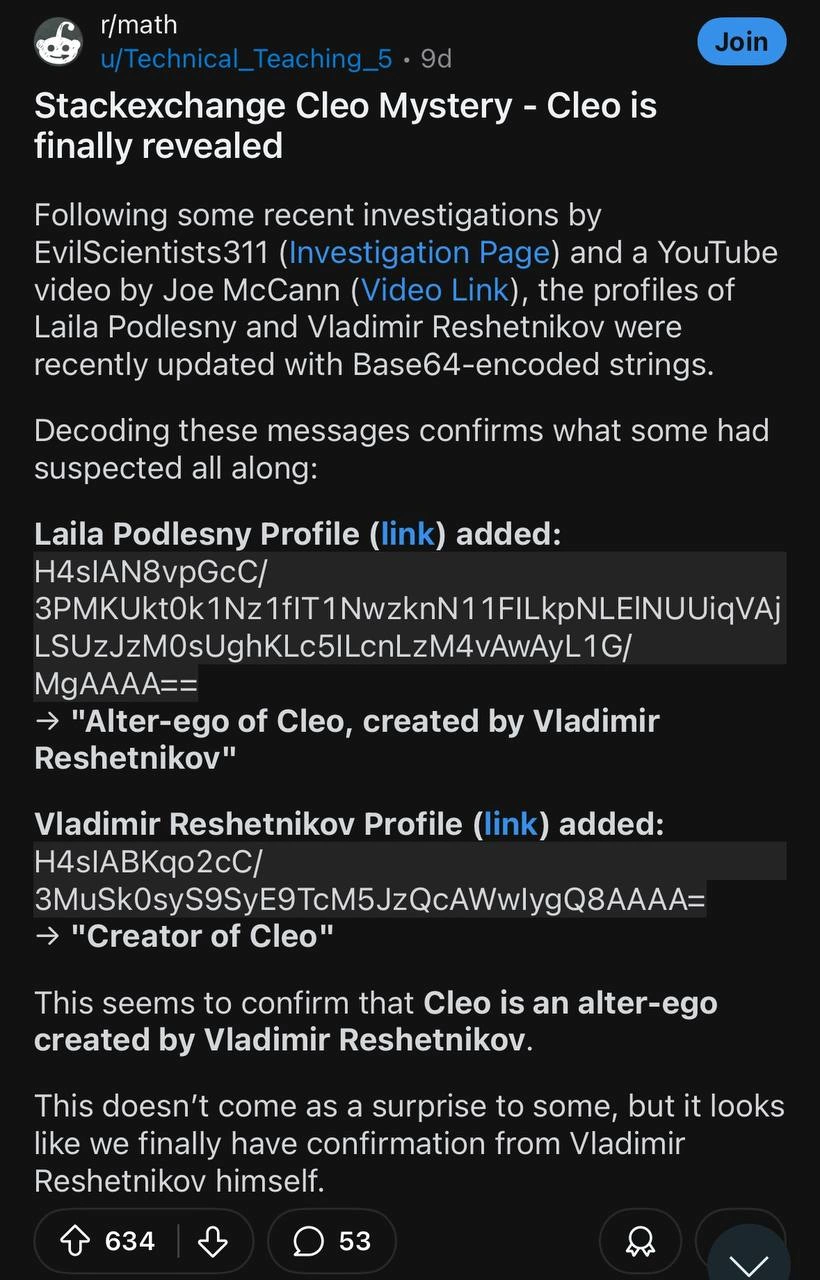
The Base64 Reveal of a Stack Exchange Sock Puppet
Description
A screenshot of a Reddit post from the r/math subreddit, titled 'Stackexchange Cleo Mystery - Cleo is finally revealed'. The post details the resolution of a long-standing mystery within the Stack Exchange community regarding the identity of a user named 'Cleo'. It explains that following investigations, the profiles of two users, Laila Podlesny and Vladimir Reshetnikov, were found to contain Base64-encoded strings. The post shows the decoded messages: Laila's profile reveals 'Alter-ego of Cleo, created by Vladimir Reshetnikov', and Vladimir's profile reveals 'Creator of Cleo'. This confirms that 'Cleo' was a sock puppet account. This story is significant for the technical community as it involves online identity, community-driven investigation, and a nerdy method of confession (Base64 encoding) on a platform known for its rigorous technical standards

Comments
7Comment deleted
Revealing your elaborate sock puppet scheme via Base64 is the developer equivalent of a Scooby-Doo ending: you pull off the mask, and it was the high-rep user all along... and he would have gotten away with it if it weren't for those meddling kids and their online decoders
Cleo got “mystery-solved” the moment Reddit piped her Gzip+Base64 blob into an online decoder - proof that we’ll architect zero-trust meshes all day, yet still confuse string encoding with cryptography
When your authentication system is so secure that the only way to prove your identity is to Base64 encode "I am me" in your profile and hope someone with too much free time notices
When your Stack Overflow reputation is so legendary that people start forensically analyzing Base64 strings in your profile to uncover your alt accounts - because apparently 2.8 million rep points under one identity just isn't enough flex. This is what happens when the community that debugs production incidents for fun turns its collective attention to platform metadata: they treat user profiles like they're reverse-engineering a proprietary binary protocol. Nothing says 'senior engineer energy' quite like discovering someone's sock puppet through character encoding analysis rather than, you know, just asking them
Only in dev communities do we run forum drama through an incident runbook: spot H4sI, base64 -d | gunzip, mark RCA as “identity misconfiguration,” and close it as Working-As-Encoded
Base64 sockpuppets on Stack Overflow: hiding in plain sight until some dev runs 'base64 -d' and your rep farm CAPs out
StackExchange plot twist: Cleo’s secret identity was guarded by gzip+Base64 - when your opsec starts with H4sI, anonymity is just a serialization detail