Skip to content
DevMeme
5969 of 7435
The Engineer Behind the Stack Exchange Sock Puppet
DevCommunities Post #6539, on Feb 18, 2025 in TG

The Engineer Behind the Stack Exchange Sock Puppet

Why is this DevCommunities meme funny?

Level 1: Musical Chairs at Work

Imagine a kid who joins one school club, and then just a few months later switches to a different club, and then yet another, all within the same year. In September he’s doing chess club, by Thanksgiving he’s quit to be in the soccer team, and before the soccer season even finishes he jumps over to play in the school band. It’s a little chaotic – just when everyone at one club starts to know him, he’s already moving on to the next thing. But maybe he’s chasing whatever seems most exciting at the moment or looking for where he fits best. This LinkedIn profile is like that kid: the person changed jobs every few months, hopping from one company to another very quickly. Most people usually stay at a job longer so they can really be part of the team and finish what they start. That’s why reading this feels a bit like watching a game of musical chairs – you’re amazed how fast they keep finding a new seat (or in this case, a new job!). It’s funny in the same way it’s funny to see someone constantly switching games on the playground: it makes you wonder if they’re having a great adventurous time, or if they just can’t sit still in one place.

Level 2: Tech Stack Tour

For a newer developer or someone early in their career, let’s break down what this LinkedIn profile is showing:

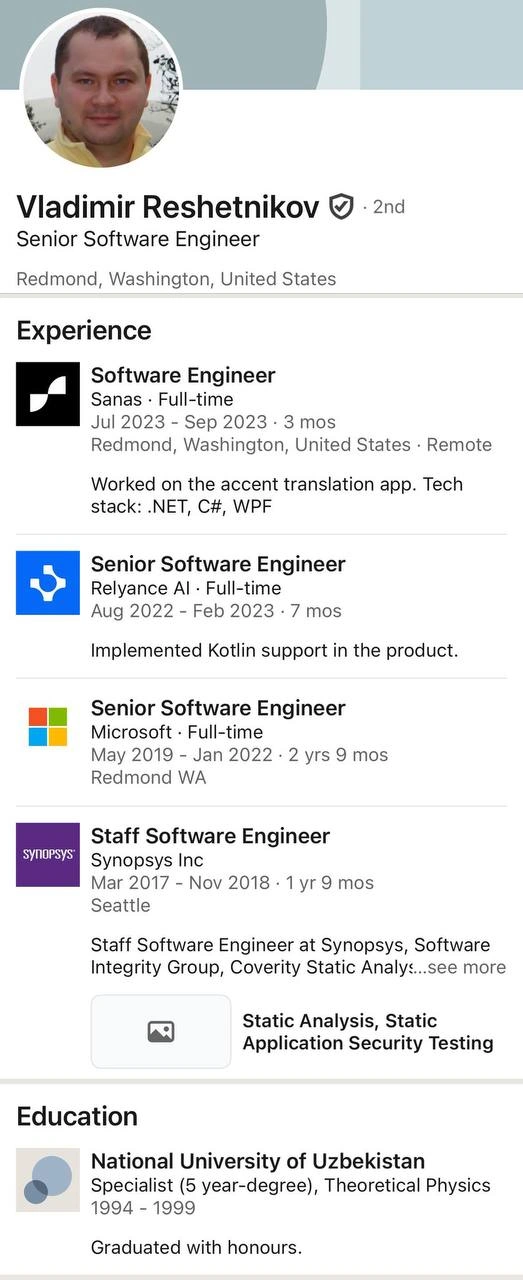
  • LinkedIn “Experience” section: The profile lists jobs in order with titles, companies, and dates. Each entry shows how long the person worked there. For example, "Jul 2023 – Sep 2023 (3 mos)" means only three months at that job. That’s a very short stint – basically the length of a summer internship. Seeing several back-to-back short roles like 3 months or 7 months is what we mean by rapid_tenure_changes or “job hopping.” It immediately tells you this person moved around a lot in a short time.
  • .NET & C# (at Sanas): In the first role listed (Software Engineer at Sanas), the tech stack includes .NET and C#. .NET is a Microsoft framework and runtime for building applications, and C# (pronounced “see-sharp”) is the main programming language used with .NET. They’re commonly used for Windows software. The profile mentions WPF as well – that stands for Windows Presentation Foundation, a UI toolkit in .NET for making desktop application interfaces (windows, buttons, forms, etc.). So when he "worked on the accent translation app" using WPF and C#, it means he built a Windows desktop program that can listen to someone speak and output it in a different accent. This shows he was doing front-end application work, likely creating the look-and-feel and functionality of that accent-changing app.
  • Kotlin support (at Relyance AI): The next role was Senior Software Engineer at Relyance AI for 7 months, where he “implemented Kotlin support in the product.” Kotlin is a modern programming language that runs on the Java Virtual Machine. It’s big in Android app development and also used on servers instead of Java because it’s concise and safe. If their product needed Kotlin support, perhaps the product was a tool (maybe an analyzer or platform) that initially only worked with certain programming languages. He was responsible for making sure it could work with Kotlin code as well. For instance, if Relyance AI’s software analyzed codebases for compliance or privacy issues, and it originally only handled, say, Python and Java, he added the capability to understand Kotlin projects too. Doing that in 7 months shows he likely had to learn the ins-and-outs of Kotlin and integrate it quickly — not a trivial task.
  • Static Analysis & Security Testing (at Synopsys): Before those, he was a Staff Software Engineer at Synopsys for about 1 year 9 months. Synopsys is known for developer tools, especially in the security realm (they have a product called Coverity for static code analysis). Static analysis means automatically scanning source code for bugs or security vulnerabilities without actually running the program. It’s like doing a spell-check or grammar-check on code to catch mistakes early. Static Application Security Testing (SAST) is static analysis focused on security issues – for example, finding places where a program might be vulnerable to hackers (like SQL injection or buffer overflow flaws) just by examining the code. As a Staff Engineer working on these tools, he was likely working on complex software that parses source code, which is deep, back-end, compiler-like work. It’s a very different domain from building UIs or user-facing apps.
  • Job titles – Senior vs. Staff: Senior Software Engineer is a common title for someone who’s experienced (often at least 5-7 years into their career) and can independently own features or mentor others. Staff Software Engineer is typically one level above Senior at many companies – usually that means an engineer who leads major projects, designs system architecture, and coordinates across teams (sometimes also called Lead Engineer or Principal Engineer in other organizations). Interestingly, on his profile he was “Staff” at Synopsys but then “Senior” at Microsoft. That’s not actually a demotion; it’s more about how companies title their roles. Microsoft, being a huge company, has many levels of Senior (Senior I, Senior II, etc.) and beyond that titles like Principal or Partner. Synopsys might use “Staff” where another company would say “Senior.” So when you see that, don’t think he went backwards – it’s just different naming. In any case, both titles mean he was not a junior developer; he was at a level expected to make big contributions and decisions.
  • Education in Theoretical Physics: At the bottom, the Education section shows he got a Specialist degree in Theoretical Physics in 1999 from the National University of Uzbekistan. This is basically equivalent to a Master’s in Physics. It’s a clue about his background: he likely started his professional life in a very different field (maybe research or teaching), and later transitioned into software engineering. In the 1990s, especially in places like Uzbekistan, people who were good at math or physics often found their way into programming jobs as the tech industry grew in the 2000s. A physics background means he’s probably strong in problem-solving and mathematics. Many senior engineers today don’t actually have a formal computer science degree – they might have learned programming on the job or through self-study. Seeing “Graduated with honours” in physics just tells us he’s a smart cookie, even if he took a non-traditional path into software.

Putting it all together, this profile paints the picture of a highly experienced Senior Engineer who has touched a lot of different technologies in a short time. For someone new to the industry, it’s useful to note that switching jobs every few months is unusual – typically, staying at least a year or two is common to really get experience from a role. But in fast-paced tech, job hopping does happen, especially with startups or when chasing better opportunities. Each of his moves probably offered something new: one job was all about building a desktop app with DotNet/WPF for a cutting-edge AI tool, another was about enhancing a product to support a new programming language (Kotlin), and another was about working on advanced developer tools for code security (static analysis). It’s both impressive (because he adapted to very different challenges) and a bit dizzying (because that’s a lot of ramping up and moving on). A junior engineer looking at this should understand that while this many hops is not the usual path, it highlights how diverse and dynamic a software career can be. One year you might be debugging C# desktop applications, and the next year you’re knee-deep in scanning Kotlin code for security flaws. In tech, learning how to learn quickly can be one of the most valuable skills of all!

Level 3: Loyalty 404

This LinkedIn profile screenshot reads like patch notes for a career: v2017 – released as beta Staff Software Engineer at Synopsys; v2019 – major update to Senior Software Engineer at Microsoft; v2022 – hotfix adding Kotlin support at Relyance AI; v2023 – short-lived feature branch working on a .NET/WPF accent translator app. In plain terms, we see a seasoned engineer bouncing between four employers in rapid succession, each tenure shorter than the last. It's the classic JobHopping sprint: jumping from a stable enterprise gig into startups and back, trading long-term stability for immediate CareerGrowth (or at least a shiny new title and signing bonus).

In the CorporateCulture of decades past, such rapid moves would raise eyebrows – especially among Career_HR folks who used to prize years-long loyalty. A resume like this might have been labeled "unreliable" or flagged for CareerExpectations misalignment. But in today’s tech industry, this pattern is often met with knowing smirks and nods. Why stick around waiting for a 3% annual raise when a hop can net a 30% jump in salary and a beefier title? This profile encapsulates a modern paradox: companies preach loyalty and “we’re a family” culture, yet routinely reorg or lay off teams; engineers respond by keeping their LinkedIn on standby for the next offer. Recruiters have learned that a Senior Engineer with multiple short stints isn’t necessarily a red flag anymore – it might just be someone riding the booming market or escaping one sinking startup for the next rocket ship.

What makes it comical is the contrast between prestigious titles and fleeting durations. Senior Software Engineer at Microsoft for nearly 3 years sounds solid – plenty of time to navigate office politics, slay some legacy code dragons, maybe even get a promotion – but then you see Senior Software Engineer at Relyance AI for just 7 months, and a Software Engineer stint at Sanas lasting only 3 months. Blink and you’d miss those jobs. It’s as if the moment the new-hire orientation was over, this engineer already had one foot out the door. The whirlwind tour of mixed_enterprise_startup_experience suggests someone sampling the buffet of tech workplaces: a long haul at an established giant followed by a rapid-fire taste of two different startups’ chaos. Each change came with a new tech flavor, too. He went from wrangling Static Analysis tools at Synopsys (think of being a code quality detective) to big-team projects at Microsoft, then dove into an AI compliance product needing Kotlin integration, and finally built a fancy WPF desktop application UI in .NET/C# for an accent_translation_app. The man’s programming journey reads like a polyglot speedrun through the industry’s trendiest niches.

Even the job titles themselves tell a story. He started as a Staff Software Engineer at Synopsys and then became Senior at Microsoft – a nominal step down in many engineering ladders (since "Staff" often outranks "Senior"). Title inflation and deflation across companies is a real circus: your Staff is someone else’s Senior. Our journeyman likely didn’t mind trading a fancier title for a Microsoft badge, and then promptly leveraged that Big Tech clout to get senior roles at smaller firms. It’s a savvy CareerGrowth hack many seniors know: earn credibility at a famous company, then hop to a startup where every ex-FAANG hire is instantly a Principal (or at least gets their own team Slack emoji). Of course, startups can implode or pivot on a dime – that 7-month Relyance gig and 3-month Sanas sprint hint at some combination of “this isn’t what I signed up for” and “oops, funding dried up.” In true cynical fashion, the only thing moving faster than his promotions was the rate at which he updated his LinkedIn headline.

The humor here also comes from imagining the whirlwind pace: did he even finish setting up his dev environment and memorize the office Wi-Fi password before moving on? A SeniorEngineerLife like this means constantly being "the new guy" – learning acronyms, fixing onboarding bugs, then peacing out before the next all-hands meeting. It’s exhausting just to think about, yet many developers do it intentionally. Each jump offers new challenges, a fresh codebase with hopefully less TechnicalDebt, and often a bigger paycheck. It’s practically the norm in some circles: these rapid_tenure_changes are no longer a scarlet letter but a badge of adaptability. The end result is a LinkedIn profile that’s equal parts impressive and absurd – a highlight reel of high-level roles played in fast-forward. Seasoned devs chuckle because it’s too real: in an industry obsessed with speed and innovation, even careers themselves now move at 2x speed.

Description

A screenshot of the LinkedIn profile for Vladimir Reshetnikov, a Senior Software Engineer. The profile includes a headshot of a man in a yellow collared shirt, and lists his location as Redmond, Washington. The 'Experience' section details a career at several notable tech companies, including a recent 3-month stint at Sanas, 7 months at Relyance AI, nearly 3 years at Microsoft as a Senior Software Engineer, and almost 2 years at Synopsys as a Staff Software Engineer. His education is listed as a 5-year specialist degree in Theoretical Physics from the National University of Uzbekistan, where he graduated with honours. This image provides the real-world professional identity of the person revealed to be behind the 'Cleo' sock puppet mystery on Stack Exchange, as detailed in the previous post. The interest for the tech community lies in the juxtaposition of a seemingly standard, successful senior developer's career with the creation of a complex, long-running online alter-ego on a technical platform

Comments

7
Anonymous ★ Top Pick His resume proves he can pass a system design interview at Microsoft, but his Stack Exchange history proves he can also design a single system with a split personality
  1. Anonymous ★ Top Pick

    His resume proves he can pass a system design interview at Microsoft, but his Stack Exchange history proves he can also design a single system with a split personality

  2. Anonymous

    My résumé has so many 3-to-6-month gigs it practically reads like a Kubernetes dashboard - spin up a .NET pod, inject some Kotlin, clear static analysis, then get gracefully evicted before the WPF finishes rendering

  3. Anonymous

    When your physics degree finally pays off because you can calculate the exact trajectory of your career bouncing between companies every 6 months

  4. Anonymous

    When your LinkedIn profile reads like a microservices architecture - highly distributed, loosely coupled, and with an average lifespan measured in months rather than years. Three months at the latest gig suggests either the accent translation app achieved perfect accuracy on day 89, or someone discovered that 'implementing Kotlin support' and 'worked on accent translation' are the enterprise software equivalent of 'it's not you, it's the tech stack.' Props for the Theoretical Physics degree though - at least someone understands why quantum superposition is a more stable career state than modern software engineering tenure

  5. Anonymous

    LinkedIn compresses the hard parts: “Implemented Kotlin support” decompresses to “wrote a parser, did Gradle graph surgery, re-trained the CI cache, added SAST rules, and spent two quarters in stakeholder diplomacy.”

  6. Anonymous

    This résumé reads like an event‑driven system - short‑lived services deploying WPF/.NET, then Kotlin, then AI; the only component with strong consistency is the keyword “Static Analysis.”

  7. Anonymous

    Theoretical physics degree: Ideal prep for WPF data bindings that exist in superposition until runtime collapse

Use J and K for navigation