
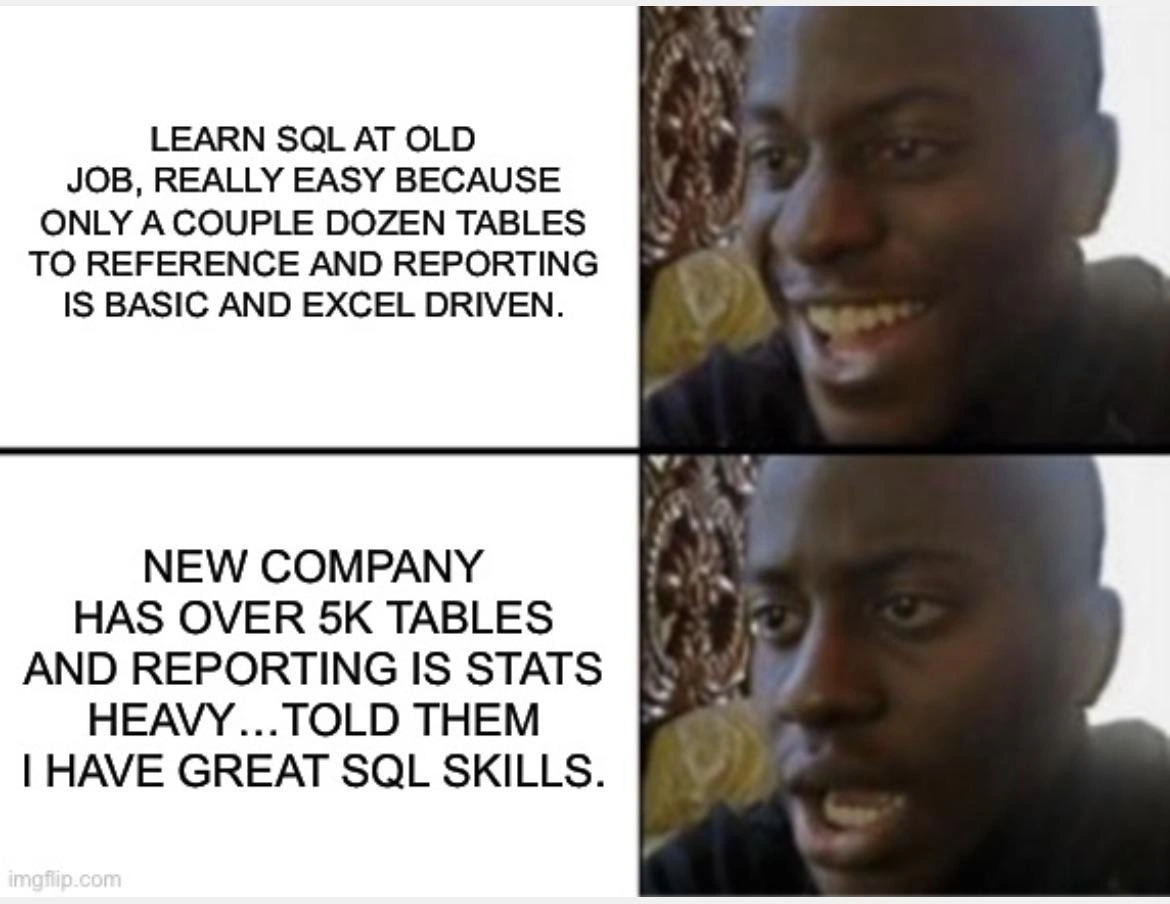
When your 20-table SQL expertise meets a 5,000-table production schema
Description
Two - panel reaction meme with a vertical split: text on the left, a man’s facial reaction on the right. Top panel shows him happily smiling beside the caption, "LEARN SQL AT OLD JOB, REALLY EASY BECAUSE ONLY A COUPLE DOZEN TABLES TO REFERENCE AND REPORTING IS BASIC AND EXCEL DRIVEN." Bottom panel shows the same person suddenly staring ahead in shock (face partially blurred), next to the caption, "NEW COMPANY HAS OVER 5K TABLES AND REPORTING IS STATS HEAVY…TOLD THEM I HAVE GREAT SQL SKILLS." The humor comes from overestimating one’s SQL proficiency after working with a tiny schema and then confronting an enterprise data warehouse with thousands of tables, complex joins, and heavy analytics. Technically, it highlights the gulf between simple Excel-driven querying and large-scale relational database design, reminding engineers that SQL difficulty grows non-linearly with schema size and reporting complexity







Comments
6Comment deleted
I told them I’m great at SQL - turns out the real skill here is archaeology: excavating 5,000 tables to find the one “user” relic that won’t trigger a Cartesian-product boulder the moment I hit JOIN
The difference between "I know SQL" and "I know SQL" is about three years of therapy and a deep personal relationship with the information_schema database
Going from a 'couple dozen tables' to 5K+ tables is like confidently saying you know Git because you've mastered 'git add' and 'git commit' on your personal project, then joining a company where the monorepo has 847 active branches, a merge conflict archaeology team, and someone's still debugging why a rebase from 2019 occasionally resurrects deleted code. Suddenly your 'great SQL skills' feel like bringing a SELECT * to a window function fight - sure, it technically works, but the query planner is judging you, the DBA is crying, and you're about to learn what 'execution plan analysis' really means when your JOIN takes longer than the sprint
Old job: SELECT *; new job: 5k‑table warehouse with SCD2 dims, a subway‑map ERD, and JOINs that trigger cost‑based existential crises
LeetCode SQL: 3-table breeze. Prod: 50-table joins that make your query planner beg for mercy
Enterprise SQL is where “I joined a few tables in Excel” becomes a three-hour EXPLAIN-plan therapy session for late-arriving facts across twelve schemas and a data dictionary last updated in 2014